Renting a Dumpster Costs $294 to $800 a Week. The Price Depends on Who Answers the Phone
A 20-yard dumpster rents for $275 to $700 a week for the same steel box, and the cheapest quote is often the one that bills you later. Landfill fees jumped 10 percent in a single year, and nobody publishes a price.
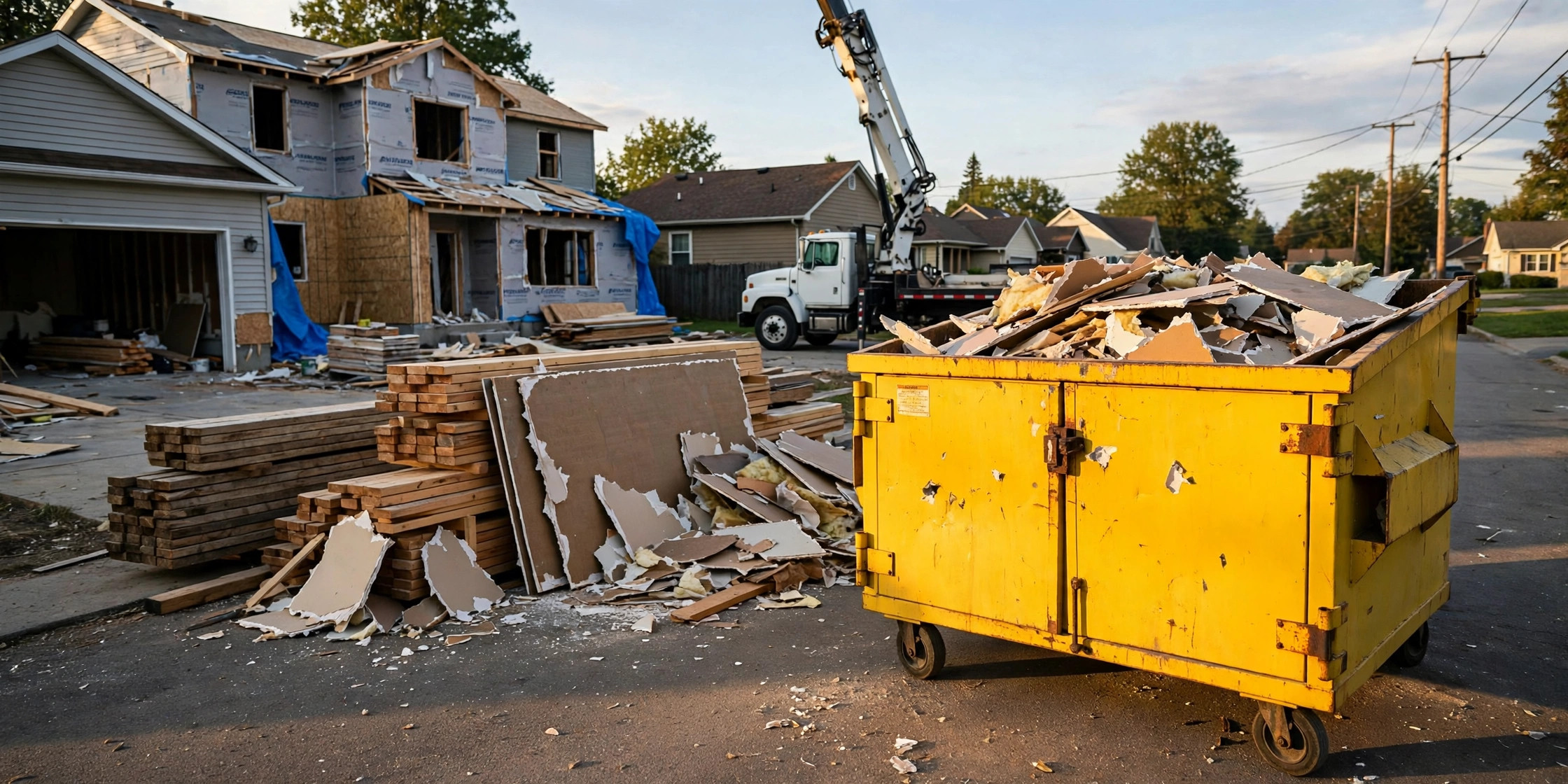
The Problem
Renting a dumpster is one of the last ordinary purchases in America with no published price. Angi puts the national average at $386 a week, with a typical range of $294 to $480 and an outer range of $200 to $800. A 20-yard dumpster, the most common size, rents for $275 to $700 a week. That is a 2.5-times spread for the same steel box, the same seven days, the same pile of debris. In Birmingham, Alabama, the same size runs $425 to $625. In Orlando it runs $375 to $575. Nobody can tell you why your quote sits where it does, because nobody publishes the inputs.
Three inputs decide the price, and all three are hidden. First is the landfill tipping fee, what the dump charges per ton. Second is the included weight, usually 2 to 4 tons on a 20-yard rental, above which overage fees of $50 to $100 a ton apply. Third is the hauler's own cost: truck, driver, fuel, and the container itself. A customer sees one number, the weekly quote, and learns the other three only when the final bill arrives. Wasters Blog puts the national average near $385 and warns that dump fees, fuel surcharges, and permit costs sit outside the base rate. Overweight fees are the most common surprise, and they are the mechanism that makes a cheap quote expensive.
Buying is a phone process. Waste Management, the largest operator in the country, does not publish dumpster prices online; you call or chat for an estimate. Republic Services works the same way. Local independents, who do most of the actual hauling, quote by phone and often by voicemail. A homeowner planning a kitchen remodel calls three haulers, waits for callbacks, and compares three numbers that cover different weights, different rental lengths, and different fee schedules. A contractor running five jobs compares fifteen. None of it is recorded anywhere, so the next customer starts from zero and the last customer's price is lost.
A $275 dumpster and a $700 dumpster can be the same steel box on the same street in the same week.
Weight is where the money hides. A 20-yard dumpster full of household junk weighs about 2 tons. The same box full of roofing shingles weighs 4 to 5 tons. A quote that includes 2 tons and charges $75 a ton over the cap turns a $275 rental of shingles into a $425 rental, and the customer finds out at pickup, when the box is already full and the roof is already off. Permits add a second surprise: a dumpster on a public street needs a city permit in most places, priced and processed differently in every jurisdiction, and the hauler rarely mentions it until delivery day.
Haulers suffer from the same opacity in reverse. A small operator with six trucks and forty containers has no way to advertise an empty Tuesday. Containers sit in the yard while a homeowner three miles away calls the national broker instead. IBISWorld counts only 232 roll-off enterprises serving the US market, but that number covers the formal industry; thousands of small haulers, junk removal outfits, and regional operators work below it, most of them invisible to anyone who does not already have their number. Empty containers are the industry's wasted capacity, and no market exists to fill them.
Market Size
Original TAM calculation: published estimates disagree by a factor of eight, because they measure different things, and this article says so instead of picking the biggest number. IBISWorld, the narrowest definition, puts US roll-off dumpster rental at $542.5 million in 2025, growing to $998.9 million by 2033. A broader roll-off estimate puts the US market at $1.6 billion in 2024, reaching $2.3 billion by 2033 at a 6.8 percent annual growth rate. The broadest definition, all commercial dumpster rental including permanent containers, runs about $4.5 billion in 2024. This article uses the $1.6 billion roll-off figure as its base-case TAM: temporary containers only, the segment a marketplace can actually intermediate.
| Market definition | 2024-25 size | What it counts | Use here |
|---|---|---|---|
| IBISWorld roll-off enterprises | $542.5M | Formal roll-off rental firms only | Conservative floor |
| Roll-off rental, broad estimate | $1.6B | All temporary roll-off rentals | Base-case TAM |
| All commercial dumpster rental | $4.5B | Temporary plus permanent containers | Ceiling |
Divide the base case by the average ticket and the volume appears. At $1.6 billion divided by Angi's $386 average weekly rental, the US books roughly 4.1 million roll-off rentals a year. That is a planning estimate, not a measurement: it assumes every rental is one week at the average price, and real rentals run from three days to a month. It is consistent, though, with the one hard volume number in the industry: Dumpsters.com says it has rented 1.9 million dumpsters since its founding in 2009, which is about 110,000 a year for a single broker in a market doing roughly 4 million.
SAM narrows to the customers a marketplace can actually serve. Commercial end use holds 43.2 percent of the market, and those are mostly large accounts with negotiated contracts and national vendors. The remaining 56.8 percent, about $0.9 billion, is residential and small-contractor work: homeowners, roofers, remodelers, and property managers who book one job at a time and pay the quoted price. Assume half of that segment will book online when a transparent option exists, a planning assumption stated as such, and SAM is about $450 million a year. SOM in year three: route $12 million of gross merchandise volume, about 26,700 rentals at a $450 average ticket, and take 10 percent, or $1.2 million. Contractor subscriptions add $209,000 across 600 accounts at $29 a month. Weight-ticket verification and dispute handling add about $90,000. Total year-three revenue is about $1.5 million. That is a small business by venture standards, and this article says so plainly in the Limitations section. The case for building it is that the market is fragmented enough to enter, the customers are reachable through one search query, and nobody has built the transparent version yet.
For scale, the debris behind these numbers is enormous. The EPA estimates the United States generates about 600 million tons of construction and demolition debris a year, against about 292 million tons of municipal solid waste. Every ton of that debris rides in a container somebody rented, and the rental is the one step in the chain with no price list.
The Product
A transparent, bid-based roll-off marketplace with verified weight tickets, built around the quote rather than the container. Five modules:
- Live competing bids: A customer enters a ZIP code, a size, a debris type, and a date. Haulers within range bid a binding all-in price: delivery, pickup, rental days, included weight, and overage rate, each shown as its own line. Bids stay open for two hours. The customer picks on total cost, not on the headline number, and the winning bid is a contract, not an estimate.
- Published price history: Every completed rental publishes its price, size, weight, and ZIP code, anonymized, into a public price index. A homeowner in Dallas sees the last 200 twenty-yard rentals in Dallas before booking. The index is the product's distribution engine: it ranks in search for every "dumpster rental cost [city]" query, and it is the reason haulers cannot quietly raise prices.
- Verified weight tickets: At pickup, the hauler photographs the landfill scale ticket and uploads it before the final bill is issued. The platform matches the ticketed weight against the included weight and computes the overage itself. A customer who disputes a charge sees the ticket, not a line item. Tickets are verified against the landfill's published tipping fee for that county, so an inflated disposal charge is visible on its face.
- Contractor accounts: Roofers and remodelers run many jobs at once. One dashboard holds every active rental, its fill status, its pickup date, and its weight ticket. Swap-outs, where an empty box replaces a full one on the same trip, are scheduled as a single job and priced as one. Volume pricing is published per contractor, not negotiated in private, so a five-truck roofer and a fifty-truck roofer see the same rate card.
- Empty-container matching: Haulers publish idle containers by yard and date. A customer booking for next Tuesday sees the idle box three miles away before the hauler three counties over. The hauler fills a dead day, the customer gets a lower bid, and the platform takes its fee on a rental that would not have happened otherwise.
Unit Economics
| Metric | Value |
|---|---|
| Average order value (20-yard, one week) | $450 |
| Platform take rate | 10% |
| Platform take per rental | $45 |
| Payment processing (2.9% of $450) | $13 |
| Support + weight-ticket verification | $4 |
| Cost to serve per rental | $17 |
| Gross profit per rental | $28 |
| Gross margin | 62% |
| CAC per homeowner | $15 |
| CAC per contractor account | $150 |
| LTV (contractor, 6 rentals/year, 3 years) | $504 |
| LTV:CAC ratio (contractor) | 3.4:1 |
| Startup cost | $960K |
| Break-even | Month 22 |
Methodology note: LTV uses gross profit per rental only: $28 times 6 rentals a year times 3 years equals $504, and it assumes a small contractor who rents about every other month. A homeowner rents once every few years, so homeowner LTV is about $34 against a $15 CAC, a 2.2 to 1 ratio; homeowners are the volume and the price-index content, contractors are the profit. CAC of $150 for a contractor reflects direct outreach, onboarding, and a first-job discount. Break-even means monthly operating break-even: gross profit covering the $42,000 monthly burn, reached around month 22 on a ramp to 2,000 rentals a month. Startup cost of $960,000 funds the build and exactly 12 months of burn, so cash is zero at month 12 and the plan has no buffer if the first year-2 rentals slip. Cumulative cash break-even, counting the build, does not arrive until about month 32.
Startup Costs
| Category | Cost | Notes |
|---|---|---|
| Marketplace + bidding + price index | $150K | Quote builder, bid engine, public price history by ZIP code. 5 months. |
| Weight-ticket verification + dispute desk | $60K | Ticket upload, landfill fee matching, overage computation, dispute workflow. |
| Hauler onboarding + software integrations | $50K | Connections into Docket and Wastebits so haulers take orders inside the tools they already use. |
| Pilot program (3 metros) | $50K | Hauler recruitment, subsidized first jobs, on-site verification of ticket workflow. |
| Marketing + content, year 1 | $110K | Price-index content for every metro, paid search on high-intent rental queries. |
| Legal and insurance | $35K | Broker terms, hauler contracts, liability for missed pickups and property damage. |
| Build subtotal | $455K | |
| Operating runway (12 months at $42,000/month) | $504K | Four-person team, cloud hosting, support. Covers the build period and the pilot phase. |
| Total startup cost | $960K |
Go-to-Market
Phase 1 (months 1-6): Build the price index and publish it free. A public Dumpster Price Index, with median prices by metro and size, is the cheapest possible inbound engine: every homeowner who searches "dumpster rental cost" before booking lands on it, and every hauler who wants to know what competitors charge reads it. Seed the index with quoted prices collected by phone from haulers in the first three metros, labeled as quoted prices, then replace them with completed-rental prices as volume arrives. Sign 30 haulers as design partners in exchange for free platform access during the pilot.
Phase 2 (months 7-12): Open bidding in Dallas, Atlanta, and Phoenix, three metros with heavy remodeling and roofing activity and different tipping-fee levels. Run 500 rentals end to end: bid, delivery, pickup, ticket, final bill. Each rental has to prove two numbers, not one. First, that the winning bid beats the customer's best phone quote. Second, that the final bill matches the bid within $25. If either number fails, the product is a directory, not a marketplace, and the pricing has to change before scale.
Phase 3 (months 13-24): Add contractor accounts with multi-job scheduling and published volume rates, then expand to the next ten metros by tipping-fee spread, where the gap between the cheapest and priciest hauler is widest. Publish a quarterly Dumpster Price Index report showing median prices alongside tipping fees by region, so the relationship between disposal cost and rental price is visible in one chart. A metro with a $45-a-ton tipping fee and a $450 median rental is not ranked against one with an $80-a-ton fee and a $650 median, and customers can see which haulers charge for disposal and which charge for the truck.
Competitive Landscape
| Company | What It Does | Gap |
|---|---|---|
| Waste Management | Largest US waste operator; roll-off rentals nationwide, phone quotes, no published online pricing | No online price, no bidding, no weight transparency; the customer calls and takes the number |
| Republic Services | Second-largest operator; same national footprint, same phone-quote model | Same gap as Waste Management; scale without transparency |
| Dumpsters.com | National broker founded in 2009; 1.9 million dumpsters rented, 2,000+ providers, 46 states; recapitalized by Blue Point Capital in August 2026; integrates with Docket hauler software | A managed broker, not a marketplace: one quoted price, no competing bids, no published price history, no weight-ticket verification |
| Bin There Dump That | Franchise network of local operators; residential focus, driveway protection as a selling point | No online pricing; franchise model means prices vary by owner with no way to compare |
| Wastebits / Docket | Hauler software: quoting, dispatch, invoicing, and order intake for the operators themselves | Supply-side tools, not a customer marketplace; they make haulers efficient without making prices visible |
| Local independents | Thousands of small haulers doing most of the actual work, usually phone-only | Invisible to anyone without their number; no way to compare, book, or verify |
Why Now
Five forces converge on this startup.
First, disposal costs jumped, and disposal is the largest single input in the price. The Environmental Research and Education Foundation reports the average US landfill tipping fee rose 10 percent in 2024, from $56.80 to $62.28 a ton, the largest single-year increase since 2022. Construction and demolition debris averaged $65.84 a ton. When disposal is 44 percent of the rental price, a 10 percent rise in disposal is a 4 percent rise in the rental, and the customer who cannot see the disposal line cannot tell whether the increase is real or invented.
When disposal is nearly half the price, a hidden disposal charge is the whole business model.
Second, the volume is steady and the customers are searchable. About 600 million tons of construction and demolition debris a year means the demand does not depend on a boom; roofs get replaced and kitchens get remodeled in every economy. Customers search for prices before they call, which means a published price index captures demand at the exact moment it forms.
Third, the incumbent broker just got private equity money, which validates the model and leaves the transparent lane open. Blue Point Capital recapitalized Dumpsters.com in August 2026 to expand business-to-business sales and pursue acquisitions in the fragmented waste market. A recapitalized broker will get bigger, not more transparent; its model is a single managed quote, and a bidding marketplace is a different product, not a bigger version of the same one.
Fourth, the supply side is finally software-ready. Haulers already run Docket and Wastebits for dispatch and invoicing, and Dumpsters.com already pushes orders into Docket directly. A marketplace that plugs into the same tools does not ask a hauler to learn a new system; it asks the hauler to accept bids inside the dashboard it already opens every morning.
Fifth, container costs rose, which pushes quotes apart. Section 232 steel and aluminum tariffs rose to 50 percent in 2025, raising the cost of new containers for haulers. When input costs rise unevenly, some haulers absorb them and some pass them through, and the spread between quotes widens. Opacity hurts most exactly when prices are moving.
Original Contribution: The $275 Dumpster Loses Money
A calculation nobody has published in this form. Take a 20-yard rental at the $450 average and decompose it. Disposal comes first: a typical load weighs about 3 tons, and at the 2024 construction-debris tipping fee of $65.84 a ton, disposal costs about $198, or 44 percent of the price. Truck, driver, and fuel come next: two trips, drop-off and pickup, at roughly $140 for a local run, an estimate flagged as such, built from driver time, diesel, and wear. Container depreciation and overhead take about $40. That leaves about $72 of margin, or 16 percent. The numbers add up: $198 plus $140 plus $40 plus $72 equals $450.
Now run the same arithmetic on the $275 quote, the bottom of the national range. Disposal is still $198, the truck is still $140, overhead is still $40, and the total cost is still $378. A $275 quote loses about $100 before the truck leaves the yard. Somebody pays that $100, and it is the customer, through the overage clause. A 20-yard rental typically includes 2 tons. A roofing job fills the box with 4 tons of shingles. Two extra tons at $75 a ton is $150, and the $275 quote becomes a $425 bill. The cheap quote is not a discount; it is a loan against the overage fee, and the customer discovers the interest rate at pickup.
Geography proves the mechanism. EREF data shows the Northeast averaging $80.67 a ton and the South Central region averaging $44.87. At the Northeast rate, disposal alone on a 3-ton load is $242, so a $275 quote loses $140 before overage and cannot exist without it. At the South Central rate, disposal is $135, the same $275 quote still loses money but only by about $35, and a lean operator with a short haul can plausibly honor it. This is why the cheapest quotes cluster in cheap-disposal states and why the same size costs twice as much in the Northeast: the tipping fee, not the hauler, sets the floor. A marketplace that publishes the tipping fee next to the quote makes that floor visible, and a hauler quoting below it has to explain itself.
Run the sensitivity. If the load is 2 tons instead of 3, disposal falls to $132 and the $450 rental carries $138 of margin, which is why haulers love clean household junk and dread shingles. If the load is 5 tons, disposal rises to $329 and the rental loses money before overage even at $450, which is why heavy debris carries higher quotes and stricter weight caps. If tipping fees rise another 10 percent, to about $72.40 a ton, disposal on a 3-ton load becomes $217 and the average rental needs to rise about $20 to hold margin. Every one of these numbers is checkable against a scale ticket, which is the point: the whole price can be derived from two public inputs, the tipping fee and the weight, and the marketplace exists to publish both.
Limitations
This analysis has several weaknesses that should be stated plainly.
First, the market-size range is wide enough to change the conclusion. IBISWorld says $542.5 million, the broad roll-off estimate says $1.6 billion, and the broadest commercial definition says $4.5 billion. If the true roll-off market is the IBISWorld number, the SAM is about $155 million rather than $450 million, and the year-three revenue target of $1.5 million requires routing 2.8 percent of the entire serviceable market, a much harder ask. Direction of travel is not in doubt, since every estimate grows 5 to 7 percent a year, but the current-year volume is genuinely uncertain, and the 4.1-million-rentals figure is derived from an average price, not counted.
Second, the cost decomposition rests on an estimate. Disposal at $65.84 a ton is measured, from EREF's survey of 351 landfills. The $140 truck cost is a planning estimate, not a measured figure, and it varies with distance, diesel prices, and driver wages. If the true truck cost is $100, margin on the average rental is $112 rather than $72, and the cheap quote loses less. If it is $180, margin is $32 and the business is thinner than the unit economics table suggests. The sensitivity analysis shows the overage mechanism survives either way, but the margin line does not.
Third, haulers may refuse to bid transparently, and they have reason to. A marketplace that publishes every price compresses margins toward the cheapest operator, and the cheapest operator is often the one cutting corners on insurance, permits, or disposal. Haulers who currently win on relationships and responsiveness lose to haulers who win on price alone, and the first group is the one with the trucks the marketplace needs. Dumpsters.com solved this by being a managed broker that protects hauler margins; a transparent marketplace solves it only if enough haulers value filled containers over protected prices.
Fourth, the 10 percent take is unproven, and the ticket is small. Ten percent of $450 is $45, and $17 of it goes to payment processing and support. A marketplace that routes $12 million of volume keeps $1.2 million of it, which is a fine small business and a poor venture return. Realistic early customers are small contractors renting every other month, not national builders with procurement departments, and the platform needs thousands of them.
Fifth, weight tickets can be gamed. A hauler photographs its own scale ticket, and a ticket from a friendly scale or a mixed load can overstate weight. Verification against published tipping fees catches inflated disposal charges but not inflated weights, and the dispute desk becomes the cost center that eats the margin it exists to protect. Independent weigh verification would fix this and would cost more than the fee it protects.
Finally, the costs land somewhere, and this article has not said where. Transparent pricing pushes the cheapest haulers to the top of the list, and the cheapest haulers are the likeliest to dump illegally to avoid the tipping fee they quoted. Illegal dumping is already a real cost of the current system, and a race to the bottom makes it worse, not better. The platform's verification layer can only catch what the ticket shows; a load that never reaches a landfill produces no ticket at all. For proportion, the 600 million tons of construction debris a year includes concrete and asphalt that is mostly recycled already, so the marketplace's diversion impact is on the mixed-load fraction, not the whole stream. And the platform proposed here has a conflict to manage: it profits from the rentals it certifies, so the weight verification it sells must be auditable by a party that does not earn a fee on the job. Self-verified tickets from a platform that profits from the rentals would not survive the dispute they exist to settle.
Strongest Counterargument
The most compelling case against this startup is that the broker lane is already won, the customers do not repeat, and the haulers will not play.
Start with the incumbent. Dumpsters.com has rented 1.9 million dumpsters, works with more than 2,000 providers across 46 states, integrates directly into the software haulers already use, and just took private equity money to expand. It solved the customer problem, finding a hauler without calling five of them, sixteen years ago. A transparent marketplace offers those same customers a second quote and a price history, which is a better product in theory and a marginal one in practice: the customer who got a dumpster delivered on time at a fair price has no reason to switch, and the hauler who gets steady orders from the broker has no reason to bid against itself.
Then consider repetition. A homeowner rents a dumpster once every few years, during a remodel or a move. There is no subscription, no habit, no network effect on the demand side; every rental is a fresh acquisition through paid search or content, at $15 a head, against a $28 gross profit. Contractors repeat, but contractors already have haulers: a roofer who has used the same operator for five years gets priority scheduling and a phone call answered, and a marketplace bid cannot match that relationship with a lower number alone.
Then consider the supply side. Haulers are capacity-constrained in peak season, which means they have no reason to pay a marketplace for leads when the phone already rings. In the slow season they have capacity but no incentive to publish the low price that fills it, because the published price becomes the price they are held to in peak season too. A marketplace that charges the hauler nothing and the customer 10 percent still has to convince the hauler that transparency is worth more than the margin it gives up, and the hauler's answer, most of the time, will be that it is not. The startup's answer is that the price index brings customers the hauler cannot reach, that empty-container matching fills dead days, and that verified tickets reduce disputes. That answer is plausible but unproven, and it depends on haulers valuing new customers over protected prices. If that assumption fails, this is a content site with a booking form, not a marketplace.
The Bottom Line
America rents about 4 million roll-off dumpsters a year, pays $294 to $800 a week for them, and buys them by phone, from operators who do not publish prices, against a disposal fee that jumped 10 percent in a single year and now makes up nearly half the ticket. The cheapest quote in the range loses money on its own terms and recovers it through overage fees the customer discovers at pickup. The largest broker in the business solved the finding problem sixteen years ago and stopped there: one quote, no bidding, no price history, no verified weight. What does not exist is the layer that makes haulers compete in public, publishes what every rental actually cost, and proves the weight on a scale ticket. That layer is the whole business. Transparency, verification, and matching, sold to an industry that currently sells all three by phone, separately, and only when asked. That layer is a $1.6 billion market on the base case today, growing toward $2.3 billion by 2033. Too small for a unicorn. Exactly the right size for a focused vertical business that charges for the quote instead of for the steel box.
What You Can Do
If you are renting a dumpster this month: ask for the included weight, the overage rate per ton, and the rental length in writing before booking, and get a second quote from a hauler you have not used before. If the quote is under $300 for a 20-yard box, ask what the weight cap is, because the overage clause is where the rest of the price lives. If you run a hauling business: publish your prices, your included weight, and your overage rate, because the customers who need you cannot compare you today. If you build this: start with the price index, not the marketplace. A free index that every homeowner bookmarks before calling is distribution no competitor has, and a marketplace without distribution is a booking form with a login page.
Related
📰 Commercial Waste Invoice Intelligence SaaS for Multi-Location Operators — the same opacity, applied to the monthly waste bill instead of the one-off rental
📰 Construction & Demolition Waste Diversion Documentation SaaS — the paperwork twin: proving where debris went, applied to diversion instead of price
📰 Dynamic Pricing SaaS for Independent Self-Storage Operators — pricing transparency as the product: the same pattern, applied to storage units instead of steel boxes