82% of Older Americans Live in Homes Nobody Has Made Safe. This Startup Sells the Fix, the Contractor, and the Paperwork in One Visit
America has 61.2 million people aged 65 and older, a fall bill of $80 billion in a single year, and houses built for people who never get old. Only 18% of older adults have made any aging-in-place modification to their home. Selling them a grab bar is not the business. Selling them a trusted assessment, a fixed-price contractor, and someone to chase the benefit paperwork is.
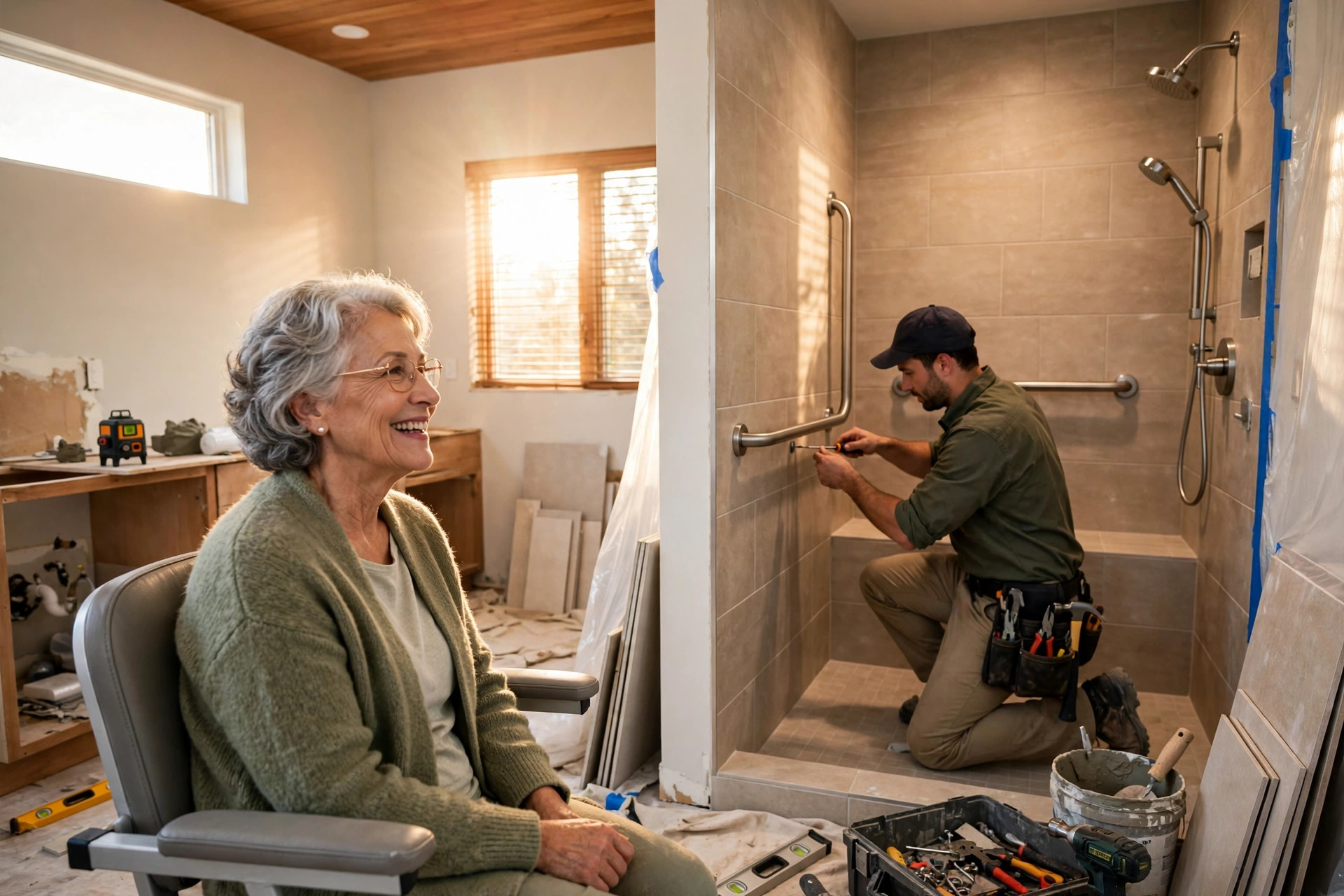
The Problem
Falls are the leading cause of fatal and nonfatal injuries among adults aged 65 and older, and the numbers behind that sentence are brutal in their plainness. In 2020, older adult falls produced 3 million emergency department visits, 1 million hospitalizations, and more than 36,000 deaths, according to a CDC analysis published in Injury Prevention. Healthcare spending on nonfatal falls alone reached $80.0 billion that year, with Medicare paying the largest share. One in four older adults falls each year, which means prevention is not a wellness extra. It is the difference between living at home and living somewhere else, paid for by someone else, after a night nobody planned.
Houses make the risk worse, because most American houses were never designed for a person with weaker balance, worse vision, and a walker. Fewer than 5% of U.S. homes have basic accessibility features, and only 18% of older adults have made any aging-in-place modification to their residence, according to figures cited by the Milken Institute Future of Aging initiative. Read those two figures together and the market failure sharpens. A bathroom with a tub wall to climb over, a front step with no rail, a staircase with no second handrail, and a hallway lit by one dim bulb are not exotic hazards. They are the standard American house, occupied by a population that gets older every year while the house stays exactly the same.
Families know this in theory and stall in practice, for reasons that have little to do with caring. An adult child living three states away does not know whether a $400 grab bar job or a $14,000 bathroom rebuild is the right scope, does not know which local contractor will show up, and does not know whether Medicare Advantage, the VA, Medicaid, or nobody will pay any of it. Original Medicare does not cover home modifications such as ramps or widened doors for general aging-in-place use. Medicare Advantage plans can offer home and bathroom safety benefits, but coverage varies plan by plan, year by year, and benefit by benefit, which turns a simple safety job into a research project. So families wait. Waiting ends at a hospital discharge, when a physical therapist hands over a list of modifications with a two week window, a contractor backlog of two months, and no one to coordinate either.
Contractors are not the villain in this story, and that matters for the business model. Most aging-in-place work is done by small local remodelers, many certified through the National Association of Home Builders Certified Aging-in-Place Specialist program, who get work by word of mouth and cannot afford a benefits desk, a clinical assessor, or a national brand. A homeowner who finds one good CAPS remodeler is lucky. A homeowner who finds one, gets a fixed price in writing, gets the work inspected, and gets a benefits claim filed correctly is rarer still. Fragmentation is the gap. Nobody owns the whole job from fall risk to finished rail to filed form.
Market Size
TAM: $5.27 billion. Verified Market Research valued the U.S. aging-in-place renovation service market at $5,265.51 million in 2024 and projected $9,209.30 million by 2032, a compound annual growth rate of 6.92%, in its U.S. aging-in-place renovation service report. Homeowners accounted for 83.37% of that 2024 market, or $4,525.72 million, which fits a direct-to-homeowner business better than a landlord or facility pitch. Older homeowners also now drive remodeling itself: Harvard Joint Center for Housing Studies data cited in a 2025 Improving America's Housing summary show people aged 65 and older rising from 14% of the remodeling market in 2003 to 27.2% in 2023, overtaking the 35 to 44 bracket, inside a total remodeling market above $600 billion. Aging-in-place work is a slice of a much larger spend, and the slice is growing because the people holding the houses are aging in them.
SAM: $1.51 billion for bathroom safety scope alone. Bathroom modifications were the largest segment of the U.S. aging-in-place renovation market in 2024 at 28.70%, or about $1,558.16 million, according to the same Verified Market Research report. Multiply the $5,265.51 million TAM by 28.70% and the result is $1,511 million, which matches the reported segment value within rounding. That is the right SAM for a startup that starts where falls happen most, in the bathroom, with walk-in showers, grab bars, curbless entries, raised toilets, and slip-resistant floors, before it expands to entries, stairs, kitchens, and lighting. A second SAM cut points to geography: the Southeast held 30.6% of the domestic market with the fastest regional growth, reflecting retiree concentration in Florida, Georgia, and the Carolinas, which is why a launch metro belongs there rather than in a young coastal city.
SOM, year three: 1,800 safety-scope jobs in one launch region at an average job value of $7,800, for $14.04 million in gross merchandise value (1,800 x $7,800). At the revenue mix in the unit economics table below, that cohort produces roughly $2.9 million in company revenue, before any business-to-business line. Sensitivity is honest here: at 1,200 jobs the GMV falls to $9.36 million, and at an average job of $5,500 the 1,800-job cohort falls to $9.90 million. Either downside still supports a focused regional operator, because the cost base is assessors, vetting, and software, not inventory or a fleet. Scale comes from adding metros with the same playbook, not from inventing a new product for each city.
The Product
A concierge that sells three things as one visit, with one price list, one accountable party, and one file the family can forward to a sibling. Families do not buy a marketplace. They buy an end to the research project.
- Occupational therapy led home safety assessment: A 90 minute visit, in person or by video plus photos, producing a ranked 42 point checklist, measurements, photos, and a written report that separates must-fix-now items from nice-to-have remodels. A grab bar in the wrong stud is worse than no grab bar, and a report signed by a clinician carries weight with a discharge planner, a family group chat, and a benefits reviewer in a way a contractor quote does not.
- Fixed-price vetted contractor scopes: Pre-priced packages for the ten jobs that cover most risk: bathroom grab bars and shower seat, tub-to-shower conversion, curbless shower, raised toilet, entry ramp or rail, stair handrails on both sides, widened doorway, kitchen reach and lighting fixes, whole-home lighting upgrade, and slip-resistant flooring in wet rooms. Contractors are licensed, insured, background checked, and CAPS certified or supervised by someone who is, with milestone payments released only after photo evidence and, for larger jobs, an independent check.
- Benefits desk: A staff team that checks the exact plan before work starts, not after. It files Medicare Advantage home and bathroom safety claims where the plan covers them, VA Home Improvements and Structural Alterations (HISA) applications where the veteran qualifies, Medicaid waiver and state program paperwork where it applies, and Area Agency on Aging and nonprofit grant referrals where no payer covers the job. Families see in writing what is covered, what is capped, and what they will pay, before a contractor touches a wall.
Trust rules are part of the product, not a page buried in a footer. No contractor pays for ranking. No assessment is free in exchange for steering a family to the most expensive remodel. No upsell from a $900 safety package to a $28,000 full bathroom rebuild without a second, written clinical reason and a cooling-off period. Prices are published, change orders are priced before work starts, and the assessment report belongs to the family even if they hire someone else. A company that monetizes fear about a parent falling will lose the discharge planners, physical therapists, and VA service officers who are its best referral channel, and it should.
Unit Economics
Revenue comes from four lines, and only one of them depends on a payer saying yes. That split is deliberate, because the payer line is the least reliable part of the business.
| Line | Price or rate | Year-three math |
|---|---|---|
| Home safety assessment | $349 per visit | 1,800 x $349 = $628,200 |
| Contractor take rate | 12% of job value | 12% x $14,040,000 = $1,684,800 |
| Benefits desk fee | $499, or 12% of recovered amount if lower | 600 paid cases x $499 = $299,400 |
| Annual safety check subscription | $19 per month, from year two | 3,000 subscribers x $228 = $684,000 at full run rate, phased in |
Put the first three lines together for the year-three cohort and revenue is about $2.61 million, rising toward $2.9 million as subscriptions phase in and some subscribers convert to a second job. Assessment cost, paying an occupational therapist or trained assessor plus travel and report time, runs about $180 per visit, leaving $169 of margin per assessment. Customer acquisition, dominated by adult-child search and discharge or therapy referrals, is budgeted at $420 per completed job, which a single job covers through the $936 contractor take plus $169 assessment margin, or $1,105 in total, before any benefits fee. A second job from the same home, or a subscription renewal, is where the model gets comfortable. A business that needs a second job to survive its first acquisition cost is fragile, and this one is designed not to.
Startup costs, to first revenue plus six months of operation: $950,000 in total. Software for assessment reports, contractor scheduling, photo evidence, and benefits tracking costs $260,000. An occupational therapy lead, an operations lead, and two assessors for the first six months cost $280,000. Contractor vetting, insurance, and quality checks cost $90,000. Launch marketing in one metro, built around therapy and discharge referrals plus adult-child search, costs $180,000. Legal work on contractor licensing, benefits rules by state, and health information handling costs $70,000. Working capital and contingency hold the remaining $70,000. Ships in 6 months: assessment and contractor network in one metro first, benefits desk for Medicare Advantage and VA HISA second, subscription checks third, because a benefits desk launched before the contractor network works is a promise with no one to keep it.
Competitive Landscape
No national company owns this exact job, which is both the opportunity and a warning. Fragmentation usually means the job is hard to standardize, not that nobody noticed it.
| Competitor | What they do well | Gap this startup exploits |
|---|---|---|
| Angi and Thumbtack | Large contractor supply, fast matching | Generalist matching with no clinical assessment, no fixed safety scopes, and no benefits paperwork |
| Re-Bath, Bath Fitter, West Shore Home | National bath remodel brands, fast installs | Single-product remodel sales, priced for full bathrooms, not targeted safety packages |
| Local CAPS remodelers | Craft skill, local reputation, aging expertise | No national brand, no benefits desk, no published prices, booked by word of mouth |
| Home care agencies | Trusted in the home, see fall risk first | They refer modifications out and do not build, price, or warrant them |
| AARP HomeFit guide and similar checklists | Free, credible, widely shared | A checklist with no contractor, no price, and no one to file a claim |
Adjacent startups in fall detection, medical alerts, and remote monitoring solve a different moment. A pendant helps after a fall. A rail helps before one. Selling both through the same referral channel makes sense later, but a startup that launches by selling hardware will be judged as a hardware company, with hardware margins and hardware support costs, and will lose the simplicity of the concierge pitch.
Go-to-Market
Start in Tampa Bay, Florida, inside the Southeast region that already leads the market, and win 100 jobs before spending on a second city. Referral partners do the first selling: hospital discharge planners, outpatient physical therapy clinics, home care agencies, and VA service officers, all of whom see the fall risk before the family searches for a contractor. Adult-child search captures the second wave, with pages and ads written for the actual query, which is usually a daughter searching for a walk-in shower for an elderly parent, not a senior searching for remodeling. Pricing transparency does the third wave, because published package prices travel in family group chats in a way a "call for a quote" form never will.
Proof for the next metro is a small set of numbers, not a brand campaign: median days from assessment to completed job, share of jobs completed at the quoted price, share of benefits claims approved on first filing, and repeat or referral rate from the first 100 homes. A discharge planner who can tell a family that the last 50 jobs finished in 18 days at the quoted price will refer the 51st. A planner who has watched a contractor vanish will not, and no ad budget repairs that.
Why Now
Three forces arrive at the same time, and the oldest baby boomers turning 80 in 2026 is the simplest one to count. Census figures cited in recent coverage put the population aged 65 and older at 61.2 million in 2024, growing by more than 3% a year, with projections above 80 million by 2040. A market that grows by demography does not need a cultural shift to grow. It needs supply that can keep up with birthdays.
Medicare Advantage created the second force, then made it confusing enough to need a guide. Home and bathroom safety modifications were the fastest growing popular supplemental benefit for 2024, growing 120% to 1,504 plans, according to a Faegre Drinker analysis of plan benefit data reported in December 2023. Yet a JAMA Network Open study of 2024 enrollment found only 1% of Dual Eligible Special Needs Plan enrollees and 0% of other Medicare Advantage enrollees were in plans offering structural home modifications, and plans offering in-home support services fell from 9% in 2024 to 6% in 2025, according to Better Medicare Alliance data reported in October 2025. Benefits exist, shrink, change names, and vary by county, all at once. Confusion is a cost families pay in unfiled claims, and a concierge that reads the exact plan document is selling clarity, not just labor.
Veterans benefits add a third, underused payer. The VA Home Improvements and Structural Alterations grant pays up to $6,800 lifetime for a service-connected disability, or for a non-service-connected disability where the veteran has a service-connected disability rated at least 50%, and up to $2,000 lifetime in other qualifying cases, according to the VA Prosthetic and Sensory Aids Service. Those caps have not kept pace with construction costs, which limits what they cover, but $6,800 covers a serious safety package, and a lifetime benefit that families have never heard of is a referral reason for every veteran service officer in a launch metro. Fall costs complete the timing case: the CDC analysis projects fall injury costs above $101 billion by 2030 if trends hold, which gives hospitals, plans, and families a shared financial reason to pay for rails now rather than rehab later.
Risks and Challenges
Liability sits first, because an assessment creates a record. If a fall happens after a visit, a family will ask what the report missed, and a contractor error on a grab bar anchor becomes a company problem even when a subcontractor installed it. Insurance, written scope limits, independent checks on larger jobs, and a report that states plainly what it did not inspect are not overhead. They are the product.
Demand timing is the second risk. Families buy after a scare, which makes demand spiky and referral dependent, and a prevention pitch to a healthy 70 year old competes with every other use of $7,800. Contractor capacity is the third: good CAPS remodelers are scarce, busy, and wary of marketplace fees, so a 12% take rate only holds if the concierge actually delivers booked, scoped, documented jobs that save them selling time. State licensing, benefits rules, and health information handling vary enough that a second state is a new compliance project, not a copy-paste launch. Any pitch that treats those as footnotes is underpricing the business.
Original Contribution: The Unmodified Home Gap
Combine the two headline figures and a gap nobody states as a headcount emerges. Take 61.2 million Americans aged 65 and older, apply the 18% modification rate, and about 11.0 million older adults live in a home with at least one modification, leaving about 50.2 million older adults in homes with no aging-in-place modification at all (61.2 x 0.82 = 50.2). That is people, not households, and it assumes the survey rate applies evenly across age bands, which it does not, since older cohorts modify at higher rates than younger ones. Treat 50.2 million as an order-of-magnitude gap, not a customer list.
Price that gap against the alternative families fear most. A $7,800 safety package equals about 7% of one year of nursing home care at more than $112,000 a year, according to Federal Long Term Care Insurance Program figures cited in the Harvard housing summary. A safety package does not prevent a nursing home admission by itself, and no honest pitch should claim it does. It buys time at home, which is what most families say they want, at a price that looks small once the alternative is priced in the same sentence.
Limitations
This analysis relies on vendor market sizing that is not audited, on survey modification rates cited secondhand, and on an average job value that is an assumption, not an observed price from a company that does not exist yet. Verified Market Research and similar firms sell reports, and their segment splits should be read as estimates with wide error bars, not as counted revenue. Medicare Advantage coverage varies by plan, county, and year, and the JAMA finding on structural modifications shows how thin that coverage can be in practice, so no benefits desk can promise approval before it reads a specific plan document. Fall reduction evidence supports programs and environmental fixes in general, not this exact bundle, this exact checklist, or this exact contractor network. Readers should treat the year-three cohort as a planning target, not a forecast, and should discount it if contractor supply in the launch metro proves thinner than assumed.
Strongest Counterargument
Prevention is a famously hard sale, and a marketplace fee on a price-sensitive job may be the weakest link in this whole pitch. Families already have a cheaper path: a trusted local handyman, a son-in-law with a drill, or a CAPS remodeler found through a neighbor, none of whom charge 12% for coordination. Adult children who live far away may distrust a national brand with a parent's bathroom more than they trust a neighbor's recommendation, and Medicare Advantage plans cutting in-home supports from 9% to 6% of plans in a single year suggest payers are retreating, not expanding, from this exact spend. If most demand arrives only after a fall, the concierge becomes a discharge vendor competing on speed with every local contractor, and speed is a thin moat. That case is strong enough that a founder should test it first: run 50 assessments through therapy referrals, measure how many convert at a published price, and kill the marketplace fee if families will pay for the assessment and the benefits help but will not pay a contractor markup. A business that survives that test has a real product. A business that only works if families ignore the cheaper path does not.
The Bottom Line
America is aging into houses that were not built for aging, falls already cost $80 billion in a single year, and the help that exists is fragmented across contractors, checklists, and benefit forms nobody reads. A concierge that puts a clinician, a fixed price, and a filed claim behind one visit does not need a new technology to matter. It needs discipline about scope, honesty about what benefits will not pay, and a first metro where 100 jobs finish on time and on price.
What you can do: If you are building this, hire the occupational therapy lead before the software, sign three therapy or discharge referral partners before spending on ads, and publish package prices on day one. If you are a family, start this week with the bathroom, the front entry, and the stairs, in that order, ask a physical therapist for a written home safety list before a discharge, and check the exact Medicare Advantage Evidence of Coverage and any VA HISA eligibility before paying for work a plan or grant might partly cover. If you are a discharge planner or home care agency, ask any vendor for its median days to completion, its share of jobs at quoted price, and its first-filing approval rate, and refer on those numbers, not on a brochure.
Related
📰 Assisted Living Rebate Placement Service — the adjacent stay-or-move decision, where a credible home safety price changes whether a family chooses care at home or a facility
📰 Soft-Story Retrofit Orchestration Platform — the same orchestration playbook for a different retrofit, where permits, contractors, and financing stall without one owner
📰 Wildfire Rebuild Orchestration SaaS — a parallel coordination business, where owning the file from insurer to contractor to occupancy is the product