13,500 LA Apartment Owners Were Ordered to Earthquake-Proof Their Buildings. 3,200 Never Did.
The holdouts face $60,000 to $130,000 retrofits they cannot finance. Santa Monica's deadlines land through July 2026. No software helps them run the mandate, so a retrofit operating system could own the compliance wave.
The Problem
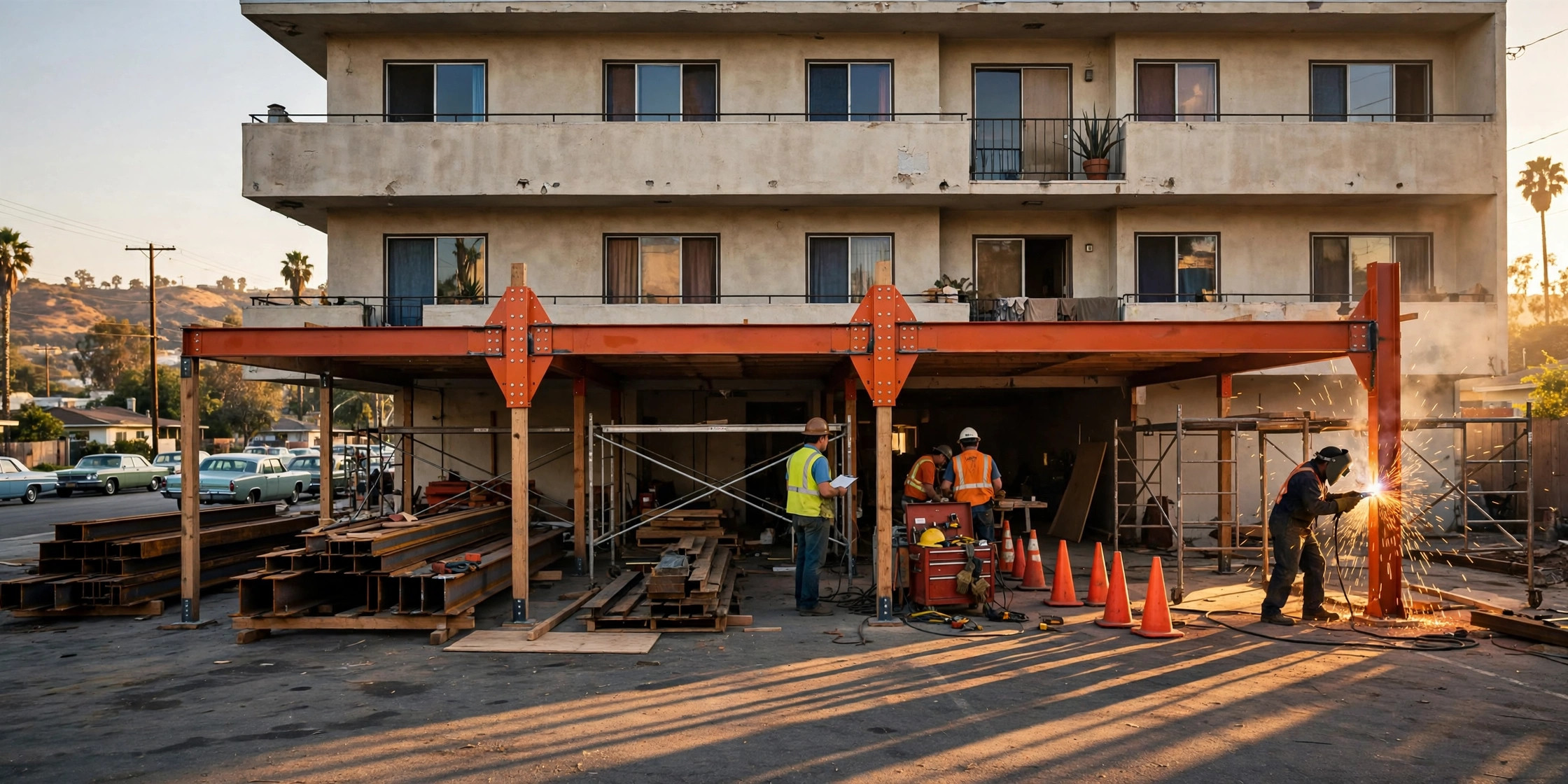
A soft-story building is easy to spot once you know the shape. Picture the classic Los Angeles dingbat: two or three stories of stucco apartments sitting on top of an open ground floor of carports, held up by skinny wooden posts. In an earthquake, that open ground floor is the weak link. The upper floors are stiff while the ground floor flexes beneath them. Then the building pancakes. This failure mode killed sixteen people in the 1994 Northridge earthquake, most of them in one collapsed Northridge Meadows apartment complex.
The engineering fix is well understood: bolt steel moment frames or plywood shear walls into the open ground floor, anchor everything to the foundation, and tie the stories together so the building moves as one unit. The fix costs $60,000 to $130,000 per apartment building, according to estimates published when Los Angeles debated its ordinance. That was the 2015 estimate, and contractors have not gotten cheaper since. What they quote today, by building size:
| Building Size | Typical Scope | Quoted Range | Source |
|---|---|---|---|
| 4-8 units | Shear walls, small grade beams, usually no moment frame | $20,000-$44,000 | Retrofit Pros |
| 10-15 units | Single moment frame, shear walls on return walls | $45,000-$80,000 | SoCal Retrofitting |
| 20-30 units | Single moment frame, full-length grade beams | $82,000-$120,000 | Weinstein Construction |
| 50 units | Multiple moment frames, plumbing relocation, stucco repair | $250,000-$350,000+ | Weinstein Construction |
Los Angeles made the fix mandatory with Ordinance 183893, signed in October 2015, which ordered the retrofit of every wood-frame soft-story building permitted before January 1978: roughly 13,500 apartment buildings, plus about 1,500 brittle concrete buildings on a separate 25-year clock. Owners got two years to submit engineering plans and seven years to finish construction after receiving their order to comply; the orders went out in waves starting in 2016, so the seven-year clocks started expiring in 2023.
The mandate met reality in the compliance data. Los Angeles building department figures, cited in a 2026 paper in Earthquake Spectra, put city soft-story compliance at 76%; Oakland, which adopted its ordinance in 2019, sits at 70%. Do the subtraction: roughly 3,200 Los Angeles buildings never complied. That same 2026 research, which studied Los Angeles's non-ductile concrete retrofit program through interviews with owners and engineers, named financing as the single greatest barrier to compliance and found the penalties for noncompliance so unclear and so weak that one engineer said it is probably cheaper to pay the fine than to retrofit. The concrete program is a different ordinance with larger projects, so applying those interview findings to soft-story holdouts is an inference, but the enforcement apparatus is the same: the law is a misdemeanor on paper under LAMC 91.9311, real enforcement runs through the building department's pro-active code enforcement program, and the financial consequences remain murky enough that thousands of owners chose to wait. Nothing happened to them.
The 3,200 are not the institutional landlords. The big owners complied early; they have asset managers, capital reserves, and relationships with design-build firms. The remainder is the long tail the mandate never designed for: immigrant families who own one 8-unit building in Koreatown, retired couples living off a 12-unit in the Valley, small partnerships holding a 1960s walk-up in Santa Monica. These owners do not have a structural engineer on retainer and have never filed a Tenant Habitability Plan. They got a letter from the city in 2017, put it in a drawer, and hoped the deadline would move. In some cases it did; in most cases, it did not. The mandate never designed for them.
The Gap in the Market
Every existing player in the retrofit economy sells to the owner from one side of the table. Every one of them benefits from the owner's confusion. That confusion is the business model.
| Company | What They Do | What's Missing |
|---|---|---|
| Optimum Seismic | The dominant design-build firm: engineering, steel fabrication, and construction under one roof. Claims 3,500 to 4,000 retrofit and renovation projects completed since 1984. Preferred supplier of the Apartment Association of Greater Los Angeles, which gives it unmatched distribution into exactly the owner population the platform needs. | They are a contractor, not an owner advocate. They scope the project, price the project, and build the project. The owner has no independent check. Not on the scope. Not on the price. Their business model depends on the information asymmetry the platform would destroy. They also do not touch financing, tenant habitability plans, or rent pass-through filings beyond basic guidance. |
| Alpha Structural | Major LA structural engineering and construction firm, active in soft-story, non-ductile concrete, and foundation work. Frequently quoted in industry press on retrofit economics. | Same structural conflict as Optimum: design-build means grading your own homework, with no compliance deadline tracking across the owner's portfolio and no financing layer. |
| Fragmented local contractors (RetroFitting 360, Bay Cities, Weinstein, SoCal Retrofitting) | Dozens of licensed contractors quoting soft-story jobs across LA. Most offer free consultations and handle permits as part of the job. | Quotes are bespoke and uncomparable: one contractor's $45,000 bid and another's $80,000 bid for the same building may reflect different scopes, different frame systems, or different margins, and the owner cannot tell which. Nobody tracks the city's deadline for the owner, nobody files the THP, and the owner coordinates engineer, contractor, city, and tenants themselves. |
| Angi / Thumbtack / general marketplaces | Lead generation for home services, including some retrofit contractors. | Zero seismic-specific intelligence: no ordinance database, no deadline tracking, no standardized scope templates, no pass-through math, no THP workflow. A soft-story retrofit is not a water heater install; treating it like one is how owners get burned. |
| PACE providers (AllianceNRG and others) | Property Assessed Clean Energy financing, which California allows for seismic retrofits. The loan attaches to the property tax bill. | Financing only. No project orchestration, no bid leveling, no compliance tracking. PACE liens also complicate future sales and refinancing, which the providers do not advertise. |
The pattern: the contractor sells construction, the lender sells debt, and nobody sells the owner a coherent project. The 8-unit landlord in Koreatown needs five things that currently come from five different vendors who do not talk to each other: an engineer to scope the work, a contractor to bid it honestly, a city permit desk that moves, a financing package she can afford, and a tenant habitability plan that keeps her out of housing court. The platform that bundles all five, on the owner's side of the table, does not exist.
The Solution
A retrofit operating system that sits on the owner's side of the table and runs the entire project through five modules in one dashboard: compliance clock, engineered scope, competitive bids, financing, and tenant paperwork.
1. The compliance clock ($49/month per building): The platform ingests the city's order to comply, parses the building's tier and deadlines, and maintains a live countdown for every property in the owner's portfolio. It tracks the five LA milestones (order received, plans submitted within 2 years, permit obtained within 3.5 years, construction complete within 7 years, final sign-off) and the equivalent schedules for Santa Monica, Oakland, San Jose, Culver City, Pasadena, West Hollywood, Burbank, and Beverly Hills. When a deadline slips inside 90 days, the owner, their property manager, and their lender all get escalated alerts, because the most expensive retrofit is the one that starts after the city has already referred the file to enforcement. The single most valuable feature is also the simplest: a machine-readable version of nine cities' retrofit ordinances, which today exist only as PDFs on municipal websites, written in legalese, updated without notice, and interpreted differently by every plan checker who touches them.
2. The fixed-price bid marketplace (5% take on project value): The owner uploads the building address. The platform pulls the assessor record (year built, unit count, stories, lot size), classifies the building into one of twelve retrofit archetypes (small tuck-under, mid-size open-front commercial, hillside, etc.), and generates a standardized scope template. Three vetted engineers bid the design work against that template. Three vetted contractors bid the construction against the winning design. Every bid is line-itemed to the same scope, so a $45,000 bid and an $80,000 bid can be compared apples to apples for the first time in this industry's history. The platform holds the construction funds in escrow, releases them against city inspection milestones, and backs the work with a 5-year workmanship warranty. Contractors pay nothing to join; they pay the take only on won jobs. The honest shops will love this, and the shops quoting by vibes will hate it.
3. The financing stack (referral fees + origination): This is the module the market is missing: interview research on the city's concrete retrofit program named financing as the top barrier, and every contractor working the soft-story list says the holdouts look the same. The platform runs the full affordability math for each building: the LA rent pass-through (up to 50% of cost, capped at $38 per unit per month for 120 months, approved by the Housing and Community Investment Department of Los Angeles (HCIDLA)), the San Francisco version (up to 100% of cost, capped at 10% of current rent), Property Assessed Clean Energy (PACE) financing terms, conventional loan options, and any grant the building qualifies for. For a $90,000 retrofit on a 12-unit LA building, the math the owner sees is concrete: $45,000 recoverable through the pass-through at $38 per unit per month, $45,000 to finance, PACE at prevailing rates versus a 7-year commercial loan, monthly debt service per unit, and the payback period. The platform pre-fills the HCIDLA cost recovery application and the Tenant Habitability Plan, the two filings owners currently discover only after a contractor mentions them in passing, usually months into a project that has already burned its contingency on surprises the paperwork would have prevented. Financing is the number one barrier to compliance. Whoever solves the financing UX owns the market.
4. The tenant layer (included): Every LA retrofit of a rent-stabilized building requires a Tenant Habitability Plan (THP) filed with the housing department before construction starts, which covers effectively the entire pre-1978 soft-story stock. The THP governs work hours, parking access during construction, dust and noise mitigation, and whether any tenant must temporarily relocate (and who pays). The platform generates the THP from the project scope, files it, tracks approval, and gives tenants a plain-language project page: what is happening, when, how loud, where to park. Tenant disputes are a top-three cause of retrofit project delays, which is why a tenant who understands the schedule, the noise, and where to park during construction is a tenant who does not call the housing department. The tenant page also publishes the housing department's approved pass-through calculation, so the surcharge on the tenant's rent is verifiable against the city's determination rather than the landlord's word. Tenants fund roughly half of every retrofitted project through the pass-through; the platform treats them as stakeholders with a right to the math, not just an audience for construction notices.
5. The insurance and resale file (included): When the city signs off, the platform assembles the complete documentation packet: stamped engineering plans, permit cards, inspection sign-offs, before-and-after structural photos, and the contractor's warranty. That packet does three jobs across the building's remaining life: it feeds the earthquake insurance conversation (the California Earthquake Authority offers homeowner-policy discounts of up to 25% for verified retrofits of qualifying wood-frame homes, and commercial carriers get documented answers to the seismic questions they now ask at underwriting), it pre-answers the seismic section of every future buyer's disclosure and lender questionnaire, and it establishes the post-retrofit valuation basis, because a retrofitted building with documentation appraises differently from one with a handshake and a memory.
The Math: What One Building Looks Like
Take a typical holdout, a 12-unit, two-story soft-story building in the San Fernando Valley built in 1964 with tuck-under parking, on the Los Angeles Department of Building and Safety (LADBS) list since 2017 with no plans ever submitted, owned by a retired couple for whom the building is their entire retirement.
The project: Engineering assessment and stamped plans: $8,000. Steel moment frames, shear walls, foundation anchorage, stucco repair: $72,000. Permits and city fees add $4,000, THP filing and tenant notices $3,000, and a temporary parking arrangement during construction another $3,000, for a total project cost of $90,000.
The financing: LA's cost recovery program lets the owner pass through up to 50% of the cost to tenants at $38 per unit per month for 120 months. On $90,000, that is $45,000 recovered, or $31.25 per unit per month across 12 units, under the cap. The remaining $45,000 gets financed at 8% over 10 years, which puts debt service at about $546 per month, or $45.50 per unit per month. Net out-of-pocket to the owner after the pass-through: roughly $14 per unit per month for ten years, then zero, against a building that is now compliant, insurable at a discount, and worth more at sale. The distributional reality deserves a plain statement: tenants pay about $45,000 of this $90,000 project through higher rents, while the owner keeps the appreciated asset. The policy rationale is that tenants get the life-safety benefit, and the pass-through is capped and time-limited, but a pitch that treats the tenant contribution as free money is dishonest about whose money it is.
The platform's cut: 5% of the $80,000 contracted project value (engineering plus construction) is $4,000. Twelve months of the compliance clock at $49/month is $588, and the financing referral is worth roughly $900. Total platform revenue per building: about $5,500, against a customer acquisition cost the apartment-association channel can plausibly hold under $800. The owner pays $90,000 they were legally required to pay anyway, and gets the project managed, the tenants handled, the financing structured, and the insurance file assembled. The alternative is what the 3,200 holdouts are doing now, which is nothing, while the city's pro-active enforcement clock runs and the eventual project gets more expensive every year they wait.
Revenue Model
| Revenue Stream | Amount | Notes |
|---|---|---|
| Marketplace take (construction) | 5% of project value | On an $80K average contracted job (engineering + construction): $4,000, on escrowed funds released against inspection milestones, with contractors paying only on won jobs. |
| Compliance clock SaaS | $49/building/month | Deadline tracking across nine cities, document vault, escalation alerts to owner, manager, and lender, with an annual prepay discount. |
| Financing origination + referral | 1-2% of financed amount | PACE, commercial loans, grant navigation. The pass-through calculator is free; the originated loan pays. |
| THP + cost recovery filing service | $1,500 flat per project | Done-for-you Tenant Habitability Plan and HCIDLA cost recovery application: high margin, mostly templated. |
| Property manager portfolio tier | $199/month per 10 buildings | For managers running compliance across dozens of client buildings, with white-labeled owner reports. |
| Post-retrofit insurance file | $299 one-time | Assembled documentation packet for earthquake insurance discount applications and resale disclosures. |
Unit economics per building: Blended revenue ~$5,500 (marketplace take dominates). Gross margin ~70% after escrow, warranty reserve, and filing labor. CAC via apartment association partnerships and city-list direct mail: ~$800. Payback on CAC: under 2 months from the marketplace take alone. The SaaS clock is the retention engine: once the building's compliance record lives on the platform, the owner does not leave before final sign-off, and the insurance file keeps them after.
Market Size
TAM: A coalition letter supporting California's 2023 retrofit funding bill estimated 100,000 soft-story apartment buildings statewide, housing roughly 2.5 million people. At an $85,000 average project cost, that is $8.5 billion in lifetime project spend (Los Angeles's program alone represents roughly 13,500 buildings × $85,000 ≈ $1.1 billion). A platform capturing 5% of project value plus SaaS and financing revenue addresses roughly $425 million in transaction revenue before counting the non-ductile concrete wave. Treat the 100,000 figure with care: it comes from an industry advocacy letter, not a building-by-building census, and many of those buildings sit in cities with no mandate. But the direction is right, and every new city ordinance converts more of it from theoretical to addressable.
SAM: Buildings under active mandate with meaningful non-compliance, plus newly mandated inventory: roughly 3,200 remaining of Los Angeles's 13,500, roughly 1,286 soft-story buildings still at risk in Santa Monica, about 30% of Oakland's inventory outstanding, and low-thousands of buildings across the new or expanding programs in San Jose, Culver City, Pasadena, West Hollywood, Burbank, and Beverly Hills. LA's non-ductile concrete program: ~1,200 buildings on a 25-year clock, about 12% past the plan-submittal stage in the 2026 Earthquake Spectra research, a second wave for the 2030s. Call it 8,000 near-term buildings at $85,000: $680 million in project spend, or ~$34 million in platform transaction revenue at a 5% take, plus SaaS.
SOM (year 3): 350 orchestrated retrofits per year at $85,000 average and a 5% take = $1.49M in marketplace revenue. 1,200 buildings on the compliance clock at $49/month = $706K ARR. Financing origination on 200 financed projects at 1.5% of $45,000 average = $135K. THP filings on 350 projects at $1,500 = $525K. Total: ~$2.85M revenue in year 3, at roughly 65% gross margin, from a single metro. Nine more cities are waiting.
Why Now
Santa Monica's deadlines are landing right now. The city's phased compliance schedule, extended two years by COVID emergency order, puts soft-story retrofit completion dates at September 2025, October 2025, November 2025, February 2026, May 2026, and July 2026, depending on building tier. As of the city's own reporting, barely a fifth of vulnerable soft-story buildings had passed inspection. More than a thousand Santa Monica owners are in the enforcement window this year. An owner staring at a July 2026 deadline in October 2026 is either compliant or in violation, which is a customer with urgency. Deadlines do that.
Los Angeles is done asking nicely; the courtesy-letter era is over. The building department runs retrofit enforcement through its pro-active code enforcement program, and the pattern is the one contractors already know: the remaining owners are not confused about the law, they are stuck on the money. A platform whose core competency is the financing stack rather than the steel is aimed at the actual bottleneck, which is the only honest place to aim.
New cities keep joining, and Oakland's 2019 program is now mid-enforcement. San Jose's council voted its soft-story ordinance forward in September 2024. Culver City, Pasadena, West Hollywood, Burbank, and Beverly Hills all have programs or active inventories. Every new ordinance mints a fresh cohort of owners who need exactly this product on day one, before the holdout psychology sets in. The platform's city-expansion playbook is the ordinance itself: when a city passes the law, the sales team arrives with the compliance clock already encoded.
The state money exists on paper and wants an excuse to flow. California statute (Government Code 8590.16) establishes the Seismic Retrofitting Program for Soft Story Multifamily Housing and declares the Legislature's intent to appropriate $250 million. The 2023-24 budget omitted the appropriation, though AB 1505 tried to restore it and to direct Cal OES to dedicate at least 15% of federal hazard mitigation grant funds to seismic retrofits. The funding fight is not over, and a platform already embedded with the exact buildings the money targets is positioned to become the disbursement rails if the appropriation ever lands. Being the system of record when the subsidy arrives is worth more than the subsidy, because the platform that already holds every building's compliance file becomes the rails the money travels on.
The second wave is already on the books. LA's non-ductile concrete program covers roughly 1,200 buildings with a 25-year compliance horizon, and about 12% had reached the plan-submittal stage in the 2026 Earthquake Spectra research. Those are $500,000 to $50 million projects, an order of magnitude larger than soft-story, with the same owner-side orchestration gap and the same financing barrier. The soft-story platform is the wedge; the concrete program is the expansion.
Insurance is starting to price the risk, and the California Earthquake Authority offers homeowner-policy premium discounts up to 25% for verified seismic retrofits of qualifying wood-frame homes. Commercial carriers writing apartment buildings in California's hardening insurance market are asking harder questions about unretrofitted stock. A retrofit with a documentation packet is an insurable asset, while a retrofit without one is a rumor, which is exactly why the platform manufactures the packet.
Startup Costs
| Category | Cost | Notes |
|---|---|---|
| Software development (MVP: compliance clock + bid marketplace, 8 months) | $320K | 3 engineers. Ordinance engine encoding 9 cities' retrofit schedules, assessor-record ingestion, archetype classifier, escrow and milestone payments, document vault. |
| Structural engineering advisors (scope templates) | $75K | Licensed SE consultants to build the 12 archetype scope templates and bid-leveling rubric. The company is not doing engineering; it is encoding it. |
| Contractor network build (LA pilot) | $60K | Vetting 25 engineers and 25 contractors: license checks, insurance verification, reference projects, and test bids against the template, because the vetted network is the moat. |
| Legal and regulatory | $80K | Contractor licensing compliance (no unlicensed contracting activity), escrow and money-transmitter analysis, THP filing authorization, warranty structuring, city-by-city filing rules. |
| Pilot program (40 buildings in LA) | $90K | Subsidized compliance clocks, white-glove onboarding for the first 40 owners, dedicated project managers to learn where the process breaks. |
| Apartment association partnerships | $40K | AAGLA, local chapters, trade shows, and co-branded compliance webinars: the channel that reaches mom-and-pop owners. |
| City-list direct outreach | $35K | LADBS publishes the non-compliant list. Direct mail and field outreach to the 3,200 holdouts is legal, targeted, and cheap. |
| Cloud infrastructure + escrow ops (12 months) | $50K | Hosting, document storage, payment processing, escrow partner fees. |
| Total | $750K |
Limitations
The 100,000-building statewide TAM comes from an industry coalition letter supporting AB 1505, not from a census. It is the best available estimate and it is advocacy-sourced. The true count of soft-story multifamily buildings in California is unknown because most cities have never inventoried them, which is itself part of the opportunity and part of the uncertainty.
The demand thesis has a hole the research on the concrete program named explicitly, and it likely applies here: penalties are weak and poorly communicated, and at least some owners have done the math and concluded that noncompliance is cheaper than a $90,000 retrofit. If enforcement stays soft, the addressable market is not 3,200 LA holdouts but the subset motivated by financing access, insurance pricing, or resale value. The platform's pitch cannot be "comply or else" when the "or else" is a murky misdemeanor. It has to be "here is how the project pays for itself," which is a harder sale and the reason the financing module is the product, not a feature.
Mom-and-pop landlords are among the hardest customers in proptech to reach digitally. They answer their phones, they go to apartment association meetings, they trust the contractor their cousin used, and they do not read SaaS blogs. The $800 CAC assumption depends on the apartment-association channel and city-list direct mail working at scale. If it does not, CAC doubles and the unit economics still work, but growth slows to a crawl, and a slow-growth marketplace in a deadline-driven market can miss its window entirely. There is also an adverse-selection problem inside the SAM: owners who ignored a decade of letters include a hard core who will not spend at any price, and the reachable subset was never sized. If only half the holdouts can be converted, every SAM-derived figure in this piece halves with it.
Retrofit construction is also a known vector for tenant harassment: buyout pressure and nominally temporary relocations have been used to dislodge rent-stabilized tenants, and the pass-through itself raises rents. A platform filing THPs at scale should build relocation tracking and legal-aid referrals into the tenant layer from day one rather than discovering the abuse vector after the fact.
Every city is a new integration, which is genuine defensibility once built but also the reason a competitor cannot clone this in a weekend. Nine cities' ordinances in the MVP is already ambitious; each has different tiers, deadlines, pass-through rules, THP equivalents, and filing portals. That cuts both ways: it is slow to build and slow to expand.
The 5% marketplace take assumes contractors accept it. Design-build firms currently capture the full project margin; asking them to bid transparently against two competitors for a 5% platform fee is asking them to commoditize themselves. The first 50 contractors must be the ones already competing on price and service, the shops with published rates and good reviews, who see the platform as deal flow rather than margin compression. If only the desperate shops join, bid quality collapses and owners notice.
Strongest Counterargument
The strongest counterargument is that Optimum Seismic will build this. They have the brand, the AAGLA relationship, 3,500-plus completed projects, the engineering staff, and a co-founder who sat on the mayor's transition team. A "retrofit concierge" product from Optimum, white-labeled for every owner on the LADBS list, would have instant distribution and instant credibility. They could bundle financing referrals and THP assistance tomorrow.
They will not, for the same reason the waste haulers never built restaurant compliance software, and for the more immediate reason that every quarter they spend building SaaS is a quarter their crews are not pouring concrete. Optimum's margin lives in the opacity between their scope and their price. A neutral bid-leveling marketplace forces their $95,000 bid to sit next to a competitor's $72,000 bid on identical line items, and no contractor volunteers for that comparison. Their design-build model is the moat and the blind spot: they cannot be the neutral arbiter of scope because they profit from the scope. The startup's entire value proposition is owner-side neutrality, which is structurally unavailable to anyone who also pours the concrete.
The deeper risk is not Optimum but apathy, which has a ten-year track record of beating deadlines. Apathy is undefeated. The 3,200 holdouts have survived nearly a decade of letters, deadlines, and extensions by doing nothing, and the research suggests the enforcement regime lets them keep doing it. A marketplace for a purchase the customer is determined not to make is a beautiful product with no buyers. The counter to apathy is the financing math: the owner who learns that a $90,000 project nets out to $14 per unit per month after the pass-through, with the building worth more and insurable at a discount on the other side, is a different customer from the owner who only ever saw the $90,000 number. The platform's job is to make that math unavoidable. If it cannot, the business does not work, because a tool the customer is determined not to buy is not a business.
What You Can Do
If you own a soft-story building in Los Angeles: Check whether your address is on the LADBS retrofit list. If you received an order to comply and never submitted plans, you are accruing enforcement risk under the city's pro-active enforcement program, and every month of delay is a month of rent pass-through you are not collecting. Get an engineering assessment before you get a contractor bid; the assessment is a few thousand dollars and it turns every subsequent bid into a comparable number. File the Tenant Habitability Plan early, because it is the step owners discover last and the one that delays projects most.
If you own in Santa Monica: Your deadline is likely between now and July 2026 depending on your building tier. The city's two-year COVID extension is spent, so get your screening report filed immediately if you have not; the engineering and permit phases each take months, and contractors are booking out as the deadline wave hits.
If you are a contractor: Publish your prices. The shops that will win the next decade of retrofit work are the ones owners can compare without a decoder ring. Standardize your bid format around the city's scope checklist. The platform described here will exist within five years; the contractors on it on day one will be the ones who were already transparent.
If you work for a city with a new ordinance: Publish your compliance list as machine-readable data, not a PDF. Publish the deadline schedule as a calendar feed. Every hour an owner spends deciphering your ordinance is an hour they are not spending hiring an engineer. San Jose is writing its program now; the cities that make compliance legible will get compliance.
If you are building this: Start in Los Angeles with the 3,200 non-compliant buildings on the published LADBS list. That is a named, address-level lead list your competitors do not have to pay for. Your first 25 contractors should be the shops already publishing prices on their own websites; they are pre-sold on the thesis. Do not build the engineering module; encode the archetypes with advisor help and stay out of the licensed-engineering business. The wedge is the financing calculator plus the THP filing, because those are the two things no contractor does well and every owner needs. The marketplace can wait for version two, because version one is a compliance clock, a financing stack, and the discipline to say no to contractors who will not bid against the template.
The Bottom Line
California's soft-story mandates are a decade-long experiment in what happens when the law requires something the market cannot deliver. The engineering is solved, and the money, on paper, is manageable: a $90,000 project that nets to $14 per unit per month after the legal pass-through. What is missing is the connective tissue between the ordinance and the owner: the deadline tracking, the comparable bids, the financing math, the tenant paperwork, the insurance file. Three thousand two hundred Los Angeles buildings are sitting in violation right now, most of them owned by people who have never managed a construction project and never will again. They do not need another contractor; they need an operating system for the one retrofit they will ever do. The company that builds it collects 5% of a $680 million compliance wave, keeps the SaaS clock running for a decade, and walks into the non-ductile concrete program with the customer list already in hand.