System and Method for Predicting Lithium-Ion Battery Thermal Runaway in Micromobility Devices Using Charger-Side Charge Curve Analysis Without Battery Management System Cooperation
Abstract
Disclosed is a system and method for predicting lithium-ion battery thermal runaway in micromobility devices (e-bikes, e-scooters, e-mopeds) using only the voltage and current waveforms observable at the battery pack terminals during and after charging, with no cooperation from, communication with, or modification of the pack's battery management system (BMS). The batteries that catch fire are overwhelmingly the ones nobody is watching: low-cost packs with minimal or absent BMS telemetry, charged by dumb constant-current/constant-voltage (CC-CV) chargers that report nothing. An in-line sensing and safety module sits electrically between any unmodified charger and the pack, sampling pack-terminal voltage and current at 10 to 100 Hz plus charger and ambient temperature. From these two-terminal measurements alone, the module extracts six families of thermal-runaway precursor features: (1) premature CC-to-CV transition detected via coulomb-counted state of charge at CV entry, indicating a weak parallel cell group hitting its voltage ceiling early; (2) pack DC internal resistance measured from the voltage step at plug-in current onset, temperature-compensated and tracked across sessions; (3) high-frequency impedance estimated opportunistically from the charger's own switching ripple; (4) accelerated open-circuit voltage decay during a post-charge rest phase, indicating dendrite-induced micro-shorts; (5) capacity fade beyond a cycle and calendar aging model; and (6) thermal anomaly scoring from measured heating versus an I²R heat model. Each pack establishes its own baseline over its first several charge sessions, and Bayesian changepoint detection flags drift without absolute thresholds, accommodating the wide manufacturing variance of low-cost packs. Anonymized feature trajectories are shared across a device fleet so that failure signatures learned from packs with reported incidents improve risk scoring for all devices, and correlated drift across packs of the same model triggers batch-defect alerts. Tiered responses range from advisory notifications through charge capping at reduced state of charge to complete charge termination via an integrated series contactor, with critical alerts directing the user to isolate the pack outdoors.
Technical Field
This invention relates to battery safety prognostics, specifically to charger-side diagnostic systems that infer internal lithium-ion cell degradation and thermal-runaway risk from pack-terminal electrical measurements, operating without BMS telemetry, cell-level voltage taps, gas sensors, or any modification to the battery pack or charger.
Background
Lithium-ion battery fires in micromobility devices are a sustained public safety crisis. The New York City Fire Department recorded 268 lithium-ion battery fires in 2023 causing 18 deaths and 150 injuries, and 277 fires in 2024 causing 6 deaths (FDNY, January 2025). In response, New York City enacted Local Laws 39 and 40 of 2023 banning the sale of uncertified batteries and chargers, and established a battery trade-in program to remove dangerous packs from circulation. The failure physics are well understood: dendrite penetration, separator damage, or manufacturing defects create internal micro-shorts; localized heating decomposes electrolyte; vented gases ignite; thermal runaway propagates cell to cell in seconds. The tragedy is that the precursors develop over weeks, not seconds.
Existing monitoring approaches all assume a cooperative, instrumented pack. Premium e-bikes ship with smart BMS units that report per-cell voltages over Bluetooth; laboratory methods estimate internal temperature distribution via multi-frequency impedance spectroscopy on BMS hardware, as disclosed in LITF-PA-2026-052; and ambient volatile-organic-compound sensing can detect electrolyte venting before runaway, as disclosed in LITF-PA-2026-119. Standards exist: UL 2271 covers batteries for light electric vehicles and UL 2849 covers e-bike electrical systems. None of this reaches the fire population. The packs that burn are typically low-cost imports with rudimentary or absent BMS boards, no telemetry, no balancing, and dumb CC-CV brick chargers. A CPSC-commissioned Exponent test report on e-bike battery packs found post-test voltage imbalances of 40 to 50 mV across five cell groups in packs with no cell balancing performed, confirming that imbalance accumulates silently in exactly the packs least able to report it (CPSC staff statement on contractor e-bike battery test report).
The charger side, by contrast, is universal and accessible. Every lithium-ion micromobility pack is charged with a CC-CV profile: the charger holds current constant (typically 0.3C to 0.5C) while pack voltage climbs, then holds voltage constant at 4.20 V per cell (54.6 V for a 13-series 48 V pack, 42.0 V for a 10-series 36 V pack) while current tapers to a cutoff threshold near C/20. This profile is an information-rich diagnostic signal hiding in plain sight. Cell imbalance distorts it: a weak parallel group reaches its voltage ceiling early, dragging the whole pack into CV prematurely while the charger still pushes full current into the remaining groups, overstressing them. Rising internal resistance steepens the plug-in voltage step. Dendrite micro-shorts reveal themselves as accelerated self-discharge once charging stops. All of these signatures are visible at the two pack terminals, measurable by a device that never opens the pack, never talks to a BMS, and never modifies the charger.
The gap in the art is a complete retrofit system that: (a) instruments the charger side of any dumb CC-CV charging setup with no pack or charger modification; (b) extracts thermal-runaway precursor features from pack-terminal voltage and current alone; (c) learns per-pack baselines to handle manufacturing variance without absolute thresholds; (d) monitors the pack during post-charge rest for micro-short signatures while drawing micropower from the pack itself; (e) pools anonymized feature trajectories across a fleet to learn failure signatures and detect bad production batches; and (f) acts on its own risk assessment by capping charge or terminating charging entirely. No published system known to the disclosers performs charger-side thermal-runaway prognostics without BMS cooperation.
Detailed Description
1. In-Line Sensing and Safety Module Architecture
The module is a pass-through dongle inserted in series between the charger's DC output connector and the battery pack's charge port, using standard barrel, XLR, or Anderson-style connectors matching the installed base. In an alternative embodiment, the same circuitry is integrated into a replacement smart charger. Electrically, the module presents negligible insertion impedance (under 5 mΩ series resistance) and contains: a bidirectional current sensor (Hall-effect or 16-bit shunt-based, ±0.5% accuracy, 0 to 15 A range); a pack-voltage sense channel via an auto-ranging resistor divider covering 24 V to 84 V nominal packs (24/36/48/52/60/72 V systems) with 12-bit or better resolution; a series power MOSFET or electromechanical contactor rated for the full charge current plus 50% margin, defaulting to closed (fail-safe pass-through) and opening only on critical risk assessment or explicit user command; an NTC thermistor thermally coupled to the module enclosure plus an optional non-contact infrared thermopile aimed at the pack; a low-power microcontroller (ARM Cortex-M4 class or equivalent) performing all signal processing locally; and BLE plus Wi-Fi radios for phone pairing and optional cloud uplink. During charging, the module is powered from the charger's output; during rest-phase monitoring, it draws under 50 µA from the pack, negligible against pack self-discharge.
2. Charge-Phase Feature Extraction from Two-Terminal Waveforms
During each charge session the module samples pack-terminal voltage V(t) and current I(t) at 10 to 100 Hz and extracts the following precursor features, all computed on-device:
2a. Premature CC-to-CV transition. The module detects CV entry as the point where dV/dt falls below a threshold while the charger holds the CV setpoint, confirmed by current beginning its taper. It estimates state of charge at CV entry by coulomb counting from session start (∫I dt divided by the pack's learned full-charge capacity). In a balanced pack, CV entry occurs at 70 to 85% SOC for typical 0.3C to 0.5C charge rates. When one parallel group is weak, that group hits 4.20 V early and the pack enters CV at anomalously low counted SOC, while the remaining groups continue accepting current at elevated voltage stress. The module tracks CV-entry SOC across sessions; a downward drift exceeding 5 percentage points from the pack's own baseline indicates growing imbalance. CV tail duration (time from CV entry to taper below C/20) is tracked as a corroborating feature, since premature entry lengthens the tail.
2b. Plug-in internal resistance step. At charge initiation, current steps from zero to I_cc within milliseconds. The instantaneous voltage step ΔV = I_cc × R_pack yields the pack's DC internal resistance, measured before significant heating occurs. R_pack is temperature-compensated using the module thermistor and a pack thermal model, then tracked across sessions. Gradual growth follows normal aging; a sudden jump of more than 25% between consecutive sessions indicates damaged interconnects, cracked welds, or a failing cell group, all of which concentrate heating under load. This measurement requires no excitation beyond the charger's own turn-on transient.
2c. Switching-ripple high-frequency impedance. Dumb chargers are switch-mode supplies whose output carries ripple at the switching frequency (typically 40 to 150 kHz) with amplitude proportional to load current. The module's ADC, sampled at 100 Hz, cannot resolve this ripple directly; instead, a dedicated analog envelope detector (precision rectifier plus low-pass filter) extracts ripple amplitude V_ripple at the pack terminals. The ratio V_ripple/I_ripple at the switching frequency is a single-frequency impedance probe, sensitive to growth in bulk ohmic resistance from electrolyte degradation, weld cracking, and interconnect corrosion. Drift in this metric corroborates the DC resistance measurement through an independent physical path.
3. Rest-Phase Micro-Short Detection via Open-Circuit Voltage Decay
The most direct thermal-runaway precursor is also the simplest to measure. After charge termination (current below 50 mA for 5 minutes) or when the charger is unplugged from the wall while the pack remains connected, the module enters rest-monitoring mode, sampling pack OCV every 60 seconds while drawing under 50 µA. A healthy lithium-ion pack's OCV decays slowly, on the order of 1 to 5 mV per hour at full charge, dominated by benign relaxation polarization. Dendrite-induced micro-shorts provide a parasitic discharge path that accelerates decay to tens of mV per hour or faster, often with a characteristic accelerating (convex-downward) trajectory as the short's local heating lowers its own resistance. The module fits the decay curve to a two-exponential model (fast polarization relaxation plus slow parasitic drain) and flags the session when the parasitic drain component exceeds the pack's baseline by a factor of three or persists across two consecutive sessions. Because rest monitoring needs no charger, no excitation, and no BMS, it converts every parked, fully charged pack into a continuously watched cell. An accelerating decay trajectory combined with any measured pack temperature rise during rest triggers the critical tier directly.
4. Capacity Fade and Thermal Anomaly Tracking
Capacity: each full charge session integrates delivered amp-hours, normalized to a reference temperature and charge rate. The module maintains a cycle and calendar aging model (square-root-of-time calendar term plus per-cycle loss coefficient, both fit to the pack's own history) and flags capacity loss exceeding the model prediction by more than 8%, which indicates cell degradation beyond normal aging.
Thermal: the module predicts expected pack heating from an I²R model using the measured session current and the tracked internal resistance, plus charger efficiency losses. Measured enclosure and pack-surface temperatures exceeding prediction by more than 10°C sustained over 15 minutes indicate abnormal internal dissipation, consistent with developing internal shorts or elevated contact resistance at the charge port.
5. Per-Pack Baseline Learning and Changepoint Detection
Low-cost micromobility packs vary enormously in cell quality, and absolute thresholds would either miss failures or drown users in false alarms. The module therefore dedicates its first five full charge sessions to baseline acquisition, computing per-feature means and variances for that specific pack, charger, and ambient environment. Thereafter, each feature stream is monitored with Bayesian online changepoint detection, which flags statistically significant shifts in the feature's distribution rather than crossings of fixed limits. A risk score fuses the six feature families through a small on-device gradient-boosted tree (under 50 KB), trained initially on laboratory aging and abuse-test data (overcharge, nail penetration precursors, thermal chamber cycling) and refined by fleet learning. All inference runs on the module's microcontroller; no cloud connectivity is required for protection.
6. Fleet Learning and Batch Defect Detection
When the user opts in, the module uploads anonymized per-session feature vectors (no identity, no location, no pack serial number; a rotating random device identifier only). A cloud analytics engine correlates feature trajectories with incident reports submitted through the companion app (swelling, smoke, fire, or charger faults). Trajectories that preceded incidents become labeled positive examples, continuously improving the on-device risk model via federated-style updates distributed as model weight deltas. Independently, the engine clusters devices by self-reported pack and charger model; when a statistically significant fraction of a model cohort exhibits correlated drift in the same feature (for example, premature CV entry appearing across dozens of packs of one model within weeks of each other), it issues a batch-defect alert identifying the suspect production lot, suitable for forwarding to retailers and safety regulators. This converts isolated consumer anecdotes into epidemiological evidence of defective batches.
7. Tiered Alerting and Charge Actuation
Risk scores map to four tiers. Normal: no user notification; features logged. Advisory: single-feature drift; companion app notification recommending visual inspection of the pack (swelling, odor, heat) and charging only while attended. Warning: multi-feature drift or confirmed rest-phase parasitic drain; the module caps charging at 80% SOC by opening the contactor when coulomb counting reaches the cap, requires explicit user acknowledgment in the app before each subsequent charge, and recommends pack replacement. Critical: accelerating rest-phase decay with temperature rise, or sudden large resistance jumps; the module opens the series contactor immediately, refuses further charging until the risk score clears across two benign sessions, sounds the module's piezo alarm, and instructs the user via the app to move the pack outdoors away from structures and contact the retailer or fire department. The contactor defaults to closed on module power loss so a failed module never bricks a pack, and all actuation decisions are logged to non-volatile memory for post-incident forensics.
8. Figures Description
- Figure 1: System block diagram showing the in-line module between dumb charger and battery pack, with current sensor, voltage sense, series contactor, thermistor, microcontroller, and BLE/Wi-Fi radios.
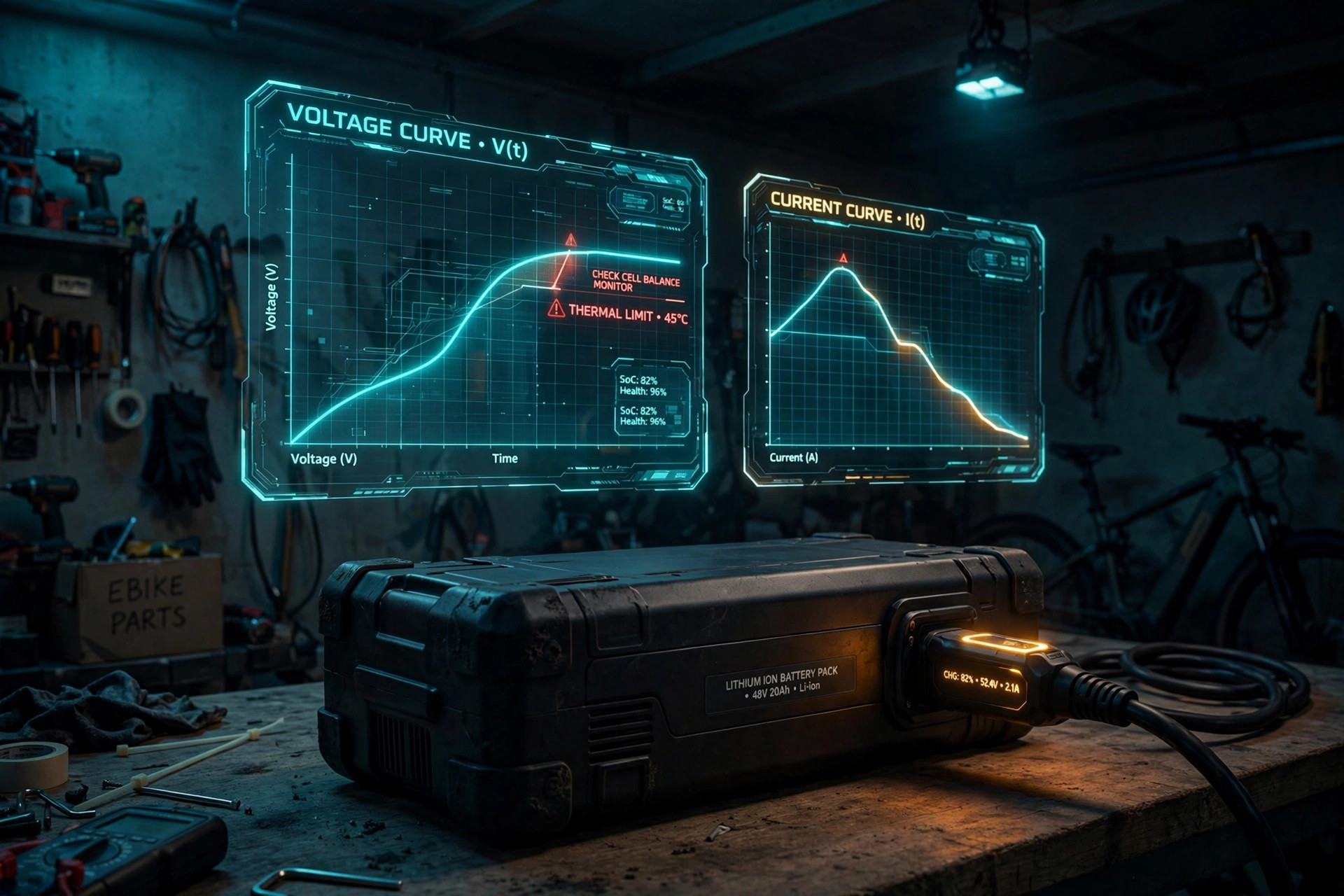
- Figure 2: Charge curve comparison: healthy pack versus imbalanced pack, showing premature CC-to-CV transition at lower coulomb-counted SOC and elongated CV tail.
- Figure 3: Rest-phase OCV decay curves: healthy slow relaxation versus micro-short accelerated decay with convex-downward trajectory.
- Figure 4: Feature fusion architecture: six feature families feeding per-pack changepoint detectors into the on-device risk model, with fleet learning feedback loop.
- Figure 5: Tiered response state machine: normal, advisory, warning (80% SOC cap), and critical (charge termination plus isolation instruction) with transition conditions.
9. Limitations and Counterarguments
Two-terminal sensing cannot localize a fault to a specific cell group: a premature CV entry or a resistance step identifies the pack as suspect, not the cell that is failing, so the system can only recommend pack-level action such as inspection, replacement, or isolation. Charger variability is the principal confounder: swapping chargers, or charger-to-charger variation in CV setpoint accuracy and ripple amplitude, shifts every measured feature, so a detected charger change forces re-baselining from new initial sessions. The central failure mode is false alarms on cheap, high-variance packs; the tiered response is designed to make false alarms cheap (an advisory notification, a charge cap) while keeping true positives expensive to miss (automatic termination). The device does not make an uncertified pack safe and is not a substitute for certified batteries, balancing, or supervised charging: it buys early warning for the installed base that regulation cannot reach quickly.
Claims
- A system for predicting lithium-ion battery thermal runaway in a micromobility device, comprising: an in-line sensing module connected in series between an unmodified constant-current/constant-voltage charger and a battery pack, the module measuring only pack-terminal voltage and current; a feature extraction unit that derives thermal-runaway precursor features from the measured voltage and current waveforms without any communication with the pack's battery management system and without any cell-level voltage taps; a per-pack baseline learning unit that establishes feature baselines from the pack's own initial charge sessions; a changepoint detection unit that flags statistically significant drift in the features relative to the baselines; and an actuation unit that generates tiered alerts and selectively interrupts charging based on a fused risk score.
- The system of claim 1, wherein the feature extraction unit detects premature constant-current to constant-voltage transition by estimating state of charge at CV entry via coulomb counting from charge start, and wherein a downward drift in CV-entry state of charge relative to the pack's baseline indicates a weak parallel cell group reaching its voltage ceiling early.
- The system of claim 1, wherein the feature extraction unit measures pack DC internal resistance from the instantaneous voltage step occurring at charge-initiation current onset, applies temperature compensation, tracks the resistance across sessions, and flags sudden inter-session increases indicative of damaged interconnects or failing cell groups.
- The system of claim 1, wherein the module enters a rest-monitoring mode after charge termination, sampling pack open-circuit voltage at intervals while drawing micropower from the pack, fitting the voltage decay to separate polarization relaxation from parasitic drain, and flagging accelerated parasitic drain indicative of dendrite-induced micro-shorts.
- The system of claim 4, wherein an accelerating open-circuit voltage decay trajectory combined with measured pack temperature rise during rest triggers a critical tier response comprising immediate charge termination and user instruction to isolate the pack outdoors.
- The system of claim 1, wherein the feature extraction unit estimates high-frequency pack impedance from the amplitude of the charger's own switching ripple measured at the pack terminals via an analog envelope detector, providing an excitation-free impedance probe sensitive to charge-transfer resistance growth.
- The system of claim 1, further comprising a capacity tracking unit that integrates delivered charge per session, compares measured capacity against a cycle and calendar aging model fit to the pack's history, and flags capacity loss exceeding model prediction as cell degradation.
- The system of claim 1, further comprising a thermal anomaly unit that predicts expected pack heating from a current-squared-times-resistance model using measured session current and tracked internal resistance, and flags sustained measured temperatures exceeding prediction as abnormal internal dissipation.
- The system of claim 1, further comprising a fleet learning unit that receives anonymized per-session feature vectors from a plurality of modules, correlates feature trajectories with user-reported battery incidents to refine risk models distributed back to the modules, and detects correlated feature drift across packs of a common model as a production batch defect.
- The system of claim 1, wherein the actuation unit implements tiered responses comprising: an advisory tier issuing inspection notifications; a warning tier capping charge at reduced state of charge and requiring user acknowledgment per session; and a critical tier opening a series contactor to terminate charging, sounding an audible alarm, and instructing pack isolation.
- A method for predicting lithium-ion battery thermal runaway without battery management system cooperation, comprising: inserting a sensing module in series between an unmodified charger and a battery pack; sampling pack-terminal voltage and current during charging; extracting precursor features comprising CV-entry state of charge, plug-in internal resistance step, switching-ripple impedance, session capacity, and thermal deviation; monitoring pack open-circuit voltage decay during a post-charge rest phase to detect micro-short parasitic drain; learning per-pack feature baselines from initial sessions; applying changepoint detection to flag feature drift; fusing flagged features into a risk score; and actuating tiered responses from advisory notification through charge termination based on the risk score.
- The system of claim 1, wherein the module auto-ranges across nominal pack voltages from 24 V to 72 V, presents under 5 mΩ series insertion resistance, defaults its series contactor to closed on power loss, and logs all actuation decisions to non-volatile memory for post-incident forensics.
Implementation Notes
The sensing module is implementable as a retrofit dongle with a bill of materials under $20 at volume: an ARM Cortex-M4 microcontroller with integrated BLE, a 16-bit shunt-based current sensor, a resistor-divider voltage channel with auto-ranging, a 30 A MOSFET pair or compact contactor, an NTC thermistor, and a piezo alarm element. The on-device risk model (gradient-boosted trees over approximately 20 features) fits in under 50 KB of flash and executes in milliseconds between charge sessions; protection does not depend on cloud connectivity. Rest-phase monitoring draws under 50 µA from the pack, adding roughly 36 mAh per month: under 0.3% of a typical 15 Ah pack's capacity, a small fraction of the pack's own self-discharge. The companion app handles onboarding (pack voltage auto-detection on first plug-in), alert delivery, incident reporting that feeds fleet learning, and batch-defect notifications. Firmware follows software safety practices consistent with UL 60730 Class B for automatic electrical controls, including watchdog supervision, ADC plausibility checks, and contactor weld detection via voltage sensing across the open contactor. No personally identifying information, location data, or pack serial numbers leave the device; fleet uploads carry only rotating random identifiers and feature vectors. The system is positioned as a safety accessory, not a substitute for certified packs and chargers: it watches the installed base of uncertified hardware that regulation cannot reach quickly, buying time and evidence while standards and enforcement catch up.
Prior Art References
- FDNY Commissioner Announces Significant Progress in the Battle Against Lithium-Ion Battery Fires: 268 lithium-ion battery fires and 18 deaths in New York City in 2023; 277 fires and 6 deaths in 2024
- CPSC Staff Statement on Contractor e-Bike Battery Test Report (Exponent): 40 to 50 mV cell-group imbalance observed in tested e-bike packs with no balancing performed
- UL 2271, Standard for Batteries for Use In Light Electric Vehicle (LEV) Applications; UL 2849, Standard for Electrical Systems for eBikes: voluntary certification standards for micromobility batteries and electrical systems
- New York City Local Laws 39 and 40 of 2023: prohibition on the sale of uncertified lithium-ion batteries and chargers for micromobility devices
- Battery University, "Charging Lithium-Ion" (BU-409): CC-CV charge profile characteristics: constant current phase to 4.20 V/cell followed by constant voltage taper to C/20 cutoff
- LITF-PA-2026-052: Lithium-ion battery internal temperature estimation via multi-frequency impedance spectroscopy on BMS hardware (BMS-side method; this disclosure operates without BMS cooperation)
- LITF-PA-2026-119: Thermal runaway detection using ambient VOC emission signatures from MOX gas sensors (requires additional sensing hardware in the charging environment; this disclosure uses only charger-side electrical measurements)