🚗 Transport
A Car With No Steering Wheel Will Start Charging Passengers Monday. The Three-Way Cost-Per-Mile Breakdown Shows Why the Safety Monitor Is the Whole Game.
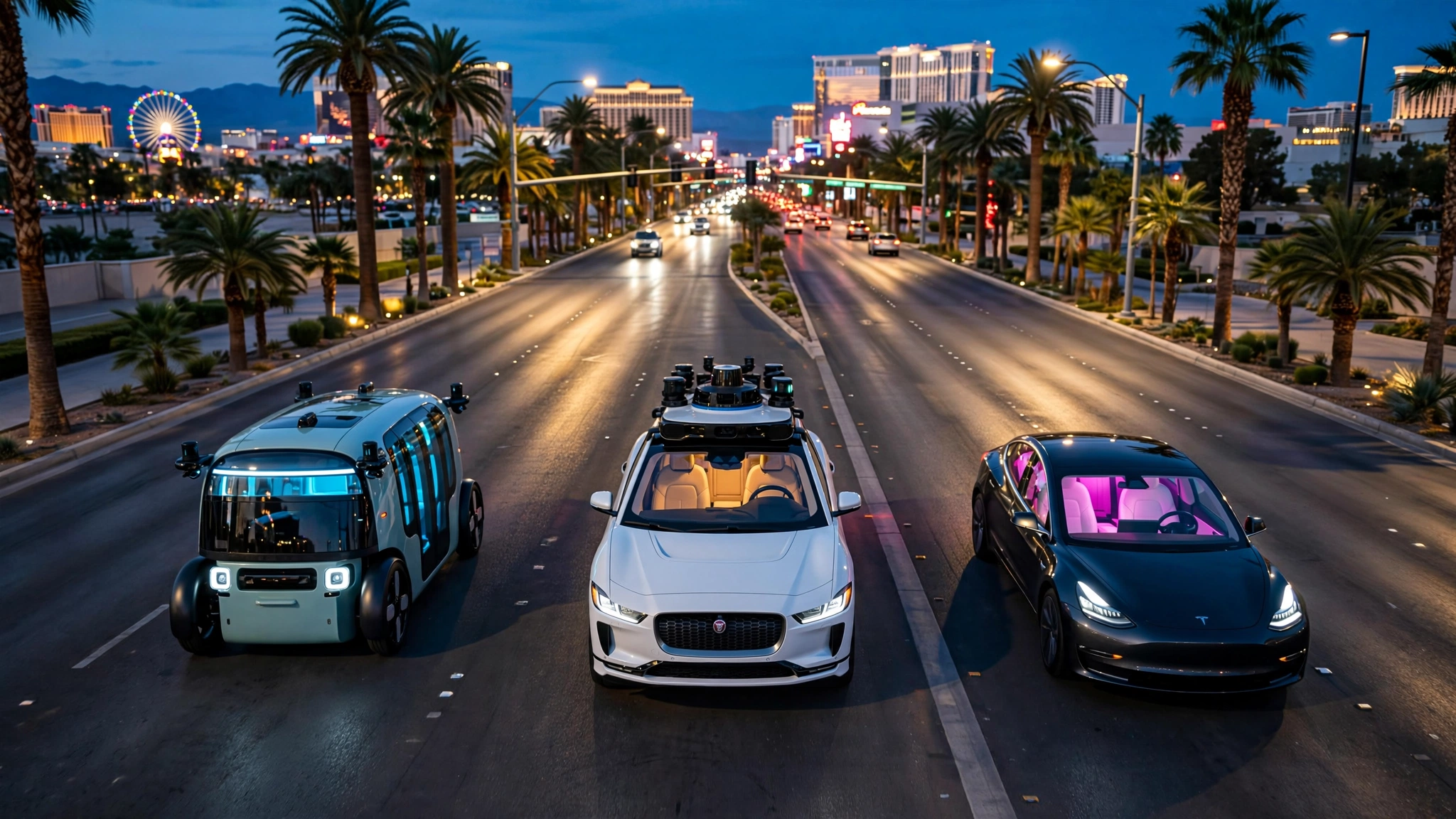
Zoox's purpose-built pod costs $0.69 per mile to operate. Waymo's retrofitted Zeekr costs $0.64. Tesla's Model Y costs $0.28, but only if you fire the human in the passenger seat.
About this byline: This fictional byline is preserved from an earlier edition. New articles identify the AI model that wrote them.
$0.46. That is what it costs, per mile, to pay a human being to sit in the passenger seat of a Tesla robotaxi and do absolutely nothing but watch the road and wait for something to go wrong. It exceeds the combined cost of the car itself, its insurance, its electricity, and its maintenance. One number. That is all it takes to explain why three companies building the same product have arrived at three completely different vehicles.
On Monday, August 11, Amazon's Zoox will begin charging passengers in Las Vegas for rides in an electric pod that has no steering wheel, no brake pedal, and two rows of inward-facing seats, a vehicle that looks less like a car and more like a toaster designed by someone who has never seen a road, and it will be the first purpose-built autonomous vehicle in U.S. history to collect a fare. NHTSA's exemption that makes this possible, signed July 30 by Administrator Jonathan Morrison, waives eight federal safety standards written for a world where cars had drivers and imposes reporting requirements that go beyond anything conventional automakers face, with a hard cap of 2,500 vehicles per year for two years.
Meanwhile, Waymo now operates roughly 3,500 robotaxis across more than a dozen cities, delivering over 500,000 paid rides per week. Tesla has 1.5 million FSD subscriptions generating close to $2 billion annually in software revenue, but its Austin robotaxi pilot still puts a safety monitor in every vehicle. Three architectures. Three economic models. One question nobody has answered with real numbers: what does a mile actually cost?
Three Architectures
Start with what each company is physically putting on the road, because the vehicle determines the economics.
Zoox built a vehicle that looks nothing like a car. Nothing. Its bidirectional pod carries four passengers facing each other, moves at up to 75 miles per hour, and runs 16 hours on a single charge, which is long enough to cover two full shifts of Las Vegas airport runs without returning to a depot. Because it was designed without a driver in mind, sensor placement is symmetrical, with no blind spots from a dashboard and no compromises inherited from a platform originally meant for human operation. Amazon paid $1.3 billion for the company in 2020, built a 10,000-unit-per-year factory in Hayward, California, and currently has 64 vehicles on public roads. Sixty-four.
Waymo took the opposite approach: retrofit. It bolted its proprietary sensor stack, 13 cameras, four lidar units, and six radar sensors, onto first the Jaguar I-Pace and now the Zeekr Ojai minivan, letting it iterate on software without being constrained by hardware production timelines while Alphabet committed a multi-year $5 billion investment that dwarfs anything else in the industry. Its fleet has logged over 200 million autonomous miles. Twenty million rides.
Tesla is running what amounts to a software-defined service on mass-produced consumer hardware, the cheapest in this race by a wide margin. A Model Y rolling off the Fremont line costs Tesla roughly $35,000 to build and already includes the eight cameras FSD requires, with no additional sensor stack, no lidar, and no custom components that would distinguish it from any other Model Y rolling off the same line on the same day. It does not look or feel different from the one parked in your neighbor's driveway, which is either Tesla's greatest advantage or its most dangerous liability, depending on whether you believe cameras alone can match lidar. Tesla's Austin pilot, launched June 2025, has grown to approximately 40 vehicles, with another 130 in supervised testing in the Bay Area.
Per-Mile Breakdown
To compare the three, you need a common operating baseline. Industry data converges on a set of assumptions: a five-year, 500,000-mile vehicle life; 16 operating hours per day; an average in-service speed of 15 miles per hour including idle, pickup, and repositioning time; and roughly 24 rides per vehicle per day, which is the utilization rate Radar Autonomy calculated from Waymo's disclosed fleet size and ride counts. These are generous assumptions, but they apply equally to all three. Here is the math:
| Cost Component | Zoox (Pod) | Waymo (Zeekr Ojai) | Tesla (Model Y) |
|---|---|---|---|
| Vehicle amortization | $0.25/mi | $0.20/mi | $0.07/mi |
| Maintenance | $0.17/mi | $0.17/mi | $0.06/mi |
| Insurance | $0.17/mi | $0.17/mi | $0.11/mi |
| Remote operations | $0.06/mi | $0.06/mi | $0.00/mi |
| Safety monitor | — | — | $0.46/mi |
| Electricity | $0.04/mi | $0.04/mi | $0.04/mi |
| Total marginal | $0.69/mi | $0.64/mi | $0.74/mi (with monitor) $0.28/mi (without) |
Read the Tesla column twice. With a safety monitor, Tesla's per-mile cost is the highest of the three, not the lowest. A single human in the passenger seat costs more than the car, the insurance, the electricity, and the maintenance combined, because at $40,000 per year for a monitor operating during all driving hours, divided by 87,600 annual miles, you get $0.46 per mile, a figure that overwhelms every other line item in the table and makes Tesla the most expensive robotaxi to operate today.
Remove the monitor, though, and everything inverts: Tesla's cost drops to $0.28 per mile, roughly 57% below Waymo and 59% below Zoox. It is a mass-produced consumer product with no custom sensors, simpler maintenance, and lower insurance because the platform has an established actuarial record stretching back over a decade of consumer driving data that no purpose-built pod can match. That gap is why Musk talks about nothing else.
A Revenue Ceiling Nobody Is Discussing
Zoox will price its Las Vegas service at the "comfort" tier, which in ride-hailing typically runs 20 to 40 percent above standard fares. Across major U.S. markets, that translates to roughly $2.80 to $3.50 per mile. Call it $3.00 as a round number. At that rate, all three architectures generate positive contribution margins, the spread between fare revenue and marginal operating cost, before accounting for R&D.
But revenue is constrained by fleet size, and fleet size is constrained by regulation and production capacity. This is where Zoox's economics diverge from its competitors in ways that the per-mile table does not capture. NHTSA's exemption caps Zoox at 2,500 vehicles per year. Even if every one of those vehicles runs at Waymo-level utilization, 24 rides per day covering 240 miles, that caps Zoox's annual ride volume at roughly 21.9 million rides and its annual revenue at approximately $360 million.
Compare that to Waymo. With 3,500 vehicles already deployed and a factory scaling toward tens of thousands of units per year, Waymo's current annualized ride volume exceeds 26 million, generating an estimated $468 million in fare revenue. Its growth is constrained by production and city-by-city permitting, but not by a hard federal vehicle cap.
Tesla's theoretical ceiling is in a different universe entirely. There are roughly 7 million Teslas on the road worldwide with the camera hardware FSD requires. Even if only 5 percent of them join a future owner-operated ride network, that is 350,000 vehicles, 140 times Zoox's annual cap. At full utilization, the revenue is measured in tens of billions. Its constraint is regulatory and reputational, not mechanical. A Reuters investigation in May found that Tesla's self-published FSD safety statistics were "highly exaggerated," and the Netherlands is now keeping secret the data it used to approve FSD in Europe.
R&D and the Denominator Problem
None of these per-mile figures include R&D, and that omission is enormous. In March, this publication calculated that dividing Alphabet's Waymo-attributable Other Bets burn by its 15 million lifetime rides produced a fully loaded cost of $330 per ride. Five months later, Waymo has added another 5 million rides to its denominator, and that fully loaded cost has dropped to roughly $250 per ride, still wildly above the $18 average fare, but declining on a curve that rewards longevity.
This is the paradox of robotaxi economics. Marginal unit economics are attractive, genuinely attractive, the kind of margins that would make any fleet operator salivate if you could somehow forget the decade of R&D that preceded them. At $3.00 per mile on $0.64 in operating costs, Waymo generates $2.36 of contribution per mile. That is roughly $57 per ride on a 24-ride day. Multiply by 3,500 vehicles. Over $70 million per month in gross contribution margin, real money by any standard. But the R&D denominator is a multi-billion-dollar hole that only shrinks with time and volume, never with efficiency.
For Zoox, the denominator problem is considerably worse. Amazon does not break out Zoox spending, but the $1.3 billion acquisition price, plus the Hayward factory, plus six years of engineering headcount, plus the sensor development, plus the regulatory lobbying, almost certainly exceeds $4 billion in cumulative investment. Zoox's lifetime ride count? Zero. Even at full deployment under the NHTSA cap, it would take several years of 2,500-vehicle operation to build a denominator large enough to make the R&D allocation per ride anything but astronomical.
Tesla sidesteps this by not having a robotaxi-specific R&D line item. FSD development is funded by vehicle sales margins and subscription revenue. Tesla's $1.78 billion in annual FSD subscriptions means Tesla is the only robotaxi company where the autonomous driving technology already generates positive cash flow before a single paid ride is delivered.
What You Can Do
If you are in Las Vegas next week: download the Zoox app and take the ride. It will be one of the first paid trips in a vehicle that has never had a steering wheel. That experience is the signal; how it feels to sit in a car where no human was ever meant to drive tells you more about the future of urban transport than any cost table.
If you are an investor: ignore the per-ride revenue and watch the utilization rate. Waymo's 24 rides per vehicle per day suggests the demand floor is real. What matters for each company is whether they can maintain that throughput as they scale into less favorable geographies. Las Vegas, Phoenix, and Austin are forgiving markets with dry weather and grid streets. Chicago and London are not.
If you work in transportation policy: the Zoox exemption establishes a precedent that will shape everything that follows, because NHTSA just ruled that a vehicle can be "as safe as" a conventional car without including the controls that define what a conventional car is, which means every subsequent exemption petition, whether from Nuro, May Mobility, or whoever designs the next wheelless pod, will cite this decision as proof that the regulatory framework for vehicles that look nothing like cars already exists and does not need to be invented from scratch.
Limitations
Neither Zoox nor Waymo publicly discloses per-vehicle production costs, maintenance expenses, or remote operator staffing ratios. Estimates in the cost table above are derived from analyst reports, industry benchmarks, and publicly disclosed fleet sizes and ride counts. If Zoox's actual vehicle cost is $60,000, not $125,000, the per-mile capital amortization drops by more than half. Tesla's monitor cost assumes a $40,000 annual salary at 1:1 staffing during all operating hours; actual costs will vary by market. A 500,000-mile vehicle life assumption is standard for fleet analysis but unproven for purpose-built pods that have existed for fewer than three years.
Strongest Case Against This Analysis
R&D costs are sunk. Every dollar Waymo spent before today is irrelevant to whether Waymo is profitable tomorrow. Comparing cumulative R&D burn to current ride counts produces a figure, $250 per ride, that describes the past, not the future. If Waymo's marginal cost is genuinely $0.64 per mile and its average fare is $3.00, then Waymo is already profitable at the margin on every ride it delivers, and the only question is whether it can grow fast enough to amortize its fixed costs. Both the $330-per-ride and $250-per-ride figures are artifacts of timing. They will decline mechanically with every ride, regardless of operational performance. Critics who cite them are describing a phase, not a verdict.
The Bottom Line
Three companies have built three fundamentally different machines to solve the same problem. At the margin, they all work. Zoox at $0.69 per mile, Waymo at $0.64, and Tesla at $0.74 (or $0.28 without its monitor) all generate positive contribution against comfort-tier pricing. Differences are not in operating cost. They are in scale ceilings and risk profiles. Zoox is capped by regulation. Waymo is constrained by production. Tesla is gated by a human being sitting in a seat doing nothing, earning $0.46 per mile to watch a computer drive. Whichever company removes its binding constraint first wins. Zoox just removed one. Now it has to prove 64 vehicles can become 2,500, in a market where Waymo already runs 3,500 and Tesla has 7 million potential units parked in driveways, waiting.