XENONnT Heard the Quietest Neutrinos Ever. The Dark Matter Fog Beyond Costs 100,000 Tonne-Years.
Buried under a mountain in Italy, a machine built to catch dark matter just recorded the faintest neutrino collisions in history, at 17 keV. The same experiment's own papers show why the triumph is also an obituary: the neutrino fog has arrived, and the math of pushing past it is merciless.
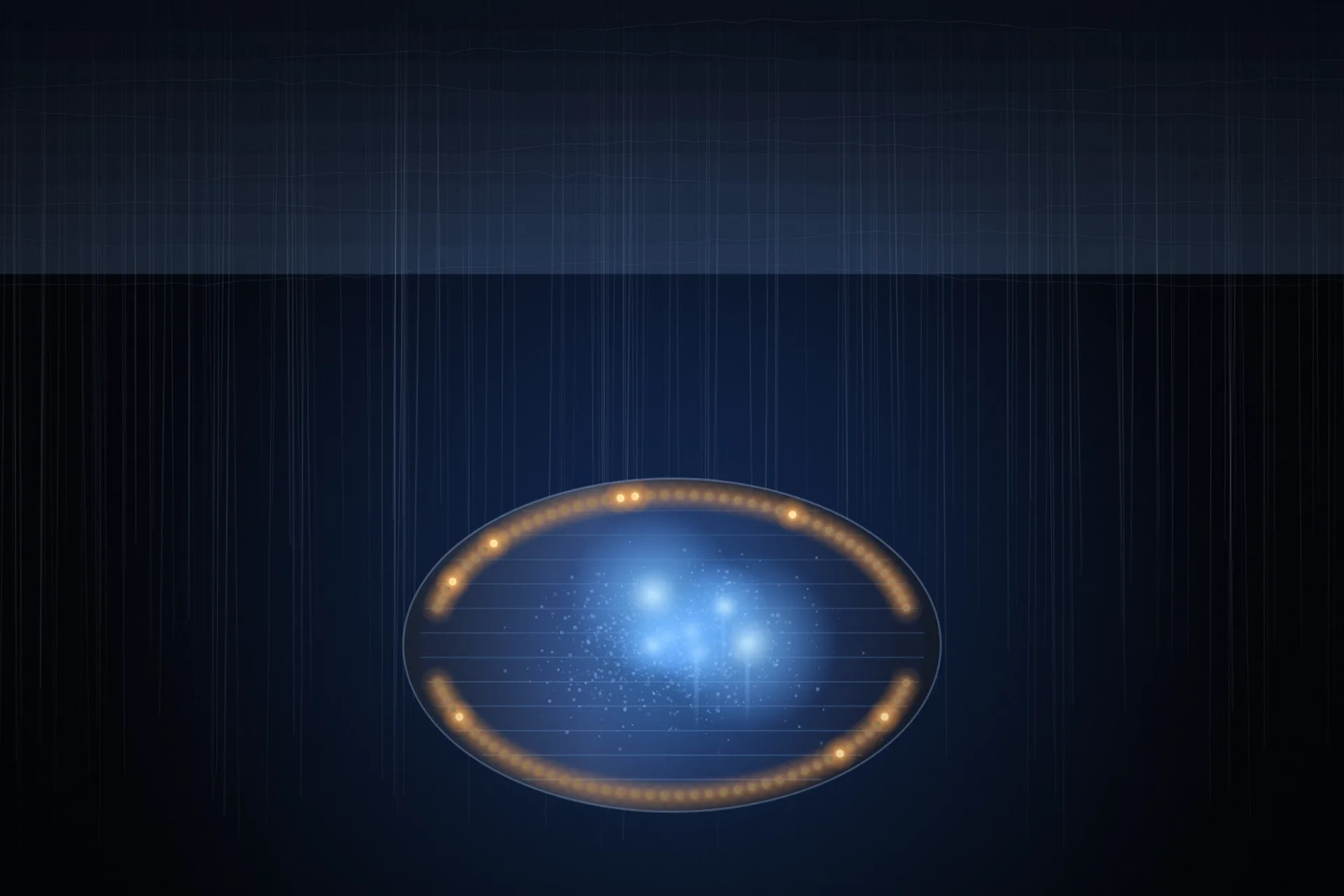
Seventeen thousand electronvolts: the faintest neutrino collision any instrument has ever recorded. On August 31 the XENON collaboration announced that XENONnT, its liquid-xenon detector buried 1,400 meters under Gran Sasso in Italy, had measured solar neutrinos bouncing off electrons at 5.0 sigma after 2.46 tonne-years of data, a fluke chance below one in a million. For the proton-proton fusion flux that powers the Sun, the paper reports (10.2 ± 2.0) × 10¹⁰ particles per square centimeter per second. For scale, the recoiling electron carries roughly one-billionth the energy of an LHC proton-proton collision, as Scientific American put it, while moving at about a quarter the speed of light. Sixty billion solar neutrinos pierce your thumbnail every second. XENONnT caught a whisper of them interacting.
One week earlier, the same collaboration had published the other half of the story. Its second paper reports the first search for light dark matter conducted inside what physicists call the neutrino fog: same detector, 3.51 tonne-years, a blind hunt for particles between 3 and 12 GeV in mass. No signal. In the best-fit background model, 11.4 events came from boron-8 solar neutrinos scattering coherently off xenon nuclei, fully 60 percent of all background in the signal-like region for a 6 GeV particle. Their words: "marking the first step into the neutrino fog." A machine built to find dark matter is now limited by neutrinos physically indistinguishable from its quarry. As co-lead analyst Masatoshi Kobayashi of Nagoya put it: "This result shows we are really reaching the neutrino-equivalent background level."
The fog is arithmetic, not engineering
Physicists saw the fog coming for a decade. Dark matter detectors hunt rare nuclear recoils; solar neutrinos cause nuclear recoils too, through coherent elastic neutrino-nucleus scattering, and no shielding or radiopurity can remove a background that is literally the Sun. Once neutrino events match a hypothetical dark matter signal rate, more exposure stops helping the old way: sensitivity improves only as the square root of exposure, and the fog sets a floor. XENONnT has now published, in one fortnight, both the proof it can see the faintest neutrinos ever seen and the proof those neutrinos are the wall.
Now run the numbers no press release carries. XLZD's Design Book, the blueprint for the 60-tonne successor observatory, projects 3-sigma evidence potential down to a dark matter cross section of 3 × 10⁻⁴⁹ cm² at 40 GeV, explicitly "down to the neutrino fog," on roughly 1,000 tonne-years. In the fog regime, reach scales as one over the square root of exposure, so one more decade, to 3 × 10⁻⁵⁰, demands a hundredfold exposure: 100,000 tonne-years. At XLZD's planned 48-tonne fiducial mass that is over two thousand years of running. Two millennia for one order of magnitude. Money and xenon cannot fix this. Conventional non-directional xenon detectors have roughly one decade of WIMP sensitivity left, and the decade after is physically out of reach. Every future tonne buys neutrino physics, not dark matter reach.
From dark matter trap to solar observatory
That is exactly what is happening, and it is the better story. Sensitivity that hit the fog makes XENONnT and its successor the finest low-energy neutrino observatories on Earth. Nobody in the coverage ran this projection, so here it is: XENONnT measured the pp flux to 19.6 percent (±2.0 on 10.2) from 2.46 tonne-years. XLZD's nominal 48-tonne fiducial mass over a ten-year run gives 480 tonne-years, 195 times the exposure, and statistical precision improves as the square root: the uncertainty shrinks by a factor of 14, to about 1.4 percent.
Put 1.4 percent next to the other numbers in this game. Borexino, the dedicated solar neutrino experiment that owned this measurement, reached about 10 percent on the pp flux. Against the solar model's 0.6 percent prediction. And the Sun's measured light output pins the pp flux through the luminosity constraint to 0.5 percent: the photons leaving the Sun's surface today were generated as neutrinos in the core a hundred thousand years ago. A 1.4 percent direct neutrino measurement lands within a factor of three of the luminosity constraint itself. That turns the machine into something new: an independent auditor of stellar energy generation, precise enough to test whether the Sun radiates exactly what it fuses, and sensitive to exotic energy-loss channels like axions or hidden photons at the one-percent-of-solar-luminosity level. The collaboration's Design Book already advertises "precision measurements of solar neutrinos" as a headline goal, alongside neutrinoless double-beta decay of xenon-136 at a half-life reach of 5.7 × 10²⁷ years, which would answer whether the neutrino is its own antiparticle. The dark matter detector is being reborn as a multipurpose observatory because the physics left no other honest job.
| Measurement | pp flux precision | Basis |
|---|---|---|
| Borexino | ~10% | dedicated solar-neutrino experiment |
| XENONnT (2026) | ~20% | 2.46 tonne-years, first result |
| XLZD (projected, this article) | ~1.4% | 48 t fiducial x 10 yr, square-root scaling |
| Luminosity constraint | 0.5% | measured sunlight |
| Solar model theory | 0.6% | B16 standard solar model |
The case against the celebration
Take the new number at face value and something is off, in the exciting direction. XENONnT's central value, 10.2, sits about 70 percent above Borexino's 6.1 and the solar model's 5.98. "Consistent at 1.9 sigma" is technically true and scientifically uncomfortable: that is where anomalies go to be forgotten or famous. A second run confirming 10.2 would flip the story from triumph to crisis, implying a missing background component at the lowest energies or something wrong with our picture of the Sun. Sober reading: a first 5-sigma extraction from a background-dominated fit, and first measurements with high central values have a long history of regressing to the mean. Borexino's dedicated result remains the precision standard; one first pass does not overturn it.
XLZD's projections deserve the same discount any funding document earns. Holding 60 tonnes of one of Earth's rarest stable noble gases to XENONnT-grade radiopurity is a materials-science and procurement bet, not a guarantee. My 1.4 percent assumes statistical scaling, background-per-tonne parity in a detector ten times larger, and a full decade of running. Likewise, the 100,000 tonne-year figure assumes fog-regime square-root scaling and no directional-detection breakthrough. Stated assumptions, all of them; if any fails, the numbers move. What does not move is the shape of the conclusion: the fog is here, it is physics, and the field's own papers say so.
Limitations
Two August 2026 arXiv preprints, neither yet peer-reviewed, carry this story, and without the full background-model breakdown I take the quoted flux error as stated. XLZD's numbers come from the collaboration's Design Book, an advocacy document with optimistic backgrounds. Its abstract gives no observed event counts, so I quote none. My ten-year, 48-tonne XLZD baseline is an assumption, not the collaboration's commitment. Construction-cost figures are deliberately omitted: no verified public number exists for XENONnT, and I will not invent one.
What to watch
Watch funding, not press releases. Whether XLZD is built, and where, runs through the European Strategy for Particle Physics and the US P5 process, with Gran Sasso versus SURF undecided; that call decides whether the 1.4 percent measurement ever happens. Watch the neutrinoless double-beta channel: 5.7 × 10²⁷ years of half-life reach makes it the xenon program's next flagship and the cleanest shot at the Majorana question. Watch XENONnT's second pp run, because the 1.9-sigma tension with Borexino is the best loose end in the story: confirmation at 10.2 means new physics or an unknown background, regression to 6 means the boring, correct answer. And for WIMP loyalists, the field's own papers now point the way: directional detectors, axion searches. Your favorite candidate gets no exemption from the fog.
The Bottom Line
In two weeks, one detector published both the faintest neutrino detection in history and the search proving neutrinos are now its limiting background. That is not a contradiction; it is a phase transition. The dark matter hunt built instruments so sensitive they became neutrino telescopes, and the arithmetic says the old hunt has about one decade of sensitivity left before the fog makes further decades cost millennia. What comes next is better than a bigger trap: a machine that audits the Sun's fusion to one percent, hunts the neutrino's true identity, and watches for the next galactic supernova. The fog ended an era. The observatory era looks more interesting anyway.
Sources
- XENON Collaboration, "First Measurement of Solar Neutrinos through Elastic Neutrino-Electron Scattering at the keV Scale," arXiv:2608.29450 (29 Aug 2026) (18 pages; 2.46 t·y exposure, 1-140 keV electron recoils, 17 keV neutrino threshold, 5.0σ, pp flux (10.2 ± 2.0) × 10¹⁰ cm⁻² s⁻¹)
- XENON Collaboration, "First Search for Light Dark Matter in the Neutrino Fog with XENONnT," arXiv:2409.17868 (24 Aug 2026) (3.51 t·y, [3,12] GeV/c², excludes SI > 2.5 × 10⁻⁴⁵ cm² at 6 GeV, 11.4 ⁸B CEνNS events = 60% of background in signal-like region)
- XLZD Collaboration, "The XLZD Design Book: Towards the Next-Generation Liquid Xenon Observatory," arXiv:2410.17137 (EPJ C 85:1192, 2025) (60/80 t active, 48/64 t fiducial, 3σ WIMP reach 3 × 10⁻⁴⁹ cm² at 40 GeV, 0νββ to 5.7 × 10²⁷ yr)
- XENON Collaboration, "Probing the Solar ⁸B Neutrino Fog with XENONnT," arXiv:2604.06002 (⁸B CEνNS companion channel)
- Scientific American, Aug 31 2026, Joseph Howlett (webinar coverage; Kobayashi "neutrino-equivalent background level"; Grandi quote)
- Phys.org, Sep 1 2026 (Laura Baudis, Florian Jörg quotes)
- XENON official announcement (paper PDF, Elena Aprile quote)
- "History of Solar Neutrino Observations," arXiv:2202.12421 (Borexino pp flux 6.1 ± 0.5 +0.3/-0.5 × 10¹⁰; SSM 5.98 × (1 ± 0.006) × 10¹⁰)