America Just Installed a Record 20.2 GWh of Batteries. Its Data Centers Burn That Much Every 52 Minutes.
Q2 2026 was the biggest battery quarter in American history: 20.2 gigawatt-hours, seven gigascale projects, Arizona alone setting a state record. Data centers bought three-quarters of commercial storage. Run the math and the whole record quarter disappears in under an hour of data-center electricity use.
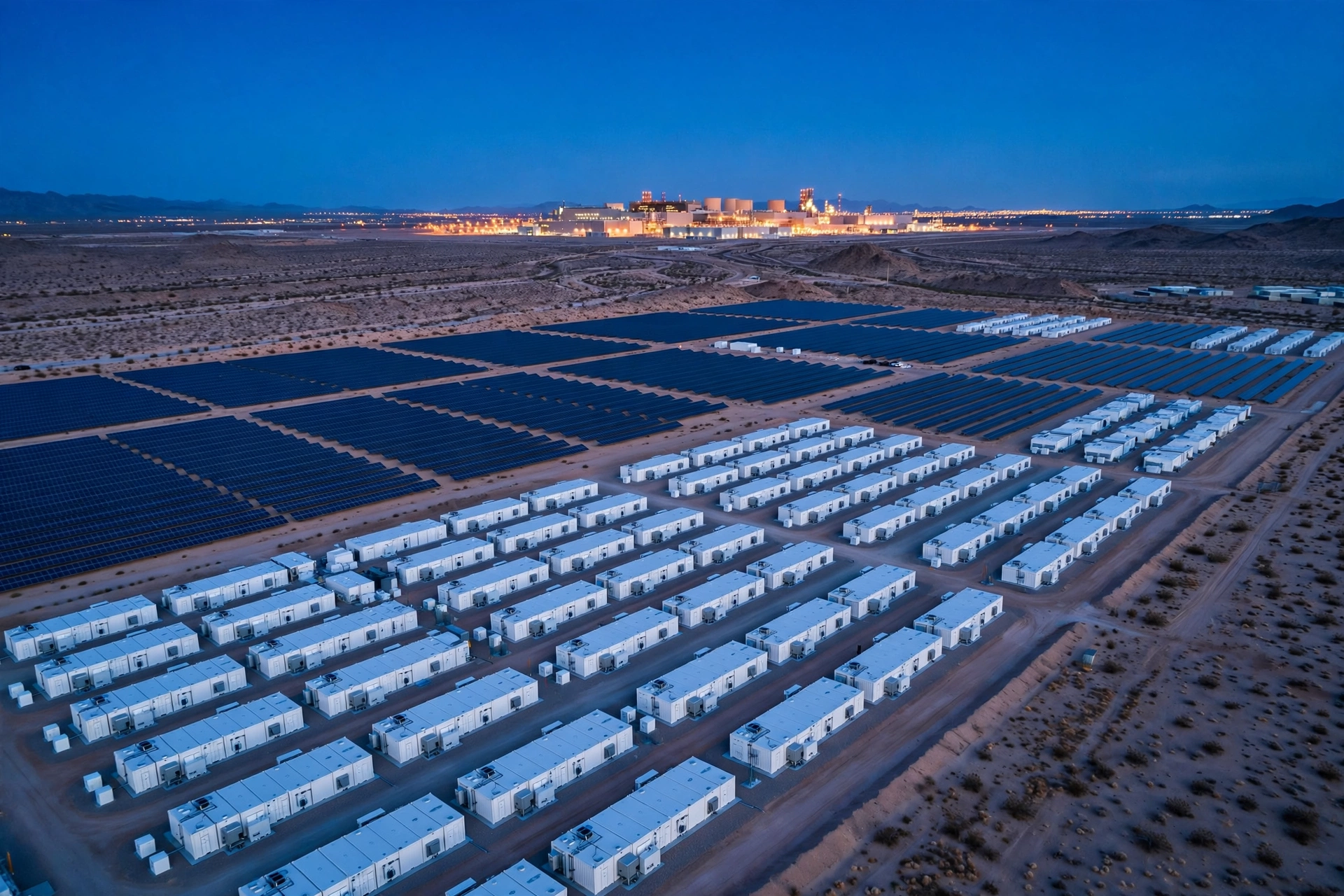
Fifty-two minutes. That is how long it takes America's data centers to burn through the entire record battery quarter. Between April and June 2026, the United States installed 20.2 gigawatt-hours of battery storage, the largest three-month build in the country's history, according to the quarterly SEIA and Benchmark Mineral Intelligence energy storage outlook reported by MIT Technology Review. Gartner estimates US data centers will consume about 204 terawatt-hours of electricity this year, which works out to an average draw of 23.3 gigawatts around the clock. Divide 20.2 GWh by 23.3 GW and you get 0.87 hours, less than a lunch break, a footnote on the data-center electricity bill for the biggest battery quarter America ever recorded.
None of which means the quarter was small. It was genuinely enormous. Those 20.2 GWh brought first-half 2026 installations to 30.8 GWh, up 23% year over year, and put the country on pace for 71 GWh in the full year, a 20% increase over 2025, which itself was a record. Analysts raised their 2030 forecast 11.5% on the strength of the numbers, to 683 GWh of cumulative capacity. Utility-scale storage capacity has nearly doubled in 18 months, from 88 to 165 GWh, because grid operators across the Southwest realized that the fastest dispatchable capacity they could buy was a battery. More than a tenth of every battery ever installed in America came online in a single quarter.
What the record was made of
Almost all of the growth came from the grid, not from garages. Utility-scale projects accounted for about 18 GWh of the 20.2, including seven gigascale installations, each over a gigawatt-hour, four in Arizona, two in California, and one in Utah, the kind of projects that used to take a year of headlines each and now arrive seven at a time. Arizona alone added 6.2 GWh, the strongest quarter ever recorded by a single state; Texas added 3.8 and California 3.6. In power terms, the quarter added 6.7 GW of continuous output capacity, which implies an average duration near three hours. Roughly 44% of the new storage was paired with solar and the rest stood alone, and batteries supplied more electricity to the US grid in the first eight months of 2026 than in all of 2025.
| Segment | Q2 2026 installs | Share |
|---|---|---|
| Utility-scale | ~18 GWh | ~89% |
| Commercial & industrial (behind the meter) | 1.8 GWh | ~9% |
| Residential | 0.657 GWh | ~3% |
Source: SEIA/Benchmark Mineral Intelligence Q3 2026 outlook, via pv magazine USA and electrek. Residential and C&I figures from pv magazine USA.
Who actually bought the record
Here is the part the headline numbers miss. Behind the meter, the commercial sector installed 1.8 GWh in the quarter, and data centers made up about three-quarters of the new commercial batteries. Homes, the original face of distributed storage, installed just 657 MWh, and residential installations are projected to fall 16% this year after the home-battery tax credit ended in 2025. Commercial storage outpaced home storage nearly three to one in the quarter, and the homeowner lost. Nonresidential tax credits largely survived, so the subsidy system is now formally aligned against the homeowner, rewarding the companies with the largest loads while the people the grid was built for watch the incentive expire.
It mirrors something the Energy Information Administration confirmed the same month: commercial electricity sales are set to exceed residential sales for the first time in American history in 2026 (Reuters, September 9). Both the load and the storage that serves it have changed owners in the same year, after twenty years of grid policy that assumed the marginal kilowatt-hour buyer was a household. In 2026 the marginal buyer is a server rack.
How far short it falls
Stretch the 52-minute number across the full year and it gets worse. Across a whole year of record building, the entire 2026 forecast of 71 GWh equals roughly three hours of data-center demand: 71 GWh against the 204 TWh Gartner expects US data centers to consume, or 0.035% of their annual electricity. Goldman Sachs estimates 13.6 GW of new data-center capacity was scheduled to come online in 2026, against 6.7 GW of new storage power capacity in the record quarter. Storage buildout and load growth are playing different sports.
There is also a supply-chain number buried in the report that matters more than the record. Nearly every cell installed this quarter was made in China, and this is the first year the storage tax credits require projects to limit their reliance on Chinese batteries, which means every gigascale project now navigates a compliance regime the domestic supply base cannot yet satisfy. Benchmark's Shan Tomouk notes the domestic factories meant to fill the gap cannot meet demand until around 2030. America is building its way out of a load crisis with someone else's batteries, under a credit regime that now penalizes exactly that.
The strongest case against this article
Fair objection, stated at full strength: the 52-minute framing is theater, not a failure metric, because storage was never meant to run data centers for a day; a 3-hour battery exists to shave the evening peak, keep prices down after solar ramps off, and give grid operators dispatchable power exactly when it is most valuable, and by that standard 6.7 GW of new dispatchable capacity is a genuine triumph, with batteries doing more for the grid in eight months of 2026 than in all of 2025. Data centers buying three-quarters of commercial storage is not perverse either: a battery next to a data center cuts demand charges, smooths interconnection queues, and is precisely the kind of flexible load-resource hybrid the grid needs. That number only bites if you expected batteries to absorb the AI boom. Nobody serious promised that.
What this does not prove
Honest boundaries on the claims. Every deployment figure traces back to one industry report from SEIA, a trade association with an interest in the sector's growth story; the underlying dataset is not public, so independent verification is not possible. On the headline split: the "three-quarters" data-center figure describes the commercial share of behind-the-meter installs, and the absolute split within commercial storage is not itemized in the reporting, so treat 1.35 GWh as an estimate, not a count. Gartner's 204 TWh is a forecast, not metered consumption, and data-center loads vary widely by region and hour, so 23.3 GW is an annual average that flattens a spiky reality. None of that changes the direction of the math, but it bounds how literally to take the minutes.
What you can do
If you are a homeowner considering backup storage, know the rules changed: the federal credit that subsidized home batteries ended in 2025, so the economics now hinge entirely on your utility's time-of-use rates, so run the payback against your actual evening peak rates before signing anything. If you develop or colocate data centers, the nonresidential storage credit survived, and pairing batteries with your site cuts both demand charges and interconnection wait times, which is why three-quarters of your commercial competitors already did it. And if you allocate capital to the sector, the watch item is the China-content requirement: domestic cell supply cannot meet the 2030 pipeline, which means project pricing carries a tariff and compliance risk that did not exist two years ago.
The bottom line
Q2 2026 was the best battery quarter in American history, bought mostly by the industry causing the crisis, and that is not a contradiction: grid-scale storage did more real work for the grid this year than ever, even as data centers quietly became the biggest buyers of the technology that was supposed to serve households. Those 52 minutes are not proof the record failed. They are proof the race changed: the storage industry is sprinting, and it is losing to the load. Watch the two lines, because whichever catches up first decides who pays for power for the next decade.