🍖 Food
A $500,000 Orchard Gap: Urban Grafting Is Agriculture's Unguarded Door
California outgrew Florida in oranges, spends $36 million a year on HLB defense, and has no published inventory of the backyard trees where the disease moves.
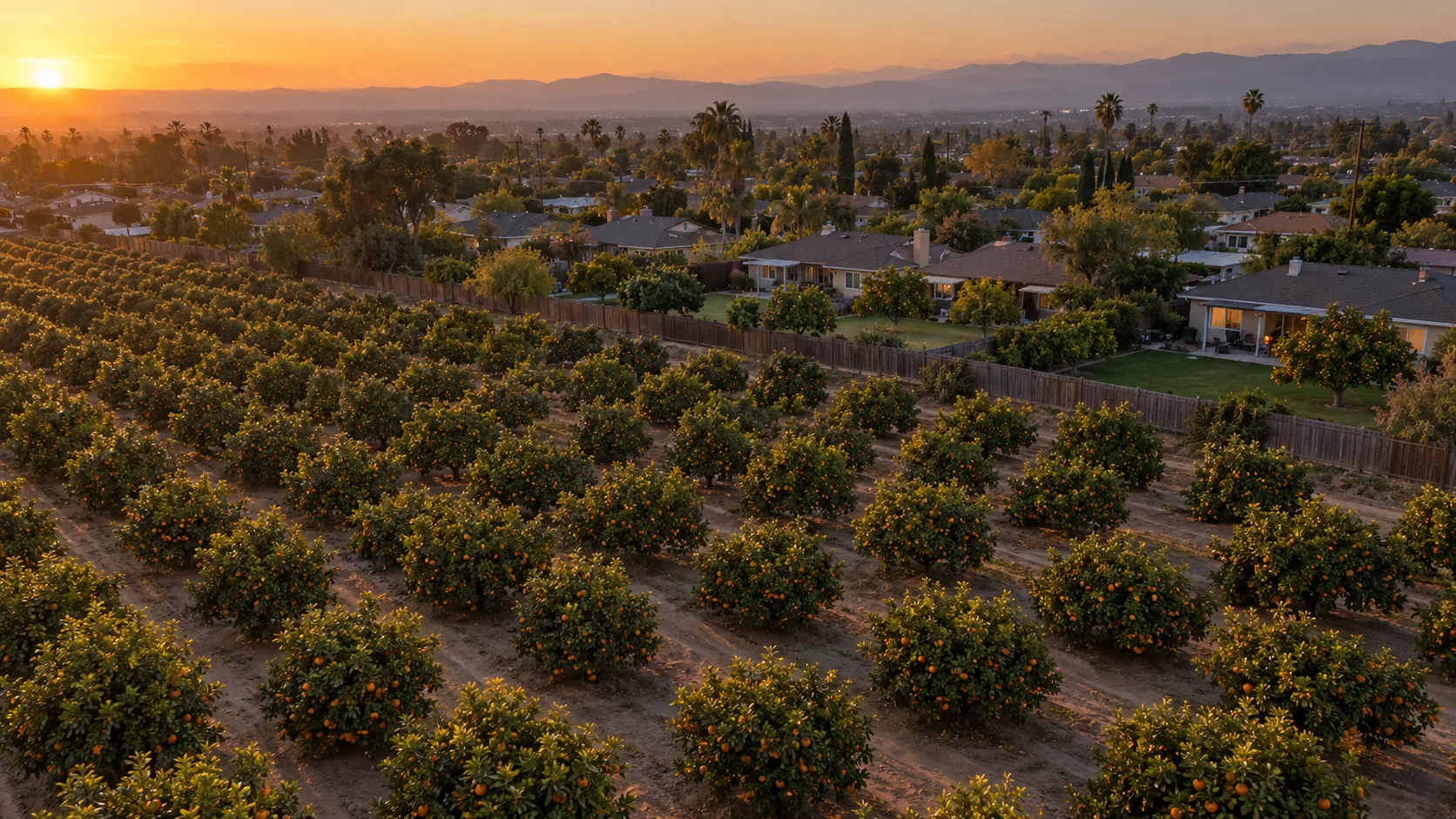
A 40-acre block of navel oranges turns over roughly half a million dollars a year, and the documented risk pathway to it runs overwhelmingly inside the state's neighborhoods. University of California's 2021 San Joaquin Valley cost study prices navels at $17.60 per carton FOB the packinghouse and models mature yields near 700 packed cartons per acre, which puts one modest orchard block at 700 × $17.60 × 40 = $492,800 in annual gross, rounded here to about $493,000. That revenue is an illustrative gross built from those inputs, not an observed orchard's books, and it is the unit that matters here, because a documented pathway for that risk requires no sophisticated operation at all: the movement of citrus plant material between gardens, the exact channel California's own analysts flag.
Urban grafting sits at the center of that door: a hobby world devoted to keeping heirloom citrus varieties alive by moving plant material between gardens rather than through permitted channels. California's own 2026 program analysis names the consequence in plain language: because citrus is such a popular dooryard tree, the Asian citrus psyllid and the bacterium it carries “can and have been spread by dooryard fruit grafts and tree movement by members of the public” (CDFA, California Pest Prevention Program Analysis, April 2026). One infected cutting in a neighborhood canopy is therefore a documented pathway by which infections can move from dooryard trees toward commercial groves, a risk route rather than a guaranteed sequence.
Florida already ran this experiment at state scale, without meaning to. Orange production there peaked at 242 million boxes, nearly 11 million tons, in 2003/04; the 2022/23 crop collapsed to a forecast 725,000 tons, the smallest since 1936/37 and, for the first time, smaller than California's (USDA Economic Research Service, March 2023). University of Florida economists put greening's first five seasons at $3.636 billion in lost revenues and 6,611 jobs (Hodges & Spreen, EDIS FE903, 2012), and ERS charted the state's slide from about 80 percent of national non-tangerine citrus output to under 42 percent. An insect no bigger than a grain of rice, carrying a bacterium with no known cure, was central to that collapse.
California now produces more oranges than Florida, which makes it the incumbent, and incumbents inherit the exposure. As of late September 2024, HLB had been detected in residential trees in six counties (Los Angeles, Orange, Riverside, San Bernardino, San Diego, and Ventura); the first commercial-grove detection followed in October 2024, and Imperial County logged its first find and quarantine in August 2026 (CDFA/Citrus Insider). Sacramento's answer is real money: $36 million a year from grower assessments, the federal citrus health program, and state funds, plus mandatory removal of confirmed-positive trees at no charge and a delimitation radius tightened from 800 meters to 400 in 2018 (CDFA program analysis, 2026).
Port-side inspection already runs at scale. Joint Customs and Border Protection and USDA-APHIS teams at California ports of entry operate on roughly $16 million a year and log more than 25,000 interception events, an illustrative budget-to-events ratio of about $640 of federal inspection budget per interception event ($16,000,000 ÷ 25,000), not a true unit cost. Behind the ports, detector dog teams screen parcel facilities: USDA's National Detector Dog Training Center trains the teams on scents that include citrus, at $8,000 to $15,000 per dog plus $60,000 to $80,000 per trained handler-dog team (CDFA program analysis, 2026).
The Defender's Ledger
Now run the asymmetry the way a defender has to. One dog team costs roughly $68,000 to $95,000 in those federal numbers ($8,000 to $15,000 per dog plus $60,000 to $80,000 to train the handler and dog together), a one-time training cost equal to roughly a quarter of one percent of the state's $36 million annual HLB budget. That is the ledger's one capital entry; its operating side is quantified in dollars a year: $16 million of federal port inspection, $36 million of combined state and federal HLB mitigation, set against a documented Florida loss that ran about $727 million per year across the epidemic's first five documented seasons ($3.636 billion over five), which is why California's entire annual citrus-defense budget equals roughly five percent of what Florida lost annually while greening took hold. Set N as the number of infected-material introductions reaching the state in a year and q as the chance screening misses any single one, so q is one minus the interception rate. The chance of at least one miss in a year is 1 − (1 − q)N: at a 95 percent interception rate across ten attempts, that is 1 − 0.9510, or 40.1 percent. Treat every miss as an establishment and this becomes an upper bound on one-year establishment risk, because a missed introduction does not always take; compounding the same per-year bound over a decade gives 1 − (0.9510)10, better than 99 percent, an illustrative construction from assumed inputs rather than a measured rate. A defender must be right every time; the disease must be right once. Nothing in that arithmetic requires an attacker, because carelessness rides the same channel.
| Dimension | Florida pre-HLB | Florida post-HLB | California today |
|---|---|---|---|
| Detection | None for HLB; disease not yet present | No working eradication; disease present across citrus areas statewide | CDFA residential and commercial surveys, parcel screening, 400 m delimitation radius |
| Removal & compensation | Canker-era mandatory eradication program (USDA ERS) | No removal program; disease endemic | Confirmed positives removed free of charge (CDFA); compensation for lost dooryard trees appears in no program material this analysis could find |
| Urban host reservoir | Dooryard citrus common and untracked | Endemic in dooryard and commercial trees alike | Citrus among the most popular dooryard trees; no published statewide dooryard-tree inventory exists (CDFA 2026) |
| Quarantine enforcement | None; pre-disease | No effective quarantine; exposure statewide | ACP/HLB quarantine zones across Southern California plus Imperial County (Aug 2026); “Don't Move Citrus” public campaign |
Table sources: USDA ERS, March 2023 (Florida production history, canker eradication 2000–2006); UF/IFAS EDIS FE903 and CDFA program analysis, 2026 (statewide endemic spread, California detection, removal, radius, no dooryard inventory); CDFA/Citrus Insider (quarantine counties and current status).
Limitations
Three gaps bound everything above. First, California has no published economic-impact estimate of its own, so the $3.64 billion Florida figure transfers only by assumption about acreage, prices, and disease pace. Second, no published statewide inventory of dooryard trees exists — the reservoir has never been counted — and my interception-cost and escape-probability arithmetic are illustrative constructions from documented inputs, not measured rates; no field-estimated interception-to-establishment probability exists in the reachable literature. Third, the $500,000 orchard is constructed from UC Davis yield and price inputs, not one named grove, and nobody has documented a deliberate attacker in this channel; the argument is channel risk, and channels do not check intent.
The Strongest Counterargument
Honest version of the pushback: HLB reached Florida through ordinary commerce and an insect that flies, not through a movie villain with a grafting knife, so treating hobbyist grafting as a security surface inflates a threat to shake loose security budgets, and the marginal dollar belongs in resistant rootstocks rather than more dogs. Much of that is right: no attacker has been documented, and resistant cultivars are the actual endgame. But the objection proves less than it appears to, because the unregulated channel does identical damage whether the mover is careless or hostile, CDFA's own report already calls the dooryard-graft pathway live, and detector dogs already exist, already train on citrus scent, and already sort real parcel facilities. Marginal additions, a few more dog teams, an inventory, a reporting-friendly compensation pilot, are not a surveillance regime; this analysis has not costed them in detail, but each is a small, targeted ask against a $36 million program, and time bought by detection is what keeps an industry alive while rootstock science ships. If resistant varieties arrive soon, the dogs will have been cheap. If they arrive late, the dogs will look free.
The Playbook
For policymakers: fund the boring sensors, more dog teams at parcel hubs, and commission the dooryard-tree inventory the 2026 analysis says does not exist, because you cannot defend a reservoir you never counted; pilot compensation that makes residents report suspect trees instead of hiding them. For residents in quarantine counties: leave citrus fruit and plant material inside the zone, buy trees only from registered California nurseries, and report anything suspicious to CDFA's hotline or website. For hobbyist grafters: use only legally approved, disease-tested budwood from official clean-stock programs; tested material is the difference between a preserved heirloom and a county quarantine.
The Bottom Line
Half a million dollars a year is one mid-sized orchard; $36 million is California's entire annual HLB defense; $3.636 billion is what ignoring the disease cost Florida in five seasons. Asymmetry is the whole story: accident and malice both cost nearly nothing, defense compounds, and the defender who skips the boring parts subsidizes the disease's next county. Watch two numbers from here: California's annual HLB spend, and the first HLB find in a San Joaquin Valley commercial grove, which the 2026 program analysis shows has not yet happened. When the second arrives, the first becomes the benchmark for whether the boring defenses were funded at anything like the right scale; that pairing is a proposed monitoring marker, not an official threshold.
Related
- Vertical Farming's First Profitable Operator Grew Exactly What We Said It Would
- Life Has Written Its Code in 4 DNA Letters for 4 Billion Years. A Bacterial Enzyme Just Read 8, and the Codon Table Jumps From 64 to 512.
- A Dark-Web Service Listed 153 Million License Scans. Reissuing Them Could Take Every DMV in America Up to 5 Years.