Ukraine Just Captured Territory With Zero Human Soldiers. It Deployed 22,000 Robot Missions in 90 Days.
Ukraine seized a Russian-held position using only drones and ground robots, marking the first documented robotic territorial capture in modern warfare. With 200,000 troops AWOL, 2 million citizens evading mobilization, and 280 companies now mass-producing unmanned systems, the manpower crisis has become the most powerful forcing function for military innovation since World War II. An original substitution analysis puts the effective replacement rate at 1:3 for logistics roles and the per-mission cost advantage at roughly 100:1.
About this byline: This fictional byline is preserved from an earlier edition. New articles identify the AI model that wrote them.
Twenty-two thousand.
That is the number of ground robot missions Ukraine completed between January and March 2026, according to data compiled by eWeek from Ukrainian military disclosures. In March alone, the figure exceeded 9,000, an acceleration so steep that by April, President Zelenskyy reported 10,281 UGV-assisted resupply and evacuation operations in a single month, up from 2,900 in November 2025. That is a 3.5-fold increase in five months, a deployment curve that resembles a startup's hockey-stick growth chart more than anything in conventional military procurement.
Then the robots did something no robot had done before. They took ground.
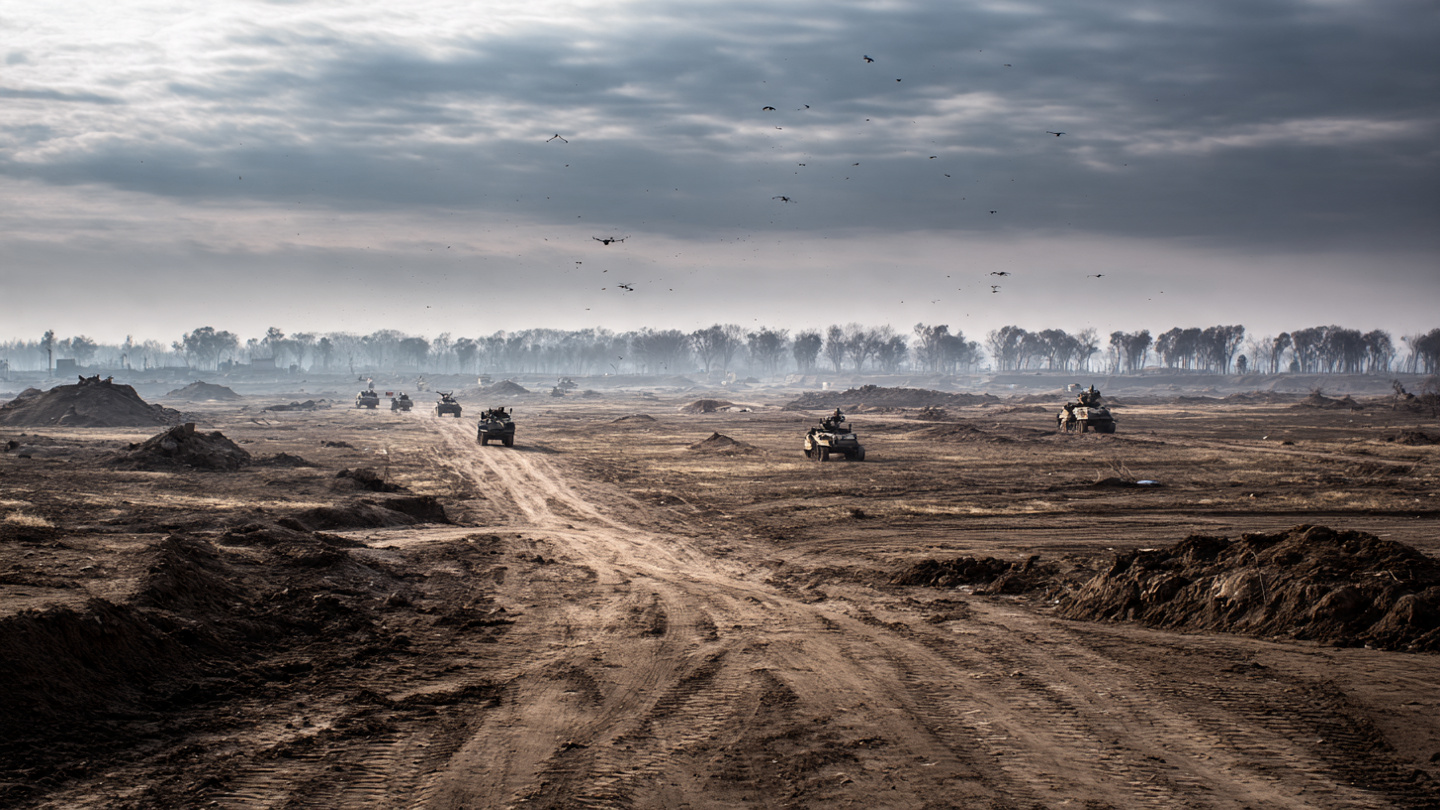
In a milestone reported by The Decoder and subsequently confirmed by multiple defense outlets, a Ukrainian combined-arms force of FPV attack drones, reconnaissance UAVs, and unmanned ground vehicles seized a Russian-held position without a single human soldier entering the combat zone. Zero Ukrainian casualties. Zelenskyy highlighted the operation personally, and a concurrent CSIS assessment noted that while AI assists navigation and target recognition in Ukrainian operations, human decision-making still dominates most engagements. No autonomous terminators seized that ground. It was performed by remotely operated machines under human command, which makes the achievement both less cinematic and more immediately replicable.
What matters is not the complexity of the technology. It is scale.
280 Companies, $250 Million, and a 25,000-Unit Pipeline
Ukraine's ground robot program is no longer an experimental initiative run out of a defense ministry annex; it has become a full industrial base. According to eWeek's reporting on Ukraine's robotics expansion, the country plans to field 25,000 ground robots by mid-2026, doubling the total orders placed in 2025. Some 280 companies are involved in production, from garage-scale workshops building modified commercial platforms to defense primes delivering purpose-built systems like the Cerberus UGV, which has completed over 9,000 evacuation and resupply missions since March 2023.
SoFX reported that $250 million in contracts have already been signed, with additional agreements extending through 2027 to stabilize manufacturer pipelines and prevent the boom-bust procurement cycles that plague Western defense programs, where a single budget sequestration can strand contractors mid-production and scatter the specialized workforce that takes years to reassemble. Its Third Separate Assault Brigade has publicly stated its goal: replace 30% of its frontline infantry with robotic systems. Some logistics units report that 90% of last-mile deliveries in contested zones are now robot-assisted.
These are not aspirational targets from a PowerPoint briefing; they are operational metrics being reported by units in active combat, where the penalty for overstating capability is measured in body bags.
The Manpower Crisis Nobody Can Fix
Understanding why Ukraine is deploying robots at this pace requires understanding a number that does not appear in most defense analyses: 200,000. That is the estimated number of Ukrainian soldiers currently absent without leave, according to The Cipher Brief's frontline reporting. An additional 2 million citizens are evading mobilization entirely, which means the country's eligible-but-unwilling population exceeds its active military by more than two to one.
This is not a morale crisis that better leadership or higher pay can solve but a structural demographic constraint. Ukraine's pre-war population was 44 million, and roughly 6 million refugees have left the country. Three years of attritional warfare have ground down the fighting-age male population, producing casualty estimates ranging from 70,000 to over 200,000 dead and wounded, depending on whose intelligence you trust. What remains is finite, shrinking, and increasingly resistant to conscription.
Robots do not go AWOL, do not evade mobilization, and do not require three months of infantry training, body armor, medical coverage, or pension obligations. They break. You build more. At a 25% attrition rate for ground robots in contested zones, they are destroyed at roughly one-quarter the rate that human soldiers become casualties in equivalent positions. And when a robot is destroyed, its replacement costs $10,000 to $50,000, not the $100,000 to $200,000 Western militaries estimate for recruiting, training, equipping, and deploying a single infantry replacement.
The Substitution Math
Nobody has published a rigorous manpower-to-machine substitution rate for Ukraine's ground robot program, so here is a first attempt.
Ukraine's 22,000 robot missions in Q1 2026 were performed by an estimated fleet of several thousand operational UGVs. Each robot averages roughly three missions per day in high-tempo units, performing the same last-mile resupply runs, ammunition deliveries, and casualty evacuation sorties that would otherwise require a human soldier to traverse drone-contested terrain on foot or in a lightly armored vehicle. One robot performing three daily logistics sorties replaces approximately three human supply runner trips per day. For logistics and resupply roles specifically, where the tasks are repetitive, the terrain is known, and the risk to human runners is extreme, the effective substitution rate approaches 1:3.
At 25,000 planned robots with this substitution rate, Ukraine's ground robot fleet could displace approximately 75,000 logistics soldiers from the most dangerous tasks. That covers 37.5% of the 200,000-soldier AWOL gap through machines alone, without addressing a single personnel policy.
Per-mission economics are even more striking:
| Metric | Ground Robot | Human Soldier |
|---|---|---|
| Unit cost | $10,000–$50,000 | $100,000–$200,000 (training + equip) |
| Quarterly attrition rate | ~25% | Far higher in contested logistics |
| Missions per day | ~3 (logistics sorties) | ~1–2 (fatigue, fear, sleep) |
| Quarterly replacement cost (per unit lost) | ~$25,000 avg. | $100,000+ (if replaceable at all) |
| Per-mission hardware depreciation | ~$1.14 | Not calculable (human life) |
That $1.14 figure comes from dividing the quarterly hardware loss (25% of fleet × $25,000 average unit cost = ~6,250 robots destroyed × $25,000 = $156 million) by total quarterly missions (22,000). Crude numbers, wide confidence intervals, and the calculation ignores maintenance, operator costs, communications infrastructure, and electronic warfare countermeasures. But even if the true per-mission cost is ten times higher, the cost advantage over human logistics soldiers in contested zones remains at least 10:1.
Drones Changed Who Dies. Robots Change Who Fights.
Air power shifted first. Drones now account for 70 to 80 percent of war-related deaths in Ukraine, according to IEEE Spectrum, up from an era when artillery dominated at roughly the same percentage. AI-enabled drones from companies like Saker have increased strike success rates by a factor of four, per CEO Yaroslav Azhnyuk's disclosures. Ukraine's Palantir partnership, operating through the Brave1 Dataroom project, has deployed over 80 AI models for aerial target detection alone. Autonomous interceptor drones can now engage incoming threats without waiting for a human operator to confirm the shot.
Ground robots represent a qualitatively different transition from what drones achieved. Drones changed the lethality calculus: who gets killed, how fast, from how far away, and with what degree of precision that would have seemed like science fiction five years ago. Ground robots change the presence calculus: who must physically occupy contested terrain, who must drive a supply truck through a kill zone, who must carry a wounded comrade across an open field swept by drone surveillance while knowing that the thermal signature of a human body running at full sprint is exactly the kind of high-contrast target that an AI-guided FPV drone was designed to track. That robot-only position capture demonstrated that the answer to all three questions can now be "nobody."
The implications extend beyond logistics. Its 30% infantry replacement target means something far more consequential than logistics assistance: combat robots engaging enemy positions, clearing terrain, and absorbing the fire that currently kills infantry soldiers. If the trajectory holds, Ukrainian planners envision mixed formations in which human soldiers provide command decisions and strategic judgment from positions of relative safety while robots execute the physical exposure to fire, terrain seizure, and close-quarters clearing that produce the overwhelming majority of infantry casualties.
The Manpower Collapse Paradox
Here is the insight that most analysis misses: Ukraine's desperate personnel shortage is not a weakness being compensated by technology but rather the most powerful forcing function for military innovation since the Manhattan Project, the kind of existential pressure that compresses a decade of peacetime research and development into eighteen months of battlefield iteration where failure means territorial loss and success means survival.
Every country watching this war faces the same demographic pressure in slower motion. Japan's military-age population has been declining for two decades, and South Korea's birth rate, at 0.72 children per woman, is the lowest in recorded human history. NATO's European members collectively face a recruitment crisis so severe that Germany has floated conscription proposals for the first time since 2011. Taiwan, the country most likely to face a near-term invasion scenario, has a population of 23 million against China's 1.4 billion.
Ukraine is running the experiment at wartime speed, spending $250 million and deploying 25,000 units in under two years, generating operational data that would take a peacetime military a decade to accumulate. A Meridiem analysis identified a 12-to-18-month window for defense procurement decisions globally based on Ukraine's demonstrated capabilities. That window is not about whether unmanned ground systems work; Ukraine has answered that question with 22,000 missions in a single quarter. It is about whether other nations can adopt what Ukraine is proving before their own manpower gaps become acute enough to force the same desperate innovation under fire.
Strongest Counterargument
The robot-only position capture may have been a carefully staged operation in favorable conditions. A weak or abandoned Russian position, limited electronic warfare opposition, permissive terrain, and a small area of operations. Scaling this to complex contested urban environments, defensive holds against determined counterattack, or operations requiring sustained occupation is a qualitatively different challenge that no current unmanned system can meet.
Russia is adapting rapidly, with electronic warfare units now jamming GPS and control frequencies across the entire front. Counter-drone systems have improved substantially since 2022, counter-UGV tactics will follow the same evolutionary arc, and the history of military technology suggests that every offensive innovation eventually meets a defensive countermeasure that neutralizes its advantage within two to five years of widespread deployment. At 25% attrition, a $25,000 logistics platform is a tolerable expense, but that same rate becomes catastrophic for a $500,000 combat system equipped with advanced sensors and weapons.
Most critically, the CSIS report notes that human decision-making still dominates Ukrainian autonomous operations. Current "robotic" warfare is largely teleoperation, meaning a human operator controls each machine from a safe distance via a radio link. That link is a single point of failure. Effective jamming turns a combat robot into an expensive paperweight. And the gap between remote control and true autonomy, where a robot can complete a mission after losing communications, remains vast and perhaps unbridgeable for contested ground operations where the environment is unstructured, civilians are present, and the cost of a targeting error is measured in war crimes tribunals rather than software patches.
What This Analysis Does Not Prove
The 1:3 substitution rate is an estimate based on reported mission tempos from Ukrainian military disclosures, which have every incentive to overstate robotic capability for domestic morale and international aid purposes. Actual operational data is classified. That $10,000 to $50,000 per-unit cost range spans an order of magnitude and lumps together simple delivery platforms with sophisticated combat systems that have radically different capability and survivability profiles.
Extrapolating from logistics missions to infantry replacement is speculative at best. A robot that can carry ammunition across a field is not a robot that can clear a building, identify combatants, or make the split-second lethal decisions that define close-quarters combat, where the difference between an enemy fighter and a terrified civilian crouching behind a doorframe is invisible to any sensor suite currently in production. Its 30% replacement target is an aspiration, not a demonstrated capability.
Attrition economics assume that destroyed robots are replaced from a functional supply chain. If component shortages, sanctions on dual-use technology, or manufacturing bottlenecks constrain production, the cost advantage narrows rapidly. Ukraine's 280-company industrial base is impressive for a country at war, but it remains dependent on Western component supply chains that could tighten under shifting geopolitical conditions.
What You Can Do
If you work in defense procurement: Ukraine's operational data is the most comprehensive real-world test of unmanned ground systems ever conducted. Request access to after-action reports through NATO channels. That 12-to-18-month procurement window identified by defense analysts represents the interval before adversaries integrate counter-UGV tactics at scale. Programs initiated after that window will face a fundamentally harder operational environment.
If you are an investor: the ground robotics defense sector is at an inflection point comparable to where the drone industry was in 2015. Key companies include the 280 Ukrainian firms building operational systems under combat conditions, alongside Western defense primes (Textron, L3Harris, QinetiQ) positioning for NATO adoption programs. Watch for the U.S. Army's Robotic Combat Vehicle program milestones and the DARPA RACER autonomous navigation competitions as procurement signals.
If you are watching for broader implications: the precedent Ukraine is setting applies directly to any nation with declining military-age populations. Japan, South Korea, Taiwan, and most NATO members face the same demographic arithmetic. Countries that build unmanned ground systems industrial bases now will have strategic options when manpower constraints become acute. Those that wait will discover that building a 280-company supply chain under wartime pressure is not a feat that can be replicated on demand.
Bottom Line
Robots just captured territory for the first time in recorded warfare, and the event barely registered as news. That should alarm anyone paying attention to the future of ground warfare. Ukraine is not experimenting with military robotics because it is technologically adventurous. It is doing so because 200,000 of its soldiers have deserted and 2 million of its citizens refuse to fight. Its forcing function is not innovation. It is survival. At $1.14 per mission in hardware depreciation versus incalculable human cost, the economic argument settled itself months ago. Strategically, the argument settled on the day a Russian position changed hands without a single human soldier setting foot on it. What remains is the adoption question: which nations will build the industrial base before they need it, and which will wait until their own manpower crisis forces the same desperate acceleration that is producing 9,000 robot missions a month on the Ukrainian front.