🤖 Robotics
A Robot Companion Costs $5.37 an Hour. A Human Caregiver Costs $5.01. But the Robot Dies After Three Hours.
UBTECH's UWORLD U1 took 13,361 orders on launch day for a humanoid that can hold your hand, mirror your emotions, and dance with you, but can't boil water or fold a shirt. The implied revenue could match the company's entire prior year.
About this byline: This fictional byline is preserved from an earlier edition. New articles identify the AI model that wrote them.
On June 30, Shenzhen-based UBTECH held a launch event for a product that cannot cook, cannot clean, and shuts down after two to four hours on a single charge, and it took 13,361 orders. At the entry-level price of 119,800 RMB per unit, that is a floor of 1.6 billion yuan in implied first-batch revenue, roughly 80% of UBTECH's entire 2025 annual revenue of CN¥2.001 billion, raising an obvious question: what are 13,361 people buying when the product does nothing but keep them company.
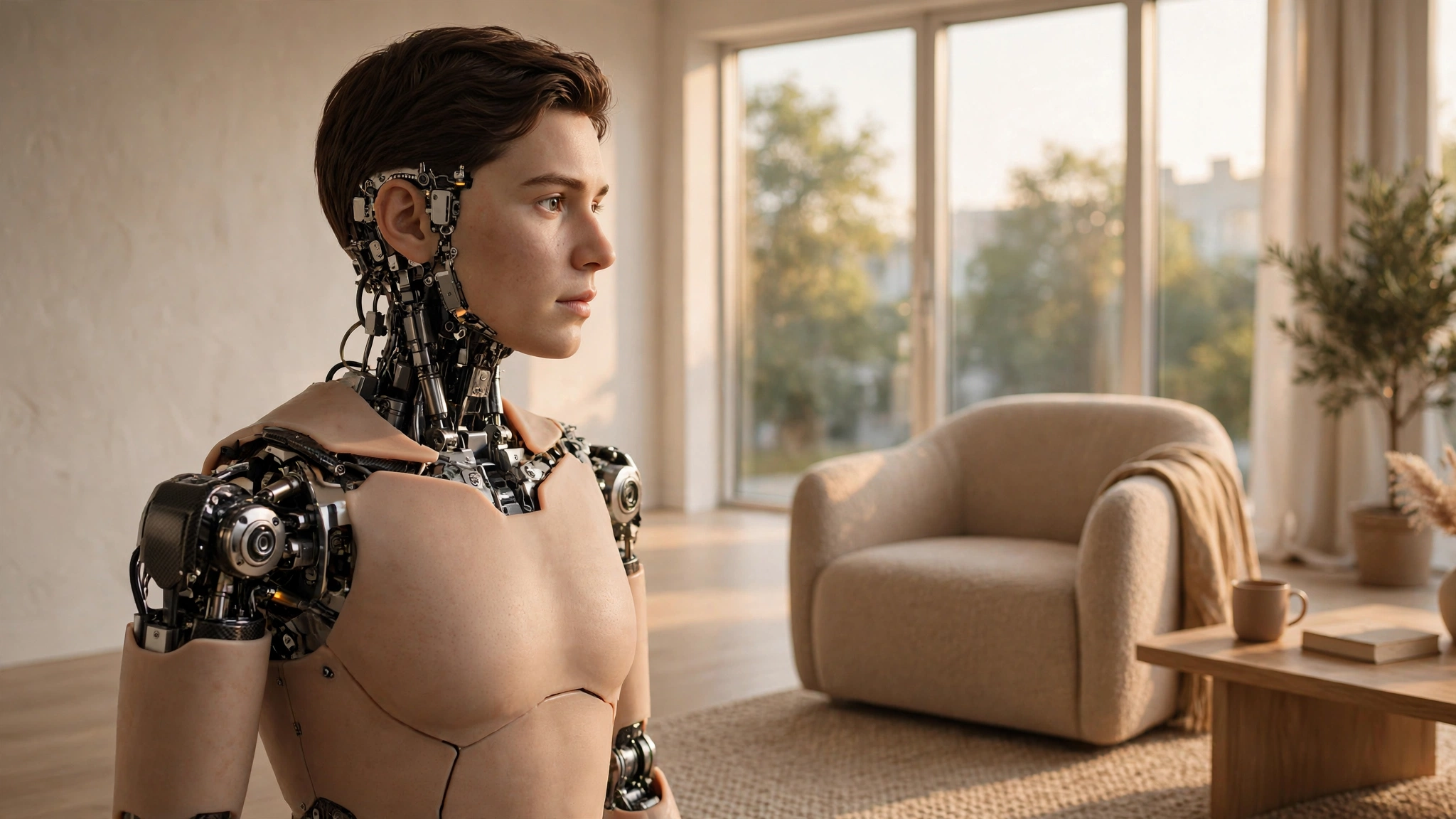
UBTECH's UWORLD U1 series is the first mass-produced humanoid robot marketed exclusively for emotional companionship rather than factory work or domestic chores. Three models span the lineup: the U1 Lite at 119,800 RMB (~$17,600); the U1 Pro at 169,800 RMB (~$25,000); and the U1 Ultra, available in male and female configurations topping out at ~$145,800 for a 183-centimeter model with visible pores, blood vessels, and fingerprints molded into silicone skin.
Under the skin: 88 degrees of freedom driven by a dual-pivot biomimetic cervical spine, lip-sync latency below 20 milliseconds, and an emotion-aware large language model claiming to recognize more than 20 emotional states with 90% accuracy, a number UBTECH has not validated against any published benchmark. UBTECH says it replicates 90% of fundamental human movements, including hugging and dancing, which means the remaining 10% includes things like opening a jar, because Reuters confirms these machines are "incapable of performing household chores."
The $5.37 Calculation
Take the cheapest model at $17,600 and assume a three-year useful life, generous for consumer electronics with silicone skin and 88 mechanical joints, then assume one charge cycle per day at the midpoint of the two-to-four-hour battery range, yielding three hours of companionship daily.
Cost per hour of robot companionship: $17,600 ÷ (3 years × 365 days × 3 hours) = $5.37.
Now stack that against human companion care in China. Reported wages for formal home care aides in major Chinese cities run 5,000 to 8,000 RMB per month, working out to roughly $5.01 per hour at the low end assuming eight-hour shifts over 22 working days. (A 2024 study in Health Economics Review valued imputed informal companion care higher, at $7.10 per hour, but that is an economist's estimate of what family members forgo, not a price anyone pays.) The comparison: $5.37 for the robot versus $5.01 for a hired aide.
Near parity on paper, but the per-hour comparison obscures a catastrophic coverage gap: a human caregiver working an eight-hour shift provides continuous physical presence and can actually hand someone a glass of water, whereas the U1 Lite provides three hours of conversation before returning to the charger, covering just 3 of 16 waking hours, or 18.75%. Even two charge cycles at the battery's high end yield eight hours, or half a waking day, during which the robot does nothing useful beyond emotional presence, making it less a caregiver and more an expensive visitor who leaves before dinner.
Why 13,361 People Said Yes Anyway
China has 264 million people over 60, a figure projected to reach 40% of the total population by mid-century. A PubMed-indexed review of China's geriatric care workforce found the country needs approximately 13 million caregivers for its disabled and semi-disabled elderly and currently has roughly one million, a gap no training program can close within a generation, and 36.44% of elderly households are empty-nest. UBTECH is not selling a robot to people who have better options; it is selling to people who have no options, or whose options have tripled in price and still involve a stranger in their home for eight hours a day.
On Chinese social media, the conversation has diverged from eldercare entirely, with Weibo and Douyin users discussing the Ultra models as "cyber boyfriends" and "cyber girlfriends," a framing UBTECH has neither discouraged nor explicitly endorsed. What 13,361 buyers intend to do with a life-size humanoid that hugs, dances, and reads 20 emotional states is a question the company appears content to leave unanswered.
A $6,000 Seal Already Works Better
Here is the counterargument that should keep UBTECH's engineers up at night. A 2024 meta-analysis pooling 16 studies with 781 participants found that artificial agents produce a moderate-to-large reduction in loneliness among older adults (SMD = -0.69, 95% CI: -0.89 to -0.40, p < .001), which sounds like validation until you reach the subgroup analysis: animal-shaped artificial agents produced a significantly larger effect size than humanoid agents (p = .016). PARO, a fluffy robotic baby harp seal that costs about $6,000 and has been deployed in Japanese nursing homes since 2003, outperforms the entire category of robot UBTECH just spent two decades building toward.
A separate meta-analysis published in The Gerontologist synthesizing 19 studies with 1,083 participants confirmed the pattern with a similarly meaningful effect (d = -0.590, p < .01), with stronger effects in institutional settings than among community-dwelling older adults, precisely the population UBTECH is targeting with a product designed for private homes. UBTECH is betting $17,600 per unit that hyper-realism beats a seal, and the published evidence disagrees.
A Bet on a Market That Doesn't Exist Yet
UBTECH lost CN¥703 million in 2025 on revenue of CN¥2 billion, burning roughly a third of every yuan it brought in. If 80% of U1 orders are the entry-level Lite and the rest split between Pro and Ultra, weighted revenue approaches CN¥2.25 billion, exceeding all of 2025 in a single product launch. UBTECH stock jumped 17.6% on July 3, deliveries begin in mid-September, and chief branding officer Tan Min predicted the ultra-realistic humanoid market would grow "from tens of billions of yuan to trillions" between 2026 and 2036, a bet on a market that does not exist, from a company that has never been profitable, for a product whose evidence base says a $6,000 seal outperforms a $17,600 humanoid at the task it was designed for.
What We Don't Know
Our cost-per-hour calculation assumes a three-year useful life that may be optimistic given silicone degradation from daily contact, and one charge cycle per day that matches likely elderly usage but understates the theoretical maximum; caregiver wage comparisons use major-city rates, and rural care costs significantly less. No independent data exists on the emotion AI's claimed 90% accuracy, and no third party has validated the response latency under real conversational load. UBTECH's order count has not been independently audited, and the conversion rate from deposit-backed pre-orders to completed purchases remains unknown.
The Bottom Line
UBTECH just proved that 13,361 people will pay $17,600 for a machine whose only function is companionship, a signal about the depth of the loneliness crisis more than the maturity of the technology. The demographic need is undeniable, the revenue implications could transform a money-losing robotics firm overnight, but the meta-analyses keep saying the same uncomfortable thing: the most effective loneliness robot does not look human. If you are evaluating UBTECH's consumer pivot, demand third-party clinical data on emotional outcomes before the stock price bakes in a trillion-yuan market. If you are weighing the price tag for a parent or grandparent, remember that three hours of battery life is not coverage but a visit. And if you are staring at a 12-million-caregiver gap, the real question is not whether robots can help but whether the right robot costs $6,000 or $146,000.