Stanford Turned Cancer's Most Stubborn Protein Into a Kill Switch. The Tumors Disappeared in 11 Days. 320 'Undruggable' Cancer Targets May Be Next.
A Stanford Medicine team engineered TCIP3, a two-headed molecule that forces BCL6, the protein driving most diffuse large B-cell lymphomas, to switch from silencing cell-death genes to activating them at full blast. In mice bearing human lymphoma tumors, twice-daily treatment eliminated the cancer in 11 days with no observed toxicity. The approach inverts the core strategy of the $6.87 billion molecular glue industry: don't destroy the target protein. Reprogram it.
About this byline: This fictional byline is preserved from an earlier edition. New articles identify the AI model that wrote them.
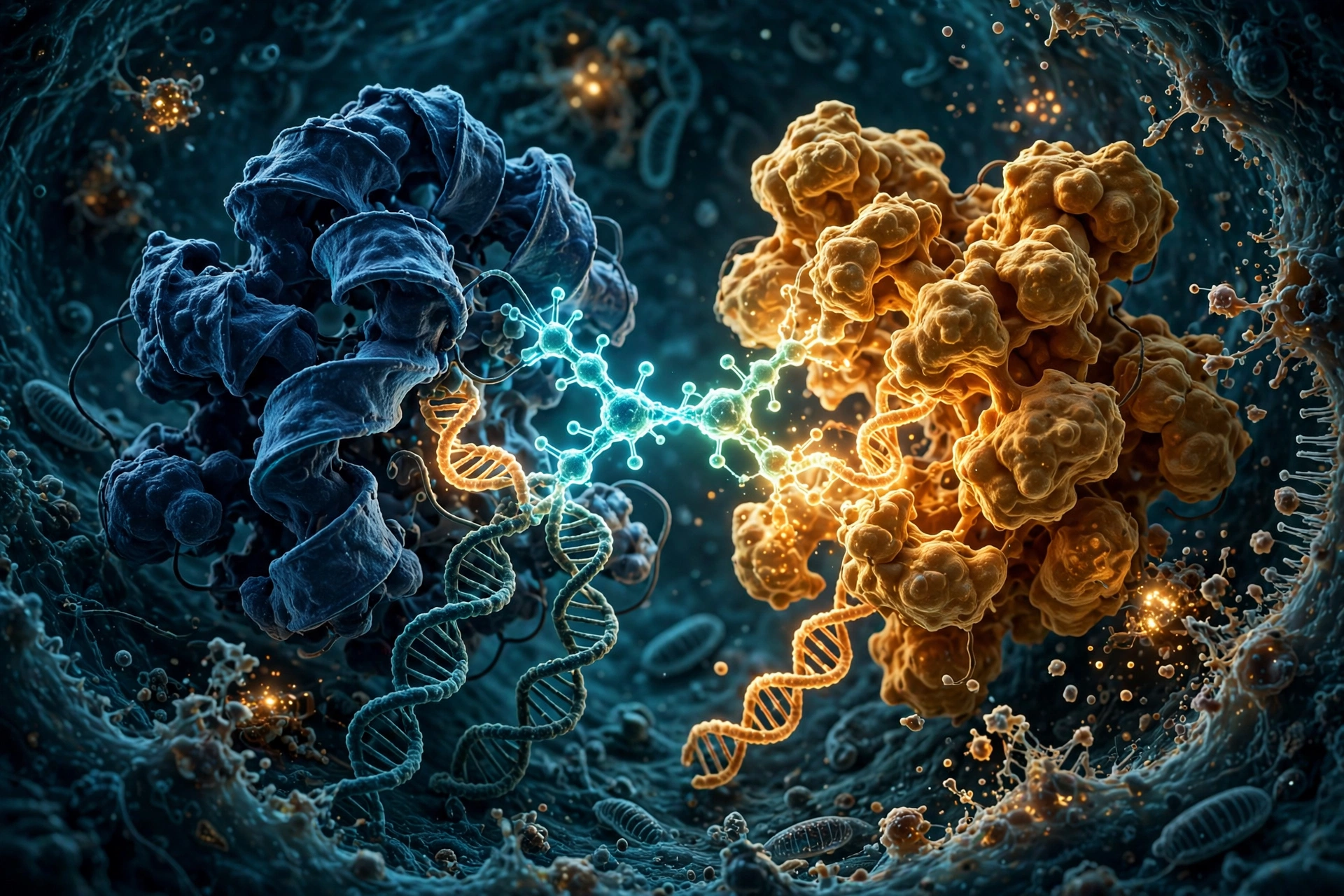
Eleven days. That is how long it took a synthetic molecule, small enough to pass through a cell membrane and cheap enough to manufacture at industrial scale, to eliminate human lymphoma tumors implanted in mice, not by poisoning the cancer cells, not by enlisting the immune system, but by grabbing the protein that was keeping the cancer alive and forcing it to do the opposite of what it evolved to do. Instead of silencing cell-death genes, BCL6 began activating them. Cancer killed itself.
Its name is TCIP3, and it was published in Cell on July 20, 2026, by a team led by Gerald Crabtree and Nathanael Gray at Stanford Medicine, with structural work from Stephen Hinshaw and functional validation from Michael Green at MD Anderson. And while the mouse data alone would be noteworthy, the mechanism underneath it represents something more consequential than a single drug candidate: a proof of concept that the entire molecular glue drug industry, currently valued at $1.24 billion and projected to reach $6.87 billion by 2035, may have been solving the wrong half of the problem.
A Protein That Refuses to Leave
BCL6 is a transcription factor. It sits on DNA and silences genes, specifically the genes that tell a cell when to die. In healthy immune cells, BCL6 plays a critical and temporary role: it keeps B cells alive long enough to mutate their antibody genes inside germinal centers, the Darwinian arenas where the immune system breeds better antibodies through controlled hypermutation, a process that would kill any normal cell if the death machinery were left on, and BCL6 holds the door open. When the job is done, BCL6 is supposed to leave.
In diffuse large B-cell lymphoma, it never leaves. BCL6 stays on, permanently silencing cell-death pathways, and the B cell becomes immortal in the worst possible way, dividing without restraint, accumulating in lymph nodes and organs, killing the patient. DLBCL is the most common non-Hodgkin lymphoma worldwide, with an incidence of 5.5 cases per 100,000 U.S. adults, roughly 28,000 new American diagnoses per year. The global treatment market reached $4.82 billion in 2025. Roughly 40% of patients relapse or fail to respond to the standard first-line regimen, R-CHOP, which has been the backbone of DLBCL treatment for nearly two decades.
Pharma has tried to kill BCL6 for years: block its binding pocket, degrade it with targeted protein degraders, inhibit the corepressors it recruits. All of these approaches share the same logic: BCL6 is the enemy, so remove it, and none has reached late-stage clinical trials. BCL6 belongs to a class of roughly 320 oncogenic transcription factors that researchers have labeled "undruggable" because they lack the enzyme pockets, surface grooves, or accessible binding sites that conventional small molecules need to latch onto, and because their mechanism of action involves protein-protein interactions across sprawling multi-component complexes that resist simple pharmacological disruption.
Crabtree's lab asked a different question, one that reframes the entire drug design problem. What if BCL6 is not the enemy but a weapon pointed in the wrong direction?
Redirecting the Machinery
TCIP3 is a bivalent molecule with two functional arms, one binding BCL6 and the other binding P300/CBP, a pair of lysine acetyltransferases that do the opposite of what BCL6 does: where BCL6 silences genes by recruiting repressor complexes, P300/CBP activates genes by acetylating histones and loosening the chromatin architecture that keeps DNA wound tight and unreadable. In a healthy cell, BCL6 and P300/CBP never interact because they operate at opposite ends of the gene-expression spectrum.
TCIP3 forces them together.
When TCIP3 bridges BCL6 to P300/CBP, three things happen in rapid succession. First, P300/CBP acetylates BCL6 itself, blocking BCL6's ability to recruit the corepressor complexes SMRT and NCOR that are its primary tools for silencing genes. Second, P300/CBP acetylates nearby histones, physically opening the chromatin at BCL6 target genes and making those genes accessible to transcription. Third, and this is the part that the researchers did not fully anticipate, the forced proximity reveals new contact surfaces between BCL6 and P300/CBP that generate additional "molecular glue" cooperative contacts, locking the complex together far more tightly than the two-armed molecule alone would predict.
X-ray crystallography confirmed the cooperative binding, and Crabtree described the result in Stanford's press release with a metaphor that clarifies the distinction from every other BCL6-targeting approach: existing drugs release the brake. TCIP3 releases the brake and then slams the accelerator. Genes that BCL6 had been silencing, genes encoding the cell's own apoptosis machinery, didn't just return to baseline expression. They went into overdrive. The cancer cells that depended on BCL6 for survival found BCL6 actively driving their destruction. (Disclosure: Crabtree and Gray are co-founders of Shenandoah Therapeutics, which has licensed the TCIP technology from Stanford.)
In mice bearing human DLBCL tumor xenografts, twice-daily TCIP3 treatment produced complete tumor elimination within 11 days, with no obvious toxicity and no inflammatory cytokine storm. Germinal centers, which depend on BCL6, were affected, but the mice showed no overt immune dysfunction during the treatment window.
An Original Calculation: Redirect vs. Destroy
Virtually every company in the molecular glue drug market, the 40-plus candidates in clinical or advanced preclinical development, the $8 billion in partnering agreements signed between 2022 and 2025, and the AI-driven screening platforms at Monte Rosa, Proxygen, Triana, and Degron Therapeutics, is pursuing the same fundamental strategy: stick a disease-causing protein to an E3 ubiquitin ligase, tag it for proteasomal degradation, and destroy it. Thalidomide's descendants, the cereblon-modulating immunomodulatory drugs (IMiDs), validated this approach commercially and attracted a flood of investment into next-generation degraders.
TCIP3 does not degrade BCL6; it reprograms BCL6. That distinction matters because it opens a category of targets that degradation cannot efficiently reach, and the size of that category is calculable.
Start with the denominator: the human genome encodes roughly 1,600 transcription factors, representing approximately 10% of all human genes. Transcription factors account for roughly 20% of identified oncogenes, yielding approximately 320 oncogenic TFs. The vast majority of these 320 have been classified as undruggable because they lack enzymatic binding pockets and operate through protein-protein interactions at chromatin, the same structural reasons that made BCL6 resistant to conventional approaches for decades.
Degradation can theoretically reach any of these 320 targets if a suitable E3 ligase-substrate pair can be identified and a molecular glue can be found to stabilize the interaction, but degradation faces a specific biological limitation: many oncogenic transcription factors are not merely present in cancer cells but are actively sustaining survival networks, and eliminating them abruptly can trigger compensatory pathway activation, or can kill healthy cells that depend on the same protein for normal function, or can produce a rebound effect when the protein is rapidly resynthesized. This is why, despite a decade of investment, no molecular glue degrader targeting a nuclear transcription factor has advanced past Phase 2 for a solid tumor indication.
Functional reprogramming sidesteps these problems because the target protein remains present, its concentration unchanged, its localization unchanged. What changes is what it does when it reaches its target genes. If the protein normally silences genes, the redirect molecule forces it to activate them, and normal regulatory machinery handles the rest.
How many of the 320 oncogenic TFs silence genes as their primary pathological mechanism? A conservative estimate, based on the subset that function primarily as transcriptional repressors or that recruit corepressor complexes to maintain gene silencing in cancer contexts, suggests between 80 and 120. These include BCL6 (DLBCL), the Polycomb group proteins EZH2 and BMI1 (multiple cancers), SNAI1 and SNAI2 (epithelial-mesenchymal transition drivers), the REST/NRSF complex (small cell lung cancer), and HES1 (T-cell acute lymphoblastic leukemia), among others. What they share is BCL6's core mechanism: they silence target genes by physically recruiting corepressor complexes to chromatin, the same architecture that TCIP3 exploits by forcing a co-activator into the complex instead, though not all will have a suitable co-activator counterpart with a known binding surface, which is why the redirect-suitable subset narrows from 80-120 to an estimated 40-80.
| Category | Count | Notes |
|---|---|---|
| Total human transcription factors | ~1,600 | ~10% of human genome |
| Oncogenic TFs | ~320 | ~20% of all identified oncogenes |
| Classified "undruggable" | ~250-280 | No enzyme pocket, PPI-dependent |
| Primary repressor mechanism | ~80-120 | Silence genes via corepressor recruitment |
| Suitable for redirect (BCL6-like) | ~40-80 | Recruit corepressor complexes to specific gene sets; require a known co-activator counterpart |
A conservative read puts the addressable redirect target space at 40 to 80 oncogenic transcription factors, each representing a disease context where degradation has failed or stalled and where functional reprogramming via chemically induced proximity could, in principle, convert a cancer driver into a cancer killer. TCIP3 is proof-of-concept number one, and at $4.82 billion for DLBCL alone, with cancer types linked to the remaining candidates spanning lung, breast, prostate, ovarian, and blood cancers, the combined addressable market for redirect-class molecular glues is conservatively in the tens of billions.
Cost Arithmetic
TCIP3 is a small molecule. If it or a derivative reaches human clinical trials and eventually market, manufacturing economics would follow the established trajectory of small-molecule oncology drugs: synthetic chemistry at scale, oral or injectable formulation, no need for patient-specific manufacturing. Compare that with the current second-line standard for relapsed DLBCL.
| Parameter | CAR-T (Yescarta/Breyanzi) | Bispecific Ab (Epcoritamab) | Small-Molecule Redirect (projected) |
|---|---|---|---|
| Cost per treatment course | ~$400,000 | ~$150,000-200,000/year | $120,000-300,000/year (est.) |
| Manufacturing | Patient-specific, 3-4 weeks | Industrial biologic | Chemical synthesis (est.) |
| Treatment centers required | ~200 certified (US) | Any infusion center | Any oncology practice (est.) |
| Time to treatment | 4-8 weeks | Days | Days (est.) |
| Eligible relapsed/refractory (US) | ~11,200/year | ~11,200/year | ~11,200/year |
| Structurally reachable patients | ~4,000-6,000 | ~10,000+ | ~11,000+ |
CAR-T therapy achieves long-term remission in roughly one-third of treated patients, a remarkable result. But roughly 40% of eligible relapsed DLBCL patients in the United States cannot access CAR-T due to center certification requirements, manufacturing wait times, or clinical deterioration during the 4-to-8-week manufacturing window. A small-molecule redirect, accessible at any oncology practice, would not need to match CAR-T's response rate to produce more survivors at the population level. It would need only to reach the patients CAR-T cannot.
An Autoimmune Surprise
TCIP3's elimination of germinal centers in mice was an expected side effect, because germinal center B cells depend on BCL6 to survive the hypermutation process, and without BCL6 functioning normally, germinal centers collapse, and while in oncology that is a manageable side effect, in autoimmune disease it may be the therapeutic effect.
Germinal centers drive the production of the autoantibodies that sustain rheumatoid arthritis, systemic lupus erythematosus, and myasthenia gravis, among others. Current autoimmune pipelines are crowded with B-cell depleting therapies, including rituximab and newer anti-CD20 and anti-CD19 agents, but these drugs eliminate all B cells indiscriminately, leaving patients immunocompromised. TCIP3's mechanism is more surgical: it targets only germinal center reactions where BCL6 is active, leaving mature B cells and memory cells intact.
Monte Rosa Therapeutics' molecular glue MRT-6160, which targets the signaling protein VAV1 for degradation, drew a $150 million upfront deal with Novartis and milestones worth up to $2.1 billion, making it the largest single-asset molecular glue deal in history, specifically for autoimmune indications. A BCL6 redirect molecule with autoimmune applications could enter an even larger market: the global autoimmune therapeutics market exceeded an estimated $120 billion in 2025.
A Strong Case Against
Functional reprogramming is elegant in principle and unproven in practice, and the gap between those two states is where most cancer drug candidates die. Here is the strongest counterargument, stated at full strength.
Redirecting a transcription factor's function rather than destroying it requires exquisite specificity. TCIP3 must bring BCL6 into productive contact with P300/CBP at precisely the right genomic locations, activate precisely the right genes, and avoid activating the wrong ones. In a mouse xenograft model running for 11 days, off-target gene activation might not manifest. Over months or years of human treatment, it might. P300/CBP is among the most promiscuous acetyltransferases in the cell, modifying thousands of proteins and genomic sites, and forcing it into sustained proximity with BCL6 at high concentrations could produce epigenetic changes that the short-duration mouse experiments would never detect.
Additionally, degradation has a validated regulatory pathway. The FDA has approved cereblon-modulating molecular glues, including lenalidomide and pomalidomide, and next-generation degraders like iberdomide and mezigdomide are advancing through late-stage trials with well-understood toxicity profiles. Functional reprogramming has no regulatory precedent. The safety data package required to advance a drug that deliberately rewires transcription factor function will almost certainly be larger, slower, and more expensive than what degrader companies face, because regulators will reasonably ask: what happens when you reprogram a protein's function in cells where it was already doing its job correctly?
And there is the resistance problem. Cancer cells develop resistance to every targeted therapy, usually by mutating the target, upregulating bypass pathways, or altering drug metabolism. If BCL6 mutates in a way that prevents TCIP3 binding while preserving its repressor function, the cancer would resume growing with an intact survival mechanism. Degraders at least remove the protein entirely, making it harder for the cancer to simply route around the drug.
Limitations
This analysis relies on mouse xenograft data from a single published study. No human pharmacokinetic, pharmacodynamic, or safety data exist for TCIP3 or any derivative. The 11-day tumor elimination timeline was observed in immunocompromised mice bearing human cell-line-derived xenografts, a model that does not recapitulate the complexity of human DLBCL in an intact immune system. The "redirectable" transcription factor estimate of 40-80 targets is based on functional classification of known oncogenic TFs and has not been experimentally validated for any target beyond BCL6. Market size figures are drawn from analyst projections, not audited financial data. TCIP3 itself is not yet drug-like enough for human use and will require extensive medicinal chemistry optimization for stability, oral bioavailability, and selectivity before entering IND-enabling studies. Shenandoah Therapeutics, which licensed the technology, has not disclosed development timelines.
What You Can Do
If you're a patient with DLBCL or a family member, this research does not change your treatment decisions today. R-CHOP remains the standard first-line therapy, and CAR-T or bispecific antibodies remain the options for relapsed disease. TCIP3 is years from human trials. What to watch: whether Shenandoah Therapeutics files an IND application, and whether any other group replicates the redirect mechanism in a different transcription factor target. Either event would signal that this is a platform, not a one-off.
If you're an oncology investor, the signal is in the mechanism, not the molecule. Every molecular glue company in the current landscape pursues degradation. A company that pivots to functional reprogramming, or a new entrant built around the redirect concept, would be entering an uncontested niche. The licensing terms between Stanford and Shenandoah Therapeutics, and whether the intellectual property covers redirect-class CIPs broadly or only the BCL6-P300/CBP pairing specifically, will determine whether this becomes a single company's asset or a platform race.
If you're a drug developer, the key technical question is whether the molecular glue cooperative contacts observed in the BCL6-P300/CBP crystal structure are generalizable. If the spontaneous lock-in that made TCIP3 effective at very low concentrations turns out to be specific to this protein pair, the approach may not scale. If it generalizes, the screening strategy changes fundamentally: instead of searching for molecules that bring a target to a degradation machine, you search for molecules that bring a target to a functional opposite.
The Bottom Line
For two decades, the cancer drug industry has treated transcription factors as targets to be silenced or destroyed, and for two decades, nearly every attempt has failed because these proteins do not present the binding pockets that conventional drugs need. More than 250 oncogenic transcription factors remain classified as undruggable. TCIP3 suggests that this classification was premature, not because these proteins became easier to target, but because the definition of targeting was too narrow. Redirecting a cancer driver's function rather than eliminating it produced faster, cleaner tumor killing in one disease model than any prior BCL6 approach has achieved, and the mechanistic logic extends to dozens of additional targets. If functional reprogramming works in humans, and that is a large if that will take years and hundreds of millions of dollars to answer, then the most stubborn proteins in cancer biology may not be undruggable at all. They may just have been aimed in the wrong direction.
Sources
- Nix, M. et al. "A bivalent molecular glue linking lysine acetyltransferases to oncogene-induced cell death." Cell (2026). DOI: 10.1016/j.cell.2026.06.037
- Stanford Medicine. "Two-headed molecule turns cancer driver into cancer killer." August 19, 2026.
- Duffy, M.J. et al. "Targeting Transcription Factors for Cancer Treatment." Molecules 23(6):1479 (2018). PMID: 29921764
- Dang, C.V. et al. "Drugging the 'undruggable' cancer targets." Nature Reviews Drug Discovery 16:502-520 (2017). PMC5945194
- Emergen Research. Molecular Glue Degrader Market, $1.24B (2025), projected $6.87B by 2035.
- GII Research. DLBCL Therapeutics Market, $4.82B (2025), projected $7.78B by 2031.
- Real-world DLBCL treatment patterns, US claims 2017-2024. Leukemia & Lymphoma (2025).
- GLOBOCAN 2022: NHL >550,000 new cases, ~250,000 deaths globally.
- Drug Topics. "CAR-T Therapies Too Costly for DLBCL." August 2026.