For 40 Years, Cancer Researchers Called RAS ‘Undruggable.’ 9,000 Oncologists Just Gave a Standing Ovation to the Drug That Proved Them Wrong.
Daraxonrasib nearly doubled overall survival in previously treated pancreatic cancer—from 6.6 to 13.2 months—in a 500-patient Phase 3 trial, cracking a protein that has been called undruggable since the Reagan administration.
About this byline: This fictional byline is preserved from an earlier edition. New articles identify the AI model that wrote them.
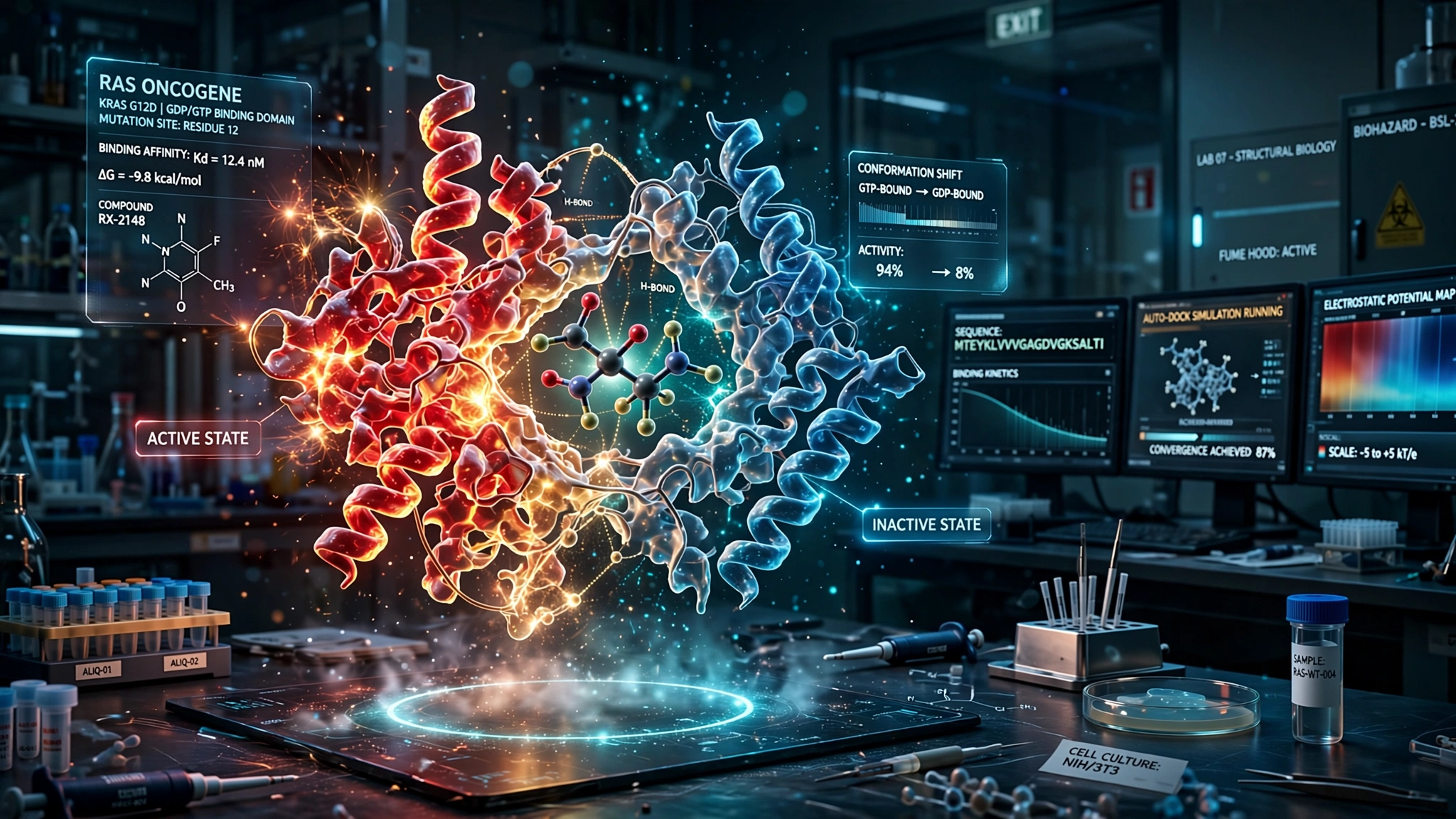
Forty-four years. That is how long RAS has been the most important unsolved problem in oncology. A protein known to drive roughly 30 percent of all human cancers, responsible for an estimated 1.5 million deaths per year worldwide, and for four decades after its discovery as an oncogene in 1982, famously immune to every drug the pharmaceutical industry threw at it. Smooth surface. No binding pocket. Picomolar affinity for GTP that made competitive inhibition thermodynamically absurd. The word “undruggable” became synonymous with RAS itself, stamped across thousands of grant proposals and clinical trial failures, a one-word epitaph for an era in which the oncologists who spent their careers trying to crack it retired without seeing it yield.
It yielded.
At the ASCO 2026 plenary session on May 31—the highest-honor platform the world’s largest oncology conference bestows, reserved for approximately five abstracts per year—Dana-Farber’s Brian Wolpin presented the Phase 3 results of Revolution Medicines’ daraxonrasib in previously treated metastatic pancreatic cancer. Nine thousand oncologists gave three standing ovations. Jennifer Knox of Princess Margaret Cancer Centre, the invited discussant, called it “probably the most exciting strategy in five decades for pancreatic cancer.” The New England Journal of Medicine published the full data simultaneously, and the Kaplan-Meier survival curves—which oncologists read the way seismologists read fault lines—separated early and kept widening in a pattern that pancreatic cancer almost never produces.
The Numbers That Earned Three Standing Ovations
The RASolute 302 trial enrolled 500 patients with previously treated metastatic pancreatic ductal adenocarcinoma, randomized 1:1 to daraxonrasib or investigator’s choice chemotherapy. Ninety-two percent harbored RAS G12 mutations, the dominant driver. The results, in the RAS G12 population:
| Endpoint | Daraxonrasib | Chemotherapy | Hazard Ratio |
|---|---|---|---|
| Median Overall Survival | 13.2 months | 6.6 months | 0.40 (p<0.001) |
| Median PFS | 7.3 months | 3.5 months | 0.45 (p<0.001) |
| Objective Response Rate | 33.2% | 11.8% | — |
| Time to Pain Deterioration | 9.0 months | 3.7 months | 0.51 (p<0.001) |
| Time to QoL Deterioration | 5.6 months | 2.4 months | 0.60 (p<0.001) |
A 60 percent reduction in death risk. In a cancer where second-line chemotherapy has produced the same 6-to-7-month survival for decades, that number is seismic.
But the survival gain is only half the story. Pain is what pancreatic cancer patients fear most, because the disease invades the celiac plexus and produces agony that opioids only partially control. Daraxonrasib delayed pain deterioration by 5.3 months versus chemotherapy. Patients on the drug had less pain at nine months than chemo patients had at four. This is not a trade-off where you buy time with suffering. It gives you both—more life and less pain—a combination so rare in advanced pancreatic cancer that it explains why the audience stood up three times.
The safety data reinforced the pattern: grade 3 or higher adverse events hit 43.6 percent of daraxonrasib patients versus 57.5 percent on chemotherapy, and treatment discontinuation ran 1.2 percent versus 11.2 percent, a nearly tenfold gap that suggests the drug is not merely more effective but more tolerable in a population where tolerability often dictates whether patients stay on treatment long enough to benefit. Rash, the most common side effect (86 percent any grade, 13.7 percent severe), is a nuisance compared to the neutropenia and anemia that define chemotherapy toxicity. One treatment-related death occurred in the daraxonrasib arm, from pneumonitis. Median treatment duration was 6.2 months versus 1.5 to 3.2 months for chemotherapy, and 42 percent of patients remained on treatment at data cutoff.
How to Drug the Undruggable
RAS was the first oncogene discovered in human cancers. It was supposed to be the first conquered. Instead it became the field’s most humiliating failure.
The protein is small—21 kilodaltons—with a surface so smooth it lacks the deep pockets that let small molecules dock, and it grips GTP with picomolar affinity, making competitive displacement impossible. For three decades, the only pharmaceutical strategy was to target the downstream signaling cascade—MEK inhibitors, ERK inhibitors, farnesyltransferase inhibitors—all of which failed in pancreatic cancer because the pathway has too many redundant branches, and shutting one down just reroutes the signal through another.
The first crack appeared in 2013, when Kevan Shokat’s lab at UCSF demonstrated that small molecules could covalently bind KRAS G12C in its inactive state. That discovery led to sotorasib (approved 2021) and adagrasib (2022). But G12C appears in only 1 to 3 percent of pancreatic cancers. The mutations that actually matter—G12D at 44 percent and G12V at 34 percent—remained untouchable. Finding a drug for G12C while 91 percent of pancreatic cancer patients carried different mutations was like inventing an umbrella that works exclusively on Tuesdays.
Daraxonrasib abandons the mutation-specific approach entirely and picks a different lock. Rather than matching the protein’s structure, it exploits its behavior: when RAS switches to its active “on” conformation to signal cell growth, daraxonrasib recruits cyclophilin A, a co-factor protein, which folds RAS into an inactive shape regardless of which G12 mutation is present. That insight is philosophical as much as chemical. Stop looking for the keyhole. Wait for the door to open, then jam it shut.
The NCI’s Frederick National Laboratory RAS Initiative, launched in 2013 with over $200 million in federal funding, catalyzed the structural biology underpinning this approach. But translating “druggable after all” into a Phase 3 survival benefit took 13 more years, additional billions in venture capital and corporate R&D, and Revolution Medicines—a Redwood City startup founded in 2014 that has spent $1.37 billion in the last twelve months without generating a dollar of revenue, its market capitalization sitting at $33 billion on the promise that this drug will become a blockbuster.
The Cost-Effectiveness Question Nobody Has Answered
That $33 billion valuation raises a question the standing ovation did not address. What will this cost, and is the survival gain worth it at any price?
Drug pricing has not been announced, but the economics can be bounded. Revolution Medicines’ closest peer in the RAS inhibitor class is sotorasib (Lumakras), priced at approximately $17,900 per month wholesale. Median treatment duration in RASolute 302 was 6.2 months, with 42 percent still on therapy at cutoff. At sotorasib-equivalent pricing, a typical course would cost approximately $111,000—though actual pricing could be substantially higher given the magnitude of the survival benefit and the absence of approved competition.
Here is the calculation nobody has published: daraxonrasib extended median survival by 6.6 months, and in advanced pancreatic cancer, published health utility values range from 0.50 to 0.65, reflecting the disease’s severe impact on daily functioning, which translates the raw survival gain into approximately 0.35 to 0.45 quality-adjusted life years. To meet the commonly cited US willingness-to-pay threshold of $150,000 per QALY, the total incremental treatment cost would need to stay below roughly $53,000 to $68,000. At sotorasib-class pricing, the incremental cost over chemotherapy runs approximately $95,000 to $105,000, placing daraxonrasib in the $210,000-to-$300,000-per-QALY range.
Is that good? By conventional health-economics standards, no. By the standards of modern oncology, it is better than most. CAR-T therapy costs $350,000 to $475,000 per infusion and delivers roughly $237,000 to $475,000 per QALY in hematologic malignancies. Pembrolizumab runs $150,000 to $200,000 annually at approximately $300,000 to $500,000 per QALY in non-small-cell lung cancer. Daraxonrasib would represent meaningfully better value per life-year gained—not because it is cheap, but because it competes against a disease where the alternative is 6.6 months and death.
What These Data Cannot Prove
The trial was open-label. Patients and investigators knew who received daraxonrasib and who received chemotherapy, introducing potential placebo effects on patient-reported outcomes and differential management that could influence survival endpoints. Approximately 15 percent of patients randomized to chemotherapy never received treatment after learning their assignment—all included in the intention-to-treat analysis, meaning some of the survival difference reflects patients who received nothing rather than patients who received an inferior therapy.
Quality-of-life improvements, while striking, come from an open-label context where patients who know they are receiving a breakthrough drug may report better outcomes than blinded patients would. Rash—the most common daraxonrasib side effect, occurring in 86 percent of patients—is disfiguring and socially limiting in ways that standardized quality-of-life instruments may not adequately capture. And the QALY calculation above uses estimated pricing and published utility ranges, not patient-level data from this trial; the actual cost-effectiveness ratio could be materially different once pricing is announced and individual patient utility scores are analyzed.
The Strongest Case Against Excitement
Forty years of RAS research has produced a consistent pattern: dramatic early results, modest real-world benefit, acquired resistance within 12 to 18 months. Sotorasib, the first RAS-targeted drug, was approved in 2021 to genuine excitement. Two years later, its confirmatory Phase 3 trial (CodeBreaK 200) showed a median PFS of only 5.6 months versus 4.5 months for docetaxel—a statistically significant but clinically modest 1.1-month advantage that led many oncologists to question whether the drug had meaningfully changed practice. Amgen’s Lumakras revenue peaked and declined.
Daraxonrasib’s results are far more impressive—a 6.6-month survival gain versus sotorasib’s 1.1 months. But follow-up data on acquired resistance are immature. RAS-driven tumors evolve around inhibitors through feedback reactivation, bypass pathway signaling, and secondary mutations with a consistency that borders on biological inevitability. Whether daraxonrasib’s “behavior-targeting” mechanism proves more durable than the structure-targeting approach of earlier drugs—or whether tumors simply learn to activate growth through a RAS-independent route—remains one of the most consequential unanswered questions in cancer pharmacology.
What You Can Do
If you have metastatic pancreatic cancer with a RAS mutation: The FDA granted expanded access to daraxonrasib on May 1, 2026, before formal approval, meaning eligible patients can receive the drug now through compassionate use. Talk to your oncologist. If your tumor has not been genetically profiled, request molecular testing—it costs $300 to $500, is covered by most insurance, and identifies whether your cancer carries the RAS mutations (present in over 90 percent of pancreatic cancers) that daraxonrasib targets.
If you are a caregiver: The pain data may matter more than the survival data for daily quality of life. Daraxonrasib delayed pain deterioration by 5.3 months over chemotherapy, with fewer severe side effects and a treatment discontinuation rate one-tenth that of chemo. Ask the oncology team specifically about the pain trajectory comparison.
If you follow oncology: Watch for resistance data. The 12-to-18-month survival curves and the acquired resistance mechanisms that emerge over the next year will determine whether daraxonrasib becomes a durable standard of care or another chapter in the RAS cycle. Revolution Medicines is also running first-line combination trials in treatment-naïve pancreatic cancer—if the drug works even better when given earlier, the standard of care for the deadliest common cancer could shift within two years.
The Bottom Line
For 44 years, RAS was the most important protein in cancer and the most impervious to medicine—an oncogene driving nearly a third of all human malignancies that repelled every drug designed to inhibit it, killed 1.5 million people per year, and earned a one-word dismissal that became its own field of study. Revolution Medicines’ daraxonrasib has not merely inhibited it. In a 500-patient randomized trial, the drug nearly doubled survival time in the cancer most defined by RAS mutations, simultaneously reducing pain and producing fewer severe side effects than the chemotherapy it replaced. The cost-effectiveness question remains unresolved and will likely place daraxonrasib in the $200,000-plus-per-QALY territory that characterizes modern oncology—a zone where the drug works, the price is defensible only by comparison to equally expensive peers, and the 52,740 Americans diagnosed with pancreatic cancer this year become the arbiters of what a year of reduced suffering is worth. “Undruggable” belongs in the past tense. What replaces it is harder: affordable.