650 Satellites, $10 a Month, Zero Dead Zones: The Economics of Starlink Direct-to-Cell
SpaceX has parked 650 LTE-equipped satellites in low Earth orbit and signed up over 8 million subscribers at $10 per month. Covering a square mile of dead zone from space costs roughly $650. Covering it with a cell tower costs $3,500 to $14,000. That gap explains why every major carrier on Earth is now negotiating with Hawthorne.
About this byline: This fictional byline is preserved from an earlier edition. New articles identify the AI model that wrote them.
Five hundred thousand square miles. That is how much of the continental United States has zero terrestrial cellular coverage, according to FCC broadband measurement data. It is an area larger than Texas and California combined where your phone becomes a paperweight the moment you leave a highway. Building cell towers to fill that gap would require somewhere between 10,000 and 20,000 new sites at $175,000 to $500,000 each. Nobody was going to spend that money. Subscriber density does not justify it.
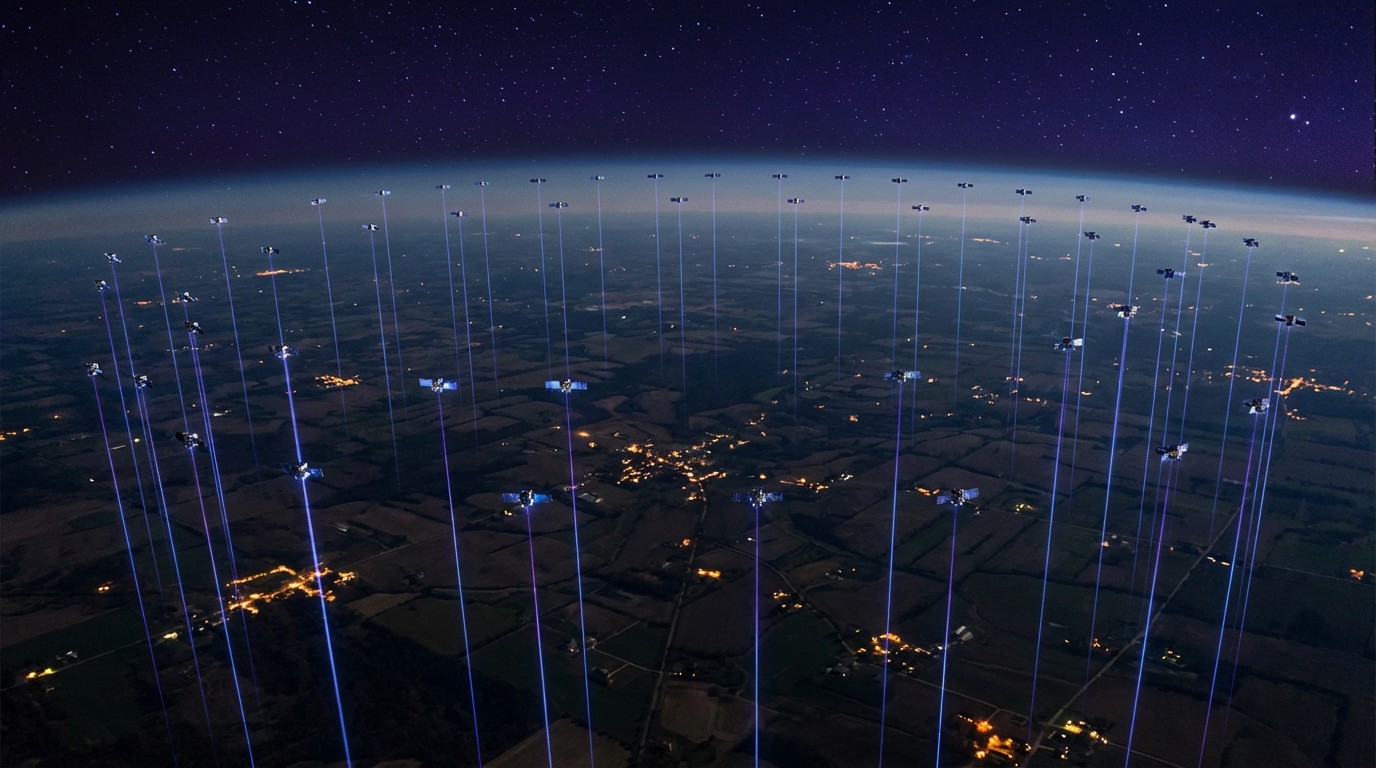
SpaceX took a different approach. Instead of planting towers on the ground, it put them in orbit. As of March 2026, 650 Starlink satellites carry LTE payloads capable of connecting directly to unmodified smartphones. T-Mobile's T-Satellite service, commercially live since July 2025, charges $10 per month. It works on more than 60 phone models. No special hardware. No app download. Your existing phone, talking to a satellite 340 miles overhead.
What matters is not whether this technology works. It does. People texted through satellites during Hurricane Helene, Hurricane Milton, and the Los Angeles wildfires under FCC emergency authority before the commercial launch. A driver in New Zealand used it to call for help after a crash in an area with no cell service. What matters is whether the economics make sense at scale.
Cost Per Square Mile
Start with the terrestrial baseline. A new cell tower costs $175,000 to $350,000 for the structure, equipment, and installation, according to industry estimates from DigitalBridge and Crown Castle filings. Rural sites push toward $500,000 once you factor in access roads, power line extensions, and permitting delays that can stretch 18 to 24 months. Each tower covers roughly 25 to 50 square miles depending on terrain and frequency band.
Do the division: $175,000 to $350,000 per tower divided by 25 to 50 square miles of coverage yields $3,500 to $14,000 per square mile. Rural sites with road construction skew higher.
Now the satellite math. SpaceX's V2 Mini satellites, the variant carrying LTE payloads, cost an estimated $500,000 each to manufacture based on analyst estimates from Quilty Space and Bryce Tech. Multiply by 650 operational DTC satellites: roughly $325 million in constellation hardware. But SpaceX launches on its own Falcon 9 rockets, so the marginal launch cost is far below what commercial customers pay. Even at full commercial pricing, the DTC shell cost is under $500 million.
Those 650 satellites cover not just the 500,000 dead-zone square miles in the U.S., but nearly every square mile of the planet between 60°N and 60°S latitude. For the U.S. dead zones alone, the math is straightforward:
$325 million ÷ 500,000 square miles = $650 per square mile.
That is 5 to 21 times cheaper than terrestrial coverage per square mile. And the satellites were operational within months of launch, not years of permitting and construction.
But the Revenue Side Is Where It Gets Interesting
Cost per square mile is only half the story. Revenue determines whether this is a real business or a subsidized science project.
Start with the U.S. T-Mobile deal. T-Satellite costs $10 per month as an add-on, or is included free in T-Mobile's $100-per-month Experience Beyond plan. T-Mobile president Mike Sievert confirmed this pricing will hold for at least a year across all carriers, including AT&T and Verizon subscribers who access the service through a downloadable eSIM.
Eight million subscribers at $10 per month generates $960 million per year in gross revenue. That alone covers the entire DTC constellation hardware cost in four months. Even at a 30% revenue share with carriers (SpaceX has not disclosed terms), the payback period on $325 million in satellite hardware is roughly 14 months.
Compare that to rural cell tower economics. A tower serving 200 subscribers at $50 average revenue per user (ARPU) and 30% operating margin generates $36,000 in annual profit. Against a $175,000 build cost, that is a 4.9-year payback period. With a $350,000 tower, it stretches to 9.7 years. Many rural towers never pay back their capital cost at all, which is precisely why carriers did not build them.
| Metric | Cell Tower (Rural) | Starlink DTC |
|---|---|---|
| Capital cost per sq mi | $3,500–$14,000 | ~$650 |
| Time to coverage | 18–24 months | Weeks (post-launch) |
| Subscribers per site | 100–500 | Millions (shared constellation) |
| Payback period | 4.9–9.7+ years | ~14 months (est.) |
| Bandwidth per user | 50–150+ Mbps | Shared 7–10 Mbps per beam |
| Indoor coverage | Yes | No (requires sky view) |
What $10 Actually Buys You
Honesty matters here. Starlink Direct-to-Cell is not replacing your cell service. It is filling a specific, brutal gap.
Gen 1 delivers roughly 7 to 10 Mbps aggregate throughput per beam, shared among all users within that beam's footprint. That is enough for text messaging, location sharing, WhatsApp, Google Maps, and AllTrails. It is not enough for streaming video or making reliable voice calls. Voice service remains in testing, with commercial availability targeted for late 2026.
Satellite passes over any given location last an average of 3 minutes and 20 seconds, with handoffs between satellites occurring roughly 18 times per hour. In Dallas, 2 to 5 DTC satellites are visible at any given time. At higher latitudes, that number climbs to 6 to 10. It works, but it works like satellite communication always has: intermittently, with latency, and with bandwidth constraints that would make a 4G user wince.
For the hiker who fell off a trail in New Zealand, that was enough. For the families cut off during Hurricane Helene, that was enough. For the rancher checking cattle prices 40 miles from the nearest tower, that is enough. "Enough" is the product.
Every Competitor Has the Same Problem
SpaceX is not alone in this market, but it has a structural advantage that borders on unfair.
AST SpaceMobile has five BlueBird satellites in orbit and partnerships with Verizon and AT&T, with commercial service planned for 2026. Globalstar powers Apple's Emergency SOS feature on iPhones since the iPhone 14, serving a narrow emergency-only use case. Lynk has eight satellites. None of them can launch their own rockets.
SpaceX's vertical integration advantage is staggering. It manufactures satellites, launches them on its own vehicles, operates the ground network, and iterates on hardware at a cadence no competitor can match. When a V2 Mini satellite fails, the replacement is already in the launch queue. AST SpaceMobile, by contrast, must buy launches from third parties at market rates, adding $50 to $100 million per launch to its cost structure.
Next generation hardware is already visible. SpaceX's planned V3 satellites, requiring Starship for launch, will deliver roughly 700 Gbps per satellite. A 15,000-satellite DTC constellation at that throughput would provide 10.5 petabits per second of total capacity, enough for over a billion simultaneous users at 10 Mbps each. SpaceX has filed the "Starlink Mobile" trademark, suggesting a possible standalone MVNO that would bypass carrier partnerships entirely.
Beyond America
America is just the proving ground. Real money sits in the 50% of Earth's land surface that has zero cellular coverage.
Airtel Africa signed a deal with SpaceX in late 2024 to deploy Starlink Direct-to-Cell across 14 African markets. Vodacom Group, Safaricom's parent company, signed a separate agreement for satellite data relay integration. In these markets, building terrestrial infrastructure is not just expensive; it is sometimes physically impossible across vast deserts, dense forests, and regions without reliable electricity.
A $10-per-month satellite connection in sub-Saharan Africa is not competing with 5G. It is competing with nothing. In the developing world, the addressable market for "any connectivity at all" dwarfs the rural American dead-zone market by orders of magnitude.
Limitations
Several caveats deserve full weight. SpaceX is a private company. Revenue figures ($11.8 billion estimated for Starlink in 2025) come from analyst projections, not SEC filings. Eight million subscribers is third-party reporting. Satellite manufacturing costs are estimates; SpaceX has not disclosed them. V3 capacity projections assume Starship achieves reliable flight cadence, which remains unproven as of March 2026. Indoor coverage is nonexistent since satellites require a clear view of the sky, a constraint cell towers do not share. And $10 per month may not reflect long-term economics once introductory pricing expires.
The Strongest Case Against
The most serious counterargument is bandwidth. At 7 to 10 Mbps shared across an entire beam, Starlink DTC is texting infrastructure masquerading as cellular connectivity. A single terrestrial tower delivers 100+ Mbps to individual users. Voice calls are still not commercially available. Full mobile data requires V3 satellites that depend on a rocket (Starship) still in development. "Death of dead zones" is really "texting works everywhere now." That is meaningful for safety and basic communication, but calling it cellular service is generous. Between "I can send a text" and "I can use my phone normally" sits an enormous gap, and closing it requires hardware that does not yet exist at scale.
The Bottom Line
SpaceX has done what no carrier would: covered half a million square miles of American dead zones at one-fifth to one-twentieth the cost per square mile of a cell tower. At $10 per month, constellation costs pay back in under 14 months. It works on unmodified phones. Fourteen African markets are signing up. But what works today is texting, not calling. Not streaming. Not browsing. V3 satellites that could change that are years away and depend on a rocket that has not yet flown a commercial payload. For now, Starlink Direct-to-Cell is the most cost-efficient way humanity has ever devised to send a text message from the middle of nowhere. Whether "the middle of nowhere" wants to pay $10 a month for that privilege will determine if this is a $1 billion business or a $100 billion one.
Sources
- FCC broadband measurement data. fcc.gov
- 650 Starlink satellites carry LTE payloads. gearmusk.com
- Hurricane Helene, Hurricane Milton, and the Los Angeles wildfires. t-mobile.com
- Quilty Space and Bryce Tech. nextbigfuture.com
- T-Mobile president Mike Sievert confirmed. ts2.tech
- AST SpaceMobile. ast-science.com
- Starlink Mobile. tmsearch.uspto.gov
- 14 African markets. techtrendske.co.ke