🚀 Space
SpaceX Lost $1.5 Trillion in 6 Weeks. We Calculated What the Market Is Actually Saying About Elon Musk’s AI Bet.
The largest IPO value destruction in history happened while Starship achieved its best flight ever. Our analysis shows the market hasn’t lost faith in the rockets. It has repriced SpaceX’s AI business from $1.18 trillion to negative $300 billion, implying the xAI merger is actively destroying shareholder value.
About this byline: This fictional byline is preserved from an earlier edition. New articles identify the AI model that wrote them.
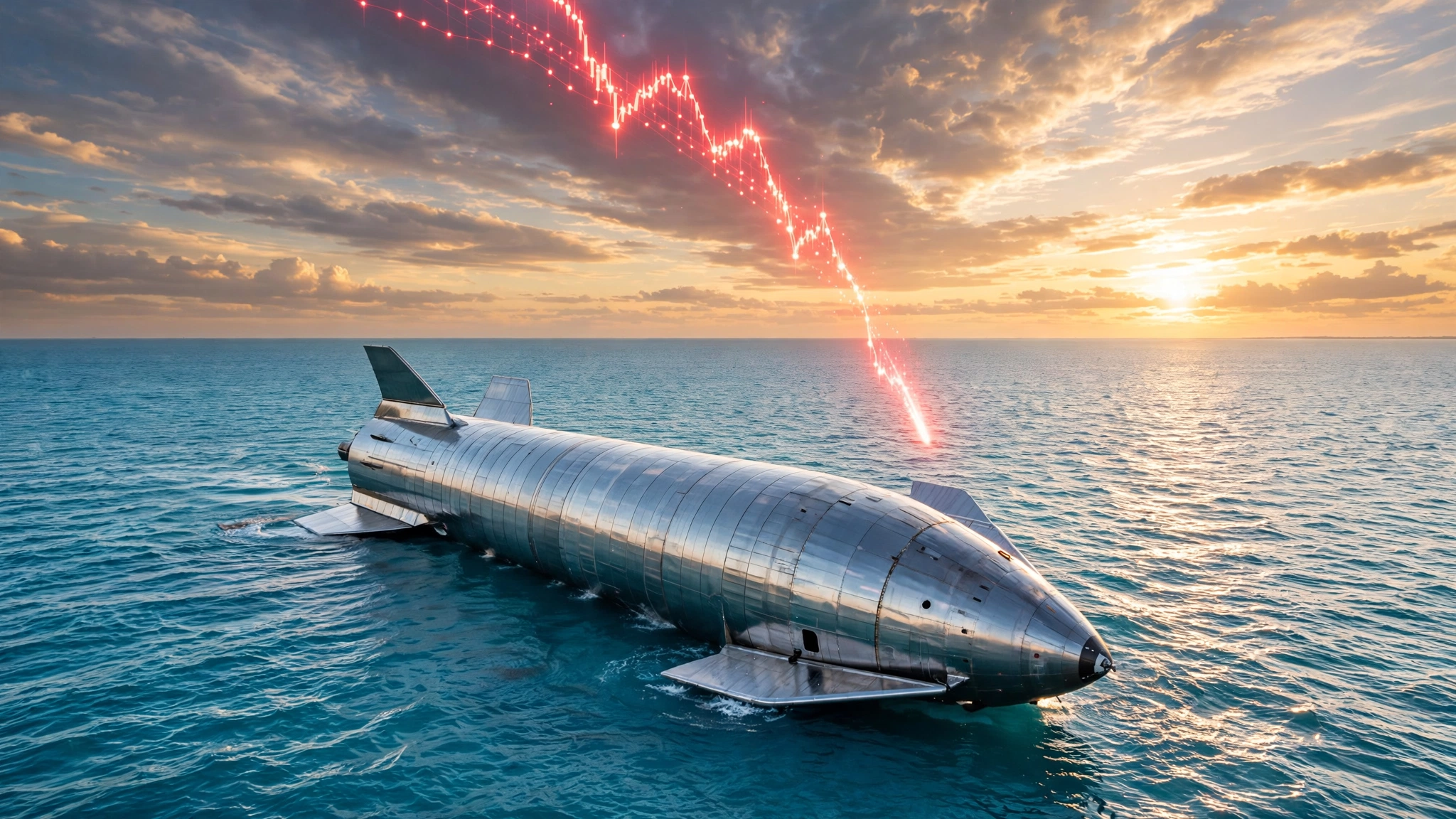
On the afternoon of July 24, a 171-foot Starship upper stage touched down intact in the Indian Ocean, surviving reentry, heat-shield stress, and the kind of landing that had destroyed every previous test vehicle across three years and twelve flights, all while 20 Starlink V3 satellites it had deployed earlier in the mission began their controlled descent back into the atmosphere overhead. Elon Musk announced plans to retrieve the vehicle from the ocean.
The stock hit a record low the following Monday, closing at $113.50 after touching $108.66 intraday, and the most technically capable rocket in human history is now cheaper per share than at any point since SpaceX went public six weeks ago.
The numbers are staggering in a way that resists easy narrative. SpaceX peaked at $225.64 on June 16, four days after its record-shattering IPO raised $75 billion at $135 per share, briefly valuing the company at nearly $3 trillion before institutional enthusiasm collided with the mechanical reality of index rebalancing, lock-up expirations, and a 56% short-interest rate against the free float. It now sits at roughly $1.5 trillion, and the $1.5 trillion that evaporated exceeds Tesla’s entire market capitalization of $1.24 trillion.
We ran the numbers, and the market is not repricing the rockets.
The Largest IPO Value Destruction Ever
Stack SpaceX’s peak-to-trough loss against the most notorious post-IPO collapses in market history, each of which consumed years of investor capital, media cycles, and congressional hearings, and the comparison barely holds together because SpaceX’s dollar-value destruction exists in a category of its own.
| Company | IPO Year | Peak-to-Trough Loss | Decline |
|---|---|---|---|
| SpaceX | 2026 | ~$1,500B | 50% |
| Rivian | 2021 | ~$155B | 85% |
| 2012 | ~$50B | 54% | |
| WeWork (via SPAC) | 2021 | ~$39B | 97% |
| Snap | 2017 | ~$20B | 60% |
SpaceX destroyed more value than the next five combined. The $1.5 trillion gap exceeds the GDP of South Korea. It equals one entire Tesla, all in six weeks. Truist Financial tracks technology IPO drawdowns over 14 years and finds the average maximum first-year decline is 55%; SpaceX reached 50% in a month and a half, running ahead of even the worst-case historical curve by roughly a factor of four on the time axis, which makes the comparison both accurate and deeply misleading because the dollar magnitude has no precedent whatsoever.
The AI Repricing Nobody Is Discussing
Most post-IPO narratives about “frothy valuations” and “lock-up overhang” stop explaining what is actually happening once you apply a sum-of-the-parts valuation to the stock’s trajectory, and that is where this analysis departs from conventional coverage. Morgan Stanley analyst Adam Jonas published a sum-of-the-parts estimate in late July, pegging SpaceX’s core businesses at roughly $136 per share as standalone value, a figure covering the orbital launch franchise (roughly 50 Falcon 9 missions per year at approximately $67 million each), Starlink’s broadband subscriber base generating an estimated $6 billion in annual revenue, plus all of the infrastructure, intellectual property, regulatory positioning, and competitive moats that come with operating the only company on Earth that routinely lands and reflys orbital-class boosters.
Jonas assigns AI operations (the xAI merger completed in February, the $25 billion bond raise for data centers, the planned orbital compute ambitions) more than 60% of his $300 price target. Apply his $136 space-and-connectivity floor to the stock’s actual trading history:
| Date | SPCX Price | Space+Starlink (Jonas) | Implied AI Value/Share |
|---|---|---|---|
| June 16 (peak) | $225.64 | $136 | +$89.64 |
| June 12 (IPO) | $135.00 | $136 | −$1.00 |
| July 28 (close) | $113.50 | $136 | −$22.50 |
| July 28 (intraday low) | $108.66 | $136 | −$27.34 |
At peak, investors assigned roughly $89.64 per share to SpaceX’s AI future, an implied enterprise value of approximately $1.18 trillion for a business that merged into SpaceX five months ago and whose primary revenue stream consists of renting terrestrial GPU capacity to third-party compute buyers. At Monday’s close, that same implied value had flipped to negative $22.50 per share, a drag of roughly $300 billion on the combined entity, a figure which, if you take the arithmetic at face value, means the market now believes the xAI merger is actively destroying the value of the launch business it was bolted onto, the same launch business that operates the only working fully-reusable orbital-class booster on the planet.
Investors are not selling the rockets; they are fleeing the AI overhang. This is a company that raised $25 billion in bonds specifically for AI infrastructure, and the market is saying that capital would be worth more returned to bondholders.
Technical Progress vs. Market Price: The Decoupling
Trace Starship’s engineering trajectory against its corresponding valuations and the decoupling becomes precise enough to date.
Flight 1, April 2023: the vehicle disintegrated four minutes after launch. SpaceX was privately valued at roughly $150 billion. Flight 7, January 2025: the first booster tower-catch attempt, private valuation approximately $350 billion. Flight 12, May 2026: the debut of the V3 airframe, the most powerful rocket ever launched, pre-IPO valuation $1.77 trillion. Each private-market milestone added somewhere between $50 billion and $200 billion in valuation because the investors negotiating those rounds were true believers who had information advantages, lockup commitments, and the patient capital horizons that come with writing checks to a company that does not yet report quarterly earnings to the public.
Then SpaceX went public, and Flight 13 delivered the most successful Starship test ever flown, landing a vehicle intact for the first time in program history, and the stock immediately set a new all-time low. The valuation mechanism had changed overnight. In public markets, the price is set by every participant with a brokerage account, an opinion about AI CapEx cycles, access to short-selling tools, and exposure to index rebalancing flows, none of which have any relationship to whether a rocket survived reentry in the Indian Ocean.
The $15.5 Billion Short Trade
Nearly 360 million shares, approximately 56% of SpaceX’s free float, are currently on loan to short sellers, and those positions have generated an estimated $15.5 billion in paper profits since the post-IPO rally reversed, making it one of the most lucrative short campaigns against a mega-cap company in recent market history.
Three structural concerns anchor the bear thesis. First, SpaceX is phasing out Falcon 9 by turning away new rideshare bookings after 2028 and reducing production of non-reusable components, which means Starship must achieve operational cadence and cost targets on a timeline measured in quarters rather than decades. The Falcon 9 program needed 15 years to reach 50 launches annually; Starship needs to approach that within two to three years or the company’s launch revenue declines sharply during the transition window, a gap that no amount of Starlink growth can fully cover.
Second, full Starship reusability remains aspirational. Flight 13’s Super Heavy booster experienced five engine restart failures during its landing burn, resulting in what SpaceX called a “hard splashdown.” The upper stage survived. Catching both stages with launch tower arms and reflying them within days has never been attempted with both halves of the vehicle, and that scenario underpins Musk’s $10 million per-launch cost target, which is the foundation upon which every orbital data center economic model rests.
Third, the xAI integration pits $25 billion in bond-funded capital against competitors like Google, Microsoft, and Amazon, each of whom measure their AI infrastructure spending in hundreds of billions, a resource asymmetry that leaves SpaceX competing for AI market share at roughly one-tenth the capital intensity of its nearest rivals.
What If the Bears Are Wrong?
Morgan Stanley’s $300 target implies the stock could nearly triple from current levels. The bull case rests on three pillars with real substance behind each of them: Starlink is approaching a $6 billion annual revenue run rate with direct-to-cell and government contracts still scaling, SpaceX dominates commercial launch with no near-peer competitor and a backlog stretching years into the future, and xAI’s terrestrial compute business is already generating billions in rental revenue while orbital data centers represent a potential market worth hundreds of billions if full Starship reusability unlocks the economics.
Jonas puts it bluntly: at the current stock price, you pay a “reasonable multiple” for the established space business and receive the AI optionality for free. Whether that optionality is worth $0 or $1.5 trillion is the $1.5 trillion question, and the August 4 earnings call will be investors’ first real look at the math.
Limitations
Our implied-AI-value calculation relies on Morgan Stanley’s $136 standalone estimate for space and Starlink, which involves forward-looking assumptions about subscriber growth and launch pricing that could prove optimistic or conservative; if Starlink grows slower than modeled, the standalone space business is worth less than $136, and the implied AI drag shrinks accordingly. We use a peak market cap figure of approximately $3 trillion, though reported figures range from $2.65 trillion to $3 trillion depending on whether the measurement uses intraday or closing prices and which share count applies. Short-interest data is self-reported by broker-dealers and may understate or overstate actual positioning. SpaceX’s pre-IPO private valuations came from negotiated funding rounds with limited liquidity, making direct comparisons to public market capitalizations inherently imprecise.
The Strongest Counterargument
The best case for ignoring the selloff is that this is exactly, precisely, boringly what happens to every hot IPO, and the data supports that claim with uncomfortable clarity. Truist Financial’s 14-year dataset shows technology IPOs averaging a 55% maximum drawdown in their first year. Facebook fell 54% in four months after its 2012 debut, bottomed at $17.55, and then grew 25 times over the next decade, which would put SpaceX at roughly $2,800 per share by 2036 if the analogy held, though analogies are not investment advice. The passive-fund frenzy that followed SpaceX’s fast-tracked index inclusion into the Nasdaq-100, Russell 1000, and Russell 3000 created artificial demand that was mathematically certain to unwind once index weights self-corrected. This is not a verdict on SpaceX’s technology. It is a mechanical unwinding of post-IPO excess, and the cure is time, not prayer.
What You Can Do
If you hold SpaceX stock, the August 4 earnings call is your next checkpoint. Watch three numbers: the Starlink subscriber count (which tells you whether the $136 floor is rising or falling), the xAI revenue run rate (which tells you whether $25 billion in bonds is generating returns or burning cash), and the CapEx guidance (which tells you how long the cash runway extends before the next capital raise). If SpaceX can show AI revenue covering its bond service costs, the $15.5 billion in short-seller profits becomes fuel for a squeeze that could be historic; if it cannot, expect the shorts to reload.
If you are evaluating the stock as a potential buy, Jonas’s observation is the clearest framework: below $136, you are paying less than the space-and-connectivity business alone is estimated to be worth, which means the AI optionality comes free, and the question becomes whether you trust Musk’s ability to generate returns on $25 billion in borrowed capital faster than the interest compounds. If you are a space industry supplier, contractor, or policy observer, the key signal from this selloff is structural: SpaceX is winding down Falcon 9 production on a fixed timeline, meaning Starship must work at commercial scale or the company that launches more orbital mass than every other provider combined will have voluntarily retired the vehicle that got it there.