Sony's Robot Beat Elite Table Tennis Players. The 20-Millisecond Window That Made It Possible.
Sony AI's autonomous robot Ace defeated elite table tennis players in official ITTF-rules matches, winning 3 of 5 against amateurs who train 20 hours a week and later taking at least one match from each of three T.League professionals. Published as a Nature cover paper on April 22, 2026, the system completes its entire perception-to-action loop in 20.2 milliseconds, roughly 11 times faster than human reaction time. Every previous AI milestone, from Deep Blue to AlphaGo to AlphaStar, happened in environments where the machine could think for seconds or minutes, or where the battlefield was digital. Ace cannot pause the game. It must see, predict, and physically strike a ball traveling over 20 meters per second against an unpredictable human opponent, all within a window shorter than a single frame of standard video.
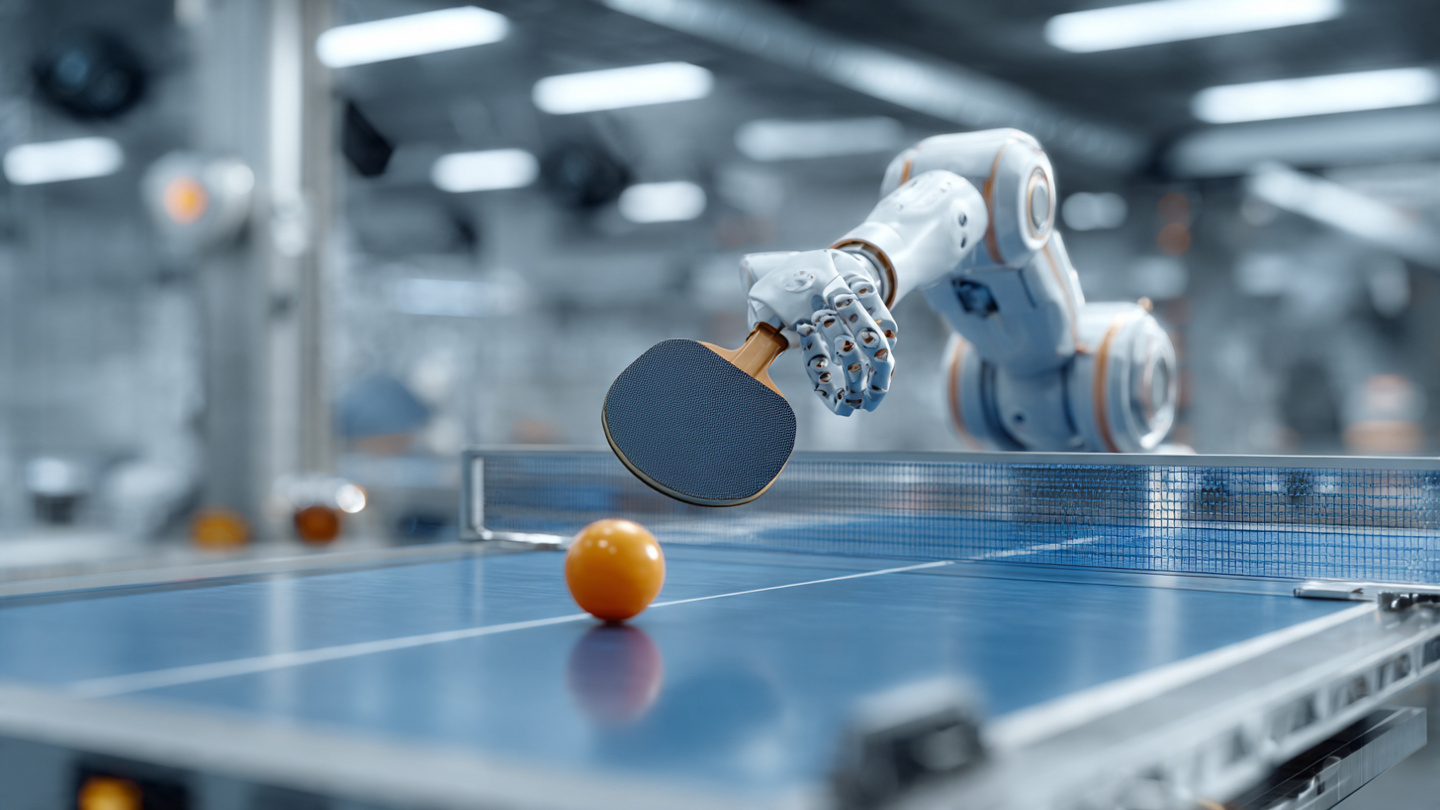
Twenty point two milliseconds. That is how long Sony AI's Ace robot takes to complete its full loop: cameras capture the ball's position, the system predicts its trajectory and spin, a motion planner selects a return strategy, and an eight-degree-of-freedom robotic arm executes the stroke. A human blink takes 150 to 400 milliseconds. A competitive table tennis player's reaction time hovers around 230 milliseconds. Ace's entire cycle, from photon hitting sensor to paddle striking ball, finishes 11.4 times faster than its opponents' nervous systems can begin to fire a conscious motor response, and the gap is not a software trick. It is physics, optics, and control theory running in a pipeline that has no equivalent in any previous AI-versus-human competition.
The results, published as a Nature cover paper on April 22, 2026, describe a system that won 3 of 5 matches and 7 of 13 games against elite amateur players who train more than 20 hours per week and have competed for over a decade. Against T.League professionals in initial testing during April 2025, the robot lost both matches but won one game. After further development, in March 2026 rematches, Ace won at least one match against each of three professional players. This is not AlphaGo, not a digital environment where the AI controls pixels. A physical arm had to hit a physical ball past a physical human who could see everything the robot was doing and adjust. No API. No game state. No pause button.
The Decision-Time Gap Nobody Calculated
Every headline comparing Ace to Deep Blue or AlphaGo misses the dimension that actually matters: time budget per decision. Here is what the decision window looks like across every major AI-versus-human milestone, compiled from primary sources.
| System | Year | Domain | Decision Time | Physical? |
|---|---|---|---|---|
| Deep Blue | 1997 | Chess | ~180 sec/move | No |
| AlphaGo | 2016 | Go | ~60 sec/move | No |
| Libratus | 2017 | Poker | ~15 sec/action | No |
| OpenAI Five | 2019 | Dota 2 | ~100 ms | No (digital) |
| AlphaStar | 2019 | StarCraft II | ~200 ms | No (digital) |
| GT Sophy | 2022 | Gran Turismo | ~16 ms frame | No (sim) |
| Ace | 2026 | Table Tennis | 20.2 ms | Yes |
The table reveals a pattern that the "AI beats human at game" narrative consistently obscures. From Deep Blue to AlphaGo, the decision budget shrank from three minutes per chess move to roughly sixty seconds per Go stone, a compression that mattered enormously for computing but changed nothing about the physical stakes. From Go to esports, it compressed further to hundreds of milliseconds, but the arena remained digital: no motors, no air resistance, no ball deformation, no opponent body language to parse through cameras rather than game-state APIs. GT Sophy's 16-millisecond frame rate seems comparable to Ace, but the car physics simulation has momentum and inertia that provide continuity between frames, and the environment is fully deterministic given inputs. A table tennis ball arriving at 20+ meters per second after being struck with unpredictable spin by a human offers no such continuity. Ball behavior changes with every rally, every opponent adjustment, every surface scuff on the rubber.
That physical column is the whole story. Ace is not the fastest AI. It is the first fast AI operating against physical uncertainty.
How the System Sees a Ball Moving at 72 Km/h
Ace's perception stack uses 9 frame-based cameras and 3 event-based vision sensors manufactured by Sony Semiconductor Solutions. Nine frame-based cameras capture position at 200 Hz, fast enough to locate the ball's center of mass at every stage of its parabolic flight between bounces. Its event-based sensors, which fire only when pixels detect brightness changes, measure spin at roughly 700 readings per second. Standard frame cameras would blur a ball moving this fast because the exposure time smears the image across multiple pixel positions. Event cameras solve this by reporting brightness changes with microsecond precision, no shutter, no frames, no blur.
Together, the two sensor types feed a prediction system that estimates the ball's future trajectory, including the spin axis and magnitude, within the first few milliseconds after the opponent strikes. That prediction feeds directly into the robotic arm's motion planner, which computes a target paddle position, an approach angle, a velocity profile for the return stroke, and a timing offset calibrated to meet the ball at the precise point in its descent where contact yields maximum control over the return trajectory. The arm has 8 degrees of freedom with custom lightweight alloy construction, designed to minimize rotational inertia so that changes in direction cost as little energy and time as possible.
Training happened in simulation using deep reinforcement learning with a technique the researchers call a "privileged critic." During training, the critic network has access to perfect ground-truth physics data that the robot could never observe in the real world, such as the exact spin vector and air drag coefficient. The policy network, which generates the actual arm movements, only gets the noisy camera data. By training the policy against a critic that knows the truth, the system learns to extract maximum information from imperfect sensor inputs. After simulation training, the policy transfers to the physical robot through sim-to-real techniques that bridge the gap between idealized physics and actual table conditions.
What the Robot Cannot Do
Ace is bolted to the floor. Immovable. It cannot move laterally, cannot take a step to reach a wide shot, cannot lean its body weight into a forehand the way a human generates power through kinetic chain mechanics from feet through hips through shoulder through wrist. Its reach extends roughly 1.5 meters from center position. That is the entire world Ace inhabits. A competent human player covering the full 1.525-meter half of a regulation table uses footwork constantly, with elite players covering 3 to 4 meters laterally during a single point.
This constraint proved decisive during matches against the T.League professionals, where the humans exploited spatial limitations by placing shots to the robot's extreme forehand and backhand corners, forcing the arm to operate at the edge of its kinematic envelope where control precision degrades. Several of the robot's losses came on points where strategic ball placement into the arm's geometric dead zones, not raw speed or spin, was the decisive factor that separated the human winner from the machine.
The sensor advantage cuts both ways: Ace uses 12 dedicated vision sensors to track one ball, while a human uses two eyes, peripheral vision, and a lifetime of learned motor prediction heuristics that generalize across every ball sport, every thrown object, every unexpected physical interaction they have ever experienced. John Billingsley, a roboticist at the University of Southern Queensland who founded the robot ping-pong competition in 1983, called Sony's approach "mob-handed," arguing that deploying this many sensors against a human's two eyes makes the comparison asymmetric in ways that diminish the achievement. He has a point, and the question is whether sensor count or physical capability is the fairer unit of comparison: nine cameras against two eyes, or one fixed arm against a full human body with 230 independently controllable skeletal muscles.
The Comparison That Matters: Unitree's Humanoid
Ace is not the only robot playing table tennis. Unitree's G1 humanoid has been demonstrated returning balls in a casual rally setting, standing on two legs, gripping a paddle in a humanoid hand, moving its torso to reach shots. Its performance is nowhere near competitive: it can sustain a gentle rally but cannot handle spin, speed, or aggressive placement from a skilled player.
That gap illuminates a fundamental design question for physical AI. Specialized systems like Ace optimize ruthlessly for one task, strip away everything unnecessary, and achieve superhuman performance within their narrow domain. Humanoid robots preserve generality at the cost of performance in any specific task, because legs designed for walking are not optimized for table tennis footwork, and hands designed for tool manipulation are not optimized for racket control. Whether physical-sport AI follows the specialist path (Ace) or the generalist path (Unitree) will determine what these systems look like at commercial scale, and the answer has implications well beyond sports, extending into manufacturing, surgery, and any domain where a robot must physically interact with unpredictable objects or people.
Strongest Counterargument
The most serious objection is that Ace does not play table tennis the way a human plays table tennis, and therefore the comparison is misleading. A human player manages footwork, strategy adaptation across a multi-game match, fatigue, psychological pressure, risk assessment on every shot, and real-time reading of an opponent's body language to predict shot selection. Ace manages none of these, simply receiving a ball, predicting trajectory, and returning it as well as its arm geometry allows. When the professionals adapted their strategy mid-match to exploit the robot's fixed position and limited reach, Ace had no equivalent strategic response. It kept doing what it always does, faster and more precisely than its opponent, until placement rather than speed decided the point.
The professionals who lost matches did not lose because the robot was "better at table tennis." They lost because the robot was better at the specific subset of table tennis that happens within arm's reach, with sufficient sensor data to predict spin and trajectory earlier than any human can. Whether that constitutes "beating a human at table tennis" or "outperforming a human at a constrained version of table tennis" is a distinction that the Nature paper does not fully address and that deserves more scrutiny than most coverage has given it.
Limitations
This article's decision-time comparison table uses approximate averages across different competition formats and time controls. Deep Blue's per-move time varied dramatically between opening book moves (near-instant) and deep midgame calculations (several minutes). GT Sophy's 16ms frame time is the simulation timestep, not necessarily the policy decision frequency. The Ace system's 20.2ms figure is end-to-end latency as reported by Sony AI and has not been independently measured by a third party. All matches were conducted in Japan with Japanese players, limiting the competitive sample to one national talent pool. The distinction between "elite amateur" and "professional" is not precisely defined in the paper, making win-rate claims difficult to contextualize against the global table tennis ranking system. The Unitree G1 comparison is based on demonstration videos, not controlled experimental conditions, and the two systems have fundamentally different design objectives that make direct comparison inherently imprecise.
The Bottom Line
If you care about robotics, manufacturing, or physical AI, track three developments over the next 18 months. First, watch whether Sony releases Ace's perception stack or reinforcement learning framework as open tools, because the privileged-critic training technique has applications in any domain where a robot must act on imperfect sensor data under tight time constraints, including warehouse picking, surgical robotics, and autonomous driving. Second, watch Unitree's G1 progress: if a humanoid robot can close the performance gap with a specialized arm in table tennis, it suggests that general-purpose physical AI may not require task-specific hardware, which would reshape the economics of every robotics startup building single-purpose machines. Third, watch for the first attempt to give a system like Ace lateral mobility. Once someone mounts this perception-control pipeline on a mobile base that can take even one step to reach a wider shot, the competitive ceiling shifts dramatically, and so does the range of physical tasks the architecture can address.
GT Sophy, Sony's previous Nature paper from 2022, proved that reinforcement learning could master simulated racing. Ace proves it can master a physical contest operating under a 20-millisecond decision budget, against an opponent who adapts, strategizes, and exploits every mechanical constraint the robot cannot fix between points. The progression from simulation to physical reality, from digital opponents to human ones, is the transition that matters. It cannot move its feet. It sees with 12 sensors what we see with two eyes. And it still won. Its next version will not have those constraints.
Sources
- Sony AI Project Ace. "Achieving human-level competitive robot table tennis." Nature, April 22, 2026. nature.com
- "Sony built the first robot to beat elite ping-pong players." The Neuron, April 2026. theneuron.ai
- "AI breakthrough: Sony robot beats elite table tennis players." Notebookcheck, April 2026. notebookcheck.net
- "Sony AI Project Ace Robot Defeats Elite Players." TechNetBooks, April 2026. technetbooks.com
- Billingsley "mob-handed" critique. AP/dnyuz, April 2026. dnyuz.com
- Wurman, P.R. et al. "Outracing champion Gran Turismo drivers with deep reinforcement learning." Nature, 2022. nature.com