🚀 Space
Rocket Lab's New Solar Cell Ditches Germanium. Every 100 kW It Builds Dodges $1 Million in Export-Controlled Metal.
IMM Apex, announced September 8, runs 31.5% efficient with no germanium substrate, and the math says each 100 kW production run sidesteps roughly 200 kilograms of a metal whose US price carries a 181% export-control premium, eleven weeks before China's suspension of its US germanium ban expires.
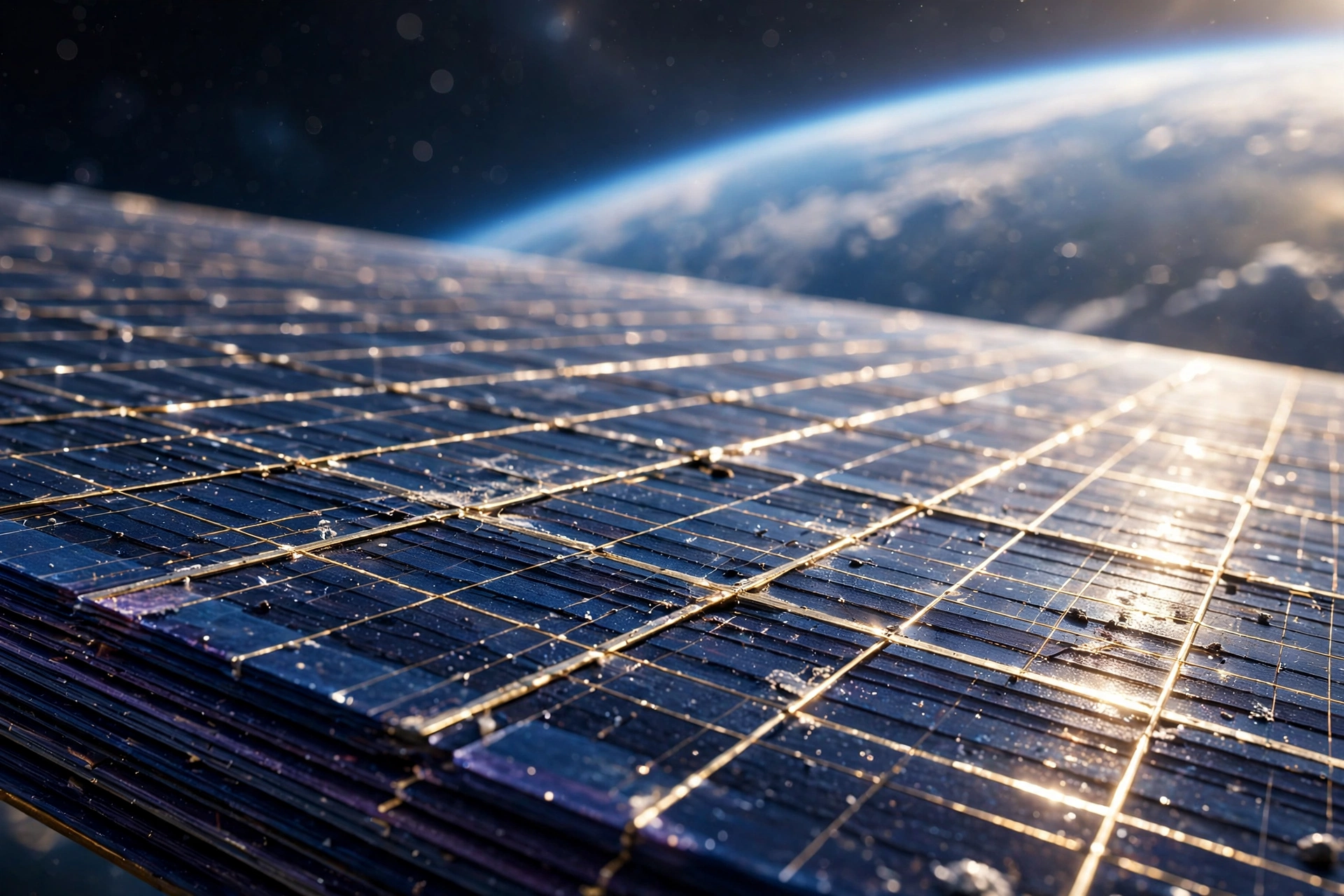
One million dollars. That is the US-market value of the germanium inside every 100 kilowatts of conventional space solar cells, a metal most coverage of Rocket Lab's September 8 announcement treated as a footnote. Rocket Lab's release led with the efficiency number, 31.5% beginning-of-life, and the weight number, 40% lower cell mass. Both are fine, but neither is the story. For three decades, nearly every multi-junction cell flying in orbit has been built on a germanium wafer, and Beijing has spent the last three years turning that wafer into leverage.
IMM Apex is Rocket Lab's answer: an inverted-metamorphic cell with no germanium substrate at all, sold as a mechanical and electrical drop-in replacement for the germanium-based heritage products, manufactured, the company says, in multi-100-kilowatt volumes. Its pedigree is real. Rocket Lab's IMM line powered NASA's Ingenuity helicopter on Mars, and more than 1,100 satellites currently on orbit run on the company's solar products, including hardware on the James Webb Space Telescope and Artemis missions. "With IMM Apex, customers gain access to a high-efficiency, lightweight, germanium-free product that combines proven reliability with faster production times," said Brad Clevenger, president of Rocket Lab USA. Faster production times is doing quiet work in that sentence. Read on.
The Metal Behind the Cell
Germanium substrates are the industry's original sin of convenience. A conventional triple-junction cell stacks gallium-indium-phosphide and gallium-arsenide junctions on top of a germanium wafer that doubles as the bottom junction and the mechanical foundation, which is why Azur Space's current 3G30-Advanced datasheet still reads "InGaP/GaAs/Ge on Ge." China produces roughly 60% of the world's germanium, and in August 2023 Beijing put all germanium exports under a licensing regime, then escalated to a targeted US export ban in December 2024. Washington and Beijing suspended that ban in November 2025 as part of a trade truce, but the suspension was reported by Reuters to expire on November 27, 2026, and the metal never left China's dual-use control list, which means every shipment still needs a government license. Count the weeks: about eleven before the deadline, with reversal possible at any time before then.
Price tells the same story in dollars. As of March 2026, Shanghai Metals Market benchmarks put 99.999% germanium at $1,949 per kilogram inside China and $5,475 per kilogram in US warehouses, a 181% premium that exists for exactly one reason: export controls. A USGS model of a full simultaneous gallium-and-germanium ban estimated a $3.4 billion hit to US GDP, with a range of $1.7 to $9.0 billion, and projected germanium prices rising another 26% on top of already elevated levels. Space is where this bites hardest in one concentrated place, since the USGS report notes solar cells among germanium's key applications, and market researchers put space satellites at 80% of the $550 million gallium-arsenide-germanium cell market. Every constellation now in production is, in a very literal sense, built on Beijing's licensing queue.
Running the Numbers Nobody Ran
How much germanium does a production run actually contain? Start with the datasheets, because Rocket Lab's own ZTJ heritage cell, the germanium-substrate product Apex replaces, weighs 84 mg/cm² at 29.5% efficiency. A germanium wafer 140 to 175 micrometers thick, the industry standard range, masses 0.745 to 0.932 kg/m² at germanium's density of 5,323 kg/m³, which means roughly nine-tenths of a conventional cell's weight is the substrate itself. At AM0 sunlight of 1,361 W/m², 100 kW of 30%-class cells needs about 245 m² of cell area. Multiply through: one 100 kW production run of conventional cells carries roughly 183 to 228 kilograms of germanium.
| Substrate thickness | Germanium per 100 kW | Value at US warehouse price ($5,475/kg) | Value at China domestic price ($1,949/kg) |
|---|---|---|---|
| 140 µm | ~183 kg | ~$1.00M | ~$0.36M |
| 175 µm | ~228 kg | ~$1.25M | ~$0.44M |
So the export-control premium alone, the gap between the US and China price for the same metal, is worth roughly $640,000 to $810,000 per 100 kW of cells. Rocket Lab says Apex is manufacturing in "multi-100-kilowatt volumes," which at minimum means 200 kW, or on the order of $2 million in US-priced germanium deleted from the bill of materials per production batch. That is before counting the weight: Apex at 40% lower cell mass than its germanium-based heritage saves about 82 kilograms of dead mass per 100 kW, mass that otherwise rides a rocket on every single launch.
Specific power tells the subtler story, and it is worth reconstructing from the datasheets because the result punctures the press-release framing. Bare-cell specific power, watts per gram, falls straight out of efficiency divided by areal mass:
| Cell | Efficiency | Areal mass | Specific power |
|---|---|---|---|
| Rocket Lab ZTJ (Ge substrate) | 29.5% | 84 mg/cm² | 0.48 W/g |
| Rocket Lab IMM-α | 32.0% | 49 mg/cm² | 0.88 W/g |
| IMM Apex (new) | 31.5% | ~50 mg/cm²* | ~0.85 W/g |
*Apex areal mass inferred: 40% below the ZTJ heritage baseline, per the release's drop-in framing. Rocket Lab has not published an Apex datasheet.
Look at that table carefully, because Apex is not an efficiency record. Rocket Lab's own IMM-α already hits 32.0%, half a point higher, and peer-reviewed IMM research reports power-to-mass ratios triple those of commercial thinned-germanium cells. Apex trades a sliver of performance for something more valuable: immunity to a mineral weapon. This was never a performance story wearing a supply-chain costume. It is a supply-chain story wearing a performance costume, and the costume almost worked.
The Gallium-Sized Hole in the Story
Now the strongest case against the victory lap, stated at full strength. Germanium is not the mineral Beijing holds most tightly. China refines an estimated 98.8% of the world's gallium, against about 59% of refined germanium, and the same USGS model that prices a germanium shock at +26% prices a gallium shock at more than +150%. Apex's epitaxial stack is still gallium-indium-phosphide on gallium-arsenide, which needs gallium and arsenic, both of them. The cell Rocket Lab just announced deletes one controlled mineral from the bill of materials while the most China-concentrated input in the entire stack stays exactly where it was. "Germanium-free" is real engineering and real de-risking, but anyone reading it as supply-chain independence is reading too fast.
Two more honest caveats are owed before any applause. "Drop-in replacement" describes mechanical and electrical compatibility, not qualification. Satellite primes still re-qualify new cells through thermal-vacuum and radiation testing before they fly on anything expensive, and national-security programs, the ones most exposed to the germanium problem, adopt new hardware on multi-year cycles. Second, "multi-100-kilowatt volumes" is a start, not a solution: constellation demand is measured in megawatts, and the industry's germanium habit took thirty years to build, which one product release does not unwind.
What the Numbers Don't Prove
Several limits on this analysis deserve daylight. Apex's headline figures come from a company press release, not an independent test or a published datasheet, and Rocket Lab left the "40% lower" baseline ambiguous: measured against its germanium heritage products, Apex lands near IMM-α-class specific power, as shown above, but measured against IMM-α itself it would imply 1.45 W/g, a much bigger claim the release does not quite make. My germanium-content estimate assumes 140 to 175 µm substrates and is presented as a band for that reason. Price data is March 2026 SMM benchmarks via a market-intelligence aggregator, and prices move. The USGS $3.4 billion figure is a modeled total-ban scenario with a wide range, not a forecast of what happens in November. And the truce-expiry date comes from November 2025 Reuters reporting; Beijing can extend, shorten, or reverse it with one announcement, which is rather the point.
What You Can Do
If you run a constellation program, the decision clock is the truce clock: roughly eleven weeks to the reported expiry, and re-qualification takes longer than that, so the time to start the Apex qual cycle was yesterday. Price your cell procurement at US warehouse germanium, not Chinese domestic, because the 181% premium is the honest planning number while controls persist. If you invest in space, watch the margin story rather than the efficiency story: the value here is deleted material cost and deleted schedule risk, and the metrics that matter are whether "multi-100-kilowatt" scales to megawatts and whether primes actually switch. If you make industrial policy, notice what worked: Rocket Lab designed the controlled mineral out of the product instead of stockpiling it, which is the resilience playbook worth funding. And if none of those are you, the takeaway is simpler. Great-power mineral politics does not live in white papers. It lives in the solar wings of the satellites overhead, and for thirty years those wings had a Beijing-shaped single point of failure, and somebody just started removing it.
The Bottom Line
Rocket Lab's IMM Apex is the most consequential space solar cell announcement in years, and not for the reasons in the headline. At 31.5% efficiency it trails the company's own IMM-α, but efficiency was never the point: each 100 kW of Apex cells built instead of germanium-substrate heritage cells sidesteps roughly 200 kilograms of a metal carrying a 181% export-control premium, worth about $1 million at US warehouse prices, while shedding 82 kilograms of launch mass. It arrives eleven weeks before China's suspension of its US germanium ban is reported to expire. The honest version of this story includes its limits: gallium remains the bigger hostage, drop-in is not qualification-free, and one product does not unwind thirty years of industry habit. None of that changes the verdict. Designing the weaponized mineral out of the product beats stockpiling it, hedging it, or hoping the truce holds, as Rocket Lab just showed the industry.