🚀 Space
Space Launch Costs Are Falling Faster Than Steamships or Solar. Only One Company Gets the Discount.
A 4,000-launch Cambridge dataset puts space technology's learning rate at 30% per doubling, beating solar panels, steamship freight, and every transport revolution except semiconductors. Meanwhile, SpaceX controls more of the orbital market than the East India Company controlled at its peak.
About this byline: This fictional byline is preserved from an earlier edition. New articles identify the AI model that wrote them.
July 15, 2026
In 1960, putting one kilogram of anything into low Earth orbit cost $87,023. Last year, the number was $3,841. That is a 95.6% decline over 64 years and roughly 4,000 rocket launches, and it has happened faster than the cost collapse of steamship freight in the 19th century, faster than the plunge in solar panel prices that reshaped the global energy market, and faster than the cost decline of wind turbines that now generate a tenth of the world's electricity.
Those numbers come from the largest standardized dataset of rocket launches ever assembled. Alessio Terzi at the University of Cambridge, working from the Bennett School of Public Policy, tracked every launch from ten spacefaring nations since the dawn of the space age. Presented at Harvard Business School's Space Economics seminar series in February 2026, the dataset shows something remarkable: space launch technology follows Wright's Law, the empirical rule that costs drop by a fixed percentage every time cumulative production doubles. And it follows this rule more aggressively than almost any technology in industrial history.
A Learning Rate That Changes Everything
Wright's Law is named for Theodore Wright, who noticed in the 1930s that every time total aircraft production doubled, the labor cost per plane dropped by 10-15%. Solar panels, batteries, semiconductors, and steamship freight all show the same pattern. What matters is the rate: how much cheaper does it get per doubling?
Using Terzi's published endpoints ($87,023 per kilogram at roughly 10 cumulative launches in 1960, falling to $3,841 at 4,000+ launches by 2024), the implied learning rate is approximately 30% cost reduction per doubling of cumulative launches. That is the compound rate at which the industry has learned to make orbital access cheaper, and it slots into a hierarchy that illuminates where space technology sits in the broader arc of human industrial capability:
| Technology | Learning Rate (cost reduction per doubling) | Time Span |
|---|---|---|
| Semiconductors (Moore's Law) | ~40–45% | 1965–present |
| Space launch (Terzi dataset) | ~30% | 1960–2024 |
| Solar photovoltaics | ~20–22% | 1976–present |
| Lithium-ion batteries | ~18% | 1991–present |
| Steamship freight | ~15–17% | 1830–1900 |
| Wind energy | ~12% | 1980–present |
Space launch technology is learning at 30% per doubling. Solar panels, the poster child for technology-driven cost collapse, learn at 20-22%. Steamship freight, the revolution that enabled global trade and the British Empire? Fifteen to seventeen percent. Only semiconductors, powered by the relentless doubling of transistor density, learn faster.
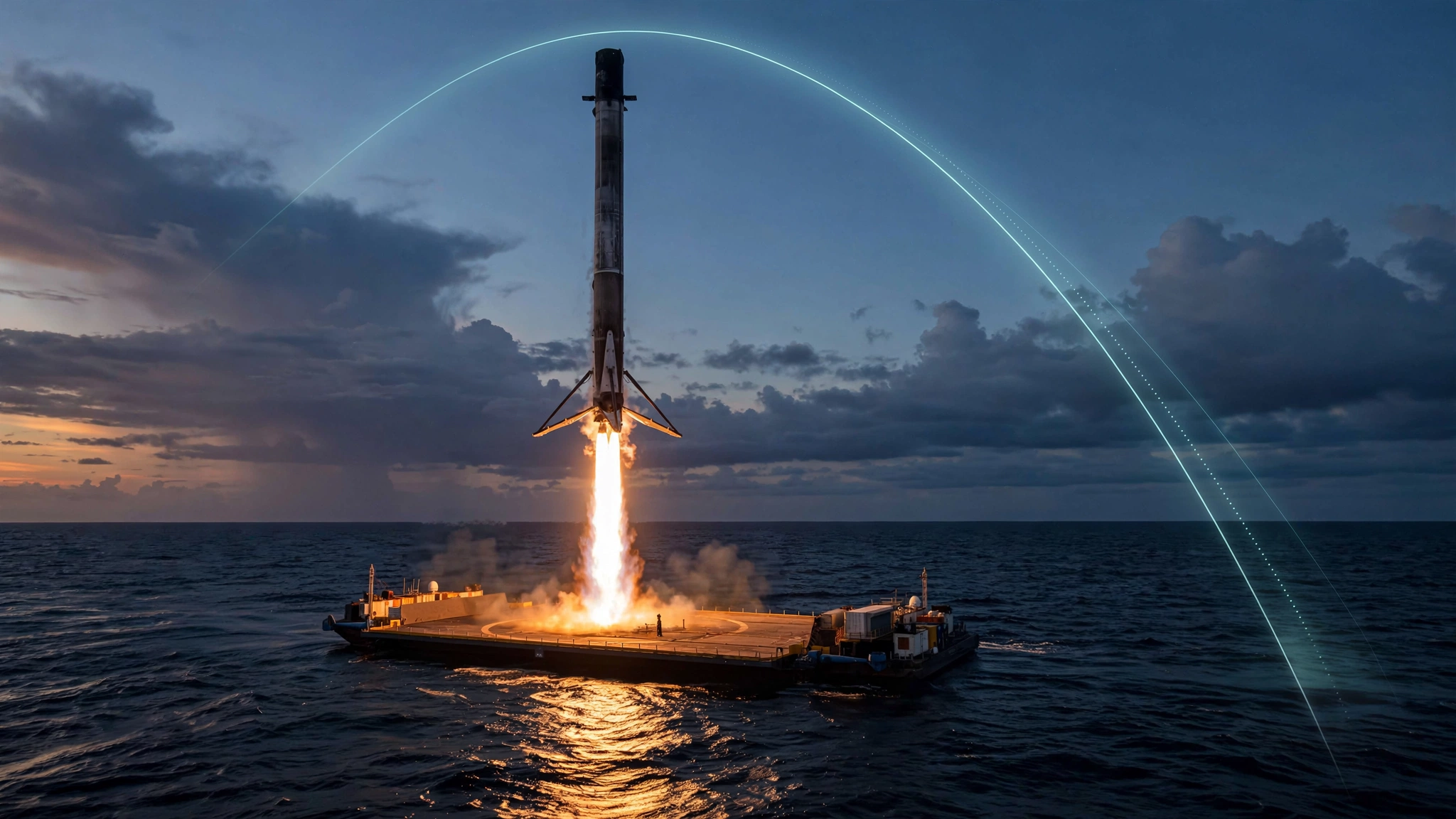
Terzi's team found a "structural acceleration" around 2010, the year SpaceX introduced its Falcon 9 rocket. Before that, costs fell slowly. During the Space Shuttle era they actually increased on a per-kilogram basis. After Falcon 9 began flying, and especially after SpaceX demonstrated booster reuse in 2017, the learning curve steepened dramatically. Payload launched to orbit has grown roughly 31% annually since 2020, compared to a languid 4% between 2000 and 2019.
An East India Company Problem
Here is where the story turns uncomfortable. SpaceX now handles approximately 75% of all payload sent to orbit. Its Falcon 9 alone launches about 150 times a year, roughly three times a week. No other entity in the history of spaceflight has controlled this much of the market, and Terzi makes an extraordinary comparison: SpaceX's dominance of orbital transport exceeds the East India Company's share of shipping to the East Indies at the Company's peak in the 19th century.
This matters because learning curves describe cost, not price. SpaceX's costs have plummeted, but what it charges is a different number entirely.
Consider the Falcon 9. SpaceX has reused individual boosters more than twenty times. After years of reuse optimization, the vehicle's internal cost per launch is estimated by industry analysts at $15-20 million. At 22,800 kilograms to LEO, that works out to roughly $660-880 per kilogram in internal cost. SpaceX charges $67 million for a dedicated Falcon 9 launch, about $2,700 per kilogram. A price-to-cost ratio of 3 to 4.
That premium is what monopoly economics predicts. "A profit-maximising quasi-monopolist will have a strong incentive to charge higher prices to potential clients," Terzi's team writes, "and some evidence already points in this direction. This in turn will reduce the total payload sent to orbit, and therefore affect the future evolution of average launch costs."
In other words, the learning curve says space should be getting cheap. But the market structure says savings aren't reaching customers at the rate they should. That is not a failure of physics but a success of market power.
Competition That Isn't
An obvious counterargument is competition. China's Long March 10B successfully recovered its booster via a sea-based net capture system on July 10, making China only the third entity, after SpaceX and Blue Origin, to land an orbital-class rocket. CASC plans to refly that same booster before year's end. Rocket Lab, Relativity Space, and half a dozen Chinese commercial startups are building reusable vehicles.
But the pricing data tells a different story. Rather than falling, competitor prices have actually increased. Rocket Lab's Electron went from $7 million to $8-10 million per flight. Firefly Aerospace's Alpha climbed from $15 million to $19 million. Virgin Orbit hiked from below $10 million to $12 million before going bankrupt in 2023. SpaceX's own rideshare prices on its Transporter missions have increased from $1 million to $2.5 million per slot.
China's booster recovery was a genuine technical achievement, but Bernstein's analysts noted it came "roughly six months earlier than anticipated," acknowledging that even optimistic Wall Street timelines had China years behind SpaceX's operational cadence. China has recovered a booster once; SpaceX has done it hundreds of times. Bridging the gap between a demonstration and a production system takes billions of dollars and decades of institutional knowledge.
A $2 Trillion Bet
SpaceX's IPO on June 12, 2026, the largest in history at $85.7 billion raised, was priced at $135 per share, valuing the company at $1.75 trillion. It briefly reached $2.67 trillion before settling back near its offering price at $139 as of mid-July. At 94 times its 2025 revenue of $18.67 billion, with a net loss of $4.94 billion last year, SpaceX is valued like a company that has already won.
Morgan Stanley analyst Adam Jonas models 50 Starship launches in 2027, rising to 6,000 by 2040. That final number represents 600,000 metric tons of payload per year — more than ten times everything humanity has put into orbit across our entire history, combined, every single year. Producing 6,000 Starship-class flights would require a fleet of 200+ vehicles, powered by roughly 8,000 Raptor engines annually. For context, Boeing and Airbus suppliers struggle to build 3,000 turbofan engines per year for all of commercial aviation.
SpaceX's IPO deck, titled "Building the Infrastructure of the Future," lays out the cost trajectory: historical average of $18,500 per kilogram, down to $2,700 with Falcon 9, $1,400 with Falcon Heavy, and a target of 99% reduction with mature Starship operations. That implies roughly $27 per kilogram, a number that, if achieved, would make orbital access cheaper per kilogram than FedEx overnight shipping across the United States.
Where Each Threshold Opens a Market
Different industries become viable at different price points. Using the 30% learning rate and Morgan Stanley's launch projections, we can map when each cost threshold gets crossed and what it unlocks:
| Cost Threshold | Projected Timeline | What It Unlocks | Addressable Market (2040) |
|---|---|---|---|
| $1,000/kg | 2028–2030 | Mega-constellations as commodity infrastructure; space tourism below $100K/person | $200B+ |
| $500/kg | 2032–2035 | In-orbit manufacturing of fiber optics, pharma, exotic alloys; self-sustaining commercial stations | $63B (Research & Markets) |
| $100/kg | 2038–2042 | Orbital data centers; space-based solar power demos; premium intercontinental transport | $39B (orbital compute alone) |
| $10/kg | 2045+ | Lunar construction; mass space tourism at airline prices; industrial asteroid surveying | $1.8T (WEF total space economy) |
These projections assume the learning curve continues at its historical rate and that launch cadence follows Morgan Stanley's ramp. Both are big assumptions. Growth could decelerate as the easy engineering gains are captured, or it could accelerate as Starship's full reusability pushes the curve even steeper. There are also no guarantees on demand: at some point, you have to find customers who want to put things in orbit at the volumes these projections require.
What a Monopoly Premium Means
A more interesting uncertainty is the monopoly premium. If SpaceX achieves $27 per kilogram in internal cost but charges $500, the space economy develops at one pace. If it charges $50, the space economy develops at a radically different pace. Terzi's comparison to the East India Company is not merely colorful — it is structurally precise. Both the VOC and EIC controlled trade routes and set prices that maximized their returns, not the volume of goods shipped. SpaceX faces the identical strategic choice.
Its S-1 filing lists 36 pages of risk factors, including the frank admission that it may never become profitable. But the real risk is not financial; it is structural. If SpaceX uses its monopoly position to maximize revenue per kilogram rather than volume, the space economy develops slowly even as the technology improves. Benefits from the learning curve stay inside one company's margins rather than flowing into the broader economy.
Limitations
This analysis relies on Terzi's published data endpoints rather than the full 4,000-launch dataset, which remains a working paper (mimeo). Our learning rate calculation of ~30% per doubling is derived from aggregate data; the actual rate varies by era, with the post-2010 acceleration likely producing a steeper curve than the pre-Falcon 9 period. SpaceX's internal costs are analyst estimates, not disclosed figures; the company's S-1 does not break out per-launch costs. Threshold timeline projections assume the historical learning rate holds, but there is no guarantee: regulatory friction, demand saturation, or SpaceX's own pricing strategy could slow the trajectory. China's Long March 10B recovery is a single demonstration, not a production capability; extrapolating from it requires optimism about CASC's industrial scaling.
Strongest Counterargument
Monopoly pricing is temporary. SpaceX faces real competitive pressure from China's state-funded programs (which do not need to profit), from Blue Origin's New Glenn (partially reusable, operational), and from a dozen commercial ventures backed by serious capital. China's successful booster recovery, six months ahead of Wall Street's timeline, suggests the gap is narrowing faster than incumbents expect. If China achieves routine reusability and uses state-subsidized pricing to undercut SpaceX on commercial contracts, much the way Chinese solar manufacturers undercut Western panels, the monopoly premium disappears. Even the East India Company lost its monopoly.
That is a real scenario. But it requires China to go from one successful recovery to hundreds of routine ones, which took SpaceX about seven years after its first Falcon 9 landing in 2015. State subsidies accelerate timelines but do not eliminate engineering physics.
Bottom Line
Physics of space access are improving faster than almost any technology humans have ever developed. Economics of space access are improving more slowly, bottlenecked by a market structure in which one company sets the price for 75% of all orbital transport. For everyone who is not SpaceX, the actionable question is not when launch costs hit $100 per kilogram. Wright's Law says they will. It is when competition forces the price to follow the cost.
If you are investing in space-adjacent industries (orbital manufacturing, satellite services, space-based solar), model for the price curve, not the cost curve. They are diverging, and the gap is where SpaceX's $2 trillion valuation lives. If you are a government building sovereign launch capability, Terzi's data says the learning rate rewards volume: every doubling of your cumulative launches drops your costs by 30%, but you need to actually launch, not just build rockets. If you are a SpaceX shareholder, the risk is not that the technology fails. It is that the monopoly premium eventually gets competed away, and a company valued at 94x revenue is suddenly a 10x revenue company with great rockets and normal margins.
Wright's Law does not care who owns the rockets. It just says that more launches mean cheaper launches. Whether the market will let that happen is a different equation entirely.