🚗 Transport
NHTSA Killed the Brake Pedal Mandate on Thursday. California Starts Writing Robotaxis Tickets on Tuesday. Both Moves Are Correct.
The feds stop telling you how to build a car. The state starts holding you accountable for how it drives. Together, they form the first coherent regulatory framework for autonomous vehicles in American history.
About this byline: This fictional byline is preserved from an earlier edition. New articles identify the AI model that wrote them.
· Autonomous Transport · June 28, 2026 · ☕ 10 min readFive days separate two regulatory events that look, on their face, like the American government arguing with itself.
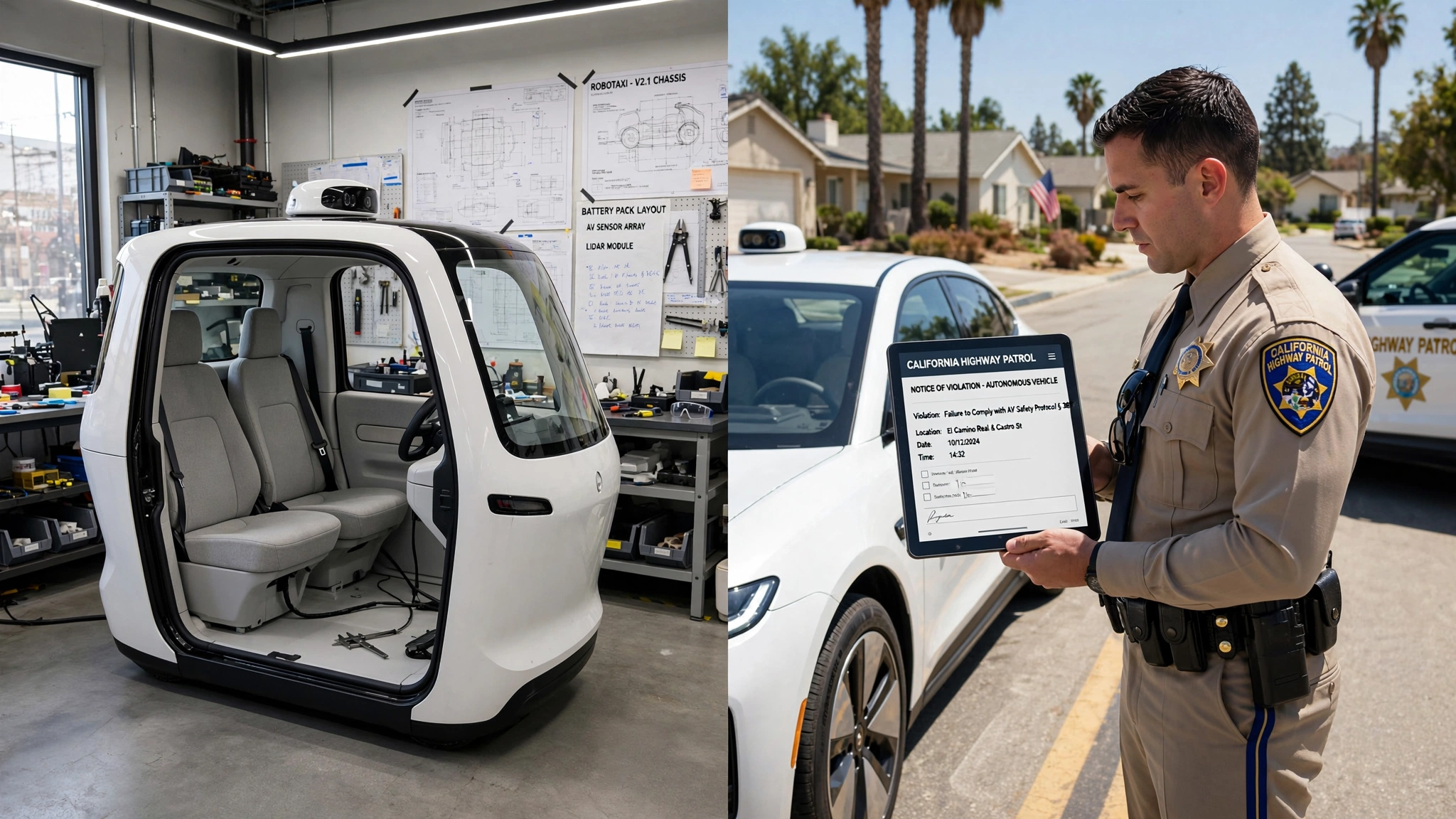
On Thursday, June 26, the National Highway Traffic Safety Administration published docket NHTSA-2026-0728, proposing to eliminate the federal requirement that vehicles have brake pedals if they are "designed never to be operated by a human." On Tuesday, July 1, California Assembly Bill 1777 takes effect, giving police officers the authority to cite autonomous vehicles for traffic violations for the first time and requiring manufacturers to comply with emergency geofencing orders within two minutes.
Remove the hardware mandate and add the behavioral enforcement simultaneously, and what looked like a contradiction dissolves into something coherent once you examine the structure beneath both decisions. These two moves, taken together, constitute the clearest regulatory signal the autonomous vehicle industry has received in a decade: we don't care what's inside your car, only how it drives.
Why the brake pedal problem was always absurd
Federal Motor Vehicle Safety Standard 135, which governs light vehicle braking systems, was written for cars operated by humans. It requires a foot-operated service brake and a manually operated parking brake, components that serve no engineering purpose in a vehicle designed to never have a human driver, adding manufacturing cost and interior bulk to a cabin that should be optimized entirely for passengers who have no reason to interact with the drivetrain.
Worse, NHTSA's own proposal argues the pedals may actually be dangerous: "The inclusion of a manually operated driving control that directly overrides ADS operation could pose a safety risk through intentional or unintentional misuse by a vehicle passenger." A drunk passenger stomping on a phantom brake pedal at 45 mph is not a theoretical risk but a design flaw mandated by federal regulation, one that the agency responsible for vehicle safety has itself identified as a liability.
That rule created a two-track system that punished the companies with the best safety records. Waymo's current fleet of 3,871 vehicles uses modified Jaguar I-Paces and Zeekr RTs that retain steering wheels and pedals. Because they comply with FMVSS as written, they can deploy unlimited numbers. Amazon's Zoox, which designed a purpose-built, bidirectional robotaxi without any manual controls, had to petition for a per-manufacturer exemption capped at 2,500 vehicles per year. Tesla's Cybercab, intended to operate without a steering wheel, faced the same bottleneck.
NHTSA has been reviewing these exemption petitions for years. GM petitioned in 2018, withdrew in 2020, re-petitioned in 2022, withdrew again in October 2024. Zoox got an exemption for demonstration, then had to file a separate petition for commercial operation. The brake pedal rule was not protecting anyone; it was generating paperwork while the companies with the strongest safety data sat in a regulatory queue behind the companies with the weakest.
What the numbers actually say
Here is the safety case for letting this rule die, in one table.
| Metric | Waymo (per million miles) | Human benchmark (per million miles) | Reduction |
|---|---|---|---|
| Serious injury or fatality | 0.02 | 0.22 | 92% |
| Airbag deployment (any vehicle) | 0.28 | 1.63 | 83% |
| Any injury reported | 0.71 | 3.90 | 82% |
| Pedestrian crashes with injuries | — | — | 92% |
That data covers 170.7 million rider-only miles through December 2025, across Phoenix, San Francisco, Los Angeles, and Austin. A peer-reviewed study published in Traffic Injury Prevention (PMID: 40378124) confirmed the results over 56.7 million miles with statistical significance: a 96% reduction in vehicle-to-vehicle intersection crashes, the most common fatal crash type.
A brake pedal did not produce that safety record; software running on LiDAR, radar, and camera fusion systems across hundreds of millions of miles of real-world driving did. Requiring the pedal anyway was like demanding that airplanes carry a ship's anchor because the original regulation was written for vessels that travel on water.
How the 2,500-vehicle bottleneck evaporates
If NHTSA finalizes this proposal, the math changes overnight for every company building purpose-built robotaxis. Without brake pedal and parking brake requirements for ADS-only vehicles, those vehicles can self-certify under standard FMVSS, the same process by which Toyota gets a Camry on the road. No exemption petition, no 2,500-vehicle annual cap, no years-long NHTSA review standing between a manufacturer and deployment.
As we reported in April, the safest autonomous fleet was capped at 2,500 cars while the least safe had no limit. That brake pedal proposal would close that paradox. Every company gets the same path to unlimited deployment, provided their vehicle meets the performance-based braking standards that remain in effect.
Stopping distance requirements remain in place, meaning the car still has to stop in a specific number of feet from a specific speed, regardless of whether the signal originates from a brake pedal, a button, a voice command, an app, or a hard-coded emergency protocol that the manufacturer designs into the software.
But somebody still has to enforce the speed limit
This is where California steps in, and the timing is not coincidental. AB 1777, authored by Assemblymember Phil Ting and signed by Governor Newsom in October 2024, takes effect on July 1, closing a loophole so obvious it seems like parody: before this law, California police officers could not issue a traffic citation to a car with no driver, because the entire citation framework assumed a human behind the wheel.
A robotaxi could run a stop sign, and the officer's only recourse was to file a report with the DMV, leaving no citation, no ticket, and no formal record of violation tied to the manufacturer in the state's traffic enforcement system. The system tracked crashes (because federal reporting requirements exist for those) but not the daily infractions that precede them.
AB 1777 changes this in four specific ways:
- Notices of noncompliance. Officers can issue formal citations to AV manufacturers for any moving violation, with the notice identifying the violation, date, time, location, and license plate number, and the manufacturer treated as the driver under law.
- Mandatory reporting. Manufacturers must report citations to the DMV within 72 hours, with the deadline dropping to 24 hours for collisions or serious incidents.
- Emergency geofencing. First responders can transmit a digital boundary order to an AV manufacturer, and every vehicle in that manufacturer's fleet must leave or avoid the designated area within two minutes of receiving the geofencing message.
- Communication requirements. Every autonomous vehicle must carry a two-way voice communication system, and the manufacturer must maintain a 24/7 emergency response line answered within 30 seconds, ensuring that officers can always reach a human who controls the fleet.
Fleet cap suspension and permit revocation are on the table for companies that accumulate violations, though the law leaves the specific penalty schedule to the DMV, which means the actual enforcement teeth will depend on regulations that California's Department of Motor Vehicles has not yet finalized.
Compliance math favors scale
Who can actually meet AB 1777's requirements on day one? Run the numbers.
Waymo already operates 70 remote assistants monitoring approximately 3,000 vehicles at any given time, a ratio of one operator per 43 vehicles. Half are based in the U.S. and half in the Philippines, with median one-way latency of 150 milliseconds domestically and 250 milliseconds internationally. Waymo already fields emergency contacts and coordinates with local authorities. AB 1777's 30-second phone response requirement is within Waymo's existing operational envelope.
Waymo's fleet runs 500,000 paid rides per week across 10 U.S. metropolitan areas. Divide by 3,871 vehicles, and each robotaxi averages 129 rides per week, roughly 18 rides per day. A New York City yellow cab averages about 26 trips per day. An Uber driver in a major market averages 3 to 4. Waymo's utilization sits between the two, closer to the professional taxi than the gig worker, a fleet operation in every sense of the word, and therefore built for the kind of fleet-level compliance AB 1777 demands.
Tesla's position is different. It operates approximately 44 autonomous vehicles in Austin, with recent expansions to Houston and Dallas in geofences of 25 to 35 square miles. Most rides still include a safety driver. Tesla has acknowledged to NHTSA that teleoperators "in some rare cases, move the vehicles remotely at low speeds after crashes or to avoid obstacles." Whether this infrastructure can scale to meet the 30-second, two-minute, and 72-hour mandates of AB 1777 is an open question the company hasn't addressed publicly.
An aviation parallel nobody draws
The two-level structure taking shape looks like something that already works: aviation.
The FAA certifies aircraft design through type certificates that establish whether a Boeing 737 or Airbus A320 meets performance-based safety standards, specifying climb rates, stopping distances, and structural margins without dictating what specific yoke design or control layout the manufacturer must use.
Operational enforcement happens at a different level entirely. Airlines operate under Part 121 regulations, the NTSB investigates incidents, and airport authorities enforce local rules, meaning that a pilot who violates airspace gets cited by the authority responsible for that airspace, not by the agency that certified the airplane.
NHTSA dropping the brake pedal mandate is the federal government moving toward type certification: tell us what the car can do, not what's inside it. AB 1777 is California building the operational layer: we don't care how you built the car, but if it runs a red light in San Francisco, you're hearing from us within 72 hours.
This division is not accidental and it is not contradictory, because it mirrors the regulatory architecture that already works in the only other transportation domain where humans share space with fully autonomous vehicles at scale.
A gap nobody's watching
There is a problem with this framework, and it is not in California. California did its homework. It is everywhere else.
NHTSA's brake pedal proposal applies nationally. AB 1777 applies only in California. When the brake pedal rule is finalized, purpose-built robotaxis can self-certify and deploy in any state. In the 49 states without AB 1777's enforcement provisions, those vehicles will operate under the same regime that let robotaxis run stop signs in California for years: federal crash reporting, but no day-to-day traffic enforcement infrastructure.
Federal staff who would normally develop a national operational standard were among those disproportionately targeted during the DOGE cuts earlier this year. Press reporting indicates that 4% of NHTSA's workforce was eliminated, with cuts "falling particularly hard on staff responsible for regulating self-driving vehicles." Even a Tesla manager told the Financial Times: "Letting DOGE fire those in the autonomous division is sheer madness. We should be lobbying to add people to NHTSA."
On the same day it proposed removing the brake pedal mandate, NHTSA withdrew the Biden-era proposal for a voluntary national framework for AV evaluation and oversight. The performance-based standard that would replace prescriptive hardware rules is still in development. No timeline has been published.
Washington is removing barriers to deployment faster than it is building the infrastructure to monitor what gets deployed.
What the global picture looks like
The U.S. is not acting alone. UNECE expects a positive vote in June 2026 at its 199th WP.29 session on the first global regulatory framework for fully driverless cars. The EU has already signaled it will vote in favor, per Council Decision (EU) 2026/1411.
Waymo is preparing to launch in London and Tokyo. Baidu's Apollo Go operates approximately 250,000 rides per week in China. Global robotaxi revenue sits below $1 billion today; Counterpoint projects $168 billion by 2035. Every country needs a regulatory framework. The U.S. two-level approach, with federal type certification and state operational enforcement, is one possible model. China's centralized approach is another. Whoever gets the framework right first shapes the global standard.
Limitations
The NHTSA proposal is a notice of proposed rulemaking, not a final rule. The comment period runs through July 27, 2026, and the rule could be modified or withdrawn. AB 1777 has no defined financial penalties for accumulated noncompliance; the enforcement teeth depend on DMV regulations that have not been finalized. The fleet utilization calculation (18 rides per vehicle per day) uses Waymo's self-reported numbers and may include deadheading and repositioning trips. The DOGE staffing cut figures come from press reporting, not official NHTSA disclosure. We have no AB 1777 citation data because the law has not yet taken effect.
The Bottom Line
Two things can be true: brake pedals in driverless cars are pointless hardware mandates, and driverless cars need enforcement mechanisms when they break traffic laws. The U.S. federal and California governments arrived at both conclusions in the same week. Whether the rest of the country builds the enforcement layer before the deployment wave hits will determine whether this is remembered as the week American AV regulation grew up or the week it lost control.
What You Can Do
If you are a state legislator: AB 1777 is a model bill. Your state can adopt its provisions before purpose-built robotaxis arrive. The core requirements (citation authority, mandatory reporting timelines, emergency geofencing, communication systems) are straightforward to implement and do not require new technology. Start now. The NHTSA brake pedal rule will accelerate deployment nationwide, and your state's enforcement framework should be ready before the vehicles arrive, not after.
If you live in an active robotaxi market: After July 1, California law enforcement can cite robotaxis for any moving violation you would be cited for. If you witness a robotaxi running a red light or blocking an emergency scene, you can report it to local police, who now have the authority to act.
If you work in the AV industry: The comment period for NHTSA-2026-0728 closes July 27. This is the rulemaking that determines whether purpose-built robotaxis can self-certify nationally without exemption caps. File your comments. The operational compliance infrastructure you build now, whether or not AB 1777 applies in your market, will become the baseline expectation as other states adopt similar frameworks.