Realta Fusion Powered a Lightbulb Straight From a Fusion Reaction. The Real Story Is What It Does to the Cost Math.
On June 19, a Wisconsin startup harvested electricity directly from alpha particles escaping its WHAM fusion device, bypassing the steam turbine entirely. The CEO says the efficiency boost is 20 to 30 percent. Run the math on parasitic power, and the actual leverage on net sellable electricity is 91 percent, because direct conversion attacks the single variable that cripples first-generation fusion economics.
Ninety-one percent. That is how much net sellable electricity increases when you add direct energy conversion to a deuterium-tritium fusion reactor, according to a calculation we ran using publicly available efficiency numbers from Realta Fusion's CEO Kieran Furlong and standard thermal conversion rates from the existing fission fleet. Furlong's headline number, the one he gave TechCrunch, was 20 to 30 percent, and he was talking about total plant output, which is a useful but incomplete measure of what direct energy conversion actually buys you. We are talking about the electricity you actually get to sell after the reactor feeds itself, the number that determines whether fusion power plants make money or bleed it, and almost nobody in the fusion discourse is paying attention to the gap.
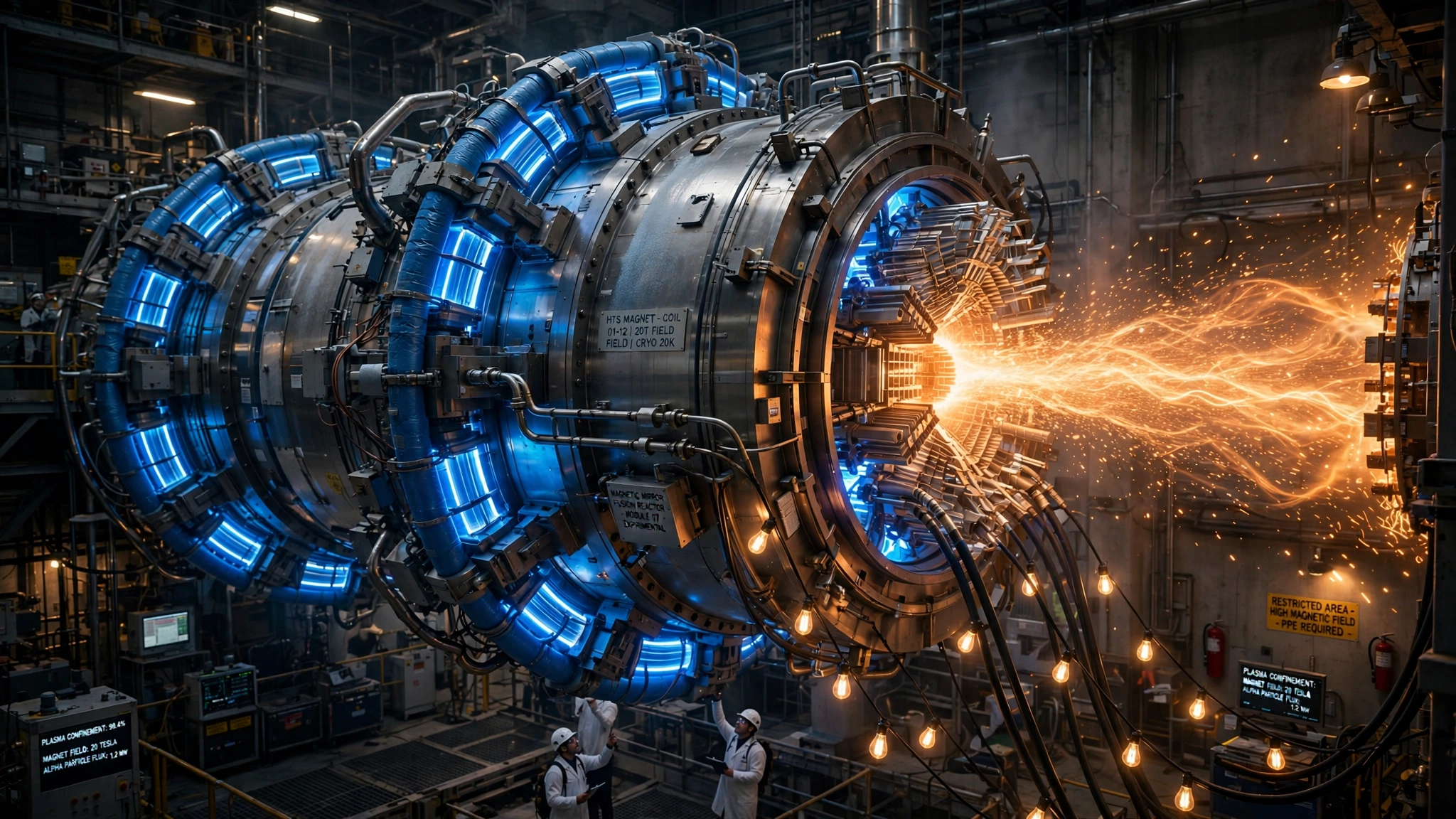
On June 19, 2026, Realta Fusion's WHAM (Wisconsin HTS Axisymmetric Mirror) device generated multiple amps of electricity at 100 volts by catching charged helium nuclei, known as alpha particles, on a prototype converter bolted to the end of the reactor. It powered a few lightbulbs, a modest demonstration by any measure, roughly the wattage of a nightlight, but it represents the first time a private company has publicly demonstrated direct energy conversion from a controlled fusion reaction. Helion Energy, the Sam Altman-backed startup valued at $15.5 billion as of June 2026, has built its entire commercial architecture around the same principle but has not yet demonstrated it publicly.
The Parasitic Power Problem Nobody Talks About
Every fusion power plant consumes a significant fraction of its own output just to stay running. Superconducting magnets need cryogenic cooling, plasma needs constant reheating through auxiliary systems, and vacuum pumps, tritium processing, instrumentation, and grid synchronization equipment all draw power. This internal consumption is called the recirculating power fraction, and it is the single most important variable separating a profitable fusion plant from an expensive science project.
A 2021 paper in Nuclear Fusion by researchers at the Dutch Institute for Fundamental Energy Research modeled this problem explicitly. Their finding: high recirculating power fraction combined with low capacity factor, which is exactly what first-generation fusion plants will face during commissioning and early operations, creates a compounding efficiency penalty that can make even a technically successful reactor commercially unviable. Parasitic load does not scale down proportionally when the plant runs below full power; it stays stubbornly high, which means a reactor operating at 60 percent capacity does not produce 60 percent of its rated net output but something far less, because the fixed parasitic load consumes a larger share of a smaller pie.
For a conventional deuterium-tritium fusion plant using tokamak geometry and steam turbines, the recirculating fraction typically runs between 20 and 30 percent of gross electric output, according to integrated cost models published by the UK Atomic Energy Authority's STEP program. That means for every 100 MW of electricity the turbine generates, 20 to 30 MW feeds back into the machine before a single watt reaches the grid.
The Math Nobody Ran
Here is where it gets interesting. In a standard D-T fusion reaction, 80 percent of the energy exits as neutrons and 20 percent as alpha particles. Under the conventional approach, neutrons hit a lithium blanket, generate heat, and drive a steam turbine at roughly 33 percent thermodynamic efficiency. Alpha particles stay trapped in the plasma and contribute to self-heating. No electricity comes from them directly, which is why, under the conventional approach, 80 percent of the fusion energy makes electricity and 20 percent merely keeps the plasma warm.
With direct energy conversion, alpha particles escape the magnetic confinement along field lines, by design in a mirror machine, and hit a converter that transforms their kinetic energy into electricity at approximately 90 percent efficiency, according to Furlong's estimates. Run both scenarios against the same 1,000 MW fusion reactor.
| Parameter | Conventional (Steam Only) | With Direct Conversion |
|---|---|---|
| Fusion power | 1,000 MW | 1,000 MW |
| Neutron energy (80%) | 800 MW thermal | 800 MW thermal |
| Steam turbine output (33%) | 264 MW electric | 264 MW electric |
| Alpha particle energy (20%) | 200 MW (stays in plasma) | 200 MW (captured) |
| Direct converter output (90%) | 0 MW | 180 MW electric |
| Gross electric | 264 MW | 444 MW |
| Parasitic load (25% of conventional gross) | 66 MW | 66 MW |
| Net sellable electricity | 198 MW | 378 MW |
| Recirculating fraction | 25.0% | 14.9% |
| Net plant efficiency | 19.8% | 37.8% |
Net sellable electricity jumps from 198 MW to 378 MW. That is a 91 percent increase, not 20 to 30 percent, because the parasitic load is roughly fixed regardless of how much gross electricity the plant produces. Adding 180 MW of direct-converted alpha power does not proportionally increase parasitic demand. Magnets still need the same cryogenic cooling whether the reactor produces 264 MW or 444 MW of gross electricity. Plasma heating load may actually decrease, since direct conversion can feed electricity straight back into the heating system at 90 percent round-trip efficiency instead of cycling through a steam turbine at 33 percent first.
This leverage effect is not unique to direct conversion. A February 2025 paper on spin-polarized fuel demonstrated the identical mathematical relationship: boosting thermal fusion power by 50 percent translates into a 90 percent increase in net electric output for compact reactor designs. Both cases share the identical mathematical relationship: when gross output rises but parasitic load stays flat, net output gets a leveraged boost that far exceeds the raw power increase. It is basic arithmetic. But in a field where most public discussion fixates on the plasma physics challenge of achieving Q > 1, the economic arithmetic of what happens after breakeven receives almost no attention.
Why Mirrors Instead of Tokamaks
Realta's WHAM device is a magnetic mirror, not a tokamak. Geometry matters for direct conversion because of how the two reactor types handle alpha particles. A tokamak is a closed doughnut where plasma circulates endlessly. Alpha particles born inside the doughnut stay inside the doughnut, depositing their energy as heat. There is no obvious place to bolt a direct converter because there is no exhaust stream of charged particles to intercept.
A magnetic mirror is an open cylinder with strong magnets at both ends. Charged particles bounce back and forth between the magnetic "mirrors." Some inevitably leak out the ends. In a tokamak, end losses are a catastrophic failure mode. In Realta's design, they are the product. Escaping alpha particles hit a converter electrode at the end of the tube and surrender their kinetic energy as electric current, which is precisely what Realta's prototype demonstrated on June 19 at lightbulb scale.
Commonwealth Fusion Systems, which has raised nearly $3 billion, more than any other private fusion company in history, is building SPARC as a tokamak. Its path to commercialization runs through steam turbines. That is not wrong, but it is a different bet. CFS is betting that brute-force magnetic confinement with high-temperature superconducting magnets will produce enough raw fusion power that 33 percent thermal efficiency and 25 percent parasitic load are tolerable. Realta is betting that a geometrically simpler machine with direct conversion will produce less raw power but keep more of it.
The Nature Energy Problem
In April 2026, a team from ETH Zurich published a study in Nature Energy estimating that fusion power plants have an experience rate of just 2 to 8 percent, meaning that every doubling of cumulative deployed capacity reduces cost by only 2 to 8 percent. Solar PV's experience rate is 23 percent, lithium-ion batteries sit at 20 percent, and both technologies achieved transformative cost reductions within a single generation. Their conclusion: fusion is "unlikely to become competitive" with other clean energy technologies, with first-of-a-kind capital costs ranging from $1,400 to $43,000 per kilowatt.
Their analysis assumed conventional plant architectures. It did not model what happens when direct energy conversion cuts the recirculating fraction from 25 percent to 15 percent. This omission matters because the LCOE of a fusion plant is exquisitely sensitive to net plant efficiency. At 19.8 percent net efficiency, a plant with $10,000/kW capital cost and 85 percent capacity factor produces electricity at roughly $134/MWh. At 37.8 percent net efficiency from the same capital investment, identical fuel costs, identical maintenance, the LCOE drops to $70/MWh. That is a 48 percent reduction in the cost of electricity from a single engineering change that adds modest hardware, an electrode array and power electronics, to the end of the reactor.
No amount of experience-rate-driven cost learning delivers a 48 percent LCOE reduction. At 5 percent experience rate, you would need roughly 13 capacity doublings to achieve the same cost reduction, starting from a 500 MW first plant and building to 4,096 GW of global deployed fusion, which is approximately 6 times current global electricity generation capacity. Direct conversion gets there with one reactor design change.
Limitations
Three assumptions in this analysis deserve scrutiny. First, the 90 percent direct conversion efficiency is Realta's own claim from a lightbulb-scale demonstration. No independent laboratory has verified this efficiency at any power level approaching commercial relevance. Scaling from 100 watts to 100 megawatts while maintaining 90 percent conversion is an engineering problem of a completely different character, involving electrode materials that survive sustained bombardment by 3.5 MeV alpha particles, power electronics that handle megawatt-scale pulsed current, and thermal management for the converter itself. If real-world efficiency drops to 60 percent instead of 90 percent, the net output boost falls from 91 percent to 45 percent. Still meaningful, but half the leverage.
Second, we held parasitic load constant at 66 MW (25 percent of conventional gross output). In practice, a mirror machine may have different parasitic requirements than a tokamak because magnetic mirror confinement is inherently less stable, potentially requiring more active control power. If parasitic load scales with gross output rather than staying flat, the leverage effect diminishes sharply.
Third, magnetic mirrors were the dominant US fusion approach from the 1950s through the early 1980s before being abandoned in favor of tokamaks. Physics killed them: end losses and velocity-space instabilities made it extraordinarily difficult to maintain plasma confinement long enough for sustained fusion, and the field moved on to tokamaks, which closed the geometry and eliminated the end-loss problem entirely. Lawrence Livermore's Mirror Fusion Test Facility cost $372 million in 1986 dollars, ran for one hour of total experimental time, and was mothballed. Realta's high-temperature superconducting magnets, which achieved a 17 Tesla field in 2024 with hardware supplied by CFS, address some but not all of the historical mirror instability problems. Whether they address enough is an open question that a lightbulb-scale experiment cannot answer.
The Strongest Case Against
Consider the strongest case against this bet. CFS expects SPARC to demonstrate net energy gain in late 2026 or early 2027, and it already has a power purchase agreement with Google for half the output of its planned 400 MW commercial plant, ARC, to be built near Richmond, Virginia. If SPARC works, the tokamak-plus-steam-turbine path delivers commercial fusion electricity within a decade using proven thermal conversion technology and an industrial supply chain that already exists for fission plants. A 25 percent recirculating fraction and 33 percent thermal efficiency are the same numbers that nuclear fission has operated with profitably for 60 years, which suggests they are commercially viable, if unexciting.
By contrast, Realta has raised $36 million, has no power purchase agreement, and demonstrated its technology at a scale roughly 100,000 times smaller than commercial relevance. WHAM is a university research instrument at UW-Madison's Physical Sciences Lab in Stoughton, Wisconsin, not an industrial prototype. Choosing Realta over CFS on the basis of this analysis would be like choosing a hand-cranked generator over a gas turbine because the hand crank has lower parasitic losses. Scale matters, demonstrated physics matters, and CFS has both in greater quantity.
What You Can Do
If you model fusion power plant economics for investment, policy, or grid planning purposes, add the recirculating power fraction as an explicit variable in your cost models. Most published LCOE projections for fusion treat thermal efficiency and capacity factor as the primary economic levers. That 2021 Dutch Institute paper demonstrates that recirculating fraction interacts multiplicatively with capacity factor, meaning that it is not an additive correction but a compounding one, which is why any reactor design that reduces recirculating fraction by 10 percentage points deserves disproportionate weight in cost models relative to designs that increase fusion gain by the same margin.
If you allocate R&D funding, Realta's lightbulb-scale demonstration of direct conversion has now graduated direct energy conversion from theoretical curiosity to demonstrated principle. Worth funding next is a converter that operates at kilowatt scale with measured efficiency under sustained alpha bombardment, a test that would validate or invalidate the 90 percent claim that the entire economic case rests on and could be designed and executed for less than $10 million, which is a rounding error in the context of the $7.2 billion the Fusion Industry Association has tracked flowing into the sector through 2025.
If you are evaluating Helion's $15.5 billion valuation, note that Helion's commercial architecture depends on direct energy conversion from D-He3 fuel, and Helion has not demonstrated direct conversion publicly. Realta just did. Helion's Polaris machine reached 150 million degrees Celsius with fusion fuel, which is a plasma physics milestone, but the company's claim to a differentiated cost structure rests entirely on a conversion technology that a $36 million startup in Wisconsin demonstrated first.
The Bottom Line
Realta Fusion lit a lightbulb with electricity harvested directly from a fusion reaction, and most coverage focused on the lightbulb. It should have focused on the math. Direct energy conversion at 90 percent efficiency does not add 20 to 30 percent to a fusion plant's total output, as Furlong conservatively stated. It nearly doubles the net sellable electricity, from 198 MW to 378 MW on a 1,000 MW reactor, by slashing the parasitic power fraction from 25 percent to 15 percent. A 2026 Nature Energy study concluded that fusion is unlikely to become cost-competitive based on conventional plant architectures and low experience rates. That conclusion rests on an assumption about plant efficiency that direct conversion may invalidate. But that word "may" is doing heavy lifting in this paragraph. Realta's demonstration is at nightlight scale. Its magnetic mirror approach was abandoned by the US fusion program 40 years ago for good physics reasons. And the 90 percent efficiency number that makes the entire economic case is unverified at commercial power levels. But the arithmetic is the arithmetic. If the conversion efficiency holds at scale, the LCOE of a fusion plant drops 48 percent from a single engineering change. No experience-rate curve in the history of energy technology has ever delivered that kind of cost reduction without building thousands of plants first.