💻 Quantum
Quantum's Error-Correction Bill Just Fell 97%: 3,000 Physical Qubits Instead of 100,000
Combining three recent error-correction results into one bill of materials shows a 100-logical-qubit machine may need 3,000 physical qubits instead of the industry-standard 100,000, with logical error rates up to 1,000 times lower at that footprint.
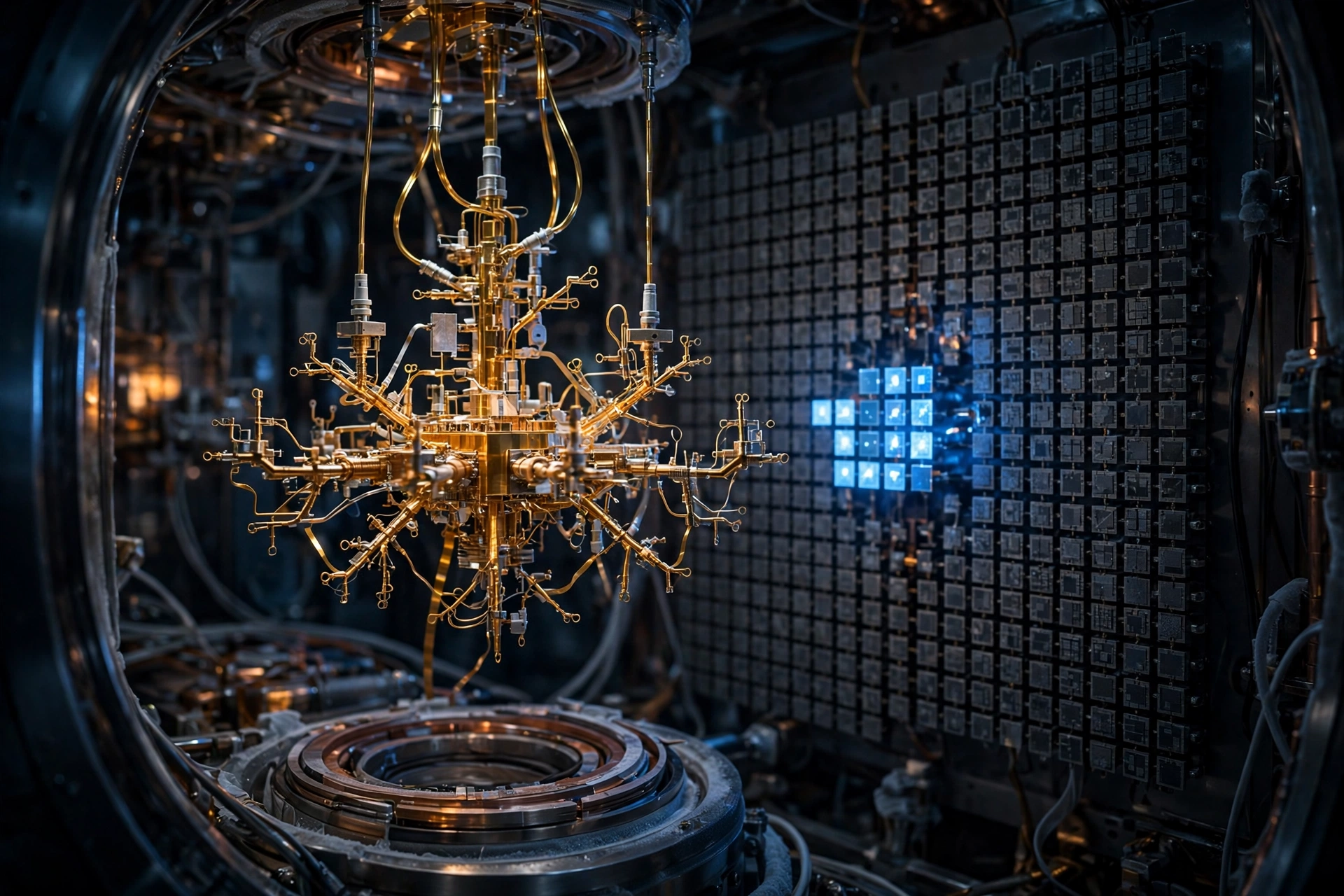
One hundred thousand physical qubits. For years, that was the unofficial price of a useful quantum computer: roughly a thousand finicky superconducting qubits sacrificed to protect every single reliable one. Three papers from the last nine months just repriced the bill, and nobody combined their numbers into one total until now.
Run the same machine through the new codes and the total comes out to about 3,000 physical qubits for a 100-logical-qubit machine, at logical error rates up to 1,000 times lower than the surface code achieves at the same footprint. That is a 97 percent reduction in the qubit bill. It is also, for now, a simulation. Read both sentences before picking one.
A Calculation Nobody Ran
Here is the full bill of materials, with every input named so you can audit it.
Take a 100-logical-qubit machine as the target. QuEra has publicly set that size as its 2026 goal, the point at which, it says, correct calculations exceed the capability of today's supercomputers.
Under the surface code, the industry's workhorse, useful fault tolerance is conventionally planned at roughly 1,000 physical qubits per logical qubit, the figure behind Google's roadmap of a million physical qubits for a thousand logical ones. Multiply. One word, and it hurts. 100 logical qubits times 1,000 physical each equals 100,000 physical qubits.
In June 2026, researchers at IQM Quantum Computers and collaborators at Freie Universität Berlin, the University of Edinburgh, and Johannes Gutenberg University Mainz published directional tile codes, a family of quantum low-density parity-check (qLDPC) codes that compile onto ordinary square-grid superconducting hardware using only nearest-neighbor iSWAP gates, the gates already native to IQM's Crystal processors. Their circuit-level simulations report that at around 30 circuit qubits per logical qubit, the best layouts cut the per-logical per-round logical error rate by up to a factor of 1,000 relative to rotated surface-code memories. One concrete instance, [[323,14,15]], works out to about 23 physical qubits per logical, with a code-efficiency ratio nearly ten times that of rotated surface-code patches.
Multiply again: 100 logical qubits times 30 physical each equals 3,000 physical qubits. Subtract: 100,000 minus 3,000 leaves 97,000 qubits, a 97 percent cut, and if you prefer the [[323,14,15]] instance's 23-to-1 ratio the bill drops to roughly 2,300, which is the kind of number that rewrites a decade of roadmaps in a single afternoon.
That is the original finding of this article. Three headline results, one machine-scale number nobody published, and the number says the field has been budgeting for the wrong hardware.
Why the Bill Collapsed
Three results converged, starting with Google Quantum AI's Willow result, which established the baseline the hard way: on real hardware. Its distance-7 surface code ran on 101 qubits with a logical error of 0.143 percent per cycle, and each increase in code distance suppressed errors by a factor of 2.14, the textbook signature of below-threshold operation. Even the logical memory outlasted the best individual physical qubit, by 2.4 times, with no asterisks attached.
Second, the IQM directional tile codes broke the trade-off everyone assumed was fundamental, because surface codes fit superconducting hardware beautifully but waste qubits while most qLDPC codes save qubits yet demand long-range connectivity or shuttling that superconducting chips cannot provide. Here is the trick: the iSWAP gate's exchange character lets stabilizers be measured as nearest-neighbor walks that move quantum information through the plane while generating the needed check-data interactions, and the role of check and data qubits swaps each round, which naturally flushes leakage from the system. Code efficiency survives compilation to strictly planar circuits, which is genuinely new.
Third, and quietest, a passive error-correction scheme finally reached breakeven when Shruti Shirol's group at UMass Amherst encoded a qubit in a microwave cavity where the photon number's parity flips whenever a photon escapes and a coupled qubit automatically injects a replacement. No monitoring, no feedback loops, just engineered dissipation flushing entropy out of the system. Their encoded qubit lived 196 microseconds, 2.15 times longer than the uncorrected code and 1.05 times longer than the longest-lived physical qubit, and published in Physical Review X, it is the first time any passive scheme has hit breakeven, the point where encoding more particles stops being a net loss.
| Approach | Physical per logical | Physical total | Error quality | Status |
|---|---|---|---|---|
| Surface code (planning figure) | ~1,000 | 100,000 | Baseline | Demonstrated on hardware (Willow) |
| Directional tile codes | ~30 | 3,000 | Up to 1,000x lower logical error per round vs surface code | Circuit-level simulation |
| [[323,14,15]] instance | ~23 | ~2,300 | Code efficiency ~10x rotated surface patches | Circuit-level simulation |
| Passive QEC (cavity) | n/a | n/a | 1.05x longest-lived physical qubit (breakeven) | Demonstrated on hardware |
The Strongest Case Against This Story
The steel-manned objection, at full strength, is this: the 1,000-fold improvement and the 3,000-qubit bill are simulation results, and simulations are where quantum claims go to look impressive before hardware humbles them. Gu et al.'s numbers come from circuit-level simulations, which idealize away correlated errors, leakage accumulation, and the decoder-latency wall that real-time fault tolerance hits on real chips. That qLDPC advantage is measured in the finite-size, near-term regime at about 30 qubits per logical; extrapolating it to the 10^-12 to 10^-15 logical error rates that useful algorithms demand is precisely the leap the simulations do not make. Decoders for qLDPC codes are also substantially harder to run in real time than surface-code decoders, which have three decades of tooling behind them. Google's below-threshold result, by contrast, is hardware with a real-time decoder at distance 5 and distance 7. One of these is a roadmap; the other is a result.
A business asterisk also applies. IQM announced its breakthrough on June 23, 2026, while preparing a Nasdaq listing through a merger with Real Asset Acquisition Corp., a SPAC. IQM's press release explicitly frames the research as advancing "a core pillar of its technology roadmap." A thousand-fold error reduction is also a thousand-fold marketing multiplier. Treat company-announced simulation results like company-announced simulation results.
What This Analysis Did Not Prove
Here are the honest boundaries: that 1,000-to-1 surface-code overhead is an industry planning figure, not a measured constant, since real requirements run 1,000 to 10,000 physical per logical depending on the target error rate and the chip's physical error rate. IQM's comparison is "up to" 1,000x at "around" 30 qubits per logical: best-case layouts, and typical layouts do worse. Passive-QEC breakeven covers photon-loss errors in a microwave cavity, not the full error zoo, and 196 microseconds remains far from the millisecond-scale coherence that deep algorithms need; Chen Wang, the group's lead, says passive and active approaches will have to combine. None of the directional-tile results have been demonstrated on actual IQM Crystal hardware as of publication, and the bill-of-materials math assumes the 30-qubit-per-logical footprint scales linearly to 100 logical qubits, which the simulations suggest but have not proven.
What You Can Do
If you evaluate quantum timelines for a living, the actionable change is a metric swap, because every roadmap still priced at 1,000 physical qubits per logical is now carrying a number the June 2026 results may have just obsoleted. The number to demand from every vendor is now logical error rate per round per logical qubit at a stated physical footprint, measured on hardware, with the decoder running in real time. Any roadmap that only quotes total physical qubit counts, without stating the logical error rate those qubits can sustain, is selling you the old price list.
If you build error-correction codes, the lesson is architectural: qLDPC designs that survive compilation to nearest-neighbor planar circuits are the ones that matter for superconducting hardware. Asymptotic code performance is irrelevant if the connectivity tax eats it, so co-design with the chip, or lose to someone who did.
For everyone else, the signal to watch is one binary event: a directional tile code, or any qLDPC family, demonstrated below threshold on real hardware. Until that happens, the 97 percent discount is a futures contract. Watch IQM's roadmap milestones toward its stated 2030 fault-tolerance target, and treat each one as the market repricing a claim into a fact, or exposing it as a simulation.
The Bottom Line
The tax. Quantum computing's hardest problem was never building more qubits; it was the brutal tax on turning shaky physical qubits into trustworthy logical ones. Two 2026 results attacked that tax from opposite ends: IQM's directional tile codes say the tax can fall 97 percent in simulation, and UMass Amherst's passive scheme says self-healing qubits can finally break even on real hardware. Combined into one bill for a 100-logical-qubit machine, the math says 3,000 physical qubits where the industry budgeted 100,000. Strip it down and the honest version is narrower: no one has built it yet, the headline advantage is simulated, and the company that announced it is heading to the public markets, but the direction is unmistakable: every quantum roadmap of the last decade was priced against a qubit budget that is being rewritten, and the new number is an order of magnitude smaller than the old one.