1.46 Million Japanese Have Withdrawn From Society. 30% of Americans Have Left Religion. The Meaning Crisis Is One Problem With Two Symptoms.
Work provides structure, identity, community, purpose, and status. UBI replaces only the paycheck. Retirement studies, hikikomori data, and the collapse of religious participation reveal a mounting meaning deficit that no cash transfer can fix—and a market forming around whoever fills it.
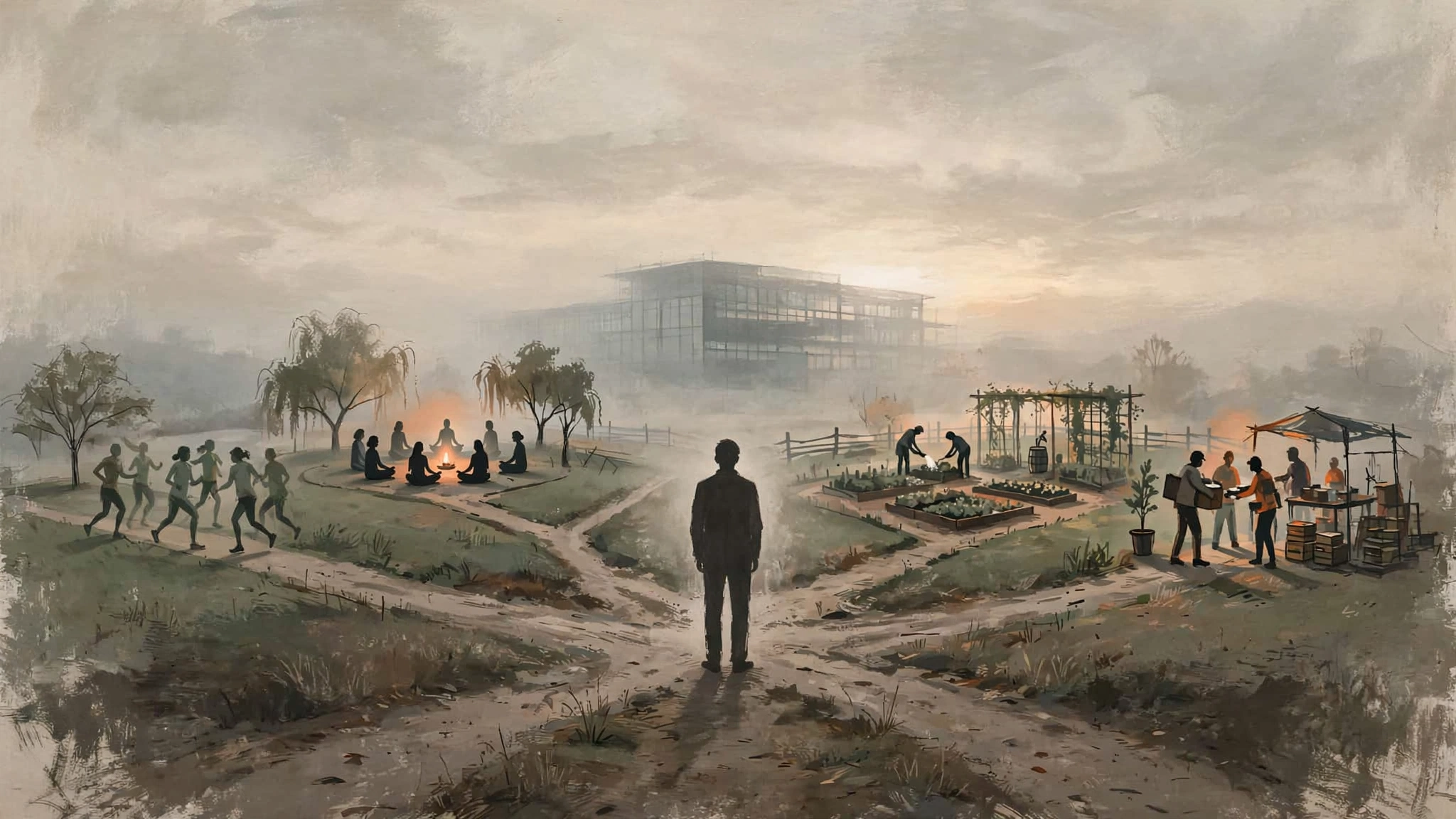
Two percent of Japanese people aged 15 to 64 have effectively stopped participating in society. The Japanese Cabinet Office's 2022 survey estimated 1.46 million hikikomori, people who rarely leave their homes and avoid nearly all social interaction outside their families, and the number grew during the pandemic, though the trend predates COVID by decades. Meanwhile, the share of Americans claiming no religious affiliation nearly doubled from 16% in 2007 to 31% by 2022, according to Pew Research Center data, and only 30% of U.S. adults now attend religious services regularly, down from 42% two decades ago. These are different phenomena in different cultures, but they share a root cause: the institutions that once provided meaning are failing, and nothing has replaced them at scale.
The conversation about AI displacing workers typically fixates on income, with UBI proposals dominating the policy response, but the evidence from people who have already lost work involuntarily suggests that money addresses the smaller half of the problem.
What Work Actually Provides
A Korean longitudinal study tracking 10,233 older adults across seven waves of survey data found that depressive symptoms showed no notable change before retirement but rose sharply afterward, persisting for more than four years among those with low social engagement. The distinction between voluntary and involuntary departure matters enormously: a separate 14-year panel study found that involuntary retirees experienced a pronounced spike in depressive symptoms peaking around the first year, while voluntary retirees saw symptoms decline within two years. A European study using SHARE data across multiple countries reported that suicidality risk increased 30% from five to nine years after retirement and 47% after ten years, suggesting that the psychological damage of worklessness compounds rather than fades.
These studies converge on a framework in which work provides at least five distinct psychological goods: daily structure (when to wake up and where to go), social identity (what you tell people you "do"), community (the people you see regularly because proximity demands it), purpose (a reason your effort matters to someone beyond yourself), and status (a legible position in a hierarchy that others recognize). Retirement and unemployment eliminate all five simultaneously, while UBI addresses none.
Finland's basic income experiment made this concrete. Between 2017 and 2018, 2,000 unemployed Finns received €560 per month with no conditions, and recipients reported a 37% reduction in depression levels, a 22% improvement in confidence, a modest 2.8 percentage point increase in employment, and a 1.6 percentage point drop in psychotropic medication use. But once the experiment ended, most outcomes converged back to control-group levels, revealing that the mental health improvements were tethered to the cash flow rather than to any durable change in structure or social connection. The Stockton SEED trial echoed this pattern, and in Kenya, GiveDirectly's UBI program found recipients were less depressed (43.7% of the control group scored as clinically depressed versus lower rates among recipients), confirming that cash reliably reduces acute poverty stress without rebuilding the social architecture that employment provides.
The Meaning Components and Who Fills Them
Original contribution: Decomposing work's psychological goods into five categories makes it possible to map which existing institutions partially address each one and to estimate the commercial scale of those substitutes.
Structure is the easiest component to replace commercially, addressed by fitness programs with fixed schedules including Peloton's live class format, CrossFit's daily WOD rotation, and gym class bookings that impose temporal discipline on participants who might otherwise drift through unstructured days. The global fitness industry generates roughly $96 billion annually, though only a fraction of members join primarily for rhythm rather than health.
Social identity is the hardest to replace, because "I'm a CrossFitter" functions as an identity claim but lacks the social legibility of a job title, and the U.S. volunteer sector's roughly 60 million annual participants skew heavily toward the already-employed, meaning those who most need an identity scaffold are least likely to find one.
Community is where boutique fitness has most aggressively filled the gap left by declining religion, and a 2015 Harvard Divinity School study documented how CrossFit and SoulCycle mirror religious functions: fellowship, ritual, accountability, shared language, and what researchers called "evangelical enthusiasm." CrossFit founder Greg Glassman acknowledged the comparison: "We keep being asked, 'Are you a cult?' and after a while I realized, maybe we are," capturing a genuine structural truth about what his company accidentally built.
Purpose is what volunteer work and caregiving address, but these activities require initiative and social confidence, precisely the traits that erode fastest after involuntary job loss. The Korean data showed that individuals with low social engagement saw sustained increases in depressive symptoms that never returned to baseline even after four years, creating a feedback loop where loss of purpose destroys the capacity to find new purpose.
Status is the most culturally specific component and the hardest to engineer through market mechanisms. Japan's hikikomori phenomenon illustrates what happens when status anxiety becomes paralyzing: once considered culture-bound, researchers now find similar withdrawal patterns across Australia, India, South Korea, the U.S., and Europe, with the DSM-5-TR recently adding hikikomori as a formal cultural concept of distress.
The Market for Meaning
Treating the institutions that partially replace work's meaning functions as a market produces large numbers: boutique fitness and wellness at roughly $40 billion globally, community-oriented coworking at $15 billion, retreat tourism at $12 billion, mental health apps at $7 billion, and volunteer platforms at $3 billion, totaling roughly $77 billion in services that collectively attempt to sell back what stable employment once provided for free.
Angus Deaton, co-author of the "deaths of despair" research, testified before the U.S. Senate that "heavy drinking, overeating, social isolation, drugs, and suicide are plausible outcomes of processes that have cumulatively undermined the meaning of life for working-class people." Between 1999 and 2013, deaths from suicide, drug overdose, and alcoholic liver disease rose by 37 per 100,000 among white non-Hispanic Americans aged 45 to 54; by 2015 in Kentucky, the rate reached 130 per 100,000 for those without a college degree versus 25–30 for those with one. The gap tracked education, not income, and what a degree provides beyond money is exactly the bundle of structure, identity, community, purpose, and status this analysis describes.
Limitations: The five-component decomposition is a heuristic rather than an empirically validated taxonomy, market sizing for "meaning provision" is imprecise because these services are not marketed as meaning substitutes, and the UBI studies reviewed vary in design, sample size, duration, and cultural context.
Strongest counterargument: Work itself is often meaningless, as David Graeber documented in his research on jobs that even their holders consider pointless, and if a significant fraction of workers view their employment as purposeless, the "meaning of work" argument may romanticize what was always just a paycheck with social scaffolding attached — in which case UBI plus cheaper community substitutes might actually represent an upgrade.
The Bottom Line: AI-driven unemployment will arrive gradually, disproportionately affect those already low on social capital, and manifest as withdrawal rather than protest. The policy response needs to fund meaning infrastructure, not just income replacement: community spaces with structured daily programming, volunteer platforms with real onboarding, and mentorship networks that confer genuine social status. Whoever builds the secular, scalable version of what churches and workplaces once provided simultaneously is building the next essential institution, and the need is already visible in the 1.46 million Japanese who stopped leaving their homes and the 30% of Americans who stopped going to church.
Related
⚖️ Prior Art: Meaning-Metric Community Instrumentation · 🚀 Startup Idea: Secular Meaning Community Platform