The Same Gene Edit That Cut Cholesterol 62% in Adults Left 80% of Human Embryos Mosaic
Columbia scientists used base editing to alter two disease genes in human embryos for the first time. A month earlier, the same technique cured dangerous cholesterol levels in 35 adults. Probability math shows why the gap between fixing grown-ups and fixing embryos is wider than most coverage suggests.
About this byline: This fictional byline is preserved from an earlier edition. New articles identify the AI model that wrote them.
On May 25, the New England Journal of Medicine published results from Verve Therapeutics' Heart-2 trial: a single intravenous infusion of a base-editing drug called VERVE-102 cut LDL cholesterol by 62% in 35 patients with familial hypercholesterolemia, an effect that persisted beyond a year with no serious treatment-related adverse events. Eli Lilly, which acquired Verve for its entire pipeline in June 2025, now owns what could become a one-shot replacement for the daily statin pills swallowed by tens of millions of patients who would much rather not.
Seven days later, on June 1, developmental cell biologist Dieter Egli at Columbia University and his collaborators posted a preprint on bioRxiv describing the first use of base editing in human embryos. They targeted the same gene, PCSK9, plus two fetal hemoglobin genes (HBG1 and HBG2) linked to sickle cell disease. Both edits were single-letter swaps, adenine to guanine, without the double-strand breaks or chromosomal carnage that had doomed every previous attempt at editing human embryos.
Almost nobody noticed the collision: same technique, same target gene, spectacular results in adults published in the world's most prestigious medical journal, and in embryos, 80% of them left mosaic.
What the Columbia team actually did
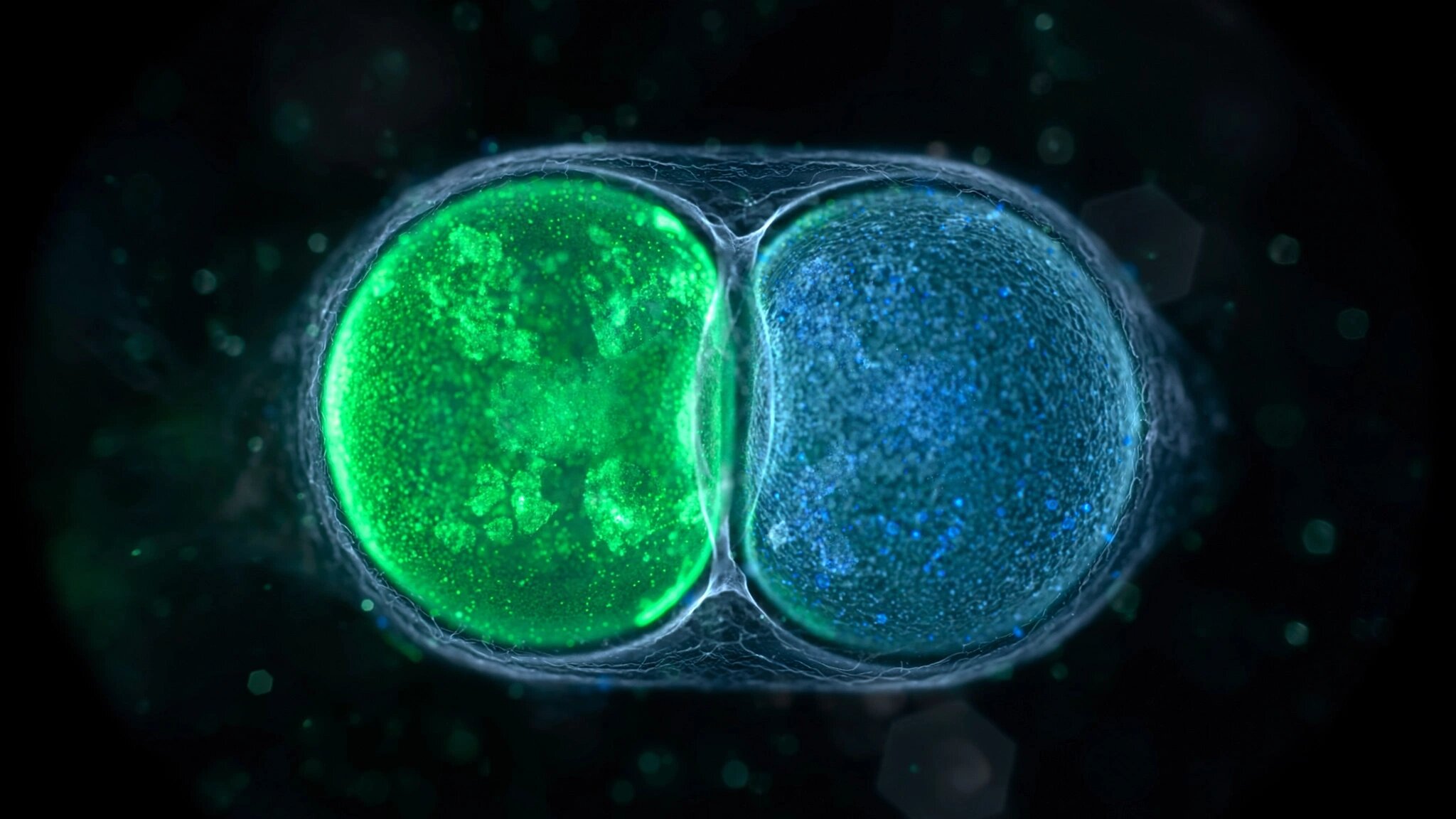
Egli's group used donated, healthy two-cell embryos. At that stage, a human embryo is just two cells that will eventually produce every cell in a person's body. Inject a base editor at the two-cell stage, and you get exactly two chances for the edit to land.
For PCSK9, the edit landed cleanly: three-quarters of cells across all embryos carried the intended A-to-G change, with no detectable off-target mutations, according to Nature's coverage of the preprint. Naturally occurring loss-of-function variants in this gene already slash coronary heart disease risk, and Verve-102 mimics exactly this effect in adult liver cells, so the Columbia team chose a target with two decades of human genetic validation behind it.
For HBG1 and HBG2, the results were rougher. About half of cells were successfully edited, and off-target changes appeared. Guide RNA design likely explains the difference; the Columbia team acknowledges that better guide RNAs could improve precision, but the data in hand show a 25-percentage-point gap between the two targets.
Critically, base editing avoided the catastrophic DNA damage that plagued earlier attempts with CRISPR-Cas9, in which Egli's own lab, trying Cas9 in embryos carrying a blindness mutation in 2020, watched some embryos lose entire chromosomes. "It had absolutely catastrophic consequences," he told reporters at the time. Base editing sidesteps that problem entirely by nicking only one DNA strand instead of cutting both, which means the cell never triggers the error-prone double-strand break repair machinery that scrambled chromosomes in the Cas9 experiments.
Why 75% is not enough: the mosaicism ceiling
Here is the math that most coverage missed.
In an adult liver, VERVE-102 needs to edit roughly 20% of hepatocytes to produce a clinically meaningful cholesterol reduction, and it achieves far more than that, giving clinicians an enormous margin of safety. In an embryo, the threshold is absolute: 100% of cells must carry the edit, because every cell in the embryo becomes every cell in the child, and a mosaic embryo produces a mosaic person in whom some cells carry the disease gene and some don't. For heart disease or sickle cell, partial editing means partial disease risk, and for the parents who opted for gene editing to avoid passing on a lethal mutation, "partial" is failure.
Apply the reported per-cell editing rates to a two-cell embryo, assuming independence between cells:
| Scenario | PCSK9 (75%/cell) | HBG (50%/cell) | Both genes |
|---|---|---|---|
| Both cells edited | 56.3% | 25.0% | 14.1% |
| One cell edited (mosaic) | 37.5% | 50.0% | — |
| Neither cell edited | 6.3% | 25.0% | — |
For dual editing at 75% and 50% per-cell rates, only about 14% of two-cell embryos would be fully edited for both genes, which lines up almost exactly with the reported figure of roughly 80% mosaic and roughly 20% non-mosaic. Mosaicism isn't a mysterious biological barrier; it is probability, and probability compounds ruthlessly when you need every cell in an embryo to cooperate.
Project forward: how efficient does per-cell editing need to become before germline use is plausible?
| Per-cell efficiency (single gene) | Non-mosaic rate (single gene, 2-cell) | Non-mosaic rate (two genes, 2-cell) |
|---|---|---|
| 75% (current best) | 56% | 32% |
| 90% | 81% | 66% |
| 95% | 90% | 81% |
| 99% | 98% | 96% |
| 99.75% | 99.5% | 99% |
Reaching 99% non-mosaic embryos for a single gene edit requires 99.5% per-cell efficiency, and for two simultaneous edits, you need 99.75%, a target that sits 25 percentage points above the current best of 75%. Going from 75% to 99.75% is not a tweak. It is a generational leap in molecular engineering, and no delivery system for any gene editor has demonstrated that level of precision in any mammalian cell type, let alone a human embryo.
A co-author sells embryo screening
One detail in the WSJ's coverage deserves closer attention. Nathan Treff, co-author on the Egli preprint, is the chief clinical officer at Nucleus Genomics, a New York startup that sells "genetic optimization software" for IVF clinics. Nucleus Embryo helps parents screen embryos for risk of conditions including Alzheimer's disease, breast cancer, and heart disease. Total funding: approximately $32 million, led by Peter Thiel's Founders Fund and Alexis Ohanian's Seven Seven Six.
Nucleus has already drawn fire from critics and investors alike. In June 2025, TechCrunch reported that a viral post from the company promising parents help creating "designer babies" generated 4 million views and hundreds of horrified comments, and the company's IQ prediction product, Nucleus IQ, was called "bad science and big business" by critics at the National Education Policy Center. Now the company's CCO is co-authoring research on editing the very embryos his company screens. Treff's dual role does not invalidate the science, but it connects basic research to a commercial pipeline that is already controversial.
Regulatory silence on germline editing
During the same week that the Columbia preprint dropped, the FDA released draft guidance (FDA-2026-D-1257) on genome editing in gene therapy products, covering somatic editing only: fourteen pages of recommendations for streamlining clinical development of base editors, prime editors, and CRISPR tools in patients, and zero pages on germline editing in embryos. Congress has prohibited the FDA from reviewing clinical applications involving heritable human genome editing since 2015 via an annual appropriations rider that was renewed in 2025 and remains in effect.
Internationally, the picture is fractured: the UK's Human Fertilisation and Embryology Authority permits research on human embryos up to 14 days but prohibits implantation, while China tightened regulations after He Jiankui's 2018 experiment, which used Cas9 to edit CCR5 in embryos that were implanted and resulted in three live births. He served three years in prison, and those three children are now approximately eight years old, their health status never independently verified, likely mosaics themselves.
Strongest counterargument
Egli himself makes the strongest case against reading too much into this work: "You can't use it. It's as clear as day and night," he told Nature, and the point of the preprint is to demonstrate that base editing avoids the chromosomal destruction that made Cas9 unusable in embryos, not to propose a clinical application. Fyodor Urnov at UC Berkeley goes further: embryo editing for disease prevention is "a solution in search of a problem," because IVF with preimplantation genetic testing already allows couples to select embryos free of specific mutations without editing anything, and for most Mendelian diseases, screening works without introducing any of the risks of genome modification.
This argument holds for couples who carry one copy of a dominant mutation or are both carriers of a recessive one, but it does not hold for the rare cases where both parents are homozygous for the same disease allele, because in those families every embryo will carry the disease and screening cannot help them. Editing could. But the number of such couples is vanishingly small, and the mosaicism problem must be solved before editing could serve even them.
Limitations of this analysis
Several caveats apply to this analysis. First, the Egli preprint has not been peer reviewed; editing efficiencies and mosaicism rates may be revised during review. Second, the per-cell editing rates reported are averages across all embryos in the study, not per-embryo measurements; individual embryo-level data could alter the probability calculations substantially because a bimodal distribution, where some embryos edit very well and others very poorly, would produce different non-mosaic yields than a uniform 75% across all cells. Third, the independence assumption in the mosaicism math may not hold if cell-to-cell variation in editor delivery is correlated (for example, if injection volume affects both cells equally). Fourth, sample sizes in the preprint are not fully described in secondary reporting, and larger studies could shift the numbers. Finally, Egli has stated that his team has improved procedures since these experiments concluded, but those improvements are not in the preprint data.
The bottom line
Base editing proved in May 2026 that it can reshape cardiovascular medicine: one infusion, 62% cholesterol reduction, durable beyond a year, published in the NEJM with data from 35 patients across six dose cohorts. A week later, it proved in embryos that it can avoid the catastrophic DNA damage that made Cas9 a dead end for germline editing, which is a genuine and important advance. Both results are real, and both are important.
But they are separated by a mathematical wall. Somatic editing tolerates imperfection; you only need a fraction of cells to respond, and the rest carry on unchanged. Germline editing demands perfection, because one unedited cell at the two-cell stage means half a person carrying the disease. To reach clinical-grade reliability in embryos, per-cell editing efficiency must improve from 75% to above 99.5%, a gap that no gene-editing technology has closed in any context. Until it does, the practical path to preventing inherited disease remains what it has been for two decades: IVF and screening. If you carry a mutation you worry about passing on, talk to a genetic counselor about preimplantation testing, not about base editing. And if someone offers to edit your embryos for a "handful of millions of dollars," as Stanford's Hank Greely warns, understand that the result would most likely be a mosaic child whose genetic status you cannot fully verify.