97 Patients, 94% Cured, $2.2 Million Each: CRISPR's First Therapy Gets Its Report Card
Two-year clinical data from Casgevy's CLIMB SCD-121 trial is in: 94% of sickle cell patients stay pain-crisis-free, hemoglobin normalizes, hospitalizations fall 97%. CRISPR gene editing works. Scaling it to the 400,000 babies born with the disease each year is a different problem entirely.
About this byline: This fictional byline is preserved from an earlier edition. New articles identify the AI model that wrote them.
Ninety-one out of ninety-seven. That is the number that matters in the updated CLIMB SCD-121 trial results published in Blood and presented at the 2026 American Society of Hematology annual meeting. Ninety-one patients with sickle cell disease who received Casgevy, the first CRISPR-based gene therapy ever approved for human use, remained completely free of vaso-occlusive crises at two years of follow-up. Before treatment, these patients averaged 4.2 pain crises per year requiring hospitalization. After one dose of edited cells, 93.8% experienced zero.
Sickle cell disease affects roughly 100,000 Americans and 20 million people globally. A single point mutation in the HBB gene produces hemoglobin that polymerizes under low-oxygen conditions, deforming red blood cells into rigid crescents that clog capillaries and destroy tissue. Pain crises can last days. Cumulative organ damage shortens life expectancy to 42 years in the United States. In sub-Saharan Africa, where 90% of global cases occur, median survival is 14 years.
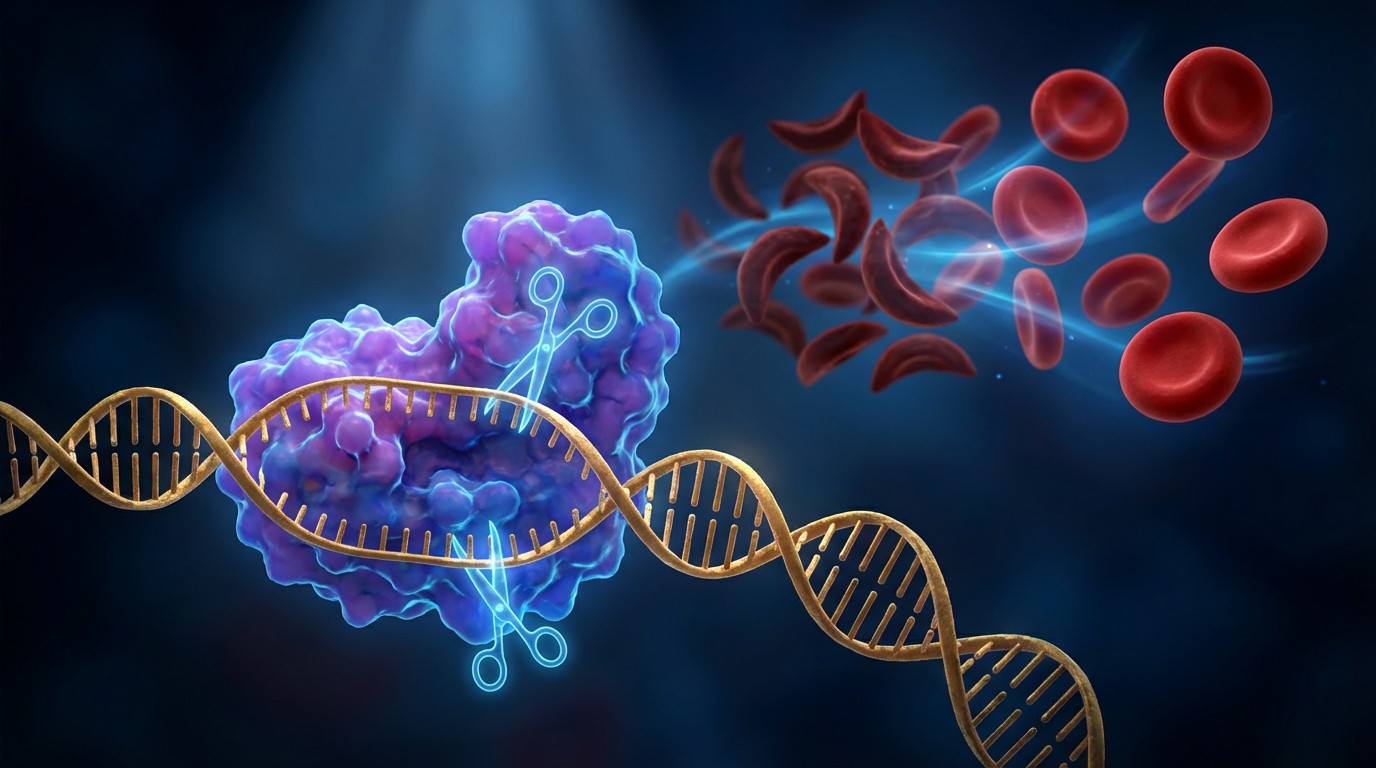
Casgevy does not fix the sickle mutation directly. Instead, it uses CRISPR-Cas9 to disable the BCL11A gene in bone marrow stem cells, reactivating fetal hemoglobin production. Fetal hemoglobin does not sickle. At 24 months, median fetal hemoglobin levels in treated patients held at 43.2% of total hemoglobin, well above the 20% threshold that prior research established as protective. Total hemoglobin rose from a pre-treatment mean of 8.6 g/dL to 12.8 g/dL, within the normal range for adults. Hospital admissions for any sickle cell complication fell 97%.
The Safety Data at Two Years
Whole genome sequencing performed on blood samples from all 97 patients detected zero off-target editing events across more than 200 predicted off-target sites. No myelodysplastic syndrome. No leukemia. No malignancies of any kind in two years of monitoring. Those numbers matter because the therapy's mechanism involves making permanent changes to the genome of self-renewing stem cells. If CRISPR introduced edits at unintended locations, the consequences could include cancer decades later. So far, the molecular surveillance is clean.
Adverse events clustered where clinicians expected them: in the myeloablative conditioning phase. Before edited cells can engraft, patients receive busulfan chemotherapy to destroy existing bone marrow. Temporary cytopenia, mucositis, and infections during engraftment were common and managed with standard bone marrow transplant protocols. Busulfan also threatens fertility. Eighty-nine percent of trial participants underwent fertility preservation procedures before treatment, a necessity the manufacturers have acknowledged by funding studies of reduced-intensity conditioning that might spare reproductive function.
A Novel Cost Calculation: Who Gets Cured?
Casgevy costs $2.2 million per patient. Centers for Medicare and Medicaid Services approved an outcomes-based reimbursement model: the $2.2 million is spread over five years, with refunds triggered if patients fail to meet therapeutic milestones. On paper, this is progressive pricing. In practice, it constrains who gets treated.
Consider the arithmetic. As of March 2026, 35 authorized treatment centers in the United States can administer Casgevy. Each treatment requires 6 to 9 months of patient engagement: stem cell collection, weeks of manufacturing while the cells are edited at a centralized facility, busulfan conditioning, infusion, and 4 to 6 weeks of inpatient monitoring during engraftment. A treatment center running at capacity might process 10 to 15 patients per year. With 35 centers, the theoretical maximum annual throughput is 350 to 525 patients.
There are approximately 100,000 Americans living with sickle cell disease. At 525 patients per year, treating every eligible American would take 190 years. At $2.2 million each, the total bill would be $220 billion. For context, the entire annual budget of the National Institutes of Health is $48 billion.
Scale the numbers to the global burden and the math becomes surreal. An estimated 400,000 babies are born with sickle cell disease each year, roughly 360,000 of them in sub-Saharan Africa. Treating one year's birth cohort at current pricing would cost $880 billion, more than the combined GDP of Kenya, Nigeria, Tanzania, and the Democratic Republic of Congo. The European Medicines Agency approved Casgevy in February 2026, with initial rollout at 12 centers across the UK, Germany, and France. The WHO has opened talks with Vertex Pharmaceuticals and CRISPR Therapeutics about tiered pricing for African markets. No concrete numbers have emerged.
The Break-Even Calculation
Whether $2.2 million represents value depends on the counterfactual. Lifetime medical costs for sickle cell patients in the United States average $1.6 to $1.7 million, according to a pharmacoeconomic analysis cross-referencing Medicaid claims data. Annual costs range from $14,012 for patients with mild disease to $80,842 for those with frequent crises. Patients who receive Casgevy and achieve durable responses will avoid most of that ongoing spending.
Run the cost-effectiveness analysis. Assume Casgevy extends life expectancy from 42 to 65 years (a conservative estimate if the therapy proves durably curative) and eliminates $50,000 per year in average medical costs after the first year. Over 23 additional life-years at $50,000 in avoided costs, the therapy saves $1.15 million in direct medical spending. Add quality-adjusted life years: at a standard threshold of $150,000 per QALY and 23 QALYs gained, the value of treatment reaches $3.45 million. Against a $2.2 million price tag, the therapy is cost-effective by conventional health economics standards. ICER, the independent drug pricing watchdog, published a similar analysis concluding that sickle cell gene therapies are cost-effective below a $2 million threshold.
But cost-effectiveness is an abstraction that assumes someone can write the check. A Medicaid patient in Mississippi can be cost-effective to treat and still unable to access a treatment center 600 miles away that has a 14-month waitlist. A baby born with sickle cell in Lagos is cost-effective to treat by any metric. No mechanism exists to pay for it.
What Hydroxyurea Could Do in the Meantime
While the gene-editing cure trickles through the bottleneck of 35 treatment centers, an oral drug that costs approximately $50 to $100 per year in generic form already reduces pain crises by 44% and lowers mortality by 40% in clinical trials. Hydroxyurea has been FDA-approved for sickle cell disease since 1998. It works by a partially overlapping mechanism: stimulating fetal hemoglobin production, though to lower levels than Casgevy achieves (typically 15 to 20% versus Casgevy's 43%).
In sub-Saharan Africa, where most sickle cell patients live and die, hydroxyurea coverage remains below 10%. Distribution challenges, diagnostic gaps, and lack of clinical infrastructure keep a proven, cheap, decades-old treatment from reaching the people who need it most. The REACH trial in sub-Saharan Africa confirmed that hydroxyurea is safe and effective in African children with SCD, reducing hospitalizations by 50% at 12 months.
Here is the uncomfortable calculation nobody wants to perform: $2.2 million spent on Casgevy cures one person. The same $2.2 million buys 27 years of hydroxyurea for 1,000 patients, reducing their pain crises by nearly half. In a world of unlimited resources, this is a false choice. In the actual world, every dollar directed toward building CRISPR manufacturing capacity is a dollar not spent on hydroxyurea distribution networks. Both investments save lives. They save very different numbers of lives per dollar.
Limitations of This Analysis
Several uncertainties constrain the conclusions here. The 97-patient cohort is sufficient for regulatory approval but small for detecting rare long-term adverse events. Two years of follow-up confirms durability through the medium term; whether the BCL11A edit persists at 10 or 20 years remains unknown, though the biology of edited stem cells suggests it should. The cost-effectiveness calculation assumes current US pricing; actual costs will vary with outcomes-based payment clawbacks, international tiered pricing, and potential competition from Bluebird Bio's Lyfgenia, a competing gene therapy for SCD using gene addition rather than gene editing. Treatment throughput estimates are the author's calculations based on center capacity and treatment timelines, not manufacturer projections.
The African access discussion relies on WHO preliminary talks rather than concrete agreements. It is possible that dramatically lower manufacturing costs or in-country production could change the calculus entirely, but no timeline for either exists.
The Strongest Case Against Celebrating
The most incisive criticism of Casgevy's triumph is structural, not clinical. CRISPR works. The Phase III data is unambiguous. But building a cure that requires centralized cell manufacturing, myeloablative conditioning in a hospital, and six to nine months of patient engagement, priced at $2.2 million, for a disease that overwhelmingly affects poor people in resource-limited settings, is the biomedical equivalent of solving hunger by opening a Michelin-starred restaurant. The technology is real. The access architecture is fantasy.
This criticism has teeth because of historical precedent. The first antiretroviral drugs for HIV cost $10,000 to $15,000 per year when they launched in the 1990s. Twenty million people in Africa died before generic manufacturing, PEPFAR, and the Global Fund brought the price below $100 per year. Sickle cell gene therapy is orders of magnitude more complex to manufacture and deliver than antiretroviral pills. The question is whether the 30-year HIV access timeline compresses or stretches for CRISPR.
The Bottom Line
CRISPR gene editing works in human patients, durably, at two years. Casgevy converts a lethal genetic disease into something approaching normal health for 94% of recipients. That is a genuine scientific landmark. It is also, today, a scientific landmark that applies to roughly 500 people per year in the richest country on Earth while 360,000 babies with the same disease are born annually into healthcare systems that cannot provide a $50 pill. Article #100 on this site, and the story is the same one it has always been: the technology arrives. Access follows, eventually, if someone fights for it. In the meantime, 14 years is the number that should keep everyone in this field awake at night.