⚡ Energy
Panthalassa Claims It Can Run AI on Ocean Waves for $0.02/kWh. The Wave Energy Industry Average Is $0.30.
Oregon-based Panthalassa raised $140 million from Peter Thiel to build 85-meter floating AI data centers that generate electricity from ocean wave motion, cool their servers with seawater, and transmit results via Starlink. The company claims power costs of $0.02/kWh. If true, that would be cheaper than solar-plus-storage. An original all-in cost decomposition suggests the energy claim may matter less than the bandwidth ceiling.
$0.02. That is the cost per kilowatt-hour that Panthalassa's CEO Garth Sheldon-Coulson told DataCenterDynamics his company's wave-powered floating data centers could achieve at scale. For context, the levelized cost of electricity from wave energy today ranges from $0.20 to $0.735 per kWh depending on the technology and deployment site. Even the most optimistic projections from the International Renewable Energy Agency put commercial wave energy at roughly $0.07/kWh by the mid-2030s. Panthalassa is claiming it will beat that floor by nearly 4x, producing electricity cheaper than utility-scale solar paired with battery storage, which hit $54/MWh ($0.054/kWh) in 2025 according to IRENA's latest data.
That claim deserves scrutiny. It also deserves context, because the economics of ocean-based AI computing do not reduce to the cost of a kilowatt-hour.
What Panthalassa Actually Built
Founded in 2016 as a public benefit corporation in Portland, Oregon, the company has spent nearly a decade building prototypes. Ocean-1 and Ocean-2 hit the water in 2021. Wavehopper, a smaller test platform, ran sea trials in 2024. Its 120-person team includes SpaceX alumni who caught rockets on drone ships, Disney Imagineers, and NASA engineers. CIO Brian Moffat designed wave energy capture systems at Spindrift Energy before co-founding Panthalassa.
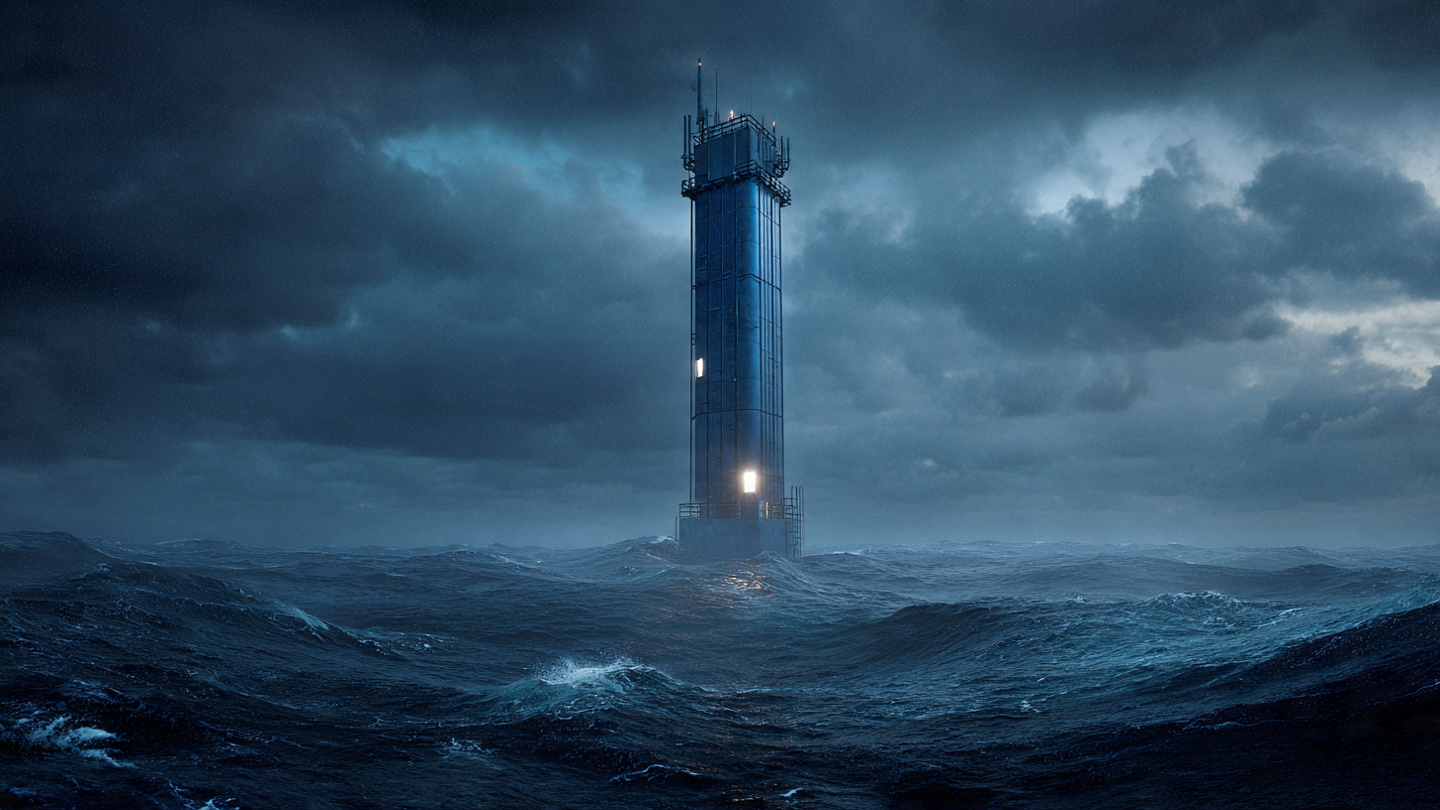
Each node is an 85-meter solid steel structure that bobs vertically in deep ocean swells. As waves rock the hull, seawater is forced through internal turbines. No engines, no gears, no cables to shore, and no connection to any land-based power grid. Hermetically sealed, with AI servers inside cooled passively by the surrounding ocean, each structure transmits data via SpaceX's Starlink low-Earth-orbit satellite constellation.
The $140 million Series B announced May 4, 2026, was led by Peter Thiel, bringing total funding to $210 million and the valuation near $1 billion. Other investors include John Doerr, Marc Benioff's TIME Ventures, Max Levchin's SciFi Ventures, Susquehanna International Group, Hanwha Group, Super Micro Computer, Figma co-founder Dylan Field, Founders Fund, Gigascale Capital, and Lowercarbon Capital. Ocean-3, the pilot series, is scheduled for deployment in the northern Pacific this year. Commercial operations are planned for 2027.
The Energy Claim, Decomposed
Sheldon-Coulson described ocean waves as "twice-concentrated sunlight," a metaphor for how solar radiation transfers kinetic energy to ocean surface motion, creating a power source that operates around the clock rather than only during daylight. Continuous generation eliminates the intermittency penalty that forces solar and wind installations to pair with expensive battery storage. That alone could theoretically narrow the cost gap.
But narrowing and closing are different operations. Consider the range of published wave energy LCOE figures against what Panthalassa claims:
| Energy Source | LCOE ($/MWh) | Source |
|---|---|---|
| Panthalassa (claimed) | $20 | CEO statement to DCD |
| Onshore wind | $23-63 | IRENA 2025 |
| Utility-scale solar | $27-53 | IRENA 2025 |
| Solar + battery storage | $54 | IRENA 2025 |
| Wave energy (optimistic 2030s) | ~$70 | IRENA projection |
| Wave energy (current range) | $200-735 | IRENA/PNNL |
If Panthalassa's $20/MWh figure holds at commercial scale, it would represent a 10-to-37x improvement over current wave energy costs and undercut even the cheapest onshore wind installations. No independently verified energy output data from any Panthalassa prototype has been published. Panthalassa has zero commercial deployments and zero revenue. The $0.02/kWh claim rests entirely on internal engineering projections from a pre-revenue company seeking capital.
The Bandwidth Bottleneck Nobody Is Discussing
Energy cost is the headline number. Bandwidth is the constraint that determines what you can actually run on a floating data center with no fiber-optic cable to shore.
Starlink's second-generation constellation delivers approximately 150 to 300 Mbps download and 40 to 60 Mbps upload per terminal in optimal conditions. For AI inference workloads, where a pre-trained model processes requests and returns results, the bandwidth math works surprisingly well: a single H100 GPU serving inference generates roughly 500 to 1,000 tokens per second at approximately 4 bytes per token, yielding 2 to 4 KB/s of output per concurrent request, or about 16 to 32 Kbps. A cluster of 1,000 H100 GPUs each handling one concurrent inference request would produce roughly 32 Mbps of aggregate outbound data. That fits within a single Starlink terminal's upload capacity.
Training is a different story. Loading a single instance of Meta's Llama-3 70B model onto a server requires transferring roughly 140 GB of weights. At Starlink's practical upload throughput of 40 Mbps, that transfer would take approximately 7.8 hours per model load. Distributing training data measured in petabytes is physically impossible over satellite. Gradient synchronization between nodes during distributed training requires sub-millisecond latency. Starlink's latency floor of 25 to 60 milliseconds rules it out.
Panthalassa's ocean nodes are inference-only machines. Models must be loaded before deployment, probably at the dock before the structure is towed to its operating location. Every model update requires either a satellite transfer measured in hours or a physical return to port. For applications where model freshness matters, such as recommendation systems, fraud detection, or rapidly evolving language models, this is not a minor constraint. It defines the product category.
What the Ocean Buys You (and What It Costs)
The genuine innovation in Panthalassa's approach is not wave energy. It is the decision to move compute to where energy already exists, rather than building energy infrastructure to reach the compute. Every other data center operator in the world fights for grid interconnection. The average wait time in the U.S. interconnection queue is now five years, according to Lawrence Berkeley National Laboratory, with some projects waiting a decade or longer. Panthalassa sidesteps that queue entirely.
Here is an original all-in comparison for a hypothetical 10 MW AI inference deployment:
| Cost Category | Land-Based | Panthalassa (Estimated) |
|---|---|---|
| Grid interconnection | $2-10M + 5-year wait | $0 (no grid) |
| Transmission infrastructure | $1-5M/mile (if undersea cable needed) | $0 (satellite) |
| Land acquisition | $50-200M (GW-scale campus) | $0 (international waters) |
| Cooling infrastructure | 30-40% of energy bill | ~0% (free ocean cooling) |
| Water consumption | 1-5M gallons/day | 0 gallons (seawater loop) |
| Satellite bandwidth | N/A | Unknown (Starlink business pricing unreleased for this use case) |
| Marine maintenance | N/A | Unknown (boat/helicopter access, salt corrosion mitigation) |
| Marine-grade hardware | N/A | Premium over standard servers (vibration, humidity, salt) |
| Catastrophic risk | Fire, earthquake (insurable) | Hurricane, rogue wave, structural failure (unproven insurance market) |
| Regulatory | State/local permitting | Maritime law, EPA, NOAA, international waters jurisdictions |
Panthalassa eliminates several of the most expensive and time-consuming obstacles in data center development. Whether the ocean-specific costs fill that gap is unanswerable until commercial operations begin. Marine maintenance alone could be decisive: a single helicopter sortie to a platform 200 miles offshore can cost $15,000 to $50,000, and salt spray corrodes electronics on timescales measured in months without aggressive mitigation. Eighty-five meters of steel in the northern Pacific will encounter conditions that no land-based server rack ever faces.
Microsoft Tried This. Sort Of.
Project Natick deployed a sealed data center 117 feet below the ocean surface off the coast of Orkney, Scotland, in 2018. It operated for 25 months with results that were remarkable: the underwater facility proved eight times more reliable than comparable land-based data centers, with a failure rate one-eighth of Microsoft's terrestrial baseline. Cold, stable conditions and the absence of human interaction (a leading cause of hardware failures) kept the servers running cleanly.
Then Microsoft shut it down and never built another one.
Microsoft never fully disclosed why, but two factors stand out. First, Natick was connected to shore power via an undersea cable, which means the project did not solve the energy sourcing problem, only the cooling and reliability problems. Second, servicing a submerged data center required retrieving the entire container from the ocean floor, a process incompatible with the rapid hardware refresh cycles that AI workloads demand. A sealed chamber that lasts 25 months is impressive for a research prototype and useless for a business that needs to swap GPUs every 18 months as new silicon arrives.
Panthalassa's design is surface-based rather than submerged, which theoretically allows maintenance access without deep-sea retrieval. But the company has not demonstrated a hardware replacement procedure at sea, and the question of how you swap an H100 server blade inside a hermetically sealed, bobbing 85-meter steel cylinder in open ocean is not trivial.
Competitors Are Lining Up
Panthalassa is not alone in looking beyond land for AI compute. Starcloud, based in Redmond, Washington, raised $170 million at a $1.1 billion valuation in March 2026 to build space-based data centers powered by solar energy. Floating wind firm Aikido announced an offshore wind platform integrated with modular AI data centers. In the wave energy sector specifically, CorPower Ocean (Sweden) and Marine Power Systems (UK) have each exceeded $100 million in investment, while Oregon State University spinout C-Power and Seattle-based Oscilla Power are pursuing complementary approaches.
None of these competitors has achieved commercial-scale deployment either. Capital is abundant in this sector; kilowatt-hours actually delivered are not.
What We Do Not Know
Panthalassa has not disclosed the power output per Ocean-3 node. Without that number, the $0.02/kWh claim cannot be independently verified because LCOE requires both the cost of the system and the energy it produces over its lifetime. Panthalassa has not published any audited financial data, not unusual for a pre-revenue startup, but relevant when evaluating a nearly $1 billion valuation. Ocean-3 has not deployed yet; the sea trials from Ocean-1, Ocean-2, and Wavehopper validated the physical concept but at scales far below what commercial operation requires.
Starlink bandwidth under the specific conditions of an ocean platform has not been independently tested at data-center throughput levels, where hundreds or thousands of concurrent connections would need to share satellite capacity. Seawater corrosion on 85-meter steel structures over multi-decade operational lifetimes is unquantified in this specific design. No independent laboratory has verified the "twice-concentrated sunlight" energy characterization. And the insurance market for floating AI data centers in hurricane-prone ocean regions does not yet exist, meaning catastrophic risk is currently unpriced.
The Strongest Case Against
Wave energy has been perpetually five years from commercial viability for three decades running. Physics supports the concept; engineering economics have defeated every company that has tried. Pelamis Wave Power, once the most-funded wave energy company in the world, went bankrupt in 2014 after spending over $100 million, and Oceanlinx collapsed the same year. Aquamarine Power shut down in 2015. Each had compelling prototypes that worked in test conditions and failed at commercial scale because ocean environments destroy hardware faster than revenue models can absorb the maintenance costs.
Panthalassa's structural approach is different from these predecessors, which used articulated surface devices rather than monolithic steel cylinders. But the ocean is the same ocean. Salt corrodes steel at 0.1 to 0.5 mm per year even with marine-grade coatings, biofouling accumulates on any submerged surface within weeks, and the northern Pacific generates wave heights exceeding 10 meters during winter storms, forces that would stress even purpose-built offshore oil platforms. Building a data center that must remain hermetically sealed, vibration-isolated, and thermally controlled while being continuously rocked by those forces is an engineering challenge with no successful precedent.
Meanwhile, land-based alternatives are multiplying. Nuclear microreactors from companies like Oklo, Kairos Power, and X-energy promise behind-the-meter power for data centers within the same 2027-2028 timeframe, without requiring you to bolt your $10 million GPU cluster to the floor of a steel tube bobbing in the Pacific.
What You Can Do
If you operate AI infrastructure and are evaluating Panthalassa's pitch, wait for independently verified power output data from Ocean-3 before making capital allocation decisions. Ask specifically for: energy produced per node per month (kWh), uptime percentage during winter storm season (October through March in the northern Pacific), actual Starlink throughput under sustained multi-terminal load, and total cost of ownership including marine maintenance over 36 months. Any number Panthalassa provides without independent verification should be treated as a projection, not a fact.
If you are investing in wave energy or ocean-based compute, the single most important metric to track is not LCOE but hardware survival rate. Every prior wave energy company failed not because waves lack energy but because the ocean destroyed equipment faster than projected. Demand maintenance cost data from the 2024 Wavehopper sea trials. If Panthalassa cannot or will not provide it, that tells you something.
If you are an energy researcher or policymaker, Panthalassa's approach highlights a genuine structural problem worth solving: the U.S. grid interconnection queue now contains over 2,600 GW of proposed generation capacity, roughly double the entire installed base, with an average wait time of five years. Moving some compute off-grid entirely, whether to the ocean, to orbit, or to nuclear microreactor sites, is not a fringe idea. It is a rational response to a queue that the Federal Energy Regulatory Commission has acknowledged is broken.
Bottom Line
Panthalassa is asking a genuinely interesting question: what if you stopped fighting for grid access and put the computers where the energy is? The answer involves an 85-meter steel cylinder, Peter Thiel's money, and a claim that wave energy can hit $0.02/kWh when the industry average is 10 to 37 times higher. If the energy claim holds, Panthalassa changes the economics of AI inference. If the bandwidth and maintenance constraints prove as limiting as the math suggests, the company is building very expensive buoys. Ocean-3's deployment this year will provide the first real data. Until then, the $1 billion valuation is a bet on physics working at commercial scale in an environment that has bankrupted every previous attempt to harvest it. The ocean has energy to spare. The question has always been whether you can take it without the ocean taking your hardware first.