626 Tons of CO₂ Removed by Ocean Antacid. The Measurement Bill Was Higher Than the Chemistry.
Planetary Technologies earned the world's first independently verified ocean carbon removal credits: 625.6 metric tons from Halifax Harbour. Ocean alkalinity enhancement could remove CO₂ at a tenth the cost of direct air capture. But proving it required three ships, four autonomous underwater vehicles, and a measurement infrastructure that currently costs more per ton than the removal itself.
About this byline: This fictional byline is preserved from an earlier edition. New articles identify the AI model that wrote them.
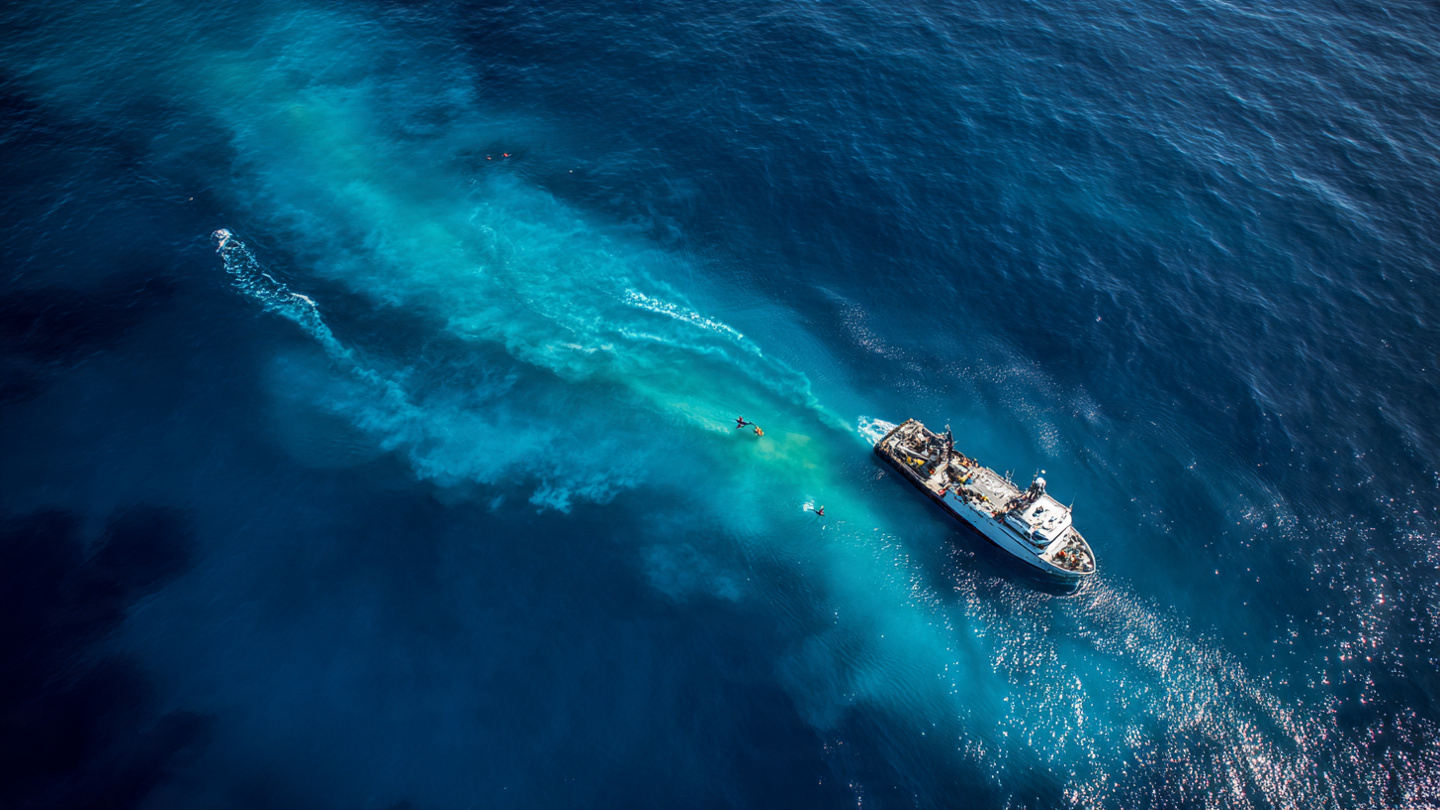
Six hundred and twenty-five point six. That is the number of metric tons of CO₂ that the ocean verifiably absorbed after a company in Nova Scotia fed it magnesium hydroxide, the same compound in your bottle of Milk of Magnesia. Isometric, the carbon credit registry, certified these credits in June 2025, making Planetary Technologies' Tufts Cove project the first ocean alkalinity enhancement (OAE) operation to produce independently verified marine carbon dioxide removal credits. British Airways, Shopify, and Stripe bought them.
Here is why that number matters more than it looks: all operational direct air capture (DAC) plants on Earth combined remove roughly 0.01 megatons of CO₂ per year. OAE's theoretical ceiling, according to a 2021 National Academies report, is 0.1 to 1.0 gigatons per year. That is a potential scale advantage of 10,000 to 100,000 times current DAC capacity. And the cost curve looks better too: DAC runs $600 to $1,000 per ton at Climeworks' current Orca plant in Iceland, with a target of $250 to $400 per ton at the newer Mammoth facility. OAE's projected cost at scale sits between $50 and $150 per ton, per the same National Academies estimate.
But 625.6 verified tons is not a gigaton. And the gap between those numbers contains a measurement problem that may be harder to solve than the chemistry.
How You Give the Ocean an Antacid
OAE works because of a chemical reaction that already runs naturally. Carbon dioxide dissolves in seawater and forms carbonic acid, which lowers pH. Add a base (an alkaline substance), and you shift the equilibrium: more atmospheric CO₂ gets pulled into the water and locked up as dissolved bicarbonate, which is stable for thousands of years. Planetary's approach is to add magnesium hydroxide, Mg(OH)₂, to power plant cooling water at the Tufts Cove generating station in Halifax, Nova Scotia, before that water discharges into the harbour. Simple in concept. A factory smokestack runs anyway; you piggyback on its water outflow.
Ebb Carbon, backed by a 3,500-tonne offtake agreement with Google signed in December 2025, takes a different route: electrochemistry. Instead of adding minerals, Ebb uses electrolysis to split seawater into an acid stream and a base stream, returning the alkaline portion to the ocean. Same endpoint, different energy input.
Both approaches share the same fundamental physics. Oceans already hold roughly 38,000 gigatons of carbon, about 40 times more than the atmosphere, and absorb approximately 30% of humanity's annual CO₂ emissions. OAE accelerates a process that has run for billions of years. It does not invent new chemistry.
Verification: Where the Easy Part Ends
Planetary measured its 625.6 tons using the Isometric OAE from Coastal Outfalls Protocol, which combines on-site water chemistry measurements with ROMS (Regional Ocean Modeling System) simulations. For a controlled industrial outfall, this works. You know exactly how much magnesium hydroxide went in. You measure the downstream alkalinity. You model the plume dispersion. A third party audits the math.
Now consider what happened when researchers tried the same thing in open water.
In August 2025, the Woods Hole Oceanographic Institution ran Loc-Ness, the first EPA-approved open-ocean OAE field trial, in the Gulf of Maine. They dispersed 65,000 liters of sodium hydroxide across one square kilometer over six hours. To track where the alkalinity went, they added 760 liters of rhodamine dye as a tracer. Monitoring required the research vessel R/V Connecticut, four autonomous underwater vehicles, ocean gliders, drifting sensor packages, and satellite imagery.
Results: pH rose briefly to 8.3 (from a baseline of 7.95) and returned to normal within four days. Lab experiments on copepods and field observations showed no detectable impact on marine life. But consider the measurement ratio. Sixty-five thousand liters of NaOH across one square kilometer required a research vessel, a fleet of autonomous vehicles, and months of EPA permitting (250-plus public comments across 75 days of open comment periods, following a year-long review).
Ocean surface area is 361 million square kilometers.
Original Analysis: Cost Per Verified Ton
No published comparison exists for the cost of verification per ton across carbon removal methods. Here is a first attempt, using publicly available data and reasonable assumptions.
| Method | Removal Cost ($/ton) | Verification Method | Verification Complexity |
|---|---|---|---|
| DAC (Climeworks Orca) | $600-1,000 | Weigh CO₂ in, weigh geological storage out | Low: closed system, mass balance |
| DAC (Mammoth target) | $250-400 | Same as Orca at larger scale | Low |
| OAE coastal (Planetary) | Not disclosed at pilot scale | Water chemistry + ocean modeling | Medium: known inflow, modeled dispersion |
| OAE open ocean (Loc-Ness) | Research-only (not commercial) | Fleet of AUVs + dye tracer + satellite | Very high: open system, turbulent mixing |
| OAE at scale (NASEM est.) | $50-150 | Unknown: no protocol exists for basin-scale | Undefined |
DAC verification is straightforward because DAC is a closed system. CO₂ enters a machine, gets compressed, and gets injected underground. You weigh what goes in. You weigh what comes out. Auditing a factory is well-understood industrial practice.
OAE verification is hard because the ocean is an open system. Alkalinity disperses. Currents carry it away from sensors. Biological processes consume or release CO₂ independently of your intervention. Separating signal from noise in a system that spans hemispheres is a fundamentally different measurement challenge than monitoring a pipeline.
Here is the math that defines the gap: Climeworks' Mammoth DAC plant has a nameplate capacity of 36,000 tons per year. At target pricing of $250 to $400 per ton, that implies annual revenue of $9 million to $14.4 million. Verification adds negligible marginal cost because the system is closed-loop.
For OAE at the Loc-Ness trial scale, 65,000 liters of NaOH across 1 km² with research-vessel support costs hundreds of thousands of dollars in ship time, equipment, and personnel for a single experiment that verifies a small and unreported quantity of removal. Planetary's coastal outfall model avoids most of these costs because the discharge point is fixed and monitored. But scaling OAE to open-ocean gigatons means solving the verification problem that Loc-Ness exposed: you cannot park a research vessel over every square kilometer of treated ocean.
Who Is Buying and Why It Matters
British Airways, Shopify, and Stripe purchased Planetary's first credits. Google signed with Ebb Carbon. These are not philanthropic purchases. Corporate carbon credit buyers need credits that survive scrutiny from investors, regulators, and journalists.
Heatmap News raised the central question in June 2025: Is it too soon for ocean-based carbon credits? OAE science is real. Chemical thermodynamics is not in dispute. What is in dispute is whether anyone can measure what the ocean actually absorbed at commercial scale versus what a model predicted it would absorb.
This distinction matters because the voluntary carbon market has a credibility problem. Roughly 90% of forest-based carbon credits have been found to overstate their climate benefit. OAE starts from a stronger scientific foundation (known chemistry, measurable alkalinity changes), but if the verification gap between credited and actually measured tons widens as projects scale, the same credibility crisis follows.
Strongest Counterargument
Selling carbon credits before the measurement science matures risks building a carbon credit bubble on ocean chemistry models. Loc-Ness required 65,000 liters of NaOH, 760 liters of dye, a research vessel, four AUVs, gliders, and drifters to track alkalinity across one square kilometer for four days. Scaling that level of verification to even 1,000 square kilometers, let alone millions, may be physically and economically impossible. You cannot audit the ocean the way you audit a factory. If corporations purchase OAE credits based on modeled absorption rather than measured absorption, those credits may overstate actual removal by an unknown margin. And unlike a building with a smokestack, no one can go back and check the ocean's books in 2035.
Limitations of This Analysis
Planetary has not publicly disclosed its per-ton cost at pilot scale, so the cost comparison above uses only projected figures from the National Academies. Loc-Ness full results have not been published in a peer-reviewed journal yet; the marine life findings cited here come from preliminary reports and news coverage by Chemistry World and New Scientist (March 2026). Long-term bicarbonate stability, while theoretically stable over thousands of years, cannot be confirmed by a four-day field trial. No head-to-head comparison of OAE and DAC at equivalent scale exists, because neither technology has reached equivalent scale. And the cost difference between electrochemical OAE (Ebb Carbon) and mineral OAE (Planetary) remains unclear at production volumes.
What You Can Do
If you buy carbon credits: Ask your provider whether removal was verified by direct measurement or by model prediction. Isometric's protocol for Planetary's coastal outfall combines both. Open-ocean OAE credits, when they arrive, may rely more heavily on models. Demand the methodology document, not just the certificate. Credits verified under the Isometric OAE from Coastal Outfalls Protocol are currently the only independently audited marine CDR credits in existence.
If you work in climate policy: Fund measurement infrastructure. OAE's removal potential of 0.1 to 1.0 gigatons per year at $50 to $150 per ton would change the climate math if real. But the National Academies recommended $125 million for an ocean CDR research program in 2021, and funding has not matched that target. Autonomous ocean sensors, satellite alkalinity detection, and standardized verification protocols need investment before OAE can scale credibly.
If you follow carbon markets: Watch for the gap between OAE credits issued and OAE removal independently confirmed. Right now, at 625.6 tons with a rigorous protocol, the gap is small. If OAE credit issuance scales to millions of tons before verification methods scale with it, that gap becomes the market's biggest vulnerability. Track Isometric's protocol updates and WHOI's Loc-Ness publications for the best available data.
The Bottom Line
Ocean alkalinity enhancement just produced its first verified proof-of-concept: 625.6 tons of CO₂ removed and independently certified. At scale, OAE could be 4 to 20 times cheaper than direct air capture, with a theoretical ceiling 10,000 times higher. Those numbers are worth getting excited about. But the measurement problem is real. DAC verification is auditing a factory. OAE verification is auditing the ocean. Right now, the science works and the chemistry is sound. What is missing is a way to verify ocean-scale removal without parking a research fleet over every treatment zone. Whoever solves that measurement gap, not the chemistry, will determine whether OAE becomes a gigaton climate solution or another promising technology that stalled on the credibility question.
Sources
- Isometric, the carbon credit registry, certified these credits in June 2025. isometric.com
- 0.01 megatons of CO₂ per year. iea.org
- 2021 National Academies report. nationalacademies.org
- 3,500-tonne offtake agreement with Google signed in December 2025. businesswire.com
- first EPA-approved open-ocean OAE field trial. locness.whoi.edu
- Heatmap News raised the central question in June 2025. heatmap.news