The Carbon Removal Industry Sold 2.47 Million Tonnes of CO₂ Cleanup. It Has Delivered 1,186.
Direct air capture companies have pre-sold 2.47 million tonnes of carbon removal credits since 2022. Actual CO₂ removed from the atmosphere as of mid-2025: 1,186 tonnes. That is a 0.05% delivery rate. The investment per tonne actually removed: $1.9 million.
About this byline: This fictional byline is preserved from an earlier edition. New articles identify the AI model that wrote them.
One thousand, one hundred and eighty-six. That is the total number of tonnes of carbon dioxide that the entire direct air capture industry has verifiably removed from Earth's atmosphere and permanently stored, according to cdr.fyi's DAC Market Snapshot through mid-2025. It is also, roughly, the amount of CO₂ the world emits in one second.
Against those 1,186 tonnes, the industry has pre-sold 2.47 million tonnes of carbon removal credits. Microsoft has bought 833,000 tonnes from five DAC suppliers. Airbus has purchased 400,000 from Occidental's subsidiary 1PointFive. Amazon has contracted 250,000. These are real purchase agreements with real money changing hands for carbon removal that does not yet exist.
Private investors have poured over $2.3 billion into DAC companies between 2021 and mid-2025. Climeworks alone has raised more than $1 billion in total equity funding. Divide that $2.3 billion by the 1,186 tonnes actually delivered, and the all-in investment cost per tonne of CO₂ removed comes to approximately $1.94 million.
The Delivery Scorecard
Three companies account for 80% of all DAC credits sold: 1PointFive (Occidental), Climeworks, and Heirloom. Their delivery records tell the story.
Climeworks operates two facilities in Iceland: Orca (4,000 t/yr capacity, operational since 2021) and Mammoth (36,000 t/yr capacity, operational since 2024). Together, they represent the most mature DAC infrastructure on Earth. As of January 2026, Mammoth had issued 383 certified carbon credits on the Puro.earth registry against a 36,000-tonne annual design capacity. Orca, after four years of operation, had issued fewer than 2,000 credits against a 4,000-tonne annual capacity. Climeworks has pre-sold nearly 400,000 credits from these two plants. It has delivered 81% of the industry's total: roughly 960 tonnes.
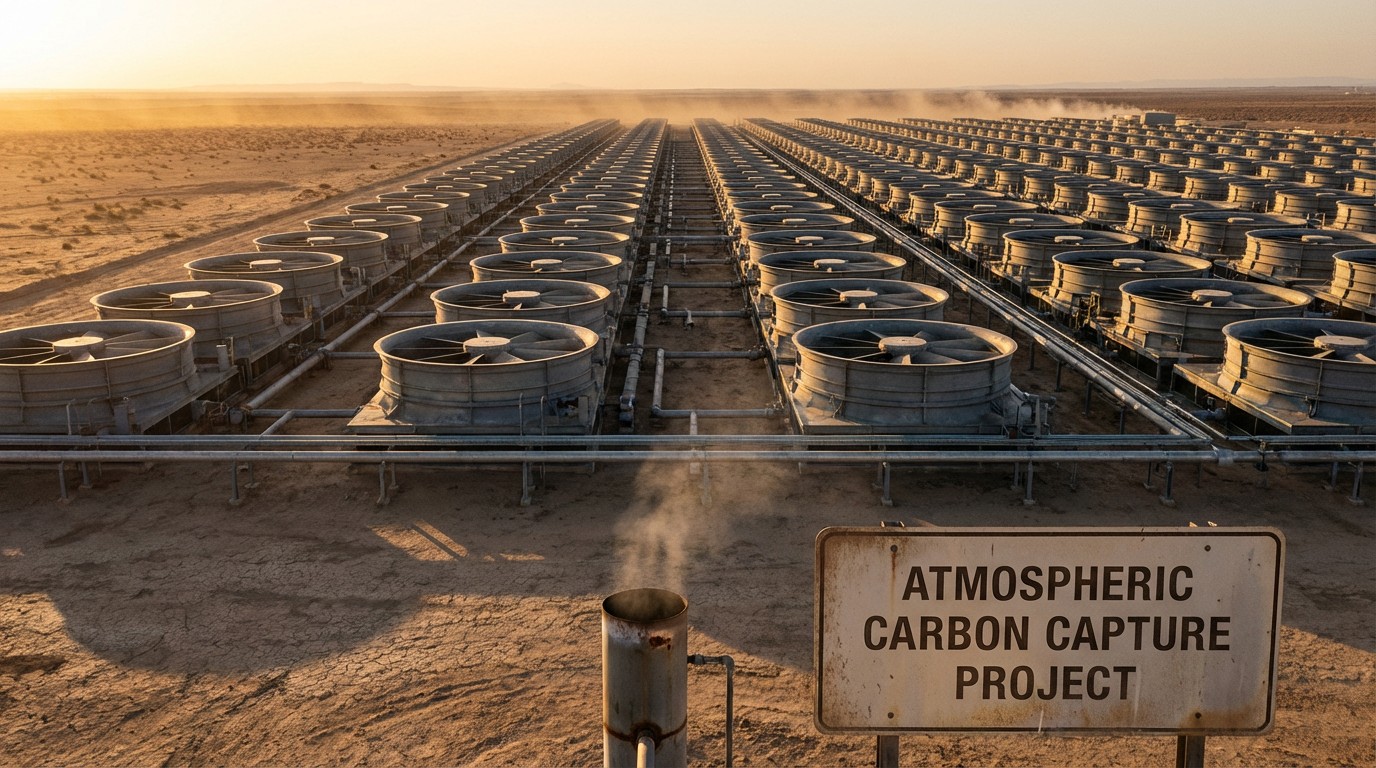
1PointFive (Occidental) is building Stratos in the Permian Basin, designed for 500,000 tonnes per year. The project budget ballooned from $800 million to $1.3 billion, with BlackRock investing $500 million. It has sold hundreds of thousands of tonnes in forward credits. It has delivered zero. Initial operations are targeting Q2 2026.
Heirloom runs a limestone-based facility in California capturing around 1,000 tonnes per year. Microsoft purchased 315,000 tonnes from Heirloom. Delivery data is sparse, but Heirloom accounts for a small fraction of the industry's 1,186-tonne total.
| Company | Contracted (t) | Delivered (t) | Delivery Rate |
|---|---|---|---|
| Climeworks | ~400,000 | ~960 | 0.24% |
| 1PointFive | ~650,000+ | 0 | 0% |
| Heirloom | ~315,000+ | ~100 | <0.1% |
| 28 other suppliers | ~1,105,000 | ~126 | ~0.01% |
| Total | 2,470,000 | 1,186 | 0.05% |
The Original Math Nobody Runs
DAC companies quote cost per tonne in ways that obscure actual economics. Climeworks cites $600–800 per tonne at Orca. Carbon Engineering (now part of 1PointFive) published $94–232 per tonne in a 2018 paper. Airhive claims to have broken below $500 per tonne at its Alberta facility in 2026. These are theoretical or marginal operating cost figures at nameplate capacity.
Here is a different calculation. Climeworks has raised over $1 billion in equity. It has delivered approximately 960 tonnes of verified carbon removal. That is $1.04 million per tonne delivered. The industry-wide figure: $2.3 billion invested, 1,186 tonnes delivered, yielding $1.94 million per tonne of CO₂ actually pulled from the sky.
This is not an operating cost. It is the total capital society has deployed per unit of carbon actually removed. The distinction matters, but so does the number. If a pharmaceutical company raised $1 billion and delivered 960 doses, we would not celebrate the theoretical cost-per-dose at full production scale. We would ask why the factory is barely running.
Why the Factories Are Barely Running
Climeworks' own audit filings provide the clearest picture. Mammoth's public project description filed with Puro.earth identifies May 2029 as the expected date for full-scale ramp-up. That is five years after the plant started operating and three years from now. The 383 credits issued represent 1.1% of one year's design capacity.
Technical barriers are real. Solid sorbent materials degrade faster than projected. Energy requirements are immense: 6–8 gigajoules of thermal energy per tonne of CO₂ captured, plus 1.5–2.5 megawatt-hours of electricity. At roughly 420 parts per million ambient concentration, DAC machines must process approximately 2,500 cubic meters of air to capture a single tonne. Scaling this to millions of tonnes requires moving continental volumes of atmosphere through chemical filters.
Climeworks is installing Generation 3 sorbent technology at Mammoth that it says captures twice as much CO₂ with half the energy and three times the filter lifespan. This is promising. It is also an acknowledgment that the technology deployed in 2024 was insufficient for commercial-scale economics. The company laid off 106 employees in May 2025 while the ramp-up continued.
The Policy Rug Pull
In August 2023, the U.S. Department of Energy selected two DAC hub projects for up to $1.2 billion in combined federal funding: Occidental's South Texas DAC Hub and Project Cypress in Louisiana (a joint venture of Battelle, Climeworks, and Heirloom). Each was allocated $500 million or more in phased grants.
In October 2025, both appeared on a DOE termination list. An internal document obtained by MIT Technology Review showed the ~$50 million first tranche for each project marked "terminate." The Carbon Business Council estimated over 130,000 jobs at risk. The broader DOE wave cancelled $7.56 billion in climate project awards.
One federal lifeline remains: the 45Q tax credit: $180 per tonne of CO₂ captured via DAC and geologically stored. At $180/tonne, a perfectly operating 500,000-tonne Stratos plant would generate $90 million annually in tax credits. Against a $1.3 billion construction cost, that is a 14-year payback on the credit alone, assuming the plant runs at full capacity from day one. No DAC plant ever has.
The Uncomfortable Geography of Stratos
Occidental's Stratos facility is in the Permian Basin. The captured CO₂ feeds into Occidental's existing pipeline and injection network. Some will be permanently sequestered. Some will be used for enhanced oil recovery, where pressurized CO₂ is pumped underground to force out additional crude oil that would otherwise remain trapped in rock.
This creates a circularity that deserves explicit accounting. Each barrel of crude oil, when burned, emits roughly 0.43 tonnes of CO₂. If a portion of Stratos's captured CO₂ enables additional oil extraction, the net climate benefit shrinks by the emissions from that additional oil. Occidental has not disclosed what percentage of Stratos's captured CO₂ will go to sequestration versus EOR. Under current 45Q rules, both qualify for the $180/tonne credit.
The First Real Cost Breakthrough
Not every data point is discouraging. In Alberta, Canada, a startup called Airhive achieved costs below $500 per tonne at its 1,000-tonne-per-year facility in 2026, part of the Deep Sky Alpha cross-technology DAC hub that began operations in August 2025. This is the first major cost reduction reported by an operational commercial facility and represents a halving of the industry's $1,000+ per tonne standard.
Canada is also becoming a refuge for DAC companies facing U.S. policy uncertainty. Canadian federal tax rebates for carbon capture are generous, and several companies have relocated or expanded northward.
The Strongest Case for DAC
Direct air capture's strongest argument is that it does not need to be cheap today. It needs to exist today so it can be cheap in 2040. Solar photovoltaic panels cost $76 per watt in 1977 and $0.20 per watt in 2024. Sequencing a genome cost $2.7 billion in 2003 and $200 in 2024. Every technology that eventually reached commodity pricing was once economically absurd.
Climeworks' Gen 3 sorbent demonstrates the mechanism: twice the capture at half the energy. If DAC costs follow a learning rate of 15–20% decline per doubling of cumulative capacity (consistent with solar's historical trajectory), reaching $100–200 per tonne is plausible within two decades. The IEA projects DAC will need to reach 85 million tonnes per year by 2030 under net-zero scenarios, which would require costs in that range.
Cdr.fyi itself frames the situation clearly: "Delays are disappointing but not surprising, and do not indicate long-term financial unsustainability." The 1,186 tonnes are the beginning of a learning curve, not the verdict on a technology.
This argument deserves its full weight. Learning curves are real. The question is whether DAC will follow solar's trajectory or nuclear fission's, where costs rose for decades despite predictions of decline, because the fundamental engineering challenges of the technology scaled nonlinearly.
What This Analysis Does Not Show
Several limitations require honest acknowledgment. The cdr.fyi delivery data covers through mid-2025; additional tonnes may have been delivered since, though no public registry updates suggest a dramatic acceleration. The $1.94 million per tonne figure conflates capital investment (plant construction, R&D, hiring, operations) with marginal operating cost; it is not meant as an operating cost metric but as a measure of total societal capital deployed per unit of carbon removed. Stratos has not yet started operating (Q2 2026 target) and could significantly alter delivery figures if it achieves even partial capacity. The Puro.earth registry may not capture all removed tonnes, as some early removals may remain unregistered. Finally, the IEA's 85 Mt/yr 2030 projection for DAC is from a normative scenario (what should happen), not a forecast of what will happen.
The Bottom Line
Direct air capture has raised billions, pre-sold millions of tonnes, and actually removed about one second's worth of global CO₂ emissions from the atmosphere. The gap between contracted and delivered is not a rounding error; it is a factor of 2,083. Some of this gap will close as Stratos comes online and Mammoth ramps up. But the industry's own filings show Mammoth reaching full capacity no sooner than 2029, and Stratos has never captured a molecule at scale. Meanwhile, the world emitted 37.4 billion tonnes of CO₂ last year. The 1,186 tonnes removed by DAC to date would be replaced by new emissions in roughly one second. The atmosphere does not grade on a curve.
Sources
- cdr.fyi's DAC Market Snapshot. cdr.fyi
- one second. brookings.edu
- more than $1 billion. climeworks.com
- 383 certified carbon credits. registry.puro.earth
- nearly 400,000 credits. geocdr.com
- ballooned from $800 million to $1.3 billion. good.is
- targeting Q2 2026. oilgasleads.com
- below $500 per tonne. ts2.tech
- laid off 106 employees. energynow.com
- MIT Technology Review. technologyreview.com
- over 130,000 jobs. carbonherald.com
- 85 million tonnes per year by 2030. iea.org