💻 Technology
Nvidia Just Pledged 40% of Everything It Owns So OpenAI Can Buy Nvidia Chips. We Did the Math.
On August 17, Nvidia guaranteed $105 billion of OpenAI's 20-year data center lease in Pike County, Ohio, a facility where Nvidia is the exclusive chip supplier. That single guarantee equals 40.5% of Nvidia's total assets. An original balance sheet analysis reveals that every dollar of guarantee unlocks $4.06 in gross profit for Nvidia itself, the most lucrative vendor-financing arrangement in corporate history, and one that concentrates roughly 70% of Nvidia's future revenue in a single customer.
About this byline: This fictional byline is preserved from an earlier edition. New articles identify the AI model that wrote them.
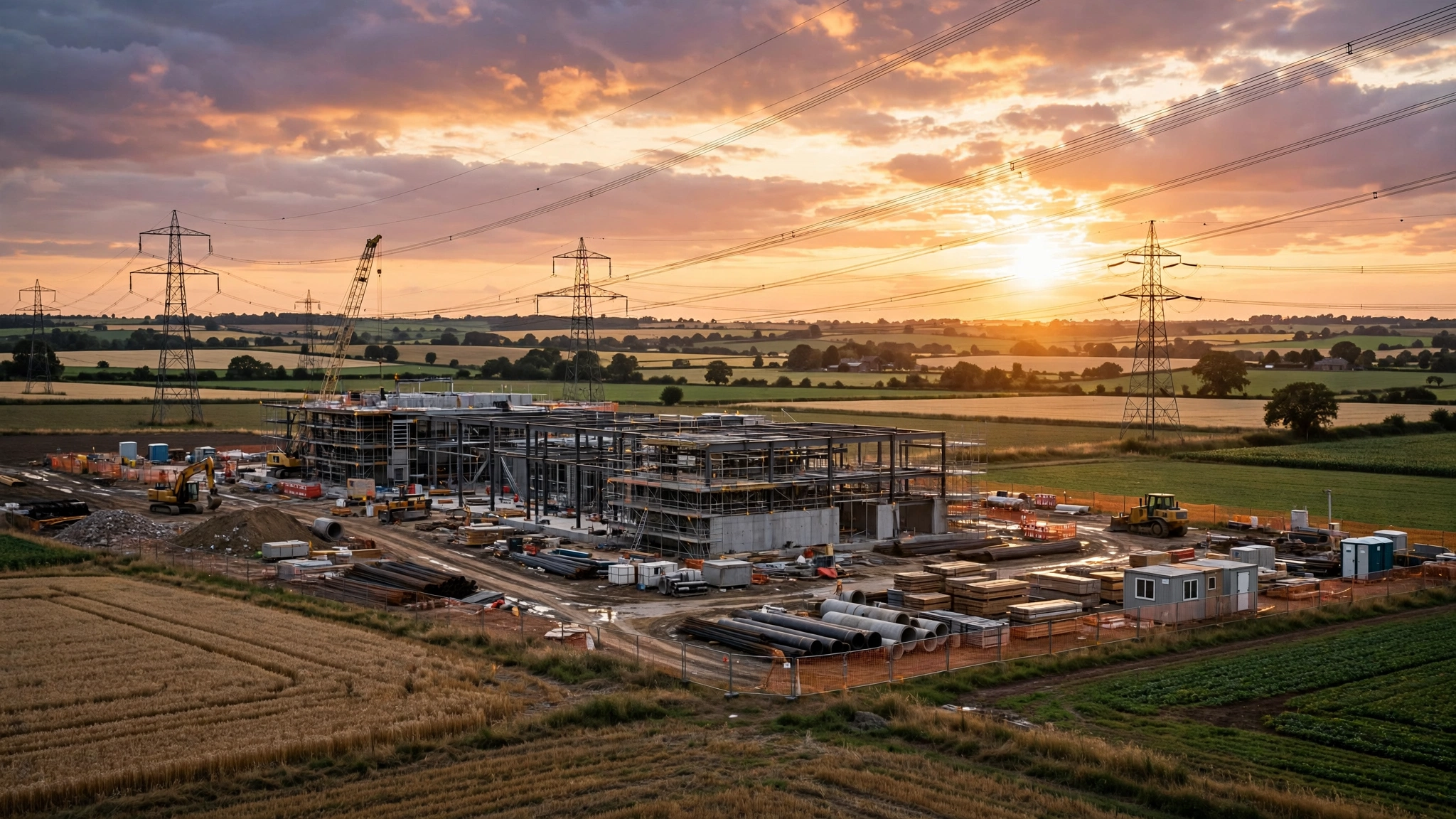
One hundred and five billion dollars. That is the size of the financial guarantee Nvidia announced on August 17 to backstop OpenAI's lease of a sprawling data center in Pike County, Ohio, a facility being developed by SoftBank-owned SB Energy on the grounds of the former Portsmouth Gaseous Diffusion Plant, a Cold War-era uranium enrichment site that once consumed more electricity than the entire state of Delaware. It covers a portion of the lease payments, the power costs, and a minimum-value commitment on the site itself, meaning if OpenAI cannot pay the rent, Nvidia covers the gap.
There is a detail in this arrangement that has not received sufficient attention. Nvidia is the exclusive chip provider for the facility.
Read that sentence again, because the financial geometry it creates is unlike anything in the history of American corporate finance. Nvidia is guaranteeing the lease so that OpenAI can occupy a building whose sole purpose is buying Nvidia's product. Huang told investors he expects to earn $200 billion in revenue from the initial 4.25-gigawatt phase and up to $600 billion from OpenAI by 2030 across all sites, including a planned 3.75-gigawatt expansion. He says this is not circular financing. We pulled Nvidia's balance sheet from the most recent SEC filing and ran the numbers ourselves.
The Balance Sheet Risk Nobody Is Quantifying
Nvidia's Q1 FY2027 10-Q, filed for the quarter ending April 26, 2026, reports total assets of $259.474 billion and total liabilities of $64 billion, leaving shareholder equity of approximately $195.5 billion. Against that balance sheet, a $105 billion guarantee works out to the following ratios, none of which have a precedent among S&P 500 companies for a contingent liability tied to a single counterparty:
| Metric | Value | Ratio |
|---|---|---|
| Guarantee / total assets | $105B / $259.5B | 40.5% |
| Guarantee / shareholder equity | $105B / $195.5B | 53.7% |
| Guarantee / cash on hand | $105B / $13.2B | 7.9× |
| Guarantee / long-term debt | $105B / $7.47B | 14.1× |
To put the 40.5% figure in context, the largest single-customer guarantee in recent corporate history before this deal was Boeing's backstop of Turkish Airlines leases, which peaked at roughly $3 billion against Boeing's $137 billion asset base in 2019, a mere 2.2% that makes Nvidia's ratio eighteen times larger.
This comes one week after Nvidia partnered with six financial institutions including BlackRock to launch financing platforms targeting more than $500 billion in third-party funding for AI infrastructure, with Nvidia backstopping up to $125 billion of that amount. Stack the two commitments together and Nvidia's combined contingent exposure reaches $230 billion, roughly 88.6% of its total assets, all accumulated within seven days.
The $4.06 Return: How Vendor Financing Actually Works
Huang's defense is that this is not circular. Here is the arithmetic that says otherwise.
Nvidia guarantees $105 billion so OpenAI can occupy a data center. That data center exists to house Nvidia GPUs. Nvidia sells those GPUs and estimates it will earn $600 billion in total revenue from OpenAI by 2030. At Nvidia's fiscal 2026 GAAP gross margin of 71.1%, as reported in its annual results, that $600 billion yields $426.6 billion in gross profit.
Gross profit per dollar of guarantee: $426.6 billion / $105 billion = $4.06.
For every dollar Nvidia puts at risk, it expects to harvest four dollars and six cents of gross profit from selling chips to the very customer whose lease it is guaranteeing. That is a phenomenal return, which explains why Nvidia is willing to do it. It also explains why calling it "not circular" requires a generous interpretation of the word. One commitment creates the demand for the product. Revenue from the product is the justification for the commitment. A snake eating its tail at a 4:1 ratio, and the only variable that matters is whether OpenAI keeps writing checks.
Customer Concentration at a Scale Nobody Has Seen
Nvidia reported fiscal 2026 revenue of $215.9 billion, with data center chips accounting for $193.7 billion of that total, or 89.7%. If Nvidia earns $600 billion from OpenAI over approximately four years, that works out to $150 billion per year from a single customer, equivalent to 69.5% of Nvidia's entire current annual revenue.
No major tech company has ever approached that degree of single-customer dependency while simultaneously holding a contingent liability on that customer's real estate. Apple's largest customer is Verizon at roughly 12% of iPhone revenue. Microsoft's Azure has no single tenant above 5%. Even TSMC, the most concentrated supplier in semiconductors, derives about 25% of revenue from Apple. What Nvidia is constructing with OpenAI is structurally different: a 70% revenue dependency backstopped by a guarantee worth half the company's book value, on a 20-year timeline, with no diversification mechanism if OpenAI pivots to custom silicon the way Google, Amazon, and Meta already have.
3.85 Hoover Dams for a Village of 2,600
Pike County sits in rural southern Ohio, population roughly 28,000. Piketon, the nearest village to the site, has about 2,600 residents. At full build-out, the data center will consume 8 gigawatts. Nvidia itself provided the conversion factor: one gigawatt powers approximately 750,000 American homes.
Eight gigawatts is enough electricity for six million homes, in a county with about 11,000 households.
According to the U.S. Energy Information Administration, Ohio's total summer generation capacity in 2024 was 30.491 gigawatts. One data center will consume 26.2% of the state's installed capacity. For context: the Hoover Dam produces 2.08 gigawatts at peak output, meaning this site requires 3.85 Hoover Dams running continuously. Vogtle, America's largest nuclear plant at 4.658 gigawatts across four reactors, would need to be built 1.7 times over.
SoftBank and SB Energy plan to construct at least 10 gigawatts of new power generation and invest $4.2 billion in regional grid infrastructure through a partnership with AEP Ohio. As the Columbus Dispatch reported in April, the natural gas portion alone would require 1.2 billion cubic feet per day and produce more than 16 million metric tons of carbon dioxide annually, equivalent to 4 million gasoline-powered cars, in a state that already ranks fourth nationally in power-sector CO2 emissions.
What Happens If OpenAI Stops Paying
Reuters reported that the guarantee structure works as follows: OpenAI pays rent. If OpenAI defaults, Nvidia covers the gap between a guaranteed minimum value on the site and whatever the owner can recoup by re-leasing or selling the property. That guaranteed minimum has not been disclosed, but it is the number that determines Nvidia's actual exposure in a default scenario.
Now consider the downside case: an 8-gigawatt data center in rural Ohio is purpose-built for one thing, running Nvidia GPUs at scale. If OpenAI defaults because its revenue model fails, because a competitor offers better inference economics, or because the AI market corrects, the number of alternative tenants who need an 8-gigawatt facility in Pike County with exclusive Nvidia chip infrastructure is exactly one: OpenAI. Residual value of a bespoke compute facility with no anchor tenant could be catastrophically low, turning Nvidia's minimum-value obligation into a multi-billion-dollar write-down on assets it does not own but promised to protect.
Danni Hewson, head of financial analysis at AJ Bell, captured the tension: "Investors are right to be worried about what seems to be a never-ending loop of AI deals, but realistically the field of players isn't all that vast and there was always going to be a degree of circular financing." She added that the "biggest test is whether these investments ultimately generate decent returns for all those laying out cash."
Limitations
Several important caveats. First, the $105 billion is the maximum guarantee, not the expected loss; Nvidia's actual exposure depends on the undisclosed guaranteed minimum value and the site's residual value in a default scenario, both of which could make the real risk substantially smaller. Second, Nvidia's balance sheet has grown rapidly, nearly doubling from $161 billion to $259 billion in total assets in the six months ending April 2026, so the 40.5% ratio may shrink if asset growth continues. Third, the $600 billion revenue projection from OpenAI by 2030 is Nvidia's own estimate and may include assumptions about expansion phases and pricing that do not materialize. Fourth, we are comparing a contingent liability (a guarantee that triggers only on default) with balance sheet totals (assets the company holds today), which overstates the immediate financial risk. That comparison is still valid for showing concentration scale, but it is not an apples-to-apples cash-outflow calculation. Finally, this analysis cannot assess the probability of an OpenAI default, which is the most important variable and the one nobody can model with confidence.
The Bottom Line
Nvidia has constructed a financial feedback loop in which it guarantees the real estate so its customer can buy its chips, then uses the chip revenue to justify the guarantee, all while concentrating a majority of its future revenue in a single counterparty with an unproven business model and a 20-year time horizon. When everything works, the economics are extraordinary: $4.06 of gross profit for every dollar of guarantee, a ratio that would make a private equity fund weep with envy. Risk is equally extraordinary: 40.5% of total assets pledged against one customer's ability to keep paying, in a facility that has no alternative use and sits in a county with a population smaller than a mid-size university.
If you own Nvidia stock, your question is not whether AI demand is real. It is whether you are comfortable with a company that just staked half its book value on the premise that OpenAI will be solvent, profitable, and loyal for two decades. If you are an institutional investor evaluating AI infrastructure exposure, demand that Nvidia disclose the guaranteed minimum value, the specific contingent liability treatment in its upcoming 10-Q, and the terms that would trigger payment under the guarantee. If you work in energy policy, note that one private transaction just committed to consuming a quarter of a major state's electricity capacity, fueled by natural gas, with CO2 output matching four million cars, and that the federal government helped make it happen. Every number here is public. Someone should be adding them up.
Related Articles
- Nvidia Just Convinced Wall Street to Lend $500 Billion Against GPU Clusters That Run at 5% Utilization. We Calculated the Break-Even Rate.
- GE Vernova Books 7 Turbine Orders for Every 1 It Ships. AI Is Breaking the Ones That Arrive.
- AI Data Centers Use Enough Water to Fill 250 Olympic Pools a Year. None of Them Report It.