Nobody Got Fired. Lao Gan Ma's Online Sales Fell Up to 90% Anyway.
China's chili-sauce giant deployed an AI inspector, cut defects to 0.02%, and fired no one. A rumor about firing 600 then taxed its online sales up to 90%.
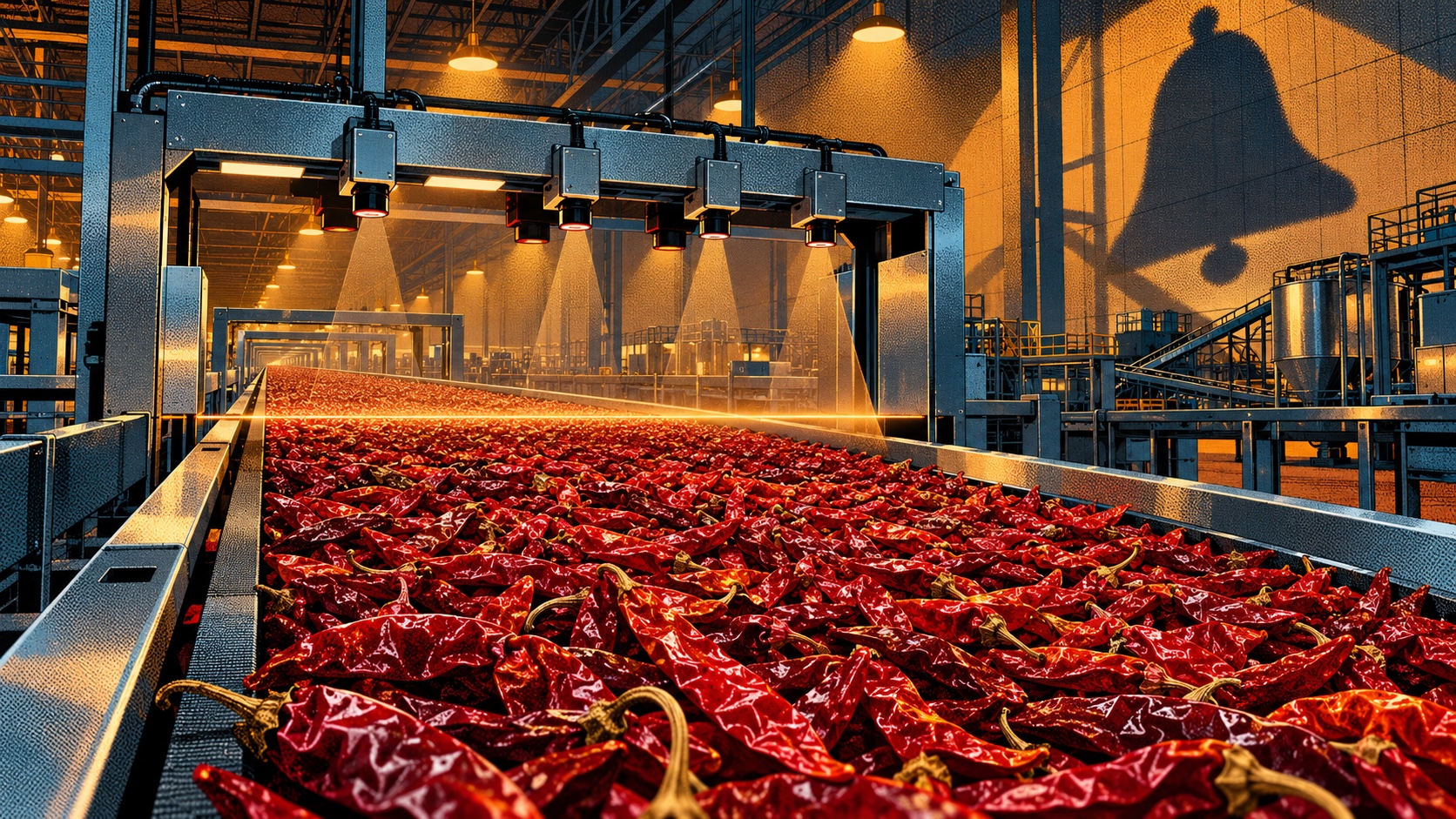
Every 0.3 seconds, a high-speed industrial camera photographs the conveyor at Lao Gan Ma's Changming production base, reads each dried chili for mold and black spot, rejecting failures before a human sorter could reach one. Since it went in, the company says, key-process defect rates have dropped to 0.02 percent. At Guizhou's provincial quality development conference in mid-October, chief quality officer Li Xin paired that stat with something bigger: 2025 revenue of 5.4 billion yuan, a company record, clearing the 2020 peak of 5.403 billion after 2021's slide to 4.201 billion.
Then the speech met the internet, which did its own arithmetic: within days it had mutated into a cleaner, crueler claim about 600 chili-sorters cut to 48 while 5.4 billion yuan got banked. That version trended, faded, and trended again on October 26 under a hashtag reading "Lao Gan Ma insured headcount down over 2,600," per Jiemian's report of Blue Whale News coverage. Denial came the same day. Company HR added a sentence that deserves to be carved somewhere: "We never employed that many workers to begin with."
One number is real, the layoff is not, and the gap between them is where the money moved.
The rumor versus the registry
Tianyancha registry data, relayed by Jiemian, puts insured headcount at 2,912 in 2022, 1,783 in 2023, 941 in 2024 and 740 in 2025: four straight declines totaling 74.6 percent, which compounds to about 36.7 percent a year. Branches stack the hashtag higher: their insured counts fell from 1,279 to 793 in the same window, a combined drop of 2,658. That underlying decline is real, large and slow, four years of outsourcing transfers, expired contracts, natural attrition and production reorganization, spread across the entire company rather than one sorting line, and counting only formal employees whose social insurance runs through the parent, a metric that excludes outsourced, dispatched, seasonal and subsidiary workers entirely.
| The viral story | The registry record | |
|---|---|---|
| Headline event | 600 chili-sorters cut to 48 in one AI cull | 2,912 insured employees in 2022, 740 in 2025 |
| Size and speed | 92 percent, in a day | 74.6 percent across four years, about 36.7 percent a year |
| Cause | The AI inspection system | Outsourcing, expirations, attrition, reorganization; company denies any AI cull |
| Scope | One sorting line | Whole company; the "2,600" version adds branches (1,279 down to 793) |
Set the rumor beside it: "600 cut to 48" is a 92 percent cut in an afternoon, on one line, by one machine. Registry reality is 74.6 percent across four years with no single cause attached, and at 552 jobs the rumor's body count is actually smaller than the true four-year decline of 2,172 insured positions, meaning the fiction understated the very trend it exploited, anchoring itself to something real while getting the timeline, the scope and the causality wrong, which converted a structural story worth covering into a libel worth denying.
Pricing the rumor
Because the company denied the event, price the fiction instead. Blue Whale News, citing a third-party tracker, reports one storefront's daily sales holding at 5,000 to 10,000 yuan before the rumor, then running at 1,000 to 5,000 for days starting October 22. Midpoint math says daily revenue fell 60 percent, from 7,500 yuan to 3,000; extremes say 90 percent, from 10,000 to 1,000. Four reported days of that removes roughly 18,000 yuan, as much as 36,000 at the extremes. That is the rumor tax, itemized.
| Event | When | Measured effect |
|---|---|---|
| AI visual QC scanning every 0.3 seconds | In production before mid-October | Defect rate down to 0.02 percent; disclosed revenue effect: none |
| "600 cut to 48" rumor cycle | Mid-October speech; hashtags re-trend October 26 | Tracked storefront down from 5,000 to 10,000 yuan a day to 1,000 to 5,000 starting October 22: minus 60 percent at midpoints, up to minus 90 at extremes |
Keep the scale honest. Eighteen thousand yuan is 0.00033 percent of 5.4 billion in annual revenue; nobody's quarter collapsed. Direction is what matters, because this is the only channel where money measurably moved: the AI inspector's disclosed revenue contribution sits at zero yuan, its wins living in quality metrics, a 0.02 percent defect rate where tired human eyes used to miss mold, while the rumor's four-day effect was negative, countable, and priced in a real ledger. In the only ledger anyone can audit, the false story out-monetized the true machine.
Why the rumor found a lever
Lao Gan Ma may be the least online giant in Chinese consumer goods: traditional dealers, little digital marketing, and a Douyin flagship store with no livestreams in the past year, per Jiemian. That is why a rumor could move its numbers: the channel is thin enough that a sentiment shock shows up in days instead of a quarter of wholesale orders. Retail monitor MaShangYing pegs the brand at about 55 percent of the chili-sauce segment and roughly 16 percent of the broader seasoning-sauce category, its top three SKUs holding the top three single-product spots. Scale that dominant reads as proof of anything, and a story about a company that famous does not need evidence, because fame performs the verification for free, in bulk, on every platform at once, which is how a provincial speech about defect rates became, without a single new fact, a national layoff story with its own hashtags inside a week.
Limitations
That sales series is one unnamed storefront measured by a third-party tracker and relayed by Blue Whale News, with no control window, no pre-period variance and no way to separate rumor effect from ordinary noise in a low-traffic shop, and since the tracker published no daily series, we cannot even confirm the pre-rumor band was stable rather than already sliding. Headcount counts insured formal employees only; with no released sorter counts, the 600 figure is unverifiable either way. System cost, vendor and coverage are undisclosed, killing any ROI comparison, and 0.02 percent is an after number with only a qualitative before. Li Xin's 5.4 billion is a conference-speech figure from a private company, not an audited filing. This piece did not trace patient zero; Jiemian says the speech "was processed into" the viral claim, and we take that phrase as the mutation point.
What you can do
If you deploy automation, publish the labor baseline before the system ships: current headcount, the attrition trend, what the machine does and does not replace. Lao Gan Ma's rebuttal arrived ten days and one taxed storefront later, and "we never employed that many to begin with" is a claim nobody can check after the fact. If you consume viral layoff numbers, run the timeline check first: 92 percent in one day and 74.6 percent over four years are different universes, and insured headcount is a registry artifact, not payroll. Reporters and investors should demand the three numbers this story lacks: baseline headcount, system cost, and a before-picture for that defect rate. Any one of them kills the rumor in an afternoon.
The strongest case against
Strongest case against, at full strength: the rumor was a smoke detector, not arson. A four-year, 74.6 percent headcount decline is real and enormous, public attention to automation-driven labor change is legitimate even when a specific instance is misattributed, and a blanket denial through a hotline is exactly what a company that did fire people would also say. On the numbers the case is simpler still, because a 5,000-to-10,000-yuan storefront is a rounding error against 5.4 billion yuan of revenue, the dip may be ordinary variance, and calling 18,000 yuan "economic damage" may flatter a numerator too small to carry the thesis. An honest version accepts the math and rejects the frame: nothing here proves misinformation is expensive, only that it is visible.
The Bottom Line
Credit where due: the machine did its job, 12,000 scans an hour, defects down to 0.02 percent, a record 5.4 billion yuan behind it, and not one person provably fired. Its story then did damage the machine never did, cutting measured sales by up to 90 percent on the one channel small enough to feel it. That is the recurring pattern, from compute commitments to orchard biosecurity to this bottle of chili crisp: the narrative clears its gates faster than the facts do. Automation economics settle over quarters; rumor economics settle in four days of storefront data. The machine was innocent. Any company deploying a camera that takes 288,000 looks a day should budget for the headline the camera cannot see: the story of the machine is part of its cost of ownership.