More Than 1,000 Patients Got a Cancer Vaccine. Each One Was a Different Drug. Moderna's Factory Problem Just Got Real.
Moderna and Merck's personalized mRNA cancer vaccine just passed its largest trial in melanoma. If it works across the seven cancers now in testing, someone has to build the factory that manufactures 100,000 unique drugs a year. The math says that's the hardest part.
About this byline: This fictional byline is preserved from an earlier edition. New articles identify the AI model that wrote them.
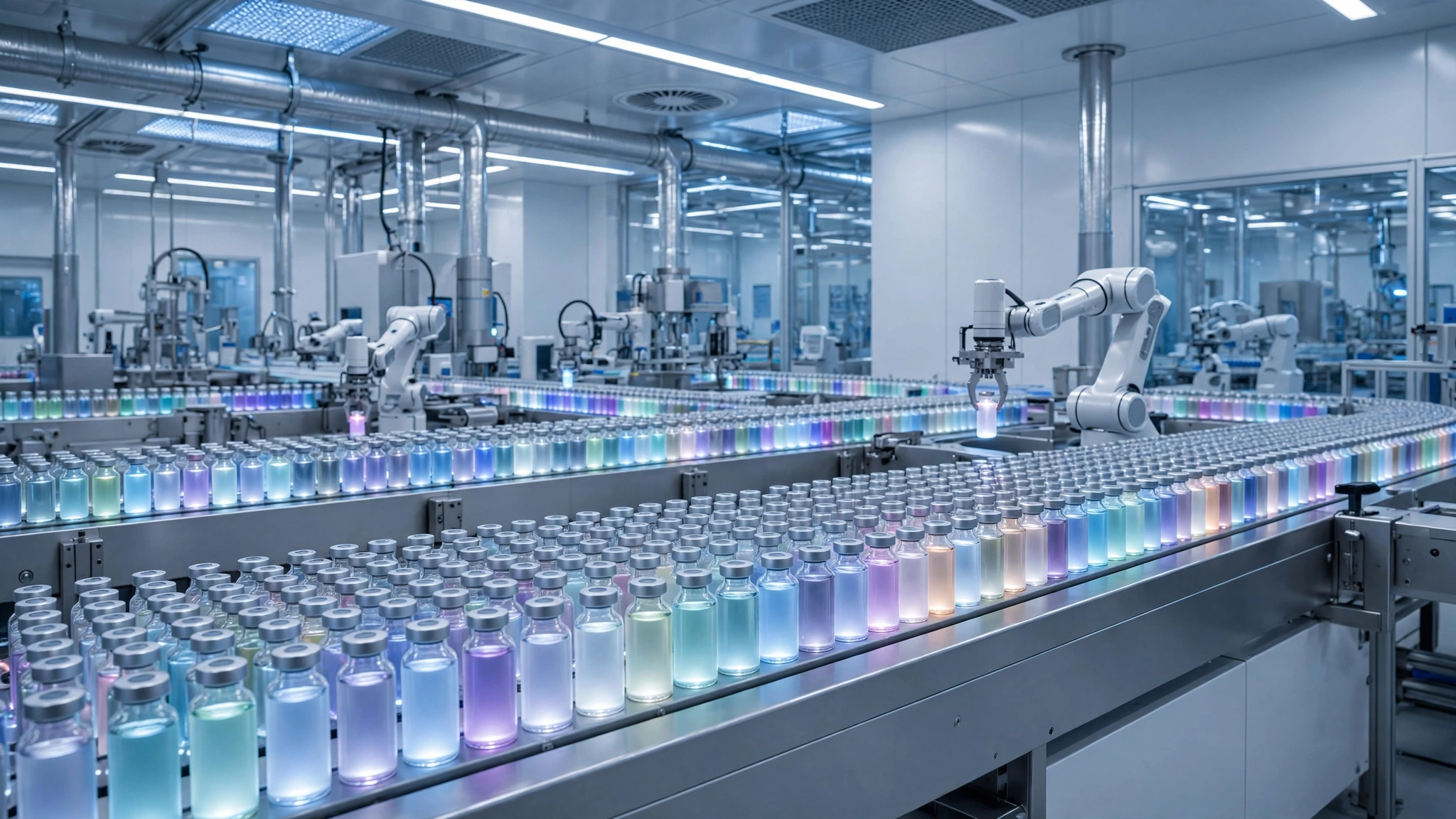
On Wednesday, Moderna and Merck announced their personalized cancer vaccine had cleared a Phase 3 trial of more than 1,000 melanoma patients. Intismeran autogene, a custom mRNA vaccine encoding up to 34 mutations from each patient's own tumor, combined with Merck's immunotherapy drug Keytruda (pembrolizumab), prevented the return and spread of cancer in patients whose tumors had been surgically removed.
"It is a monumental leap forward," said Dr. Julie Gralow, chief medical officer of the American Society of Clinical Oncology.
She's right, but the clinical triumph obscures a harder question that nobody in oncology has had to answer before, because no therapy has ever required manufacturing a unique molecular product, from scratch, for every single patient who walks through the door. Every dose in that trial was built for exactly one person, and no two patients received the same molecule. If this vaccine works beyond melanoma, the pharmaceutical industry will need to produce a unique drug for every eligible patient, every year, at a scale that has never existed.
From 157 to 1,000
A smaller Phase 2b trial called KEYNOTE-942 tracked 157 patients over five years and laid the groundwork. In June, Moderna and Merck presented the full five-year analysis at the ASCO Annual Meeting and published it simultaneously in the Journal of Clinical Oncology.
Here is what five years showed: the cancer came back half as often. Patients who received the personalized vaccine plus Keytruda had a 49% reduction in recurrence or death compared with Keytruda alone (HR 0.510, P = 0.0075). Distant metastasis, the event that kills melanoma patients, dropped 59%.
At 2.5 years, recurrence-free survival was 74.8% in the combination arm versus 55.6% with Keytruda alone. A 19.2 percentage-point absolute gap gives a number needed to treat of 5.2: treat five patients, prevent one additional recurrence, which for a cancer drug is decisive.
Overall survival trended positive too (HR 0.471), though the confidence interval crossed 1.0. The trial was not powered for that endpoint, and the question patients actually care about, does this help me live longer, remains unanswered until a larger dataset matures.
Moderna and Merck had not secured accelerated approval based on the Phase 2b data alone; the FDA wanted a larger, randomized trial to confirm the signal. Now that trial has delivered, in a population roughly seven times larger, and approval for adjuvant melanoma, likely in 2027, looks increasingly certain.
How You Build a Drug for One Person
Making intismeran autogene is nothing like filling bottles on a factory line. After a surgeon removes a melanoma, the tumor tissue ships to a sequencing lab where an algorithm scans thousands of mutations in the tumor's genome and selects up to 34 neoantigens: proteins produced by mutations found only in that patient's cancer, never in their healthy tissue, each one a potential target that trained T cells will hunt.
Moderna then synthesizes a single mRNA strand encoding all 34 neoantigens, wraps it in lipid nanoparticles, tests it for sterility and potency, and ships the finished vials back to the treating hospital. Six weeks, biopsy to first dose.
Patients receive up to nine doses of the personalized vaccine every three weeks, combined with up to nine infusions of Keytruda every six weeks, spanning a 12-to-18-month treatment course that adds no new side effects beyond what Keytruda alone produces: fatigue, diarrhea, rash, and joint inflammation.
Precision medicine, taken literally: not a drug that targets a biomarker shared by 30% of tumors, but a drug that targets the unique molecular fingerprint of one person's cancer, built from mutations nobody else's tumor shares.
Expansion
Melanoma was chosen first because it carries one of the highest tumor mutational burdens of any solid cancer: roughly 14 mutations per megabase of DNA, which means more neoantigen targets for the vaccine to encode and, likely, a stronger immune response.
Moderna and Merck are already well beyond melanoma. According to the June 2026 Merck press release, eight Phase 2 and Phase 3 trials are underway across seven cancer types. BioNTech and Roche are running a parallel program with autogene cevumeran in colon cancer (results expected 2027) and pancreatic cancer (2031).
| Cancer Type | Trial Phase | New US Cases/Year | Eligible for Vaccine |
|---|---|---|---|
| Melanoma | Phase 3 ✓ | ~100,000 | 12,000–15,000 |
| Non-small cell lung | Phase 3 | ~238,000 | ~50,000 |
| Bladder | Phase 2 | ~83,000 | ~25,000 |
| Kidney | Phase 2 | ~82,000 | ~30,000 |
| Cutaneous SCC | Phase 2/3 | ~1.8M | ~15,000 |
| Pancreatic | Early | ~66,000 | ~10,000 |
| Stomach | Early | ~27,000 | ~8,000 |
| Total (all 7 tumor types) | ~150,000–165,000 | ||
US incidence: American Cancer Society 2026 projections. Eligible patients estimated from stage-specific resectability rates.
Stephen Hoge, Moderna's president, told Reuters that "numerous trial results" are expected over the next year or two. Dr. Robert Vonderheide, director of Penn Medicine's Abramson Cancer Center, said there is "every reason to hope now, with this news, that many of them will be positive."
Hope is warranted. So is arithmetic.
Manufacturing Math
This is where the story shifts from clinical science to industrial logistics.
Consider the US patient population alone: the American Cancer Society's 2026 estimates project roughly 100,000 new melanoma cases per year. About 12,000 to 15,000 of those are stage III/IV and eligible for surgical resection, which is the population studied in both trials. If intismeran autogene is approved for adjuvant melanoma, each of those patients needs a unique, individually manufactured vaccine.
Twelve thousand custom drugs per year. One cancer. One country.
Scale it across the seven cancers in the table above: add NSCLC at 50,000 eligible patients and the total hits 62,000 unique vaccines per year. Include all seven tumor types and a plausible five-year scenario reaches 150,000 unique vaccines per year in the United States alone. Globally, triple it.
For context, during COVID, Moderna produced approximately 800 million vaccine doses per year, which was staggering and which was also one product: a single mRNA sequence, manufactured identically billions of times, optimized for throughput of a uniform commodity.
Personalized cancer vaccines invert everything about that model. Instead of one sequence at massive scale, you need massive variety at individual scale, where each patient requires a unique mRNA synthesis run, unique lipid nanoparticle encapsulation, and unique quality control testing including sterility assays and potency verification that cannot be batched or pooled because no two vaccines share a single ingredient. Every batch is a batch of one.
COVID proved Moderna could run the printing press, but cancer demands the calligraphy studio operating at the press's volume.
What a Personalized Drug Factory Costs
Moderna has not disclosed per-patient manufacturing costs for intismeran autogene. The estimates below draw on published techno-economic analyses of GMP-grade mRNA production, particularly Kis et al. (2021) in Vaccines, which modeled per-dose costs across RNA vaccine platforms, and Moderna's own COVID-era disclosures on mRNA manufacturing economics. Personalized vaccines add per-patient sequencing, neoantigen prediction, and individual QC steps that these models did not include, so the costs below are higher than commodity mRNA production and should be treated as informed estimates, not verified figures.
| Metric | Current Estimate | At Scale (Automated) |
|---|---|---|
| Cost per patient batch | $15,000–$30,000 | $5,000–$10,000 |
| Batches per line per week | 50–100 | 100–200 |
| Patients per line per year | 2,600–5,200 | 5,200–10,400 |
| Lines needed (melanoma only) | 3–5 | 1–3 |
| Lines needed (full expansion) | 20–40 | 10–20 |
Assumes six-week batch cycle. Automated estimates assume parallelized QC and robotic fill-finish.
Building a single GMP pharmaceutical manufacturing line typically costs $200 million to $500 million and takes two to four years. Multiply it out: 20 lines at $200 million apiece is $4 billion, and 40 lines at $500 million is $20 billion. That five-fold range reflects genuine uncertainty about how much automation can compress costs and how many cancer types ultimately qualify.
For comparison, consider what patient-specific manufacturing looks like today: Vertex Pharmaceuticals reported that only 64 patients received its gene therapy Casgevy across all of 2025, at $2.2 million per treatment. Intismeran autogene needs to reach two orders of magnitude more patients annually, at one-tenth the per-patient cost, and nothing in pharmaceutical history has attempted that.
But the revenue arithmetic explains why someone will build it anyway. Keytruda alone runs approximately $191,000 per year per patient in the United States. Add a personalized vaccine at $50,000 to $100,000 for the custom manufacturing component and total per-patient treatment costs reach $250,000 to $300,000. Melanoma alone at 12,000 patients: a $3 billion to $3.6 billion annual market. Add NSCLC at 50,000 patients: another $12.5 billion to $15 billion. Full seven-cancer expansion could reach $25 billion to $45 billion per year in the United States alone. For context, Keytruda generated roughly $25 billion in global revenue in 2025. Personalized cancer vaccines could match or exceed the entire revenue of the world's best-selling drug.
Those are also $25 billion to $45 billion in healthcare costs. Whether insurers, Medicare, and health systems outside the United States will reimburse $250,000 to $300,000 per patient is far from settled. Manufacturing at scale does not guarantee access at scale, especially for cancers like melanoma where detection rates and access to surgical resection already differ by race, insurance status, and geography.
Why It Might Not Generalize
Melanoma might be as good as it gets, because among solid tumors it has the highest median tumor mutational burden, which is precisely why it was chosen first. Non-small cell lung cancer, particularly in smokers, also carries a high mutational load and is the most promising expansion target, but kidney cancer, bladder cancer, and especially pancreatic cancer have substantially fewer mutations per megabase of DNA, meaning fewer neoantigen candidates, potentially weaker immune responses, and a harder path to clinical benefit.
Beyond clinical efficacy, the full Phase 3 data still needs scrutiny. Moderna and Merck have announced positive topline results but have not released the hazard ratio, confidence interval, or subgroup analyses that would let independent researchers evaluate the effect size and its consistency across patient populations. In the Phase 2b trial, overall survival at five years did not reach statistical significance. Recurrence-free survival is a meaningful endpoint, but patients want to know one thing: does this treatment help them live longer? We do not have that answer yet.
Finally, time creates its own constraint: a six-week manufacturing window works for melanoma, where post-surgical patients have weeks to months before adjuvant therapy begins, but in pancreatic or stomach adenocarcinoma, six weeks could cost patients their treatment window entirely.
What This Means If You're Alive Today
If you are one of the roughly 12,000 Americans diagnosed each year with high-risk melanoma, this vaccine will most likely reach you by 2028. Moderna and Merck will file for FDA approval, and the Phase 3 data should support a standard approval pathway. Ask your oncologist about KEYNOTE-942 and V940-001 at your next visit.
If you have non-small cell lung cancer, bladder cancer, or kidney cancer that has been or will be surgically removed, watch the trial results over the next one to two years. Several Phase 2 and Phase 3 studies are actively enrolling at sites across the country, and ClinicalTrials.gov lists active Moderna/Merck V940 trials accepting patients right now.
If you work in pharmaceutical manufacturing, supply chain, or healthcare infrastructure, start planning now, not in 2028 when approval arrives and every hospital system in the country places orders simultaneously and the manufacturing capacity that should already exist does not. Automated mRNA synthesis platforms, parallelized quality control systems, and decentralized manufacturing networks are no longer theoretical needs but the engineering bottleneck between a proven clinical concept and the patients who need it, and every month of delay between now and commercial launch is a month that a patient with high-risk melanoma waits for a drug that already exists in clinical form but cannot be manufactured for them.
Personalized cancer vaccination is now settled science. A 1,000-patient Phase 3 trial has confirmed what a 157-patient Phase 2b suggested five years ago. Can anyone build the factory fast enough to matter? That is the only question left.
Sources and Methodology
Clinical data referenced in this article are drawn from three primary sources: (1) the Merck press release of June 1, 2026, detailing five-year follow-up data from the Phase 2b KEYNOTE-942/mRNA-4157-P201 trial presented at ASCO 2026 and published in the Journal of Clinical Oncology; (2) the Merck press release of January 20, 2026, reporting the initial five-year data; and (3) Reuters reporting on the Phase 3 trial announcement, August 20, 2026.
Cancer incidence estimates use American Cancer Society 2026 projections. Manufacturing cost estimates are based on published industry analyses of GMP-grade custom mRNA production; Moderna has not disclosed its per-patient costs. Revenue projections for Keytruda use Merck's publicly filed 2025 annual report. Number-needed-to-treat calculations use the absolute risk reduction from the 2.5-year RFS data (74.8% vs. 55.6%), as the 5-year absolute rates have not been disclosed. Manufacturing capacity estimates assume six-week batch cycles and are projections, not disclosed production data from Moderna.