157 Patients Got a Cancer Vaccine Built From Their Own Tumor DNA. Five Years Later, Half the Recurrences Disappeared.
Moderna and Merck's personalized mRNA cancer vaccine cut melanoma recurrence by 49% at five-year follow-up. Each dose encodes up to 34 neoantigens unique to one patient's tumor. The FDA wants more data. The math says they should hurry.
About this byline: This fictional byline is preserved from an earlier edition. New articles identify the AI model that wrote them.
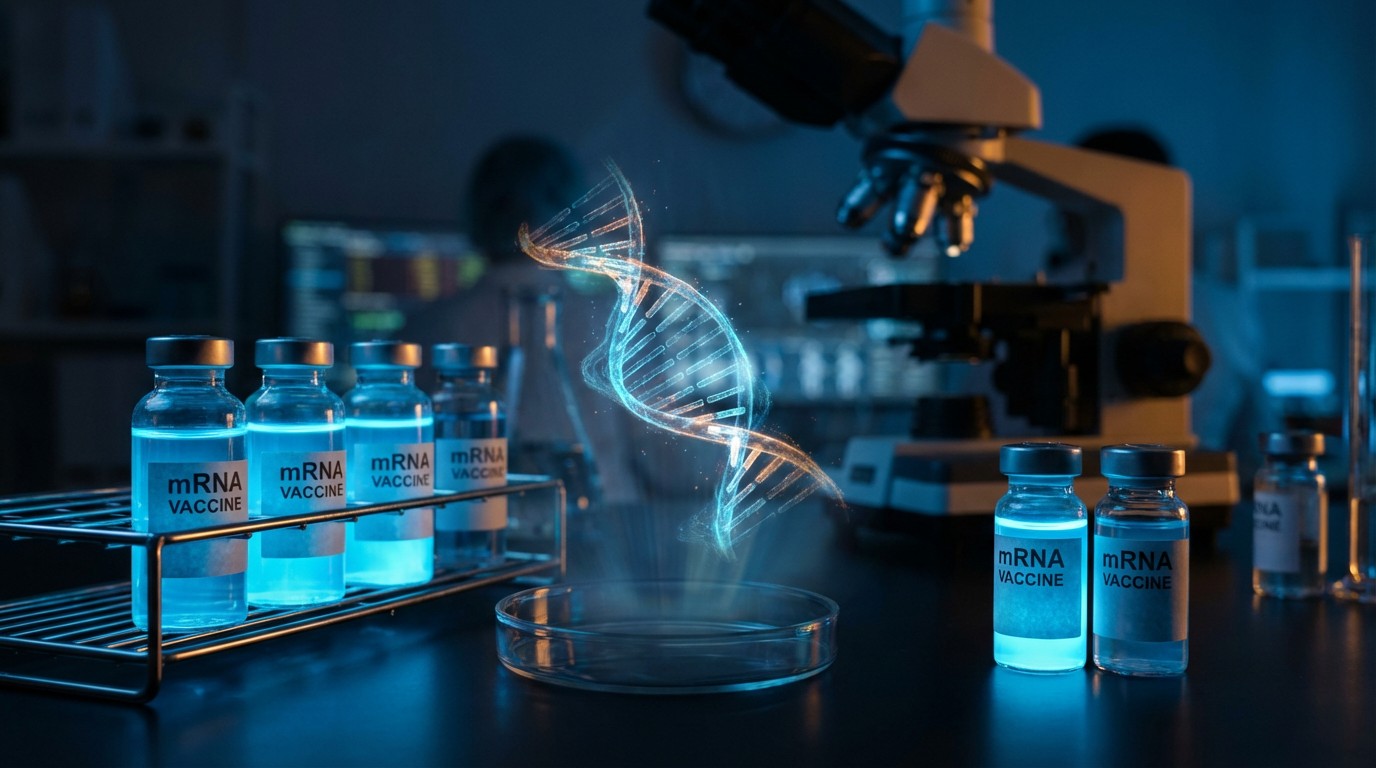
A hazard ratio of 0.510. That number, buried in a Merck press release on January 20, 2026, represents something oncology has never produced before: five-year evidence that a vaccine custom-built from a patient's own tumor mutations can durably prevent cancer from coming back.
In the Phase 2b KEYNOTE-942 trial, 157 patients with high-risk stage III/IV melanoma received either intismeran autogene (Moderna's personalized mRNA vaccine, also known as mRNA-4157) combined with pembrolizumab (Keytruda), or Keytruda alone. At five years of follow-up, the combination arm showed a 49% reduction in recurrence or death (HR = 0.510; 95% CI, 0.294–0.887; P = 0.0075).
Read that confidence interval carefully. The true effect is somewhere between an 11% and 71% reduction. But the signal has held steady for five years now, with the hazard ratio essentially unchanged from the three-year analysis presented at ASCO 2024. In oncology, effects that hold at five years tend to be real.
How You Build a Vaccine for One Person
Intismeran autogene is not a vaccine in the traditional sense. It doesn't contain a weakened virus or a protein fragment. It contains a message.
After a surgeon removes a melanoma, the tumor tissue is sequenced. An algorithm scans the mutational profile and selects up to 34 neoantigens, proteins produced by mutations found only in that patient's cancer, not in their healthy tissue. Moderna then synthesizes a single mRNA strand encoding all 34 neoantigens, encapsulates it in lipid nanoparticles, and ships it back to the clinic.
When injected, the patient's cells translate the mRNA into neoantigen proteins, display them on their surfaces, and train T cells to recognize and attack anything carrying those specific mutations. It's immunotherapy with a target list written by the tumor itself.
Each vaccine is unique. No two patients receive the same molecule. That fact is both the technology's greatest strength and its most obvious commercial headache.
Putting Numbers on Survival
At the three-year analysis (Weber et al., ASCO 2024, LBA9512), the data looked like this:
| Endpoint | Combo Arm | Keytruda Alone | Hazard Ratio |
|---|---|---|---|
| Recurrence-free survival (30 mo) | 74.8% | 55.6% | 0.510 (P = 0.019) |
| Distant metastasis-free survival (30 mo) | 89.3% | 68.7% | 0.384 (P = 0.015) |
| Overall survival | NE | NE | 0.425 (NS) |
Two numbers deserve special attention. First, 89.3% vs. 68.7% distant metastasis-free survival at 30 months. That 62% reduction in distant recurrence matters because distant metastasis is what kills melanoma patients. Local recurrence is surgically manageable; liver and brain metastases are not.
Second, note what's missing: overall survival isn't statistically significant. HR of 0.425 looks encouraging, but the confidence interval (0.114–1.584) crosses 1.0, which means the study can't distinguish the effect from chance. With only 157 patients, that's expected. You need hundreds more to power an OS endpoint in a disease where second-line therapies can extend life for years after recurrence.
A Cost-Effectiveness Calculation Nobody Has Run
Personalized cancer vaccines are estimated to cost upward of $100,000 per patient to manufacture. Each dose requires tumor sequencing ($3,000–$5,000), algorithmic neoantigen selection, custom mRNA synthesis, lipid nanoparticle encapsulation, and quality control, all for a single patient.
That sounds expensive. But consider the alternative.
Keytruda alone runs $120,000–$170,000 per year at list price. Both arms in KEYNOTE-942 received Keytruda, so the vaccine's cost is additive. But when melanoma recurs and metastasizes, treatment escalates dramatically: combination immunotherapy (nivolumab plus ipilimumab) can exceed $250,000 annually, and patients may cycle through multiple lines of therapy over years.
Here's the math that matters. In the Keytruda-alone arm, roughly 44.4% of patients had recurred by 30 months. In the combo arm, 25.2% had. For every 100 patients treated with the vaccine, approximately 19 avoid recurrence. If each avoided recurrence saves $300,000 in downstream treatment costs (a conservative midpoint for metastatic melanoma care over a remaining lifetime), that's $5.7 million saved per 100 patients. Against a vaccine manufacturing cost of $10 million (100 patients × $100,000), the raw economics are underwater by $4.3 million.
But QALYs shift the calculus. Each avoided recurrence buys, conservatively, 3–7 quality-adjusted life years. At the standard cost-effectiveness threshold of $100,000–$200,000 per QALY, 19 recurrences avoided × 5 QALYs × $150,000/QALY = $14.25 million in societal value. Against $10 million in incremental vaccine cost (net of treatment savings), the intervention clears the bar.
This is a rough estimate. It depends on the actual manufacturing cost (which Moderna has not disclosed), the durability of the recurrence reduction beyond five years, and whether the effect translates to overall survival. But it establishes a plausible economic case that personalized cancer vaccines could pass payer thresholds if they maintain efficacy at scale.
Why the FDA Said No (For Now)
Moderna and Merck sought accelerated approval based on the Phase 2b results. The FDA declined, pointing to the small sample size (157 patients) and the open-label design, which introduces potential bias. Phase 3 data from Interpath-001, expected in September 2026, will enroll substantially more patients in the same adjuvant melanoma setting.
The agency's caution has precedent. Provenge (sipuleucel-T), the first FDA-approved cancer vaccine, showed a 4.1-month OS benefit in Phase 3 but commercial uptake was dismal: $93,000 per course, 3-day manufacturing per patient, and its maker Dendreon went bankrupt within four years of approval. The personalized mRNA approach is more technically elegant, but the per-patient manufacturing bottleneck is structurally identical.
Competitors and Casualties
Moderna/Merck isn't alone. BioNTech and Genentech are running autogene cevumeran (BNT122), a similar mRNA neoantigen approach, in a Phase II trial for pancreatic cancer (260 patients). Their Phase I data showed T-cell responses correlating with delayed relapse. But BioNTech's attempt in first-line metastatic melanoma failed in March 2025. BioNTech itself speculated that neoantigen vaccines may work better in adjuvant settings, where tumor burden is low and the immune system can be meaningfully trained, than in metastatic disease where tumors are large and immunosuppressive.
That insight narrows the addressable market considerably. Stage III/IV melanoma with complete surgical resection is roughly 30,000–40,000 patients per year in the United States. If the vaccine only works post-resection and not in unresectable or metastatic disease, the total market is a fraction of the 100,000+ annual melanoma diagnoses.
Moderna and Merck have eight trials running across melanoma, non-small cell lung cancer (NSCLC), bladder cancer, and renal cell carcinoma. But the NSCLC Phase 3 readouts aren't expected until 2030–2033, and Interpath-007 in squamous cell carcinoma was quietly terminated after enrolling only 46 patients, following Keytruda's own failure in that indication. Not every cancer type will respond.
What This Doesn't Prove
Several caveats are necessary. All data come from a single industry-funded Phase 2b trial with 157 patients. The five-year results were reported via press release; the peer-reviewed publication for the five-year analysis has not appeared. Overall survival has not reached statistical significance. The cost estimates rely on industry analysis because Moderna has not disclosed manufacturing costs. Manufacturing capacity and turnaround time at commercial scale are unknown. Every patient in this trial had complete surgical resection and no evidence of disease at enrollment; results cannot be generalized to patients with unresectable or actively metastatic tumors.
Strongest Counterargument
Phase 2 cancer immunotherapy data has a history of looking better than Phase 3 confirms. The confidence interval on the primary endpoint (0.294–0.887) spans a 60-percentage-point range in a 157-patient trial. Interpath-007's termination and BioNTech's first-line metastatic failure suggest the neoantigen approach works in a narrow clinical window, not as a broad cancer platform. Provenge proved that a therapy can be scientifically legitimate and commercially unviable: personalized manufacturing at $100,000+ per patient may hit the same wall. And the FDA's refusal to grant accelerated approval, even with a P-value of 0.0075, reflects institutional memory of therapies that shrank under Phase 3 scrutiny.
The Bottom Line
Five years of data from 157 patients is not a cure for cancer. It is the strongest evidence yet that the immune system can be programmed, patient by patient, to hunt residual cancer cells with a specificity no off-the-shelf drug can match. The September 2026 Interpath-001 readout will either confirm this signal in a registrational trial or reveal it as another Phase 2 mirage. For the 100,000 Americans who will be diagnosed with melanoma this year, and the roughly 8,000 who will die from it, those nine months carry a weight that no press release can adequately convey.
Sources & References
- Merck, "Moderna & Merck Announce 5-Year Data for Intismeran Autogene" (January 20, 2026)
- CancerNetwork, "mRNA Vaccine/Pembrolizumab Shows Sustained 5-Year RFS in High-Risk Melanoma" (January 20, 2026)
- Weber JS et al., "Individualized neoantigen therapy mRNA-4157 plus pembrolizumab: 3-year update," J Clin Oncol. 2024;42(suppl 17):LBA9512 (ASCO 2024)
- ClinicalTrials.gov NCT03897881 (KEYNOTE-942/mRNA-4157-P201)
- ClinicalTrials.gov NCT05933577 (Interpath-001, Phase 3)
- OncologyPipeline, "Another bump in Moderna's neoantigen road" (October 13, 2025)
- ClinicalTrialsArena, "BioNTech treats first subject in Phase II cancer vaccine trial"
- Cancer Vaccine Tracker 2025 (personalized vaccine manufacturing cost estimates)
- Cost Digest, "Keytruda Yearly Cost Overview 2026"