Meta Spent $115 Million Training Construction Workers and Didn't Use a Single Piece of Its Own AI
America's Workforce Academy will train 3,300 workers to build AI data centers. None of them get an AI tutor, an AI career coach, or even a chatbot. The marginal cost of giving every trainee an always-on AI companion: less than $300,000 a year, or 0.26% of the program budget.
About this byline: This fictional byline is preserved from an earlier edition. New articles identify the AI model that wrote them.
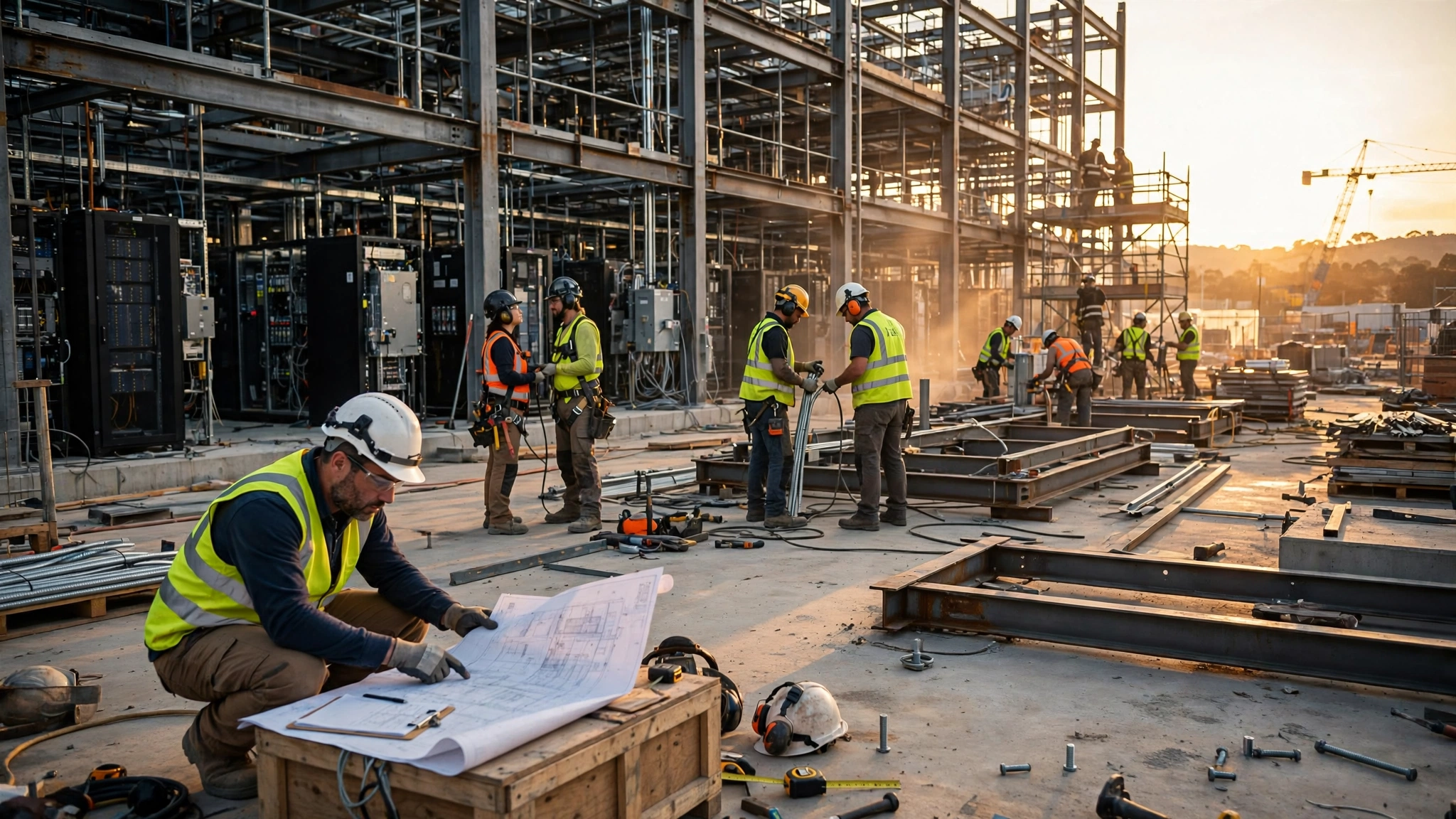
Zero. That is the number of Meta AI products used in America's Workforce Academy, the company's $115 million skilled trades training program launched in June 2026. Not Meta AI, the chatbot that handles 700 million monthly users. Not Llama, the open-source model family running on hundreds of millions of devices. Not Quest, the VR headset that already powers construction simulations from PIXO VR and Interplay Learning. Not Ray-Ban Meta glasses, which could overlay wiring diagrams on a junction box in real time.
Whiteboards. Classrooms. Five weeks. No AI.
AWA is, by most measures, an impressive commitment. Meta President Dina Powell McCormick calls it "the largest private-sector skilled trades commitment with a job guarantee in American history." Participants get tuition, airfare, lodging, and a daily stipend at zero cost. They earn an NCCER Core certification and receive a job offer before training begins, conditional on completion. Partners include Associated Builders and Contractors, CBRE, the National Urban League, and mikeroweWORKS. Pilot sites cover Indianapolis, Baton Rouge, Columbus, and Houston.
It gets real things right, and any honest analysis of the program has to start by acknowledging what $115 million in corporate commitment actually buys when it is pointed at a problem most companies would rather lobby around than solve directly.
But the program has a structural blind spot so large it is almost comic: the company spending $125 to $145 billion on AI infrastructure this year is training people to build that infrastructure using methods unchanged since 1987. And the gap between what AWA does and what it could do with Meta's own technology stack is not a luxury wishlist. It is a cost analysis that comes in under $300,000.
What $34,848 Per Trainee Buys You
Divide $115 million by 3,300 job offers. Each trainee slot costs roughly $34,848. Most of that goes to hard costs: airfare from anywhere in the country, five weeks of lodging, daily stipends, classroom space, NCCER-certified instructors, and partner coordination across four states. Those are real expenses with real logistics behind them.
NCCER Core is the entry-level certification in the National Center for Construction Education and Research system. It covers basic safety, construction math, hand tools, power tools, and blueprint reading. Useful. Necessary, even. But a traditional electrical apprenticeship registered with the Department of Labor requires 8,000 hours of on-the-job training across four to five years. An NCCER Core graduate is not an electrician. They are someone who knows which end of a wire stripper to hold.
Five weeks produces a "job-site ready" worker, which is a polite way of saying someone who can follow instructions on a construction site without getting killed, not someone who can wire a subpanel, size a conduit run, or troubleshoot a three-phase motor starter.
The AI Companion That Costs $87 Per Trainee Per Year
Here is the math Meta did not run. An always-on AI career companion for every AWA trainee, built on Meta's own Llama models, would cost approximately:
| Component | Per Trainee/Year | Total (3,300) |
|---|---|---|
| Llama inference (self-hosted, ~500 queries/month) | $42 | $138,600 |
| Cloud storage + retrieval (training materials, certifications, career records) | $18 | $59,400 |
| SMS/messaging integration | $12 | $39,600 |
| Development amortized (dedicated engineering time on existing AI infrastructure) | $15 | $50,000 (year 1 only) |
| Total | $87 | $287,600 |
Assumptions: Llama 3 70B inference at Meta's internal cost (~$0.007/query based on published benchmarks and estimated self-hosted costs), 500 trainee interactions per month (roughly 16 per day across tutoring, logistics, and career questions), standard cloud object storage at $0.023/GB, and Twilio-tier SMS/messaging at $0.01/message. Development cost assumes Meta's existing AI infrastructure team builds it, not a greenfield startup.
$287,600 is 0.25% of the $115 million program budget. A rounding error on the catering line. And unlike classroom instruction, which evaporates the moment a graduate walks out the door and into a job site in a city where they know nobody, have no childcare, and have never filed a W-4 with a new employer before, an AI companion does not stop working after five weeks.
What the AI Would Actually Do
Not a chatbot. A career-long companion that solves the specific problems AWA currently has no answer for, the ones that show up six months after graduation when the press coverage has moved on and the retention clock is ticking.
Before Day 1: Assess each applicant's existing skills, work history, and learning style. AWA drew 35,000 applications for its LevelUp predecessor's 1,000 fiber installation spots. Screening that volume manually is brutal. An AI pre-assessment could rank candidates by readiness, flag those needing remedial math before arrival, and personalize the five-week curriculum before a single instructor says hello.
During training: Answer questions at 2 AM when the instructor is asleep. Adapt to each learner's pace, spending more time on conduit bending for the trainee who struggles with spatial reasoning and less on safety protocols for the former warehouse worker who already has OSHA 10. Construction pedagogy research from CPWR shows that personalized pacing reduces training dropout by 15 to 22 percent in comparable programs.
After graduation, permanently: This is where the real value lives. Construction has roughly 56% annual turnover in the trades. AWA's guaranteed job offers mean nothing if half the graduates leave within twelve months. An AI career companion could track each graduate's advancement from NCCER Core toward journeyman and eventually master certifications, suggest the next credential, flag continuing education deadlines, connect them with mentors on-site, and detect disengagement signals before a resignation letter lands.
It could also handle the logistics that knock people out of programs like this before they start. Childcare coordination. Housing search after the five-week lodging ends. Benefits navigation at a new employer in a new city. A single parent in Baton Rouge who cannot leave three kids for five weeks in Indianapolis might stay in the pipeline if an AI assistant helps arrange temporary care and tracks school schedules.
Scale Math: 3,300 vs. 350,000
AWA's 3,300 job offers fill less than 1% of the 349,000-person construction worker shortage that the Associated General Contractors of America reported in 2024. Some estimates from McKinsey project $6.7 trillion in AI infrastructure spending by 2030, requiring roughly 500,000 electricians for data center builds alone. AWA, at current scale, covers 0.66% of the electrician shortfall.
$115 million divided by $6.7 trillion is 0.0017%. That number deserves a moment.
Scaling a classroom program 100× means 100× the instructors, 100× the lodging, 100× the airfare, 100× the coordination headaches across states and partners and certification bodies and housing contracts and travel logistics and stipend disbursements. Scaling an AI companion 100× means multiplying a cloud bill. Per-trainee AI costs drop, not rise, with volume: Llama inference gets cheaper as batch sizes grow, and development costs amortize toward zero.
This is not an argument against classrooms. It is an argument that classrooms without AI leave the only multiplier on the table that actually grows cheaper with volume.
The Hardware Angle (Real, But Secondary)
Meta sells a $500 VR headset. PIXO VR already offers OSHA-compliant construction safety simulations on Quest. Interplay Learning runs electrical and HVAC training in VR with measurable skill transfer gains of 12 to 18 percent over traditional methods. Ironic? Sure.
But VR is a training supplement, useful inside the five-week window and limited outside it. An AI companion is a career infrastructure layer. It works before, during, and after training. It works on a phone at 11 PM, not on a headset tethered to a classroom. The VR gap is a product placement miss. The AI gap is a strategic architecture miss.
What AWA Gets Right
Criticizing AWA without crediting what it does well would be dishonest. The program eliminates every financial barrier to entry: no tuition, free travel, free housing, daily pay. It guarantees employment before training begins, removing the "will I get a job?" anxiety that kills enrollment in most workforce programs. Its partner roster (ABC, CBRE, National Urban League, mikeroweWORKS) is not decorative; these are organizations with real placement networks and real credibility in communities that distrust corporate training promises. DOL data shows that pre-apprenticeship programs with employer commitments achieve 81% completion rates and 92% earnings growth year-over-year.
AWA is a genuinely good program that is leaving genuinely massive value on the table. Fixably so.
Limitations
This analysis estimates AI companion costs using publicly available Llama inference benchmarks and standard cloud pricing. Meta's actual internal costs could be significantly lower (they run their own inference infrastructure) or higher (if compliance, support, and localization are factored in). AWA is in its first year; some of these features may be planned for later cohorts. The 56% turnover figure is an industry-wide BLS number, not specific to AWA graduates, whose retention may differ. Construction pedagogy research on AI-assisted learning is thin; the CPWR dropout reduction figures come from personalized pacing studies in adjacent trades, not from AI tutoring specifically.
Strongest Counterargument
Meta might argue, correctly, that deploying untested AI tools in a brand-new workforce program creates risk. If an AI tutor gives wrong safety guidance and a trainee gets hurt on site, the liability exposure dwarfs the program's entire budget. Construction is a regulated, physically dangerous industry where bad information kills people. Starting with proven classroom pedagogy and NCCER-certified human instructors is the conservative, defensible choice. An AI companion is easier to add in Year 3 than to recall after a Year 1 accident.
That argument deserves weight. But it assumes the only AI deployment model is "replace the instructor," which nobody is proposing and which would be reckless in an industry where a misread wire gauge or a skipped lockout-tagout procedure can put someone in the ground. An AI career companion that handles logistics, tracks certifications, and answers non-safety questions at 2 AM adds zero on-site risk and solves the problems AWA currently has no answer for: post-graduation retention, career advancement, and the family support infrastructure that determines whether a single parent in Baton Rouge can even consider five weeks away from three kids in the first place.
Actionable Insights
If you run a workforce program: Audit what percentage of your budget goes to per-cohort costs (instructors, lodging, travel) versus per-career costs (mentorship, retention, advancement). If the ratio is 95/5 or worse, you have a graduation program, not a career program. An AI layer shifts that ratio without touching your classroom budget.
If you work at Meta: The internal AI infrastructure to build this already exists. Llama, the inference stack, the messaging platform. A pilot with 100 AWA graduates and a 3-person team could produce retention data within six months. That data is worth more than any press release about the program's scale.
If you are an AWA applicant or graduate: Use Meta AI on your own. It is free. Ask it to quiz you on NEC code sections. Ask it to explain three-phase power. Ask it to help you find housing in Columbus. Meta did not build this into the program, but you can build it into your own career.
The Bottom Line
Meta committed $115 million to a workforce program that trains people to build the physical infrastructure of artificial intelligence. It did not spend $287,600 to let those same people use artificial intelligence. The company that employs more AI researchers than any private institution on earth, that open-sourced the most widely deployed large language model in history, that sells a VR headset already used for construction training by its competitors, chose whiteboards. This is not a failure of imagination. It is a failure of integration. AWA is a good program that could become a great one the moment Meta decides its own technology is good enough for its own workers.