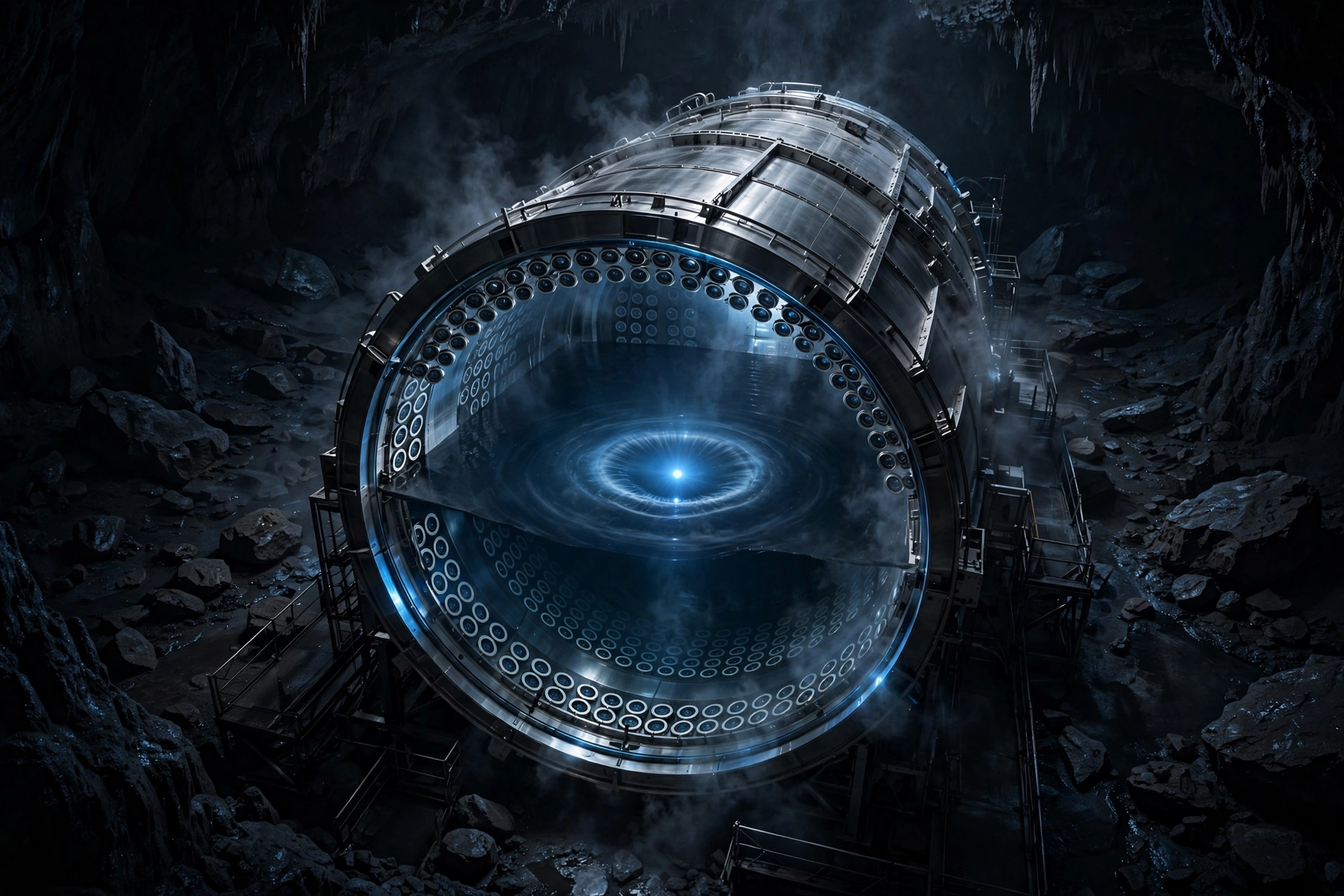
248,000 electron volts. That is how hard something kicked one xenon atom, on one day in June 2023, in a tank of liquid xenon sitting a mile underground in an old South Dakota gold mine.
For context, every dark matter search ever run has looked for kicks below about 100 keV. A 248 keV nuclear recoil is so far outside the standard search window that nobody had bothered to look there. The LUX-ZEPLIN collaboration, 250 scientists across 39 institutions, only found it because they finally extended their analysis up to 270 keV, re-examining 220 live days of data collected between March 2023 and April 2024, a 2.84 tonne-year exposure, hunting for exotic interaction models where heavy dark matter particles dump far more energy than the textbook WIMP.
They found exactly one event, and the preprint, released September 1 and submitted to Physical Review Letters, characterizes it as a nuclear recoil of 248 ± 23 (stat) ± 23 (sys) keV, in a region where the background model predicts roughly one hundredth of an event. A profile likelihood analysis puts the tension with the background-only hypothesis at 2.6 sigma globally, after correcting for look-elsewhere effects, with a maximum local significance of 3.4 sigma across the models tested. Translation: about a 0.5% chance, 1 in 215, that known physics produced this flash.
Sam Eriksen of the University of Bristol, the paper's lead author, unveiled the result September 1 at the TeV Particle Astrophysics conference in Japan. He told The Times he had been staring at the event for two years: "Every improvement we made to the analysis didn't get rid of it; in fact they made this one event stand out even more." Rick Gaitskell of Brown, the collaboration's spokesperson, was careful in the Berkeley Lab announcement: "With only one event, we don't want to get ahead of ourselves. We are not claiming to have seen dark matter."
One event, two years of scrutiny, and a half-percent chance of being a fluke: that is the entire story, and it is the most interesting dark matter result in years precisely because the collaboration published it anyway instead of sitting on it until it reached the 5-sigma discovery threshold, which, at the current data rate, would take roughly the rest of the decade.
The math nobody ran: at normal galactic speeds, this kick is impossible
Here is a calculation you will not find in the press coverage, because nobody ran it. Take the standard halo model that every direct-detection paper uses: dark matter particles drift through the galaxy with typical speeds around 220 km/s, and nothing bound to the Milky Way exceeds the escape velocity of about 544 km/s.
Now compute the hardest kick a WIMP of any mass can give a xenon nucleus. Freshman mechanics supplies the formula, E_max = 2μ²v²/M, where μ is the reduced mass and M is the xenon mass, 122 GeV/c². At the typical speed of 220 km/s, the maximum recoil asymptotes to about 131 keV as the WIMP mass goes to infinity. Read that again, because at normal galactic speeds, no WIMP of any mass, however heavy, can deposit 248 keV on xenon: it is kinematically forbidden.
To reach 248 keV you need two things at once: a WIMP moving near the galaxy's escape velocity, and a heavy one. At 544 km/s the minimum mass that can do the job is about 152 GeV/c². At 780 km/s, adding Earth's orbital motion to the escape velocity, the floor drops to roughly 77 GeV/c². Either way, the particle must come from the extreme fast tail of the velocity distribution, the rare few percent of dark matter moving fast enough to hit this hard, and it must be heavy.
This bracket, derived on a laptop from kinematics alone, lands squarely on the collaboration's own conclusion from their full spectral fit: if this was dark matter, the WIMP weighed at least 200 GeV/c², more than 200 times a proton, and interacted through something beyond the simplest models, either momentum-dependent couplings from the 15-operator effective field theory they tested, or inelastic scattering where the WIMP jumps to a heavier internal state on impact. When your back-of-the-envelope reproduces the supercomputer's answer, the claim earns a measure of trust.
It also explains why nobody saw this before. Standard searches cap out near 100 keV because the expected spectrum for ordinary WIMPs dies long before that. This event lived in an energy range the field had collectively decided was empty, but LZ looked anyway, and something was there.
From 3.4 to 2.6: the look-elsewhere tax, itemized
Headlines will say 2.6 sigma. Per the paper, the local significance hit 3.4 sigma. Both numbers are real, and the gap between them is worth understanding because it is where most "hints" go to die.
A 3.4-sigma local excess means a 1-in-2,968 chance of a background fluke, looking at one specific model in one specific energy bin. But the collaboration tested 15 effective-field-theory operators plus inelastic models, each across an energy spectrum. Every additional test is another roll of the dice, and their look-elsewhere correction converts 1-in-2,968 to 1-in-215. Divide the two: the collaboration effectively rolled the dice about 14 times.
That is honest statistics, and it is the opposite of what happened in several historical anomalies where the trials factor was computed generously or not at all. LZ is telling you, up front, exactly how much their own searching diluted the result. A collaboration willing to tax its own headline number by a factor of 14 is a collaboration taking rigor seriously.
For a human-scale anchor: 1 in 215 sits between flipping seven heads in a row (1 in 128) and eight (1 in 256). Unlikely. Not miraculous. Exactly the zone where science gets interesting and press releases get dangerous.
The graveyard: five hints, zero survivors
Dark matter direct detection has a graveyard, and every new hint should be walked through it. Here is the complete record of serious anomalies in the field:
| Year | Claim | Significance claimed | What killed it |
|---|---|---|---|
| 1998–present | DAMA/LIBRA annual modulation | Persistent signal | Contradicted by COSINE-100 and ANAIS-112; still disputed, never confirmed |
| 2010 | CoGeNT low-energy excess | ~2.8σ | Surface-event backgrounds |
| 2011 | CRESST-II excess events | ~4σ | Backgrounds; later runs saw nothing |
| 2013 | CDMS-Si: 3 events | 3σ (0.19% background-only) | Ruled out by LUX, XENON1T, SuperCDMS |
| 2020 | XENON1T: 53-event excess | 3.5σ | Trace tritium; XENONnT saw nothing (APS, 2022) |
Five serious anomalies. Zero confirmed. The base rate for a dark matter hint becoming a discovery is, empirically, zero percent. Note that CDMS-Si in 2013 had better local significance (3σ, 0.19%) than LZ's 2.6σ global, with three events instead of one, and it still died. XENON1T's 3.5σ excess drew hundreds of theory papers before dissolving into a handful of tritium atoms per kilogram of xenon.
This is not an argument that LZ is wrong; it is the prior. Anyone telling you this event is probably dark matter is ignoring the only dataset we have on how often "probably" works out in this field.
Strongest counterargument
The strongest case against this hint is not any single alternative explanation. It is the combination of the trials factor, the graveyard, and the unfalsifiability of a single event.
Consider what 2.6 sigma means operationally, because the collaboration searched an energy region nobody had examined, with models that have more free parameters than the standard analysis, and found one event. The paper details rare background topologies it considered, neutrons that scatter once and escape vetoes, pileup pathologies, misreconstructed multiples. At 248 keV, an unmodeled background only needs to happen once in 2.84 tonne-years to produce exactly this result. "We couldn't think of what else it could be" is not the same as "nothing else could do it," and the history above shows that unmodeled backgrounds have a perfect record of eventually showing up.
Then there is the timing coincidence the collaboration itself flags. Inelastic dark matter models predict an annual modulation peaking around June 2, when Earth's orbital velocity aligns maximally with the Sun's motion through the galactic halo. The event occurred on June 16, two weeks off the predicted peak. With a single event this timing means nothing statistically, and a serious reader should treat it as nothing. But it is precisely the kind of detail that will launch a hundred theory preprints, most of which will be wrong, because a coincidence at n=1 is indistinguishable from a clue.
Finally, the kinematics cut both ways. Yes, a ≥200 GeV WIMP can do this, but the standard halo model says only a few percent of dark matter moves fast enough, and the event rate for such heavy, fast WIMPs through 2.84 tonne-years at allowed cross-sections is far below one. Its own earlier exclusion limits already rule out most of the parameter space where one event would be expected rather than zero. For this to be dark matter, the true model must thread a needle: heavy enough to reach 248 keV, rare enough to have produced only one event, and interacting through operators tuned to enhance high-energy recoils, which is contrived until proven otherwise.
Limitations
This article's kinematics calculation uses the Standard Halo Model (220 km/s typical speed, 544 km/s escape velocity) and the elastic-scattering maximum; the collaboration's ≥200 GeV/c² figure comes from their full profile-likelihood fit across operators, which accounts for velocity distributions, form factors, and detector response that our bracket does not. Our "14 effective trials" is arithmetic on their reported significances, a sanity check, not their actual correction procedure. The graveyard's "zero percent" is zero out of five, a small sample, and DAMA remains technically disputed rather than dead. The projection that 5 sigma would take until roughly 2029–2030 assumes significance grows with the square root of exposure and that backgrounds stay constant; real scaling for a one-event excess is more complicated, so treat it as illustrative. No corroborating signal exists: XENONnT and PandaX-4T have not reported high-energy analyses of this kind, and a single event cannot be cross-checked until a second one arrives anywhere.
The Bottom Line and What You Can Do
A 248 keV nuclear recoil sat in three years of LZ data, invisible, because the field had decided nothing interesting happens above 100 keV. But someone looked anyway, and what they found survives two years of attempted murder by its own discoverers, carries a 1-in-215 chance of being a fluke after honest statistical taxation, and points, if real, to a dark matter particle heavier than 200 protons with interactions no textbook describes. Against that: five previous hints with equal or better credentials all died, and one event is the smallest possible unit of evidence.
If you follow physics: the thing to watch is not LZ's press cycle but the world's other xenon tanks, XENONnT and PandaX-4T, which hold comparable exposures. If either reports a single-scatter nuclear recoil above 200 keV in the next two years, the conversation changes completely, because two independent one-in-215 flukes is a one-in-46,000 coincidence. If neither does, this joins the graveyard by 2028. That is a clean, falsifiable prediction, and it is the actual scientific content of this story.
If you just like knowing how science works when it works: notice what LZ did. They found a 2.6-sigma bump, published the preprint with all the ugly details, stated the global significance after taxing themselves for look-elsewhere effects, and invited 250 collaborators' rivals to kill it. Contrast that with the long history of 3-sigma bumps announced via university press release and quietly buried. Eriksen spent two years trying to make the event go away before telling anyone. That is the behavior you want from people guarding the most sensitive hunk of quiet matter ever assembled, a detector so radio-pure that its innermost xenon sits among the most background-free large volumes on Earth for nuclear recoils.
And if you want a number to carry to dinner parties: right now, as you read this, roughly 300 million dark matter particles per second are streaming through your body, assuming the 200 GeV mass this hint favors and the standard local density of 0.3 GeV per cubic centimeter. We checked the collaboration's "millions per second" line. It is conservative by a factor of a hundred. Every one of those particles missed, except, maybe, one: in South Dakota, in June 2023.
Related
- D-Wave's 99.9% Gate Is 5x Worse and 2x Better at Fixing Itself. That's the Point.
- The Quantum Internet's Most Expensive Component Just Got 1,000x Easier to Make
Sources: LZ Collaboration preprint, "Search for dark matter particle interactions in an extended nuclear recoil energy window" (Sept 1, 2026); Berkeley Lab news release (Sept 1, 2026); Brookhaven National Lab release; Reuters (Sept 1, 2026); The Times (Sept 1, 2026); APS Physics on XENONnT resolving the XENON1T excess (2022); LZ experiment background.