A Green Laser at 90 Microwatts Just Slowed a Carbon Nanotube by 30%. Classical Physics Can’t Explain Why.
Researchers at Ruhr University Bochum proved that light creates a previously unmeasured form of friction between carbon nanotubes and water, slowing Brownian motion at laser powers 10,000 times weaker than optical tweezers. The mechanism: quantum coupling between excited electrons inside the tube and collective vibrations of surrounding water molecules.
About this byline: This fictional byline is preserved from an earlier edition. New articles identify the AI model that wrote them.
Forty-three percent thicker. That is how much more viscous water effectively becomes, from the perspective of a single carbon nanotube, when you shine a green laser on it.
Apply the Stokes-Einstein equation to the 30% diffusion reduction measured in a new Nature paper from Ruhr University Bochum, and the math is straightforward: if diffusion drops by 30%, the nanotube experiences water as though its viscosity jumped from 1.0 to 1.43 millipascal-seconds, roughly the difference between room-temperature water and water at 5°C. Nothing in the liquid changed temperature or composition. The only variable was light.
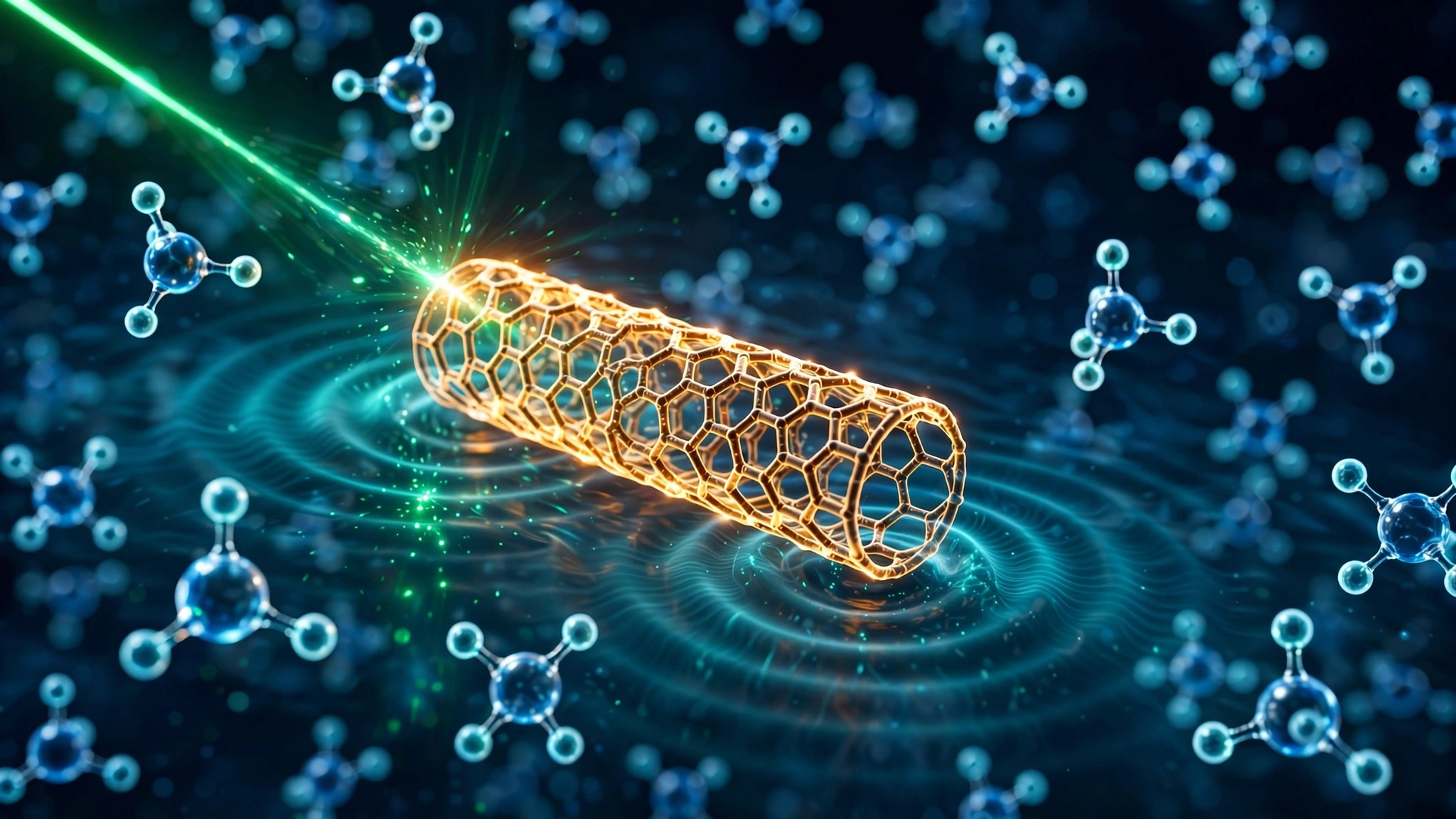
The explanation requires a concept that has been theoretically predicted for years but never cleanly demonstrated in a real experiment: quantum friction. When photons excite electron-hole pairs (called excitons) inside the nanotube, those excitons race along the tube's axis at speeds that make their fluctuating electric dipoles couple directly to the collective terahertz vibrations of surrounding water molecules, creating a drag force that is not radiation pressure, not photothermal heating, and not photophoresis, but rather a fundamentally quantum interaction between a solid's electronic excitations and a liquid's molecular modes that transfers momentum from water to tube and slows the whole structure down.
The Experiment: Light as an Invisible Brake
Sebastian Kruss, a professor of physical chemistry at Bochum, led the work with theoretical physicist Marialore Sulpizi and THz spectroscopist Martina Havenith. Their team wrapped single-walled carbon nanotubes (600 nanometers long, 100,000 times thinner than a human hair) in short DNA strands to make them water-soluble, then tracked their Brownian motion under a microscope while varying excitation laser power from 10 to 90 microwatts.
The relationship was strikingly linear. As laser power increased from 10 to 90 microwatts, diffusion decreased with a correlation coefficient (R²) of 0.996. At zero excitation, the nanotubes diffused at 1.7 µm²/s, consistent with prior measurements. Under full illumination, that rate dropped by roughly 30%. The team ran every control a skeptic could demand (confocal volume artifacts, photothermal heating, sample purity, four different solvents) and none explained the effect.
The decisive experiment came from a chemical trick. The researchers introduced sp³ quantum defects into some nanotubes, creating localized traps that pin excitons in place so they can no longer race along the tube. The result: identical nanotubes, identical light, zero slowing, proving that mobile excitons are the essential ingredient.
Chemical Tuning: A Factor-of-Two Dial
Light intensity is one lever. Chemistry is another. The team found that adding ascorbic acid (which increases the nanotube's fluorescence quantum yield and therefore exciton concentration) slowed diffusion further, while riboflavin (which quenches fluorescence) sped it up. Both relationships were linear, and the total tunability spanned a factor of two from the fastest diffusion with riboflavin to the slowest with ascorbic acid, with R² values of 0.99 and 0.98 respectively, the kind of clean dose-response curve that suggests a single dominant mechanism rather than a cocktail of confounding effects.
Run that factor-of-two through Stokes-Einstein and the nanotube experiences water as having double its actual viscosity, roughly equivalent to light mineral oil, a transformation achieved without changing the liquid's temperature, composition, or bulk properties in any measurable way.
The power difference is the key number for biomedical applications. Optical tweezers require milliwatts to watts; thermophoresis needs milliwatts; even gentle optical trapping demands hundreds of milliwatts. This quantum friction effect operates at 10 to 90 microwatts, three to four orders of magnitude less, in a regime where tissue heating and photodamage are negligible. And unlike any of those techniques, it is chemically tunable.
What the THz Data Shows
To probe the coupling mechanism directly, the team used optical-pump terahertz-probe (OPTP) spectroscopy. When they excited the nanotubes with a laser pulse and measured the THz absorption of the surrounding water, they found a spectral feature at 30 cm−1 (1 THz) that appears in no other system ever measured.
This feature appeared instantaneously on excitation and decayed with a time constant of 0.71 ± 0.24 picoseconds, matching the expected exciton decay kinetics almost exactly. A second, slower feature above 100 cm−1 matched the spectral signature of water being heated by phonons. The team interprets the fast 30 cm−1 feature as the direct fingerprint of near-field radiative heat transfer between exciton modes and water's librational modes, the pathway through which quantum friction would exchange momentum between the solid and the liquid.
Molecular dynamics simulations reinforced this picture. Using a novel polarizable model for SWCNTs that includes dynamic Drude-like oscillators to mimic the carbon π-orbital response, the simulations showed a greater than 30% decrease in diffusion when excitons were present, while a non-polarizable model using static charges of identical dipole magnitude showed zero effect whatsoever. The quantum friction requires dynamic polarizability; a static electric field sitting inside a tube does nothing to the surrounding water's collective modes.
Limitations
The simulated nanotube was 4.1 nanometers long; the experimental ones were 600 nanometers. This 150-fold length gap means the simulations capture local exciton-water coupling physics but cannot address length-dependent scaling, rotational diffusion, or the confounding role of the organic corona (DNA or surfactant) that wraps every tube in the real experiment. Only carbon nanotubes were tested, leaving the question of whether quantum friction affects other high-exciton-mobility nanomaterials (quantum dots, TMD nanosheets, perovskite nanocrystals) entirely open. Only aqueous solvents were possible due to colloidal stability requirements. And the 30 cm−1 THz feature, while compelling, is interpreted as quantum friction coupling by inference from timing and spectral shape, not by direct measurement of the force itself.
Strongest Counterargument
The most serious alternative explanation is dielectric, not thermal (the controls rule out heat convincingly). When excitons form, they change the nanotube's local polarizability, potentially altering van der Waals interactions with water in ways that mimic friction without requiring quantum coupling to THz solvent modes. The nanotube's surface simply becomes "stickier" when excited, and the slowing is a classical electrostatic effect in quantum clothing.
Where this argument weakens is in the sp³ quantum defect experiment. Defects that trap excitons should increase local polarizability at the defect site, and if the dielectric explanation were correct, trapped excitons should still slow the tube, yet they do not. Shallow traps (guanine defects) that merely reduce exciton mobility also reduce the friction effect in direct proportion. The data points to exciton mobility, not local charge density, as the key variable.
The Bottom Line
For five hundred years, from Leonardo da Vinci to high school physics textbooks, friction has been a contact force: surfaces sliding against each other, resistance proportional to weight. What Kistwal, Kruss, and colleagues have shown is that at the nanoscale, friction can be switched on and off with light, tuned with chemistry, and mediated by quantum excitations that live inside one material and reach into another through fluctuating electromagnetic fields.
What you can do with this: If you build nanofluidic devices, immobilized SWCNT arrays could function as light-controlled valves requiring no moving parts and no high-power lasers. If you work in drug delivery, light-tunable transport of nanotube carriers through tissue is now theoretically possible at biologically safe power levels. If you design SWCNT biosensors, be aware that your excitation light may be altering the diffusion dynamics you are trying to measure. And if you study quantum friction theory, you now have the first clean experimental benchmark: a 600-nanometer tube, a 480-nanometer laser, and water.