🤖 Robotics
Each of Intuitive Surgical's 11,710 Robots Generates $987,000 a Year. The Stock Just Fell 14%.
Q2 2026 earnings reveal a razor-blade model generating 3.6 times more in consumable and service revenue than system sales, with cardiac procedures replacing bariatric volume at a 10-to-1 rate. Wall Street punished the stock anyway.
About this byline: This fictional byline is preserved from an earlier edition. New articles identify the AI model that wrote them.
July 18, 2026
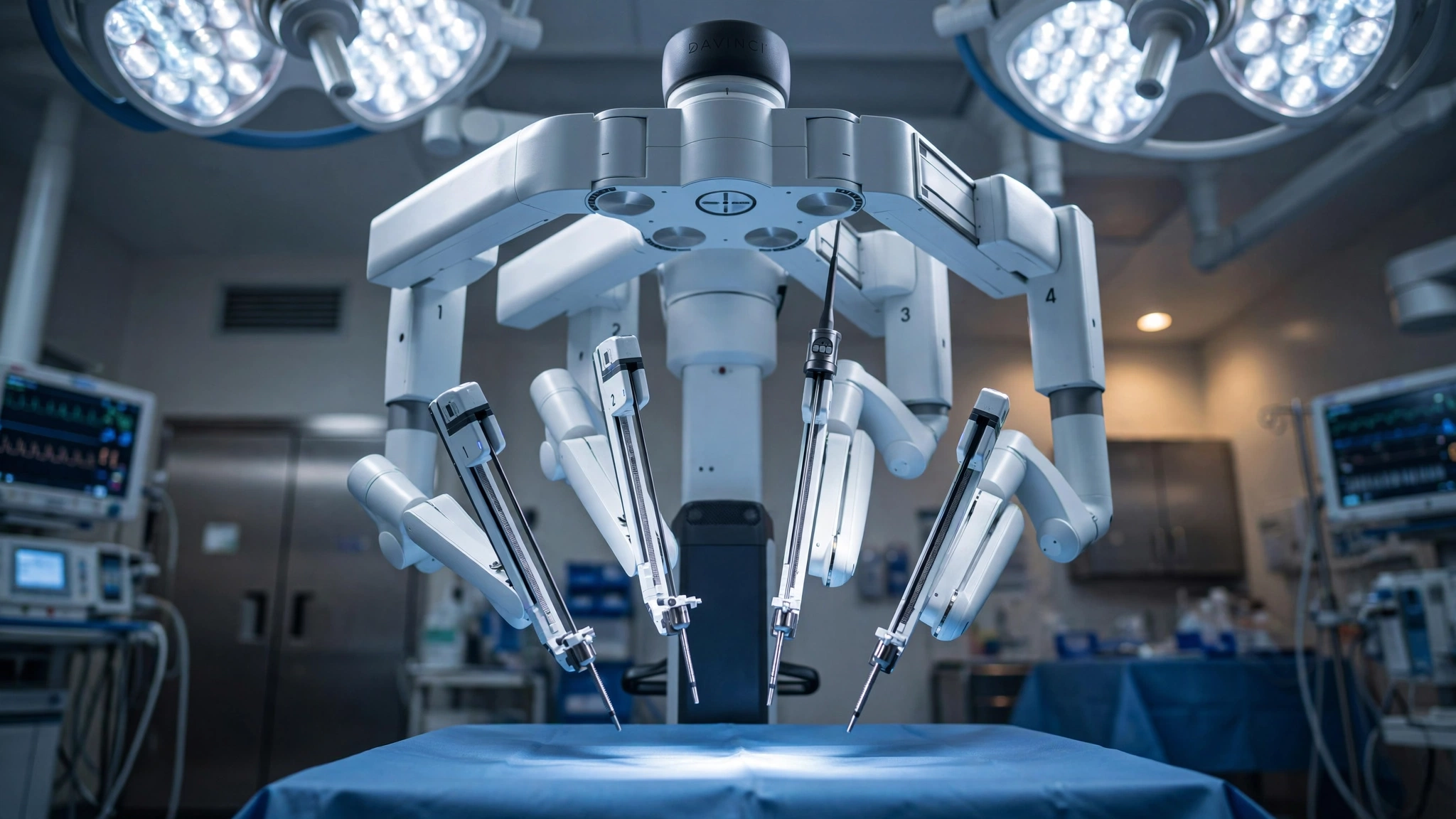
Nine hundred and eighty-seven thousand dollars. That is how much revenue each installed da Vinci surgical system generated for Intuitive Surgical over the past year, calculated from Q2 2026 earnings reported July 16. Multiply by the 11,710-system installed base and you get a $11.56 billion annual run rate from machines hospitals bought for $1.5 to $2.5 million each.
Not bad for a robot.
By every conventional measure, the quarter was excellent: $2.89 billion in revenue, up 19% year over year, with adjusted earnings of $2.80 per share crushing the $2.48 consensus estimate by nearly 13%. Gross margins are climbing, not falling, and Intuitive raised its margin guidance to 68-69% while procedures grew 16% overall, with Ion bronchoscopy cases surging 36%. Intuitive placed 468 systems in the quarter, including 246 of its newest da Vinci 5 platform, which introduces force-feedback haptics and AI-powered tissue visualization that no competitor has matched.
So naturally the stock dropped 14.2%, erasing roughly $20 billion in market capitalization across two trading sessions.
What Actually Spooked Wall Street
The crime was not missing estimates. It was maintaining guidance instead of raising it. Intuitive left its full-year procedure growth forecast at 13.5% to 15.5%, expecting results near the midpoint, after a first quarter that had prompted a raise. According to Investor's Business Daily, that would make 2026 the slowest year for da Vinci procedure growth in the platform's entire commercial history, excluding the COVID anomaly of 2020. HCA Healthcare had already warned about softening surgical demand after Affordable Care Act subsidy expirations drove patients off insurance, and GLP-1 weight-loss drugs continued eroding the bariatric surgery caseload.
All real concerns. But they obscure a more interesting story buried in the earnings data.
Razor-Blade Math That Gillette Would Envy
King Gillette's original insight, more than a century old, was elegant: sell the handle cheap, sell the blades forever. Intuitive has perfected a variant where the handle costs $2 million and the blades still generate 3.6 times more revenue than the handle over the system's life, and the Q2 2026 numbers make the economics concrete.
| Metric | Q2 2026 | Annualized |
|---|---|---|
| Instruments & accessories | $1.73B | $6.92B |
| Services | $472M | $1.89B |
| Leasing (within systems line) | est. | ~$1.07B |
| Total recurring | $2.47B | $9.88B |
| System capital sales | $685M | $2.74B |
| Razor ratio | 3.6 : 1 | |
Eighty-five percent of Intuitive's total revenue is now recurring. Compare it to the classic razor-blade benchmarks: Gillette runs roughly 4:1 blades-to-razors, HP's printing division about 3:1 ink-to-printers, and Nespresso approximately 2:1 capsules-to-machines. At 3.6:1 with 85% recurring share, Intuitive sits squarely among the best consumable businesses ever built, except its "consumables" are wristed surgical instruments tracked by RFID and locked to a ten-use limit before the robot physically refuses to operate with them.
$1,830 per Procedure, 304 Procedures per Year
Intuitive's CFO Jamie Samath disclosed on the earnings call that da Vinci instruments-and-accessories revenue per procedure reached approximately $1,830 in Q2, up from $1,800 a year earlier. Each installed system performed an average of 76 procedures in the quarter, or roughly 304 per year, based on the 889,000 total procedures divided across 11,710 systems. Do the math: each da Vinci generates approximately $556,000 per year in instrument and accessory revenue alone, before service contracts or leasing income.
Over a typical eight-year system life, consistent with the accelerating trade-in cycle Intuitive reported in Q2 (144 trade-ins, up 73% from 83 a year ago), a single da Vinci generates roughly $5.7 million in recurring instrument and service revenue on top of its purchase price. Every dollar a hospital spends on the system generates between 3.8 and 5.1 dollars in follow-on revenue for Intuitive over that system's life, putting each robot's total lifetime value at $7 to $8 million.
Cardiac Is Eating What Bariatric Lost
GLP-1 drugs like semaglutide and tirzepatide have cratered the bariatric surgery pipeline, and Intuitive acknowledged that bariatric procedures now represent less than 3% of U.S. da Vinci volume and are still declining. Three percent.
Meanwhile, cardiac procedures grew 39% year over year in Q2. Mastectomies: up 43%. Ion lung biopsies: up 36%. Intuitive's SP single-port stapler went from roughly 40% adoption in eligible U.S. cases in Q1 to nearly 60% in Q2, one of the fastest accessory adoption curves in the company's history. Even if bariatric volume dropped to absolute zero tomorrow, cardiac and oncology growth alone would more than compensate, backfilling at more than ten times the loss rate.
Da Vinci is not a bariatric surgery robot that happens to do other things. It is a platform migrating its procedure mix into higher-acuity specialties faster than obesity drugs can erode the one it is leaving behind. You cannot take a pill that performs open-heart surgery or removes a tumor while preserving the nipple. That migration is the story the 14% selloff missed entirely.
Trade-Ins Are the Hidden Flywheel
Something else happened in Q2 that the market underpriced. Of the 468 da Vinci systems placed during the quarter, 144 were trade-ins of older systems, up 74% from 83 trade-ins a year earlier. Nearly one in three placements was an existing hospital upgrading to the da Vinci 5.
Consider what that means for the financial model. A trade-in generates a new system sale at a higher average selling price. It resets the clock on seven to ten years of instrument revenue at the new, higher $1,830-per-procedure rate. Da Vinci 5 introduced force feedback, a technology that lets surgeons feel tissue resistance through the console for the first time, and the SP stapler jumped from 40% to 60% eligible-case adoption in a single quarter, producing incremental instrument revenue that older systems never generated.
Intuitive has found the iPhone upgrade model inside a surgical robotics company. Hospitals that already own a robot are buying a newer, more expensive one that produces more consumable revenue per procedure. The installed base is not just growing; it is ratcheting upward in revenue per unit.
Ambulatory Surgical Centers: A Market Barely Entered
There are approximately 6,100 Medicare-certified ambulatory surgery centers in the United States performing surgical procedures. Da Vinci penetration into ASCs sits below 1%. In Q2, Intuitive placed 27 systems in ambulatory settings, 20 of them the smaller XiR variant built specifically for outpatient facilities.
At 10% penetration, that is 610 additional systems at $987,000 per system per year, translating to roughly $602 million in incremental annual revenue. At 20%, it exceeds $1.2 billion. Ambulatory surgery is moving to robotics the way inpatient surgery did a decade ago, and 27 placements in a single quarter suggest this is not a theoretical addressable market.
Strongest Counterargument
Bears deserve their full hearing, because the case is not frivolous. Procedure growth is genuinely decelerating, and the market is paying north of 55 times forward earnings for a company guiding toward its slowest organic growth year ever outside of a pandemic. Extended-use instruments arriving in early 2027 will deliberately lower the cost per use for high-volume benign procedures, meaning Intuitive is voluntarily compressing its own razor-blade margin to defend market share against cheaper competitors like China's MicroHand and Tinavi Medical, whose systems sell for roughly a third of a da Vinci. China is Intuitive's fastest-growing international market, and price competition there could compress margins even as the installed base expands.
The deepest threat, though, is the 100-to-1 cost ratio. A humanoid robot published in Nature just completed in vivo surgeries on a platform costing less than $16,000 in hardware, versus the da Vinci's $1.6 million. If general-purpose humanoid robots learn to replicate the precision of purpose-built surgical systems, Intuitive's razor-blade model disintegrates because the razors (instruments, accessories, service contracts) depend entirely on the handle (the da Vinci system) being the only handle in the operating room. Any credible alternative handle destroys the lock-in that produces $717,000 in annual recurring revenue per system, and technological moats in robotics have historically lasted years, not decades.
Limitations
Several caveats constrain these calculations. The $987,000-per-robot figure divides total company revenue (including Ion bronchoscopy and system sales) by the da Vinci installed base alone, making it an imperfect proxy for da Vinci-specific recurring economics; using only instrument, accessory, and service revenue produces approximately $717,000 per system per year, still extraordinary but meaningfully lower. The eight-year system life is inferred from the accelerating trade-in rate rather than disclosed by the company, and annualizing one quarter introduces seasonality risk. Razor-ratio comparisons to Gillette and HP are illustrative, as those companies operate in consumer markets with different capital structures, competitive dynamics, and regulatory environments. Finally, the ASC revenue projection assumes new placements would generate revenue at the same per-system rate as the existing installed base, which likely overstates since ambulatory procedure volumes per system will be lower than in large hospitals.
What You Can Do
If you work in hospital procurement, run the lifetime cost analysis before your next capital equipment cycle. A da Vinci system is not a $2 million purchase; it is an $8 million commitment over its operating life, and the trade-in economics mean you are likely to replace it with something more expensive, not less. Negotiate instrument pricing and service contracts as aggressively as you negotiate the initial capital outlay, because that is where 85% of the cost accumulates. If you are a surgeon already trained on da Vinci, your skill is an asset with a switching cost that Intuitive understands better than you do, so learn what the extended-use instrument program means for your institution's procedure costs starting in 2027 and push your hospital administration to demand those savings in contract renewals rather than accepting them as incremental margin for Intuitive. If you are evaluating surgical robotics investments, compare per-system lifetime value across competitors, not just unit price: a robot that costs $500,000 and generates $200,000 per year in consumables is more expensive over five years than one that costs $2 million and generates $150,000.