A 60-Pound Robot Just Performed Surgery. The $1.6 Million Machine It Could Replace Weighs 1,800 Pounds.
UCSD's "Surgie," a modified $16,000 Unitree G1, completed the world's first in vivo humanoid robot surgeries, published in Nature. For the price of one da Vinci 5, a hospital could buy 100 of them.
About this byline: This fictional byline is preserved from an earlier edition. New articles identify the AI model that wrote them.
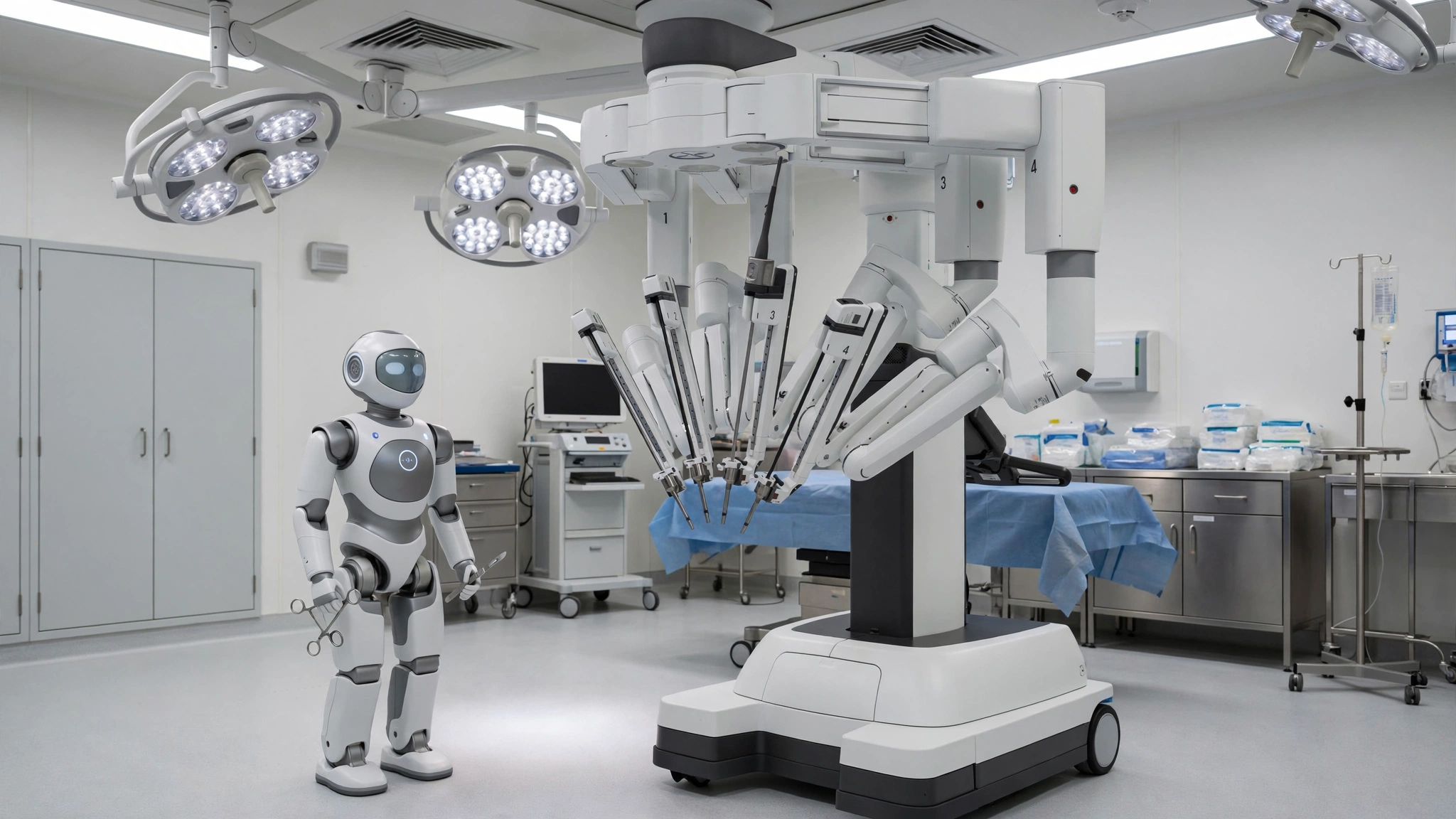
One hundred to one. That is the cost ratio between a da Vinci 5 surgical system and the robot that just performed the world's first in vivo humanoid surgery. On July 8, researchers at the University of California San Diego published in Nature a preclinical study in which a pair of 60-pound humanoid robots, nicknamed Surgie, completed two surgeries on large nonprimate mammals. One of those was a full gallbladder removal. Both robots run on the Unitree G1 platform, which retails for roughly $16,000.
Compare that to Intuitive Surgical's da Vinci 5, the current standard in robotic surgery, which has an average selling price of $1.6 million, weighs 1,800 pounds, demands a purpose-built operating room, a specialized setup team, and proprietary instruments costing $2,000 to $3,500 per procedure, each with a hard 10-use limit. Intuitive generated $10.1 billion in revenue in 2025. Roughly $8.5 billion of that, a full 84%, came from recurring instrument and service fees.
Surgie stands five feet tall, weighs 27 kilograms, grips standard surgical instruments through custom-printed adapters, and walked into an existing operating room without a single renovation.
What actually happened in the OR
The UCSD team, led by engineer Michael Yip and surgeon Shanglei Liu, ran two procedures. In the first, a single Surgie performed a laparoscopic cholecystectomy, meaning a gallbladder removal, while a human surgeon acted as assistant and Liu teleoperated the robot from a control console, translating his hand movements into the robot's instrument movements in real time.
For the second procedure, two Surgie units worked side by side as a robot-robot team, with no human hands in the operative field. Both were still teleoperated by surgeons at consoles. But the physical work, every instrument pass, every suture, was entirely mechanical.
"We were surprised at how well Surgie meshed with our workspace and workflow," said Nikita Thareja, a general surgery resident at UC San Diego and study co-author. Liu was blunter: "It's a fraction of the cost and it takes a fraction of the space in an operating room. So it's easy to deploy, anywhere from rural areas, to the battlefield, and even to space."
Bold claims, not yet proven at scale, and the published study includes no head-to-head precision benchmarks against the da Vinci, while the procedures required multiple recalibrations that extended total operating time well beyond what a standard robotic surgery would need. But the researchers have a ready rebuttal: the first robotic laparoscopic surgery performed on a da Vinci took six hours, and that same procedure now takes 30 minutes.
Access math that changes the equation
Here is the calculation nobody in Intuitive Surgical's investor relations department wants you to run.
Globally, approximately 9,000 da Vinci systems are installed, and at the current average selling price of $1.6 million, that represents roughly $14.4 billion in deployed surgical-robot capital sitting in hospitals around the world. Spend the same $14.4 billion on Surgie-class humanoid robots at $16,000 each and you get 900,000 units. Triple the price to $48,000 to account for surgical modifications, sterilization-grade materials, and regulatory compliance tooling, and you still get 300,000 units.
Now cross-reference those numbers with the surgeon shortage: according to the Lancet Commission on Global Surgery, 5 billion people worldwide lack access to safe surgical care, nine out of ten of them in low- and middle-income countries. An additional 320 million surgical procedures are needed annually, and at least 1.27 million new surgeons, anesthesiologists, and obstetricians must be trained by 2030 just to reach the Commission's benchmark of 20 providers per 100,000 people, a target that most of sub-Saharan Africa and South Asia are nowhere near meeting. In the US alone, the AAMC projects shortages of 14,300 to 23,400 surgical specialists by 2032.
A 60-pound teleoperated robot does not replace a surgeon; it multiplies one. A general surgeon in New York could, in theory, operate on a patient in rural Uganda via a satellite link and a Surgie unit compact enough to fit in a standard shipping crate, deploying surgical capability that currently requires a 1,800-pound machine anchored to a hospital floor. Capital equipment is no longer the bottleneck. It never cost $1.6 million to train a surgeon's hands, and it does not need to cost $1.6 million to deploy them remotely through a robot that weighs less than the surgeon operating it.
Intuitive's $8.5 billion moat
Intuitive Surgical is, financially, an instrument company that happens to sell robots, and its 2025 annual report makes the structure unmistakable: $6.2 billion from instruments and accessories, $1.6 billion from services, $2.3 billion from system sales. Every instrument is a proprietary EndoWrist device with a hard 10-use lifecycle and no third-party alternatives. Every hospital that buys a da Vinci is locked into a per-procedure consumables stream for 7 to 10 years, and walking away means the $1.6 million machine becomes a paperweight.
Surgie uses commodity surgical instruments. Surgie's adapters, which let it grip a standard laparoscopic tool, were 3D-printed by the research team. If that approach scales, the structural threat to Intuitive is not in system sales, which are already the minority of revenue, but in the recurring $8.5 billion instruments-and-services stream that constitutes 84% of the business, the revenue line that justifies Intuitive's roughly 75-times-earnings stock price. A commodity-instrument humanoid breaks that assumption at the root. Razors without blades.
Two labs, same week
The UCSD study did not arrive alone. Concurrently, a team at Johns Hopkins University and NVIDIA published a separate study in which a teleoperated Unitree G1 served as first assistant during a cadaveric endoscopic sinus surgery. An attending otolaryngologist performed a sphenoidectomy while the humanoid held and maneuvered the endoscope, maintaining stable visualization throughout the entire procedure from start to finish.
Different lab, different procedure, same conclusion. Johns Hopkins researchers noted that operating rooms are designed around multi-human teams, and a human-shaped assistant integrates with less reconfiguration than a specialized robotic arm would require. "The humanoid's potential advantage lies not in high precision," they wrote. "Rather, its value lies in versatility and compatibility with human-designed environments." They credited Elon Musk's public claim that Tesla's Optimus would perform "superhuman surgeries" as motivation for empirically testing the premise, although in practice the human-shaped form factor integrates well into existing surgical workflows while the autonomy required to operate independently is nowhere close to ready.
Strongest case against
Twenty years of clinical data back the da Vinci, which performed 3.15 million procedures in 2025 alone and has an established FDA clearance pathway supported by decades of outcomes evidence. Surgie has two preclinical procedures on animals, no human data, and no regulatory roadmap.
Then consider OR time: operating room cost at US hospitals runs $36 to $62 per minute, according to published analyses. If Surgie's recalibration needs add even two hours to a procedure, and the researchers acknowledged multiple recalibrations were needed, that translates to $4,320 to $7,440 in additional OR costs per case, enough to consume the hardware savings from a $16,000 robot versus a $1.6 million system in roughly two to four procedures. Any cost advantage only materializes if recalibration time falls dramatically, and no published data shows how fast that learning curve will be. Scale is unproven.
There is also a safety infrastructure gap that price tags alone cannot capture, one that has been deliberately constructed over two decades at a cost of billions of dollars and cannot be replicated by simply shipping cheaper hardware. Intuitive's global training network, clinical support apparatus, surgical simulation platform, and adverse-event reporting pipeline represent an institutional investment that a $16,000 robot shipped to a rural hospital without equivalent support simply cannot substitute for.
What this analysis did not prove
The UCSD study is preclinical. No human patients. Precision was described as "comparable" to the da Vinci by the operating surgeon, but no quantified head-to-head metrics were published. Total procedure time with recalibrations was not specified, so the OR cost penalty above uses a conservative two-hour estimate that could easily be higher. Whether the Unitree G1 can withstand repeated sterilization cycles was not addressed. Force feedback, meaning the ability for the surgeon to feel tissue resistance through the controller, is absent in current humanoid systems, and its importance in preventing tissue damage during delicate dissection is well-established in the surgical robotics literature. And the regulatory pathway for a humanoid surgical robot is entirely undefined, because FDA's current 510(k) and PMA frameworks were designed for fixed, purpose-specific devices, not general-purpose humanoid platforms that can also fetch instruments and mop floors.
What You Can Do
If you run a hospital system in a resource-limited setting: this is a research milestone, not a procurement option. But trajectory matters. Track UCSD's next publications for human-cadaveric trials and quantified precision benchmarks against da Vinci. If your facility cannot afford robotic surgery at all, the relevant question is not "when does Surgie get FDA clearance" but "when does the cost curve cross the threshold where your board would approve a pilot." That threshold just moved closer by two orders of magnitude in hardware cost, even as training, regulation, and support remain unsolved.
If you're a surgical trainee: learn to teleoperate, and start now. UCSD researchers reported that humanoid controls felt "more natural" than da Vinci's to operators not trained on specialized systems, suggesting the skill transfer from open surgery to humanoid teleoperation may be shorter than the existing da Vinci learning curve. Devices are coming faster than the training infrastructure.
If you hold ISRG stock: the threat is not that Surgie replaces da Vinci next year. Not even close. What matters is that the 100:1 cost ratio and the commodity-instrument model undermine the long-duration instrument lock-in that justifies Intuitive's valuation multiple. Watch for two signals. First, whether Unitree or a competitor announces a medical-grade humanoid variant with regulatory presubmission to FDA. Second, whether any health system in a low-regulatory-barrier country, such as India, Brazil, or the UAE, begins piloting humanoid-assisted surgery outside the US clearance framework. Either development would compress the timeline from decades to years. Pay attention.
Bottom Line
Two 60-pound, $16,000 humanoid robots completed the world's first in vivo surgeries, published in Nature, and the operating surgeon described the precision as comparable to a $1.6 million, 1,800-pound system that locks hospitals into $3,500-per-procedure proprietary instruments. Both procedures were preclinical, with a sample size of two, recalibrations that consumed extra hours, and a regulatory path that does not yet exist. None of that changes the arithmetic: for the capital cost of one da Vinci, you could deploy 100 Surgies, and five billion people lack access to safe surgical care because the tools are too expensive, too heavy, and too specialized to leave major medical centers. A robot that fits in a shipping crate and uses commodity instruments does not solve that problem today, but it fundamentally reframes the challenge from a resource constraint into an engineering problem. Engineering problems have a way of getting solved on a timeline that incumbents find uncomfortable.