India Took 22 Years to Build the World's Second Fast Breeder Reactor. The Thorium It Unlocks Could Power the Country for Centuries.
On April 6, 2026, a sodium-cooled reactor at Kalpakkam achieved first criticality after two decades of construction delays and cost overruns. India is now the second country after Russia to operate a commercial-scale fast breeder. Original cost estimate: ₹3,500 crore. Final bill: ₹8,181 crore. Strategic value: incalculable.
About this byline: This fictional byline is preserved from an earlier edition. New articles identify the AI model that wrote them.
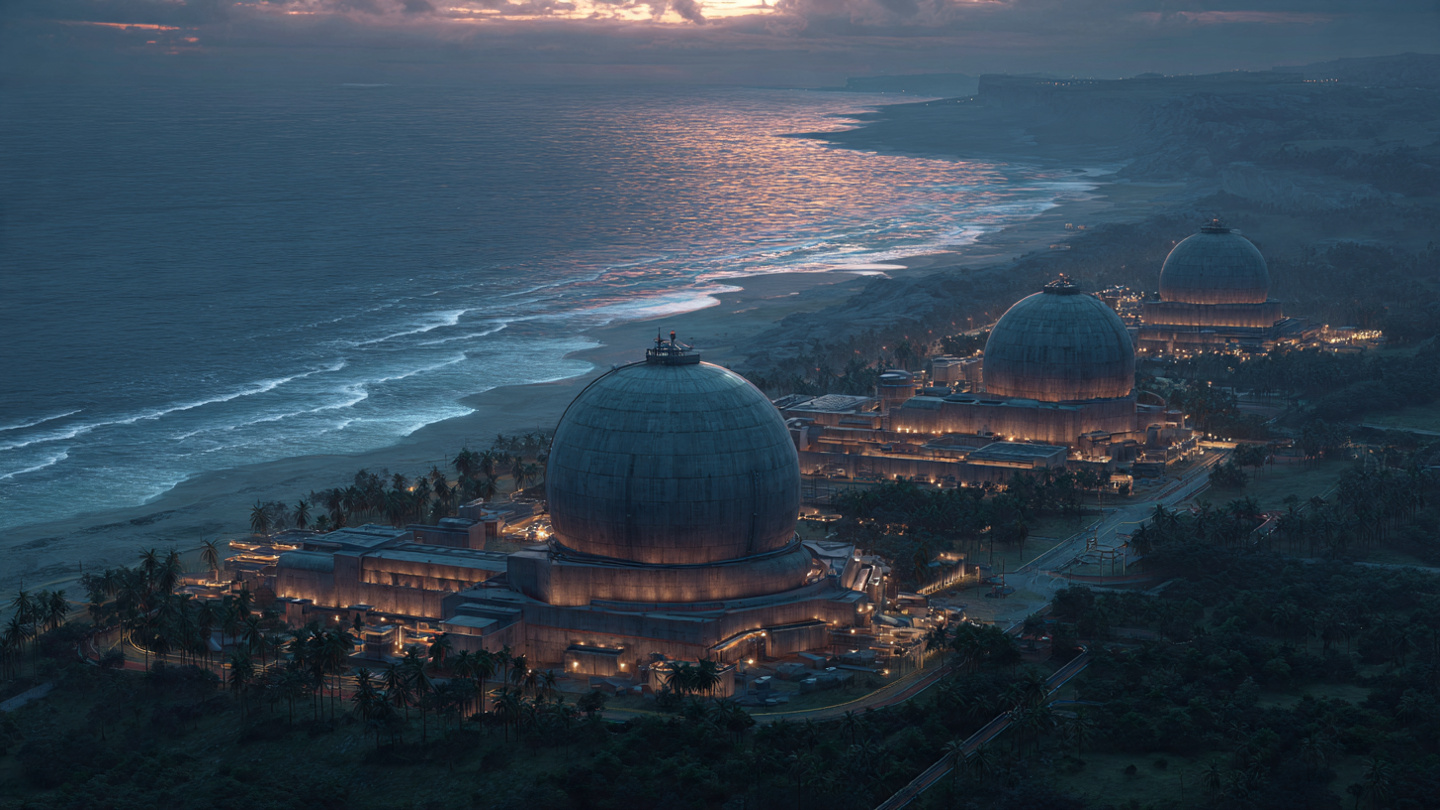
Twenty-two years. That is how long it took India to build the Prototype Fast Breeder Reactor (PFBR) at Kalpakkam, Tamil Nadu. At 8:25 PM Indian Standard Time on April 6, 2026, neutrons in the reactor's uranium-plutonium mixed oxide core reached a self-sustaining fission chain reaction. First criticality. Construction had started in 2004 with a target completion of September 2010. In the intervening 16 extra years, the project survived at least six publicly announced "imminent criticality" dates (2013, 2014, 2017, 2020, 2021, 2022), a budget that ballooned from ₹3,500 crore to ₹8,181 crore (~$975 million), and relentless criticism from nuclear skeptics who argued the money would be better spent on solar panels.
None of that changes what happened on Sunday evening: India became only the second country in the world, after Russia, to operate a commercial-scale sodium-cooled fast breeder reactor. And unlike Russia's BN-800, which was built with decades of Soviet-era fast reactor heritage, the PFBR was designed and constructed using entirely indigenous technology. No foreign technology transfers. No reactor imports. Everything from the sodium coolant loops to the fuel handling machinery was developed by the Indira Gandhi Centre for Atomic Research (IGCAR) and built by Bharatiya Nabhikiya Vidyut Nigam Limited (BHAVINI), both under India's Department of Atomic Energy.
What a Fast Breeder Does (and Why It Matters)
Conventional nuclear reactors use slow neutrons to split uranium-235, consuming fuel in the process. A fast breeder operates on a fundamentally different principle: fast, unmoderated neutrons. Its core burns uranium-plutonium mixed oxide (MOX) fuel, but surrounding that core is a "blanket" of fertile material, currently uranium-238. Fast neutrons convert that U-238 into fissile plutonium-239, producing more nuclear fuel than the reactor consumes.
India holds an estimated 846,477 tonnes of thorium, the largest reserves of any country (roughly 13.5% of the global total, per IAEA 2019 data). India's uranium reserves are modest. Physicist Homi Bhabha recognized this asymmetry in the 1950s and designed a three-stage nuclear program to work around it.
| Stage | Reactor Type | Fuel In | Fuel Out | Status |
|---|---|---|---|---|
| I | Pressurized Heavy Water Reactors (PHWRs) | Natural uranium | Plutonium-239 (in spent fuel) | Operational since 1969. 18 units, 4,780 MWe. |
| II | Fast Breeder Reactors | Pu-239 + U-238 MOX | More Pu-239, plus U-233 (from thorium blanket) | PFBR just achieved criticality. 6 more planned. |
| III | Advanced Heavy Water Reactors (AHWRs) | Th-232 / U-233 | Sustainable thorium fuel cycle | Design stage. Prototype: AHWR-300 (300 MWe). |
Stage II is where the PFBR sits. Once its blanket is switched from uranium-238 to thorium-232, fast neutrons will convert that thorium into uranium-233, the fissile material needed to fuel Stage III reactors. Stage III is the endgame: a closed thorium fuel cycle that could, in principle, power India for centuries using a domestic resource that requires no imports and cannot be restricted by foreign sanctions or supplier-group agreements.
Show the Math: What 846,000 Tonnes of Thorium Actually Means
Energy claims about thorium tend to oscillate between "unlimited power forever" and "pipe dream." Here is the arithmetic, step by step.
India's Department of Atomic Energy has stated that the country's thorium reserves could support 500 GW for over 400 years in a fully operational breeder-to-thorium cycle. Pressure-testing that claim:
In a breeder fuel cycle, near-complete utilization of fissile material is theoretically possible. Thorium-232 has a fission energy density of approximately 79.42 TJ per kilogram if fully fissioned. At a conservative 33% thermal-to-electric conversion efficiency (typical for sodium-cooled fast reactors), that yields roughly 26.2 TJ of electricity per kilogram, or about 7,280 MWh per kilogram.
Real-world fuel utilization in a breeder cycle will not reach 100%. Accounting for reprocessing losses, neutron economy inefficiencies, and blanket handling, a utilization factor of 50-70% is more defensible. Using 50% (the conservative end):
- Energy per tonne of thorium: 7,280 MWh/kg × 1,000 kg × 0.5 = 3,640 GWh per tonne
- India's thorium reserves: 846,477 tonnes
- Total accessible energy: 846,477 × 3,640 GWh = ~3.08 million TWh
- India's total electricity generation in FY2024-25: ~1,900 TWh
- Years of supply at current consumption: 3,080,000 / 1,900 = ~1,621 years
Even at 25% utilization (extremely pessimistic), the figure is ~810 years. DAE's "centuries" claim is conservative arithmetic.
India's electricity demand grows at roughly 5-7% per year. If demand quadruples to 7,600 TWh/year, the 50% utilization scenario still yields ~400 years, matching DAE's published estimate.
What India Paid for Sovereignty
Here is the question critics are right to ask: Was it worth 22 years and nearly $1 billion?
China's experimental fast reactor (CEFR, 20 MWe) achieved criticality in 2010, and its larger CFR-600 (600 MWe, slightly bigger than PFBR) at Xiapu, Fujian, is expected to be operational between 2023 and 2026, having started construction around 2017. That is roughly 6-9 years from construction start to criticality. MIT nuclear engineering professor Koroush Shirvan has noted this directly: China built a comparable reactor in approximately six years.
Russia's BN-800 (880 MWe), the world's only other commercial fast breeder, took about 8 years from its 2006 construction restart to first criticality in 2014. But Russia had the accumulated institutional knowledge of the BN-350 (1973) and BN-600 (1980), plus Soviet-era fast reactor R&D going back to the 1950s.
| Reactor | Country | Capacity (MWe) | Construction Start | First Criticality | Years | Indigenous? |
|---|---|---|---|---|---|---|
| BN-800 | Russia | 880 | 2006 (restart) | 2014 | ~8 | Partially (built on BN-600 lineage) |
| CFR-600 | China | 600 | ~2017 | 2023-2026 (est.) | ~6-9 | No (based on Russian CEFR tech transfer) |
| PFBR | India | 500 | 2004 | 2026 | 22 | Yes, fully |
India paid a sovereignty premium of roughly 13-16 extra years. Whether that was rational depends on your planning horizon. On 10 years, it looks terrible. India could have purchased Russian technology, as China effectively did. On 50 years, the calculus shifts. India now possesses domestic capability in sodium coolant systems, MOX fuel fabrication, fast reactor safety, and fuel reprocessing that cannot be embargoed, sanctioned, or revoked by a Nuclear Suppliers Group vote. For a country denied nuclear technology for three decades after its 1974 test, that immunity does not appear on any LCOE chart, but it is real.
Limitations
Several important caveats apply to this analysis.
First, the PFBR has not generated a single watt of commercial electricity. First criticality means a self-sustaining chain reaction at negligible power. Commercial operation is targeted for September 2026, but given the project's history, skepticism about that date is warranted.
Second, the thorium energy calculations assume a mature, closed breeder fuel cycle that does not yet exist. Switching the blanket from U-238 to Th-232 is a future phase. Building the reprocessing infrastructure to extract U-233 from irradiated thorium at industrial scale represents decades of additional work. DAE's Fast Reactor Fuel Cycle Facility (FRFCF) is under construction at Kalpakkam, but its completion timeline is uncertain.
Third, the global track record of fast breeders is sobering. France shut down Superphénix (1,242 MWe) in 1998 after persistent sodium leaks and a capacity factor below 7%. Japan's Monju (280 MWe) was mothballed after a 1995 sodium fire and decommissioned in 2017.
Fourth, India's total nuclear fleet produces 56.7 TWh per year from 8,880 MW, roughly 3% of national generation. Even with NTPC's $62 billion plan for 30 GW, nuclear will remain a small fraction for the foreseeable future. Solar in India now contracts below ₹2/kWh. A fast breeder's LCOE is almost certainly multiples higher.
Strongest Counterargument
M.V. Ramana, a physicist at the University of British Columbia and persistent critic of India's breeder program, has argued in the Bulletin of the Atomic Scientists that fast breeder economics are fundamentally uncompetitive. His core claim: when you account for the full cost of the plutonium fuel cycle (reprocessing spent fuel from Stage I reactors, fabricating MOX fuel, building and operating the sodium systems, handling radioactive waste), the per-kWh cost of breeder electricity is several times higher than from conventional reactors, which are themselves losing ground to renewables.
Ramana's argument deserves full-strength engagement. Solar electricity in India is now the cheapest in the world. The latest Solar Energy Corporation of India (SECI) auctions have cleared below ₹2/kWh ($0.024/kWh). Grid-scale battery storage is falling toward ₹4-5/kWh for 4-hour systems. By the time India's thorium cycle is truly operational (optimistically 2050, realistically later), solar-plus-storage may provide firm, dispatchable power at a fraction of breeder costs. At that point, the thorium reserves become a stranded asset, not because they lack energy, but because extracting it costs more than the alternative.
This is not trivial. The entire three-stage nuclear program was conceived when solar electricity cost $76/kWh (1977). If solar-plus-storage reaches ₹3/kWh for firm 24/7 power by 2040, the economic case for breeder electricity collapses.
Two responses partially address this. Nuclear provides dispatchable baseload independent of weather and seasonal variation. India's monsoon season reduces solar output by 30-50% across much of the country for four months. Grid resilience against extended low-renewable periods still demands non-intermittent sources. And fast breeders produce strategic materials that solar panels do not. Energy security is not fully captured by LCOE comparisons.
What You Can Do
If you work in energy policy or nuclear regulation: Study India's PFBR timeline as a case study in the tradeoff between sovereignty and speed. Indigenous development took 13-16 years longer than technology-transfer approaches. Quantify when the sovereignty premium pays for itself based on your country's geopolitical risk profile.
If you are an energy investor: Watch the PFBR's operational performance over the next 12 months closely. Commercial operation by September 2026 would validate sodium-cooled fast reactor technology at scale and potentially unlock investment interest in next-generation reactor companies (TerraPower, Oklo, Newcleo) that are pursuing similar fast-spectrum designs. Persistent delays or sodium system problems would reinforce skeptics.
If you are a climate advocate: Recognize that thorium-based nuclear is not in competition with solar and wind for the next 20 years. It is a hedge against scenarios where intermittent renewables cannot fully decarbonize the grid, particularly for countries with high monsoon variability, limited land for solar farms, or growing industrial baseload demand. Support both, not one at the expense of the other.
The Bottom Line
India spent 22 years and nearly $1 billion to bring a 500 MWe reactor online. By any conventional project management metric, this is a failure. Russia did it faster. China is doing it faster. Solar is doing it cheaper. But project management metrics do not capture what India actually built: an end-to-end indigenous capability in fast breeder nuclear technology that is immune to the geopolitical supply-chain risks that constrain every other part of its energy system. For a country that was locked out of international nuclear commerce for three decades, that immunity has a value that does not appear on any LCOE chart. Whether the thorium fuel cycle ultimately delivers on Bhabha's 70-year-old vision or gets stranded by plummeting solar costs will depend on decisions made in the next two decades. On April 6, 2026, the bridge opened. Where India drives across it is the real story.