$2.2 Million Gene Therapy Requires Chemo, a Factory, and Six Weeks in the Hospital. Penn Just Did It With an IV Injection.
Casgevy can cure sickle cell disease for $2.2 million per patient after six months of manufacturing, myeloablative chemotherapy, and a month-long hospital stay. Penn researchers engineered CD34-targeted lipid nanoparticles that delivered gene-editing cargo directly to human blood stem cells inside bone marrow, durably, without removing a single cell from the body. The original calculation: when you strip away the infrastructure that ex vivo therapy demands, the cost floor for a functional cure drops below $100,000.
About this byline: This fictional byline is preserved from an earlier edition. New articles identify the AI model that wrote them.
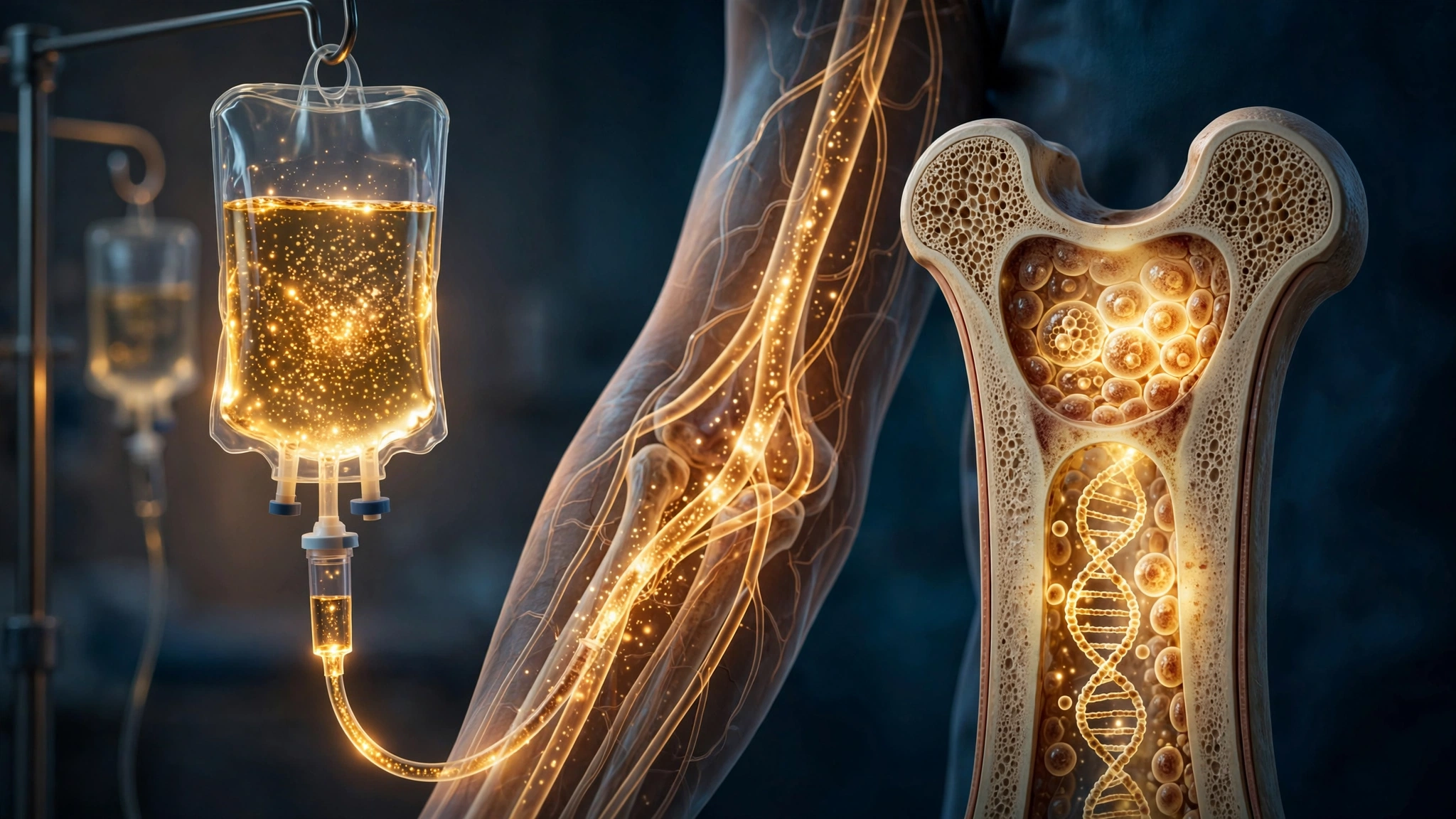
Seven million. That is the number of people alive today with sickle cell disease, a single-gene mutation in hemoglobin that deforms red blood cells into rigid crescents, clogs capillaries, and produces a lifetime of pain crises, organ damage, and early death. In December 2023, the FDA approved the first CRISPR-based cure: Casgevy, priced at $2.2 million per one-time treatment. Nearly three years later, the number of patients treated worldwide is measured in hundreds, not thousands, because the bottleneck was never the gene edit itself.
It was everything built around it.
On August 5, 2026, a team led by Michael J. Mitchell at the University of Pennsylvania published research in Nature Biomedical Engineering demonstrating that engineered lipid nanoparticles, decorated with antibodies targeting the CD34 receptor on hematopoietic stem cells, could deliver gene-editing cargo directly to human blood stem cells living in bone marrow, and that the edits persisted across multiple blood cell lineages for at least 16 weeks. No cells were removed from the body, no chemotherapy was administered, and no hospital stay was required. Work was performed in humanized mice carrying engrafted human hematopoietic systems, but the implications for the $2.2 million cost structure of current gene therapy are immediate and calculable.
What Casgevy Actually Costs, and Why
To understand why the Penn result matters, you need to understand what the $2.2 million pays for. CRISPR is the easy part. Vertex Pharmaceuticals uses Cas9 to disrupt the BCL11A erythroid enhancer in a patient's own CD34+ hematopoietic stem cells, reactivating fetal hemoglobin production and preventing red blood cell sickling. That edit, the molecular scissors cutting a specific DNA sequence, is the same in principle as what a research lab does for a few hundred dollars in reagent costs.
Everything else is infrastructure.
| Step | What Happens | Estimated Cost | Required for In Vivo LNP? |
|---|---|---|---|
| Stem cell mobilization + apheresis | G-CSF injections to push HSCs into blood; 6-hour machine harvest | $15,000-25,000 | No |
| Cell shipping + manufacturing | Cryopreserved cells shipped to Vertex facility; CRISPR editing under GMP; QC testing; ship back | $500,000-800,000 | No |
| Manufacturing timeline | Up to 6 months from collection to product delivery | (included above) | No |
| Myeloablative conditioning | Busulfan chemotherapy destroys existing bone marrow to "make space" | $50,000-100,000 | No |
| Hospital stay (4-6 weeks) | BMT-unit-level care while immune system recovers | $200,000-400,000 | No |
| Pre/post monitoring, transfusions | Blood product support, infection prophylaxis, follow-up | $100,000-175,000 | Partial |
| R&D amortization + margin | Recoup $1B+ development costs across small patient population | $500,000-900,000 | Reduced |
Add the columns. Directly eliminable infrastructure, everything an in vivo lipid nanoparticle approach would bypass, totals $765,000 to $1.325 million, representing 35% to 60% of the list price. But that understates the structural shift. The R&D amortization line, where $500,000 to $900,000 sits, is inflated precisely because the patient-specific manufacturing process limits throughput to hundreds of patients per year. A treatment that scales like a vaccine, manufactured centrally and shipped globally, amortizes development costs across orders of magnitude more patients. Cut the per-patient R&D allocation by even 80%, and the total drops to $115,000 to $365,000.
Below $115,000, within striking distance of $100,000.
What Penn Actually Did
Du et al. solved the hardest delivery problem in gene therapy: getting editing cargo to the right cells inside a living body, in sufficient quantity, without destroying everything else. Hematopoietic stem cells represent a tiny fraction of bone marrow cellularity, perhaps 0.01% of nucleated cells, and they are surrounded by stromal cells, mature blood cells, and other progenitors that would happily absorb any nanoparticle that wandered in without discrimination.
Standard lipid nanoparticles, the same platform that delivered billions of COVID-19 mRNA vaccine doses, accumulate overwhelmingly in the liver. This makes them excellent for hepatic gene therapies and terrible for blood stem cell editing. Liver tissue acts as a nanoparticle sink, a vast capillary bed lined with phagocytic cells that efficiently clear circulating particles from the bloodstream.
Mitchell's team conjugated anti-CD34 antibodies to the nanoparticle surface, creating what they termed CD34/LNPDP. CD34 is a glycoprotein enriched on the surface of human hematopoietic stem and progenitor cells, and the antibody targeting redirected the particles from the liver to the bone marrow. In humanized mice, animals whose bone marrow had been engrafted with human hematopoietic cells, intravenous injection of CD34/LNPDP carrying gene-editing payloads achieved targeted editing of human HSCs confirmed by deep sequencing at 8 weeks post-infusion.
Durability data is what elevates this from proof-of-concept to platform. At 16 weeks post-treatment, the researchers assessed multi-lineage output: edited human B cells (hCD45+CD19+), monocytes (hCD45+CD33+SSClow), and critically, the upstream HSPCs themselves (hCD45+CD33-CD19-CD34+) all carried the edits. This means the nanoparticles reached actual stem cells, not just short-lived progenitors that would burn out within weeks, and that those stem cells continued dividing and producing edited daughter cells across multiple blood lineages for at least four months.
Beyond sickle cell, the team established humanized severe congenital neutropenia mouse models and demonstrated that the editing platform could address the underlying genetic defect in that disease context, expanding scope to the broader landscape of inherited blood disorders.
An Original Calculation: Cost Per Functional Cure
What would gene therapy cost if manufacturing scaled like vaccines instead of bespoke cell therapy? Inputs are knowable.
Moderna's 10-K filings and manufacturing disclosures indicate COVID-19 mRNA vaccine doses cost approximately $15 to $25 per dose in raw manufacturing costs at scale, excluding fill-finish, distribution, and margin. That price reflects untargeted LNPs carrying a relatively simple mRNA payload, manufactured in quantities of hundreds of millions of doses per year.
A gene-editing LNP for sickle cell disease would be substantially more expensive per dose for three reasons. First, the antibody conjugation (anti-CD34) adds complexity and cost. Monoclonal antibody production at commercial scale runs approximately $100 to $300 per gram, and a therapeutic dose might require milligrams of conjugated antibody, adding perhaps $500 to $2,000 per dose. Second, the CRISPR mRNA or base-editor mRNA payload is larger and more complex than a vaccine antigen-encoding mRNA, likely doubling the lipid and nucleic acid input costs. Third, GMP requirements for a gene-editing therapeutic are stricter than for a vaccine, requiring more extensive lot-release testing and potency assays.
Even with these additions, the manufacturing cost per dose lands in a range of $2,000 to $10,000, two orders of magnitude below ex vivo cell manufacturing.
| Component | Casgevy (ex vivo) | In Vivo LNP (projected) |
|---|---|---|
| Drug manufacturing | $500,000-800,000 | $2,000-10,000 |
| Cell harvest (apheresis) | $15,000-25,000 | $0 |
| Conditioning chemotherapy | $50,000-100,000 | $0 |
| Hospital stay | $200,000-400,000 | $2,000-5,000 (outpatient infusion) |
| Monitoring + follow-up | $100,000-175,000 | $30,000-50,000 |
| R&D amortization (per patient) | $500,000-900,000 | $20,000-50,000 |
| Total | $2,200,000 | $54,000-115,000 |
R&D amortization deserves its own explanation. Casgevy's development cost approximately $1 billion. Spread across an addressable U.S. sickle cell population of roughly 100,000 patients, but a realistic treatment rate of perhaps 500 patients per year given manufacturing constraints, each patient absorbs a disproportionate share of development cost. An in vivo LNP therapy with the same $1 billion development cost but a treatment capacity of 50,000 patients per year, achievable with centralized manufacturing, reduces per-patient R&D absorption by a factor of 100.
That is the structural arithmetic: editing is cheap, but the infrastructure that current gene therapy requires around the edit is not. Remove the infrastructure, and the cost falls by 95% or more.
Access Arithmetic Is More Damning
Three hundred thousand babies are born with sickle cell disease every year, according to the World Health Organization. More than 80% are born in sub-Saharan Africa. Median GDP per capita across the continent is approximately $1,600. Casgevy's $2.2 million price tag represents 1,375 years of average income.
But the price is not even the primary barrier. Casgevy requires myeloablative conditioning in a bone marrow transplant unit, a facility that exists at perhaps 200 centers in the United States and a handful in sub-Saharan Africa. Its six-month manufacturing pipeline requires cryogenic shipping infrastructure between the patient's hospital and Vertex's manufacturing site. Four-to-six-week inpatient recovery requires hospital capacity that most African health systems cannot spare for a single patient occupying a bed for over a month.
An in vivo LNP therapy, administered as an IV infusion at any clinic with basic infusion capabilities, manufactured centrally and shipped at scale, requiring perhaps a single day of clinical monitoring, would convert sickle cell gene therapy from a procedure available to wealthy patients at elite hospitals into something structurally closer to a vaccination campaign.
At $100,000 per treatment, reaching all 300,000 newborns per year would cost $30 billion annually, a staggering sum. At $10,000 per treatment, achievable if manufacturing volumes approach vaccine scale and tiered pricing follows the GAVI model that brought pneumococcal vaccines to $3.30 per dose in low-income countries, the annual global cost drops to $3 billion, roughly what the world currently spends on sickle cell disease management that does not cure anything.
A Strong Case Against
Transplant medicine chose myeloablative conditioning for a reason, and four decades of clinical evidence support that choice. Conditioning does not merely "make space" in the bone marrow. It accomplishes three things simultaneously: it destroys the existing pool of disease-causing stem cells, it suppresses the immune system to prevent rejection of the incoming cells, and it creates a survival advantage for the newly infused edited cells so they outcompete any residual unedited ones.
An LNP that edits some fraction of HSCs in situ leaves the unedited, disease-causing cells still there, still dividing, still producing sickle hemoglobin. Unless the therapy can edit a sufficient fraction of long-term repopulating HSCs in a single infusion, the patient ends up with a mosaic of edited and unedited cells that may not reach the therapeutic threshold. For sickle cell disease, the commonly cited threshold is at least 20% corrected alleles in engrafting HSCs to produce meaningful clinical benefit. Whether an IV injection of LNPs can consistently reach that level across diverse patients with varying bone marrow cellularity, body mass, and vascular access to marrow niches remains entirely undemonstrated in humans.
Editas Medicine's data in non-human primates is encouraging: 58% mean on-target editing of HBG1/2 promoter in HSCs at five months post single IV injection. But 58% is not 100%, and the 42% of unedited HSCs remain. Whether a 58:42 ratio of edited to unedited stem cells produces a durable clinical cure without conditioning is an unanswered question that only human clinical trials can resolve.
Limitations
This analysis relies on published data from humanized mouse models, not human patients. Humanized mice are valuable but imperfect surrogates: the bone marrow microenvironment differs from native human marrow, engraftment levels are artificially supported by immunodeficiency, and the 16-week follow-up in the Du et al. study does not establish the multi-year durability required for a curative therapy. The cost projections are estimates based on analogies to vaccine manufacturing, CAR-T production costs, and monoclonal antibody pricing, not audited financial data from an actual in vivo LNP gene therapy program. No company has disclosed per-patient cost modeling for an in vivo HSC editing product. The Casgevy cost decomposition uses midpoint estimates from published sources and analyst reports; Vertex Pharmaceuticals does not publicly disclose its manufacturing cost per treatment. The global access calculation assumes tiered pricing and volume procurement mechanisms that do not yet exist for gene therapies. CD34 is not exclusive to HSCs and is expressed on endothelial progenitor cells and some tumor cells, raising off-target editing concerns that the published studies have not fully addressed. Sample sizes in the Du et al. study were small (n=3 per condition), appropriate for a proof-of-concept but insufficient for safety conclusions.
What You Can Do
If you or a family member has sickle cell disease: nothing changes today. Casgevy remains the approved therapy. Hydroxyurea, voxelotor, and L-glutamine remain the disease-modifying drugs. The in vivo LNP approach is years from human trials. Watch for IND filings from Editas Medicine, which has the most advanced in vivo HSC program, or from startups spun out of the Mitchell lab at Penn, including Liberate Bio and Capstan Therapeutics, both of which Mitchell advises.
If you work in gene therapy commercialization: the structural question is whether your manufacturing infrastructure is an asset or a liability. Vertex built a global manufacturing network optimized for ex vivo cell therapy. If in vivo delivery makes that network unnecessary, the companies that invested billions in GMP cell-processing facilities face the same disruption that digital cameras brought to film-processing labs. The timeline is long enough to adapt, but the direction is clear.
If you work in global health: the critical metric is not cost per treatment but cost per DALY averted. Sickle cell disease causes an estimated 9 million DALYs globally per year. A curative therapy at $100,000 per patient would cost roughly $3,300 per DALY averted for a patient who would otherwise lose 30 quality-adjusted life years, well within the cost-effectiveness thresholds used by WHO-CHOICE. At $10,000 per treatment, it would be among the most cost-effective interventions in global health, comparable to antiretroviral therapy for HIV.
The Bottom Line
CRISPR can cure sickle cell disease. That was proven in 2023, and no one disputes it. What remained unproven was whether the cure could be delivered without the six-month manufacturing pipeline, the myeloablative chemotherapy, and the month-long hospital stay that together constitute more than 95% of Casgevy's price and 100% of the access barrier. Penn's result does not prove it can. Humanized mice are not humans, 16 weeks is not a lifetime, and n=3 is not a Phase 3 trial. What it proves is that the delivery vehicle exists, that it reaches the right cells, and that the edits persist across blood lineages, which means the question has shifted from "is this possible?" to "how efficient does it need to be?" Between those two questions is where $2.2 million could become $100,000, and where 200 patients per year could become 200,000.
Sources
- Du, J., Luo, Z., Xie, D. et al. "Engineered lipid nanoparticles for in vivo and durable editing of haematopoietic stem cells within humanized mice." Nat. Biomed. Eng. (2026). DOI: 10.1038/s41551-026-01765-w
- Luo, Z., Zhu, A.T. & Mitchell, M.J. "Targeted lipid nanoparticles unlock in vivo human haematopoietic stem cell gene editing." Nat. Biomed. Eng. (2026). DOI: 10.1038/s41551-026-01770-z
- Breda, L. et al. "In vivo hematopoietic stem cell modification by mRNA delivery." Science 381, 436-443 (2023). DOI: 10.1126/science.ade6967
- Editas Medicine. "Targeted Lipid Nanoparticle Delivery in Non-Human Primates Enables In Vivo HBG1/2 Promoter Editing." EHA 2025 Congress, June 2025.
- FDA. "FDA Approves Casgevy for Sickle Cell Disease." December 8, 2023.
- AAFP. "Will the High Price of Gene Therapy for Sickle Cell Disease Put This Cure Out of Reach?" December 2023.
- Mount Sinai. "First Gene Therapies Approved for Sickle Cell Disease." 2024.
- WHO. "Sickle Cell Disease Fact Sheet."
- Piel, F.B. et al. "Global Burden of Sickle Cell Anaemia in Children under Five." Lancet 381(9861), 142-151 (2013). DOI: 10.1016/S0140-6736(12)61229-X
- Kelley, B. "Industrialization of mAb production technology." mAbs 12(1), 1754999 (2020). DOI: 10.1080/19420862.2020.1754999