Seventeen months. That is how long a single intravenous infusion of an experimental epigenetic silencer has kept hepatitis B biomarkers suppressed in the first patients ever treated with the approach, according to clinical data presented at the EASL Congress in Barcelona on May 30, 2026. It did not cut, nick, or rewrite a single nucleotide of DNA. It simply told the virus's own genetic machinery to be quiet.
The result matters for a reason that has nothing to do with virology. It matters because of money.
Casgevy, the world's first approved CRISPR gene therapy, costs $2.2 million per patient in the United States, and it is not even the most expensive: Bluebird Bio's Lyfgenia runs $3.1 million, Orchard Therapeutics' Lenmeldy $4.25 million. All require extracting a patient's stem cells, editing them outside the body, destroying the bone marrow with chemotherapy, reinfusing the modified cells, and weeks of hospitalization while the immune system rebuilds. Vertex estimates roughly 32,000 people in the U.S. and EU are eligible. At list price, treating all of them would cost $70.4 billion.
Hepatitis B infects 240 million people, and if you do the multiplication you will understand why nobody in gene therapy has seriously talked about curing it. Until now.
What TUNE-401 Actually Did
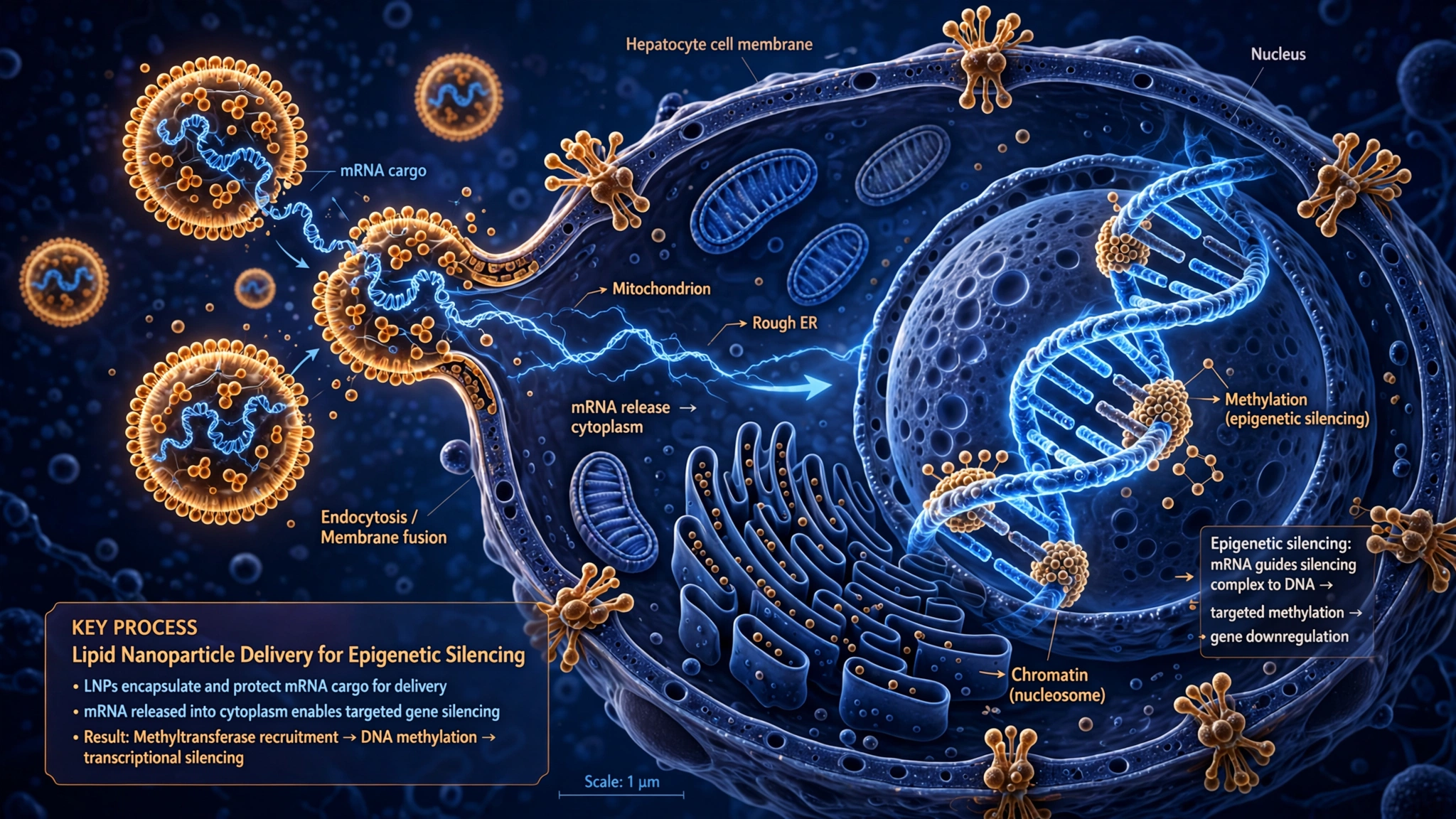
Tune Therapeutics, backed by $175 million in Series B funding from NEA, Yosemite (Reed Jobs), Regeneron Ventures, and Hevolution Foundation, designed TUNE-401 as an IV infusion of messenger RNA encapsulated in lipid nanoparticles licensed from Acuitas Therapeutics, the same company whose LNP technology powered Pfizer-BioNTech's COVID-19 vaccine.
Once infused, the LNPs deliver their RNA payload to liver cells, which translate it into a protein that physically attaches methyl groups to the hepatitis B virus's covalently closed circular DNA, the intranuclear reservoir that existing antiviral drugs cannot reach and that causes the virus to rebound whenever treatment stops. Once translated, the protein silences the gene epigenetically, without ever cutting the genome.
In the Phase 1b/2a trial across New Zealand, Hong Kong, and Moldova, Tune tested four ascending single doses (0.2 to 0.85 mg/kg) and a multi-dose cohort. Results reported at EASL:
| Metric | Result |
|---|---|
| Biomarker repression (dose levels 2-4) | 100% of participants |
| pgRNA loss (HBeAg-negative, dose levels 3-4) | 4 of 7 patients (57%) |
| HBeAg loss (HBeAg-positive, dose levels 3-4) | 3 of 5 patients (60%) |
| Durability of single-dose repression | 17 months and counting |
| Serious adverse events | None reported |
"Over the prior 30 years in hepatology, I have rarely seen a clinical signal this clear," said CEO John McHutchison, who previously ran Gilead Sciences' hepatitis C program. Phase 2 enrollment begins late 2026.
The Competition Is Already in Patients
nChroma Bio, co-founded by MIT's Jonathan Weissman, dosed its first patient in January 2026 with CRMA-1001, a competing epigenetic silencer. Like TUNE-401, it methylates cccDNA without cutting it, but nChroma claims its approach also silences integrated HBV DNA embedded in the host genome, a reservoir that Tune's therapy does not directly address. Trial sites span Hong Kong, New Zealand, and the United Kingdom.
Meanwhile, Epicrispr Biotechnologies reported in June that its AAV-delivered epigenetic editor, EPI-321, reversed muscle loss in three FSHD patients at six months. A Nature feature published June 26 called the collective effort "CRISPR's next act," profiling all three companies and the scientific lineage from dead-Cas9 to clinical reality. Three companies with human data in the same month, and a Nature feature anointing epigenetic editing as a legitimate therapeutic modality. Epigenetic editing just became real.
The Cost Math Nobody Has Run
Here is the calculation that matters. There are currently three ways to deliver gene-level cures, and they have radically different cost structures:
| CRISPR Cutting (Ex Vivo) | Epigenetic Editing AAV (In Vivo) | Epigenetic Editing LNP-RNA (In Vivo) | |
|---|---|---|---|
| Example | Casgevy (Vertex) | EPI-321 (Epicrispr) | TUNE-401 (Tune), CRMA-1001 (nChroma) |
| Delivery | Stem cell harvest → lab editing → chemo → reinfusion | Single IV (AAV vector) | Single IV (lipid nanoparticle) |
| Hospital stay | Weeks (myeloablative) | Outpatient | Outpatient |
| List price / est. COGS | $2.2M-$4.25M per patient | $100K-$500K (AAV manufacturing) | $500-$5,000 (LNP-RNA manufacturing) |
| Redosable? | Theoretically (requires repeat chemo) | No (anti-AAV antibodies) | Yes (no anti-LNP antibodies) |
| Addressable diseases | Ultra-rare (blood disorders, ~32K eligible) | Rare (FSHD, ~870K worldwide) | Common chronic (HBV, 240M worldwide) |
COVID mRNA vaccines used functionally identical LNP formulation at manufacturing costs of $2 to $5 per dose. Therapeutic doses are larger (roughly 60 mg of mRNA for a 70 kg patient at TUNE-401's highest dose, versus 30 micrograms for a vaccine), but the process is the same: mix lipids, encapsulate RNA, fill vials. Alnylam's inclisiran, an LNP-siRNA for cholesterol, is priced at $3,250 per dose. Manufacturing cost is a fraction of that.
If Tune or nChroma achieves a functional HBV cure with one to three infusions, the manufacturing cost per patient could fall between $500 and $5,000. Even at a 10x commercial markup, that is $5,000 to $50,000 per cure — 44 to 440 times cheaper than Casgevy. At the generic reference price for HBV antivirals ($30 to $36 per year, per WHO benchmarks), a single curative LNP dose manufactured at scale could eventually cost less than two years of the daily pills that 240 million people currently take without ever being cured.
Where This Breaks Down
Seventeen months of biomarker suppression is not a cure, and nobody should confuse the two. TUNE-401 has shown durable repression from a single dose, but Phase 2 data with multi-dose regimens are needed to determine whether functional cure (sustained HBsAg loss off all therapy) is achievable. The trial has enrolled patients across three countries, not three hundred. We do not know what happens beyond 17 months, and we do not know whether the therapy's effect will wane, requiring periodic re-dosing that would erode the cost advantage.
The strongest counterargument is brutally simple: pharmaceutical companies price on value, not manufacturing cost. A curative HBV therapy eliminates lifetime management of $2,000 per year and the risk of progression to cirrhosis ($5,964/year), hepatocellular carcinoma ($41,000 to $99,000), or liver transplantation ($215,162), per Toy et al. 2025. Value-based pricing could reach $100,000 to $500,000, cheaper than Casgevy but still orders of magnitude above what a subsistence farmer in sub-Saharan Africa can pay, and those are the populations where 70 percent of chronic HBV infections reside.
LNP-RNA technology enables cheap cures, but whether the business model delivers them is a different question entirely.
The Bottom Line
For the first time, gene-level therapies have been delivered to human patients using a manufacturing platform whose cost structure can scale to hundreds of millions. Tune's 17-month durability data and nChroma's first-in-human dosing are early signals, not endpoints, but they establish something important: the barrier to curing common chronic diseases at the genetic level is no longer scientific. It is economic will. If you are living with chronic hepatitis B, watch TUNE-401's Phase 2 (late 2026) and nChroma's ongoing Phase 1/2. If you are an investor, the question is no longer whether epigenetic editing works in humans but who will price their cure for the planet, not just for patients with insurance. And if you are a policymaker, the LNP-RNA cost structure makes one thing clear: the next generation of gene-level cures does not need to cost $2.2 million. What we accept as the price is a choice, not an inevitability.