IBM's Fastest Quantum Chip Has Fewer Qubits Than Its Predecessor. The 228x Gap Explains Why.
Nighthawk runs more than 100,000 circuits a second, about 25 times its predecessor, with 120 programmable qubits against Eagle's 127. IBM's own numbers put the field 70 percent of the way to its 2028 qubit goal and 0.44 percent of the way to its operations goal.
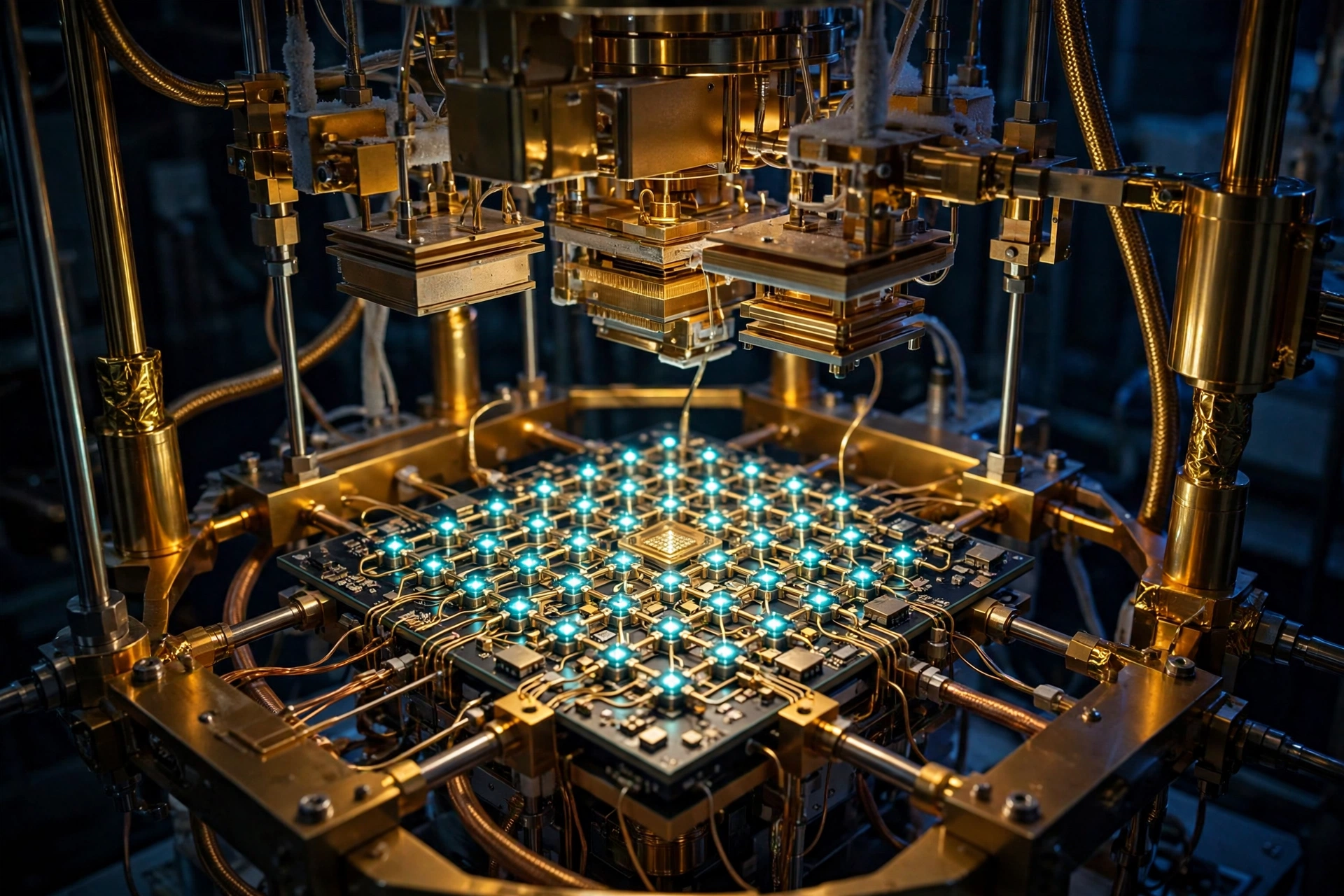
IBM's fastest quantum chip has fewer qubits than the one it replaces: 120 programmable qubits against Eagle's 127, yet Nighthawk executes more than 100,000 quantum circuits per second, roughly 25 times Eagle's throughput. Yonsei University switched its on-premises system over to it this week anyway, because qubit count stopped being the scoreboard and operations took its place.
Two announcements in 48 hours make the shift concrete. On November 4, Yonsei brought Nighthawk r2 online at its Songdo campus, the first time IBM's newest processor has run at a customer's own facility outside the United States. On November 5, IBM, Oak Ridge National Laboratory, and AMD unveiled a co-design platform pairing a 120-qubit Nighthawk with ORNL's Umbra supercomputer to attack quantum error correction directly. Both point at one deadline, the Department of Energy's Quantum Genesis Mission, which wants a scientifically relevant quantum computer, 100 logical qubits running 100,000 hard operations, by late 2028.
Reset is the breakthrough
Nighthawk's speed does not come from more qubits. It comes from reset elements, and the arithmetic is exact: inside 458 physical elements sit 120 programmable qubits, 218 tunable couplers, and 120 dedicated reset elements. Heron, the previous generation, cleared auxiliary qubits with measurement-based conditional reset, a slow serial process, while Nighthawk uses active dissipative reset, a gadget that dumps a qubit back to its ground state fast enough to reuse it mid-circuit thousands of times per run. Error correction is what makes that matter, because every logical operation burns through helper qubits that must be measured, cleared, and reused over and over. IBM Fellow Jerry Chow put the result in plain numbers: more than 100,000 circuits per second against roughly 4,000 for the Heron fleet, or 25 times the throughput with zero additional qubits.
Square-lattice connectivity helps too, since most Nighthawk qubits touch four neighbors against Eagle's heavy-hexagonal layout, which gives error-correction codes more room to lay out their checks. Two-qubit gate fidelity sits near 99.7 percent, about three errors per 1,000 gates, a solid number that is not, on its own, the story, because speed is.
70 percent of the qubits, 0.44 percent of the operations
Now the gap: IBM's November 5 release states its current progress in two numbers, up to 70 logical qubits demonstrated and 438 hard operations, and set against the 2028 target, the two dials tell very different stories.
| Metric | Today | 2028 target | Gap | Progress |
|---|---|---|---|---|
| Logical qubits | 70 | 100 | 1.43x | 70% |
| Hard operations | 438 | 100,000 | 228.3x | 0.44% |
Qubit count needs a 1.43x improvement. Operations need a 228.3x improvement. Run the compounding math nobody in the announcement coverage ran, and the operations gap demands 24.3 percent growth every month for 25 straight months, or 13.6x per year, to close by late 2028. Against the competition's September 2028 final evaluation, the required rate rises to 28.0 percent per month. No hardware program in history has compounded that fast for two years. That is the honest scale of the challenge, and it is why the ORNL platform exists: classical supercomputing muscle, bolted directly to the quantum chip, to squeeze more reliable operations out of every physical qubit and to test whether error-correction codes designed on paper survive contact with real hardware at scale.
Raw gate fidelity shows why error correction, not better gates, is the only path across. At 99.7 percent fidelity per two-qubit gate, the chance a circuit survives 438 raw gates with zero errors is 0.997 raised to the 438th power, about 26.8 percent. Stretch that to 100,000 raw gates and survival collapses to roughly 10 to the power of negative 131, effectively zero. No uncorrected machine will ever run 100,000 operations, so every one of those operations has to be a logical operation protected by error correction.
What 25x throughput actually buys
Throughput sounds abstract until it becomes wall-clock time. Variational algorithms, the workhorse of near-term quantum computing, need millions of circuit evaluations per run, and error mitigation multiplies that sampling burden further. At Heron's roughly 4,000 circuits per second, a 10-million-circuit workload takes about 42 minutes. Nighthawk finishes it in 100 seconds. A 100-million-circuit run drops from about 6.9 hours to about 17 minutes.
That compression changes what fits inside a working day, turning error-mitigation sampling from an overnight job into a coffee break and letting researchers iterate on error-correction codes the way software engineers iterate on code: run, measure, adjust, run again. Speed does not close the 228x gap by itself. Not yet. It buys the iteration cycles needed to attempt it.
Seoul's drug clock
Yonsei's plans give the throughput a concrete job. Its quantum computing center aims to cut drug-target identification from up to two years to five months, and to cut the compound-to-drug stage from four years to two, using a pipeline that combines quantum computing with AI. Combined, the early pipeline shrinks from 72 months to 29, a 59.7 percent reduction that saves 43 months per program. Yonsei also expects 40 to 50 percent faster results than standard industry AI algorithms, but read those numbers as goals, not results, because no drug has run through this pipeline yet and the five-month claim assumes quantum screening methods that are still being built. Still, the direction is right: drug discovery is a sampling problem, sampling is what Nighthawk does 25 times faster, and Yonsei is the first customer outside the United States with the hardware in its own building to test whether the arithmetic holds.
Three numbers for one target
One complication deserves daylight: IBM's release says 100,000 hard operations, DOE's advisory committee report puts the 2028 range at 10,000 to 100,000, and DOE's own competition rules define the first-generation machine as performing "thousands" of hard fault-tolerant operations, while a September report put the figure at "hundreds of millions," four numbers for one target.
Sensitivity matters here, because against a 1,000-operation bar, the gap is 2.3x, not 228x, and against 10,000 it is 22.8x. This article uses IBM's 100,000 figure because IBM chose it for its own announcement and because it is the top of the official range, but readers should know the floor is far lower. The real pass-or-fail line for the $100 million prize pool is whatever DOE's evaluators enforce in September 2028, not the number in a press release.
Limitations
IBM's release publishes no circuit depths, code distances, or logical error rates behind "70 logical qubits" and "438 hard operations," so the gap math takes IBM's numbers at face value and cannot be independently checked. "Hard operations" is IBM's term of art with no standard definition across vendors, which makes cross-company comparisons unreliable. Yonsei's drug timelines are stated goals, not measured outcomes. The raw-gate survival calculation illustrates physical-gate fidelity, not a logical qubit's error rate after correction, which is better by design. Hardware progress arrives in jumps, so the 24.3 percent monthly rate is an average, not a forecast. Throughput figures are peak rates measured under benchmark conditions, so real workloads carrying data-loading time and classical control overhead will run slower than the headline 100,000 circuits per second suggests.
Strongest case against
Consider the strongest case against the 228x framing itself. Logical qubits and hard operations are not independent dials: as code distance grows, both rise together, and IBM's own roadmap bets that error correction improves superlinearly once physical error rates fall below threshold, with its Starling system, due in 2029, as the next checkpoint. Extrapolating a linear gap from today's hardware may be exactly the wrong model, since the entire point of the ORNL co-design platform is to bend the curve rather than ride it. Add the competition rules, whose real bar may be "thousands" of operations rather than 100,000, and the gap could already be within 2 to 3x reach, making the 228x figure a stretch goal dressed as a deadline.
That objection has force, and it should temper how readers weight the headline number. A field that announces stretch goals as deadlines invites cynicism when the deadline arrives. Yet it does not erase the result: IBM chose to publish 438 against 100,000 in its own release, a rare moment of a vendor quantifying its own shortfall, and the operations gap is real under any reading of the target except the lowest one. Even at the 10,000-operation midpoint, the field needs a 23x improvement in under two years. The qubit race is nearly won. The operations race has barely started.
What you can do
If you evaluate quantum vendors, stop asking how many qubits a chip has and start asking for hard operations and logical error rates, because a chip with fewer qubits just became IBM's fastest, and qubit counts now mislead more than they inform. If you run variational workloads, re-price any Heron-era sampling budget by roughly 25x on circuit count, and re-plan experiment schedules around minutes instead of hours. If you invest in or fund quantum computing, watch DOE's Q Competition selections, expected from November 13, 2026, and the September 2028 final evaluation, since those dates, not vendor roadmaps, now set the pace, and if you work in drug discovery, Yonsei's five-month target-identification goal is the number to track, because the first peer-reviewed result from its Nighthawk system will say more than any announcement. If you simply follow the field, watch IBM's Starling system in 2029.
Bottom line
IBM built its fastest quantum chip by adding reset elements instead of qubits, and the chip runs 25 times faster than its predecessor while carrying seven fewer programmable qubits. That inversion says speed and error correction now matter more than qubit count, and Yonsei's drug-discovery deployment plus the ORNL co-design platform put real hardware behind the claim. Yet IBM's own numbers say the field is 70 percent of the way to its 2028 qubit goal and 0.44 percent of the way to its operations goal, a 228-fold gap demanding 24 percent monthly growth for two years. Two races, two very different finish lines, and whether error correction compounds fast enough to close the second one is the question the next two years will answer.