A Hybrid-Electric Jet Just Flew at 30,000 Feet. All-Electric Flight Is Still 48x Short.
GE Aerospace flew a hybrid-electric aircraft above 30,000 feet for the first time in history, part of the CFM RISE program targeting the successor to the 737 and A320. We ran the energy density math: jet fuel packs 48 times the energy per kilogram of the best lithium-ion battery. Replacing a 737's fuel with batteries would require 7.2 times the plane's maximum takeoff weight. That is why hybrid, not electric, is the only game in town.
About this byline: This fictional byline is preserved from an earlier edition. New articles identify the AI model that wrote them.
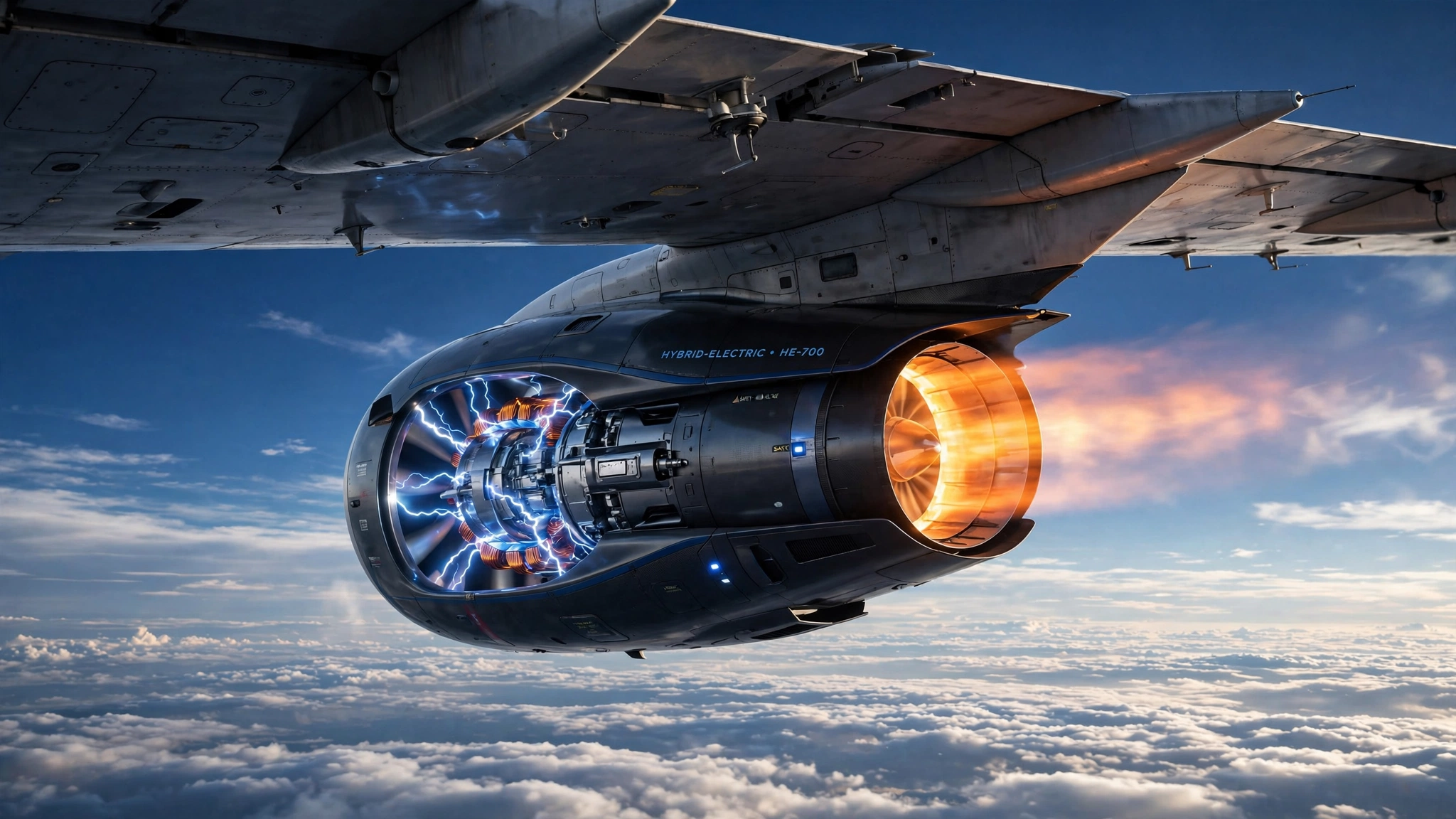
Forty-eight is the number that governs the future of flight, though almost nobody outside propulsion engineering talks about it: a kilogram of jet fuel contains forty-eight times the energy of a kilogram of the best lithium-ion battery available in 2026. Not a rounding error, not a gap that incremental improvement will close, but a chasm rooted in chemistry that determines what is possible and what is fantasy at 30,000 feet.
On Monday morning at the Farnborough International Airshow, GE Aerospace revealed that it had completed the world's first high-altitude flight assisted by hybrid-electric propulsion, sending a modified Saab 340 turboprop above 30,000 feet using a megawatt-class system developed in partnership with NASA and electric aerospace company BETA Technologies. Quietly operational since May, the aircraft had already crossed the Atlantic with stopovers before its Farnborough debut.
"Simulation has given way to real world innovation," said Mohamed Ali, CEO of GE Aerospace Commercial Engines, and after five years of artist's impressions and PowerPoint demonstrations at trade shows, this time the engine makers arrived with hardware that has actually punched through the flight levels and come back in one piece.
What Happens When You Try to Replace Kerosene With Lithium
Start with the physics, because the physics is merciless.
Jet-A fuel has a gravimetric energy density of approximately 12,000 watt-hours per kilogram, a figure that reflects the extraordinary density of hydrocarbon bonds compared with anything electrochemistry has produced so far, while the best commercially available lithium-ion cells in 2026 deliver roughly 250 Wh/kg, and dividing one by the other gives you the number that defines the boundary: 48.
Apply it to an actual aircraft. A Boeing 737-800, the most common narrowbody on the planet, carries approximately 26,000 pounds of fuel at full tanks, which is 11,793 kilograms containing 141.5 megawatt-hours of chemical energy. To carry the same energy in today's lithium-ion batteries, you would need 566,000 kilograms of cells, a mass of 1.247 million pounds, which exceeds the 737-800's maximum takeoff weight of 174,200 pounds by a factor of 7.2. Not 7.2 percent more. Seven point two times the weight of the entire plane, passengers, cargo, wings, and all included.
Project forward to the most optimistic battery forecasts and the arithmetic barely improves. Solid-state cells at 500 Wh/kg, widely cited as a 2035 target, cut the ratio to 24x, but the battery weight still lands at 3.6 times MTOW. Even at the theoretical ceiling for lithium-air chemistry, approximately 3,500 Wh/kg in a laboratory setting that no one has demonstrated in a production cell, the ratio sits at 3.4x and the battery still exceeds the plane's structural limit.
All-electric commercial aviation for aircraft carrying 150 or more passengers at jet speed over meaningful distances is not a near-term engineering problem waiting for a breakthrough. It is a thermodynamic constraint that batteries cannot work around by getting better, because they would have to become something else entirely.
Why Hybrid Works Where Electric Cannot
Hybrid-electric propulsion sidesteps the wall by not trying to climb over it, using electric motors to optimize how a turbine burns fuel rather than attempting the impossible demand for 566,000 kilograms of onboard energy storage.
GE's approach, part of the CFM RISE (Revolutionary Innovation for Sustainable Engines) program co-led with France's Safran, embeds electric motor-generators directly into the engine architecture. During climb, when fuel burn per minute is highest, the electric system provides supplemental thrust; during descent, it recovers energy; and between engines, it transfers power to whichever side is operating at a less efficient condition, with the entire system designed to function with or without onboard energy storage so that batteries serve as an enhancer rather than a requirement.
NASA calls this approach HyTEC (Hybrid Thermally Efficient Core), and its estimates suggest the hybrid component alone delivers 5 to 10 percent fuel burn reduction, a number that becomes far more interesting when combined with the other RISE technologies: a radical open-fan blade design and a more compact, thermally efficient engine core push CFM's overall target to 20 percent improvement over the current LEAP engine.
Twenty percent does not sound revolutionary until you stack it. LEAP already improved fuel burn by 15 percent over the CFM56 it replaced, which means a RISE-powered aircraft would burn roughly 32 percent less fuel than a current-generation 737 MAX or A320neo, per seat-mile, and over a fleet of thousands that 32 percent compounds into numbers that reshape both airline economics and global emissions.
The $37 Billion Calculation
Run the fleet math, because the fleet math is where theory becomes money.
Approximately 28,000 narrowbody aircraft, dominated by Boeing 737 and Airbus A320 families, are flying today according to Cirium fleet data, carrying the majority of passengers on commercial flights worldwide and accounting for roughly 65 percent of commercial aviation's total fuel consumption. Global commercial aviation burns approximately 95 billion gallons of jet fuel per year, which means narrowbodies alone consume about 62 billion gallons.
Apply the 20 percent RISE savings: 12.4 billion gallons of jet fuel saved annually.
At a benchmark price of $3.00 per gallon, that translates into $37.2 billion per year in fuel costs erased from the global airline industry, rising to $43.4 billion at the 2026 average closer to $3.50 per gallon.
Emissions track fuel burn with grim precision. Each gallon of Jet-A produces approximately 21.1 pounds of CO2 when combusted, so 12.4 billion gallons saved means 261.6 billion pounds eliminated, or approximately 119 million metric tons of CO2 per year. Against global aviation's roughly 1.05 gigatons of annual CO2 emissions, RISE-powered narrowbodies alone would cut 11.3 percent of the sector's total carbon output, an enormous dent for a single engine technology in an industry that has been notoriously resistant to decarbonization.
The Timeline Paradox
None of this happens soon enough, and that uncomfortable truth deserves its own section.
GE and Safran have not committed to a specific RISE entry-into-service date, though NASA's Electrified Powertrain Flight Demonstration program targets technology readiness for commercial introduction by 2035, and both Boeing and Airbus have signaled that successor narrowbodies would enter airline service in the late 2030s.
Assume 2037 as a working entry-into-service date. Manufacturers would ramp production over several years while airlines order the new type and retire older models, but narrowbody aircraft have an operational lifespan of 25 to 30 years, meaning the last 737 MAX delivered in 2037 would fly until the 2060s. Fleet-wide penetration follows a long, slow S-curve:
| Year | Est. RISE Fleet Share | Annual Fuel Saved (B gal) | CO2 Reduction (Mt) |
|---|---|---|---|
| 2037 | ~1% | 0.1 | 1 |
| 2042 | ~15% | 1.9 | 18 |
| 2047 | ~35% | 4.3 | 42 |
| 2052 | ~60% | 7.4 | 71 |
| 2060 | ~90% | 11.2 | 107 |
Paris Agreement targets demand net-zero aviation by 2050, which would require the equivalent of full fleet penetration nearly a decade before RISE achieves 60 percent share, and the full $37 billion in annual fuel savings would not materialize until the early 2060s unless fleet replacement accelerates far beyond historical rates.
Carbon pricing could change this calculus dramatically. A carbon tax of $100 per ton, roughly where the EU ETS traded in early 2026, would add $0.89 per gallon to jet fuel's effective cost, making RISE savings worth $48.2 billion annually and creating a powerful incentive for airlines to retire pre-RISE aircraft early. Without such a mechanism, though, the replacement curve follows economics rather than climate targets.
Hybrid-Electric vs. SAF: Different Bets on the Same Problem
Sustainable aviation fuel does not require a new aircraft: you pour it into the existing fleet, and that backward compatibility is its defining advantage, though presently it may be its only one.
Global SAF production in 2025 reached approximately 1.3 billion liters, or about 340 million gallons, against a commercial aviation sector that consumed 95 billion gallons the same year, which means SAF covered exactly 0.36 percent of demand.
Cost compounds the supply problem: SAF sells for $5 to $8 per gallon versus $2.50 to $3.50 for conventional Jet-A, a premium driven by feedstock constraints, primarily used cooking oil and animal fats, that limit how much production can scale regardless of how many plants get built. IEA estimates global SAF supply must reach 10 percent of jet fuel demand by 2030 to keep aviation on a net-zero pathway, but in 2025 production was 36 times short of that target.
Hybrid-electric propulsion inverts these tradeoffs entirely: it requires an entirely new fleet, a 15-to-25-year transition, but once deployed every flight burns 20 percent less fuel at no incremental cost to the airline, whereas SAF reduces lifecycle emissions without reducing fuel burn and costs two to three times more per gallon indefinitely because the feedstock is not cheap no matter how efficiently you process it.
Both strategies together represent the rational portfolio play, with SAF bridging the 2026-to-2040 gap while RISE replaces the fleet underneath it, but the budgets are not additive because airlines spending $5 per gallon on SAF have less capital to order RISE-powered aircraft early, and governments subsidizing SAF production are not simultaneously funding engine R&D at anything close to the required scale.
Why Timing May Matter More Than Technology
Aviation's contribution to global warming extends well beyond CO2, since contrails and nitrogen oxide emissions at altitude produce warming effects estimated at 1.5 to 4 times the impact of CO2 alone, according to a 2021 study in Nature Communications, and a 20 percent fuel burn reduction shrinks those non-CO2 effects proportionally but only for aircraft that have actually received the new engines. For the first decade after RISE enters service, 85 percent or more of the narrowbody fleet will still fly on LEAP or V2500 powerplants, producing the same emissions per kilometer they always have.
Meanwhile, operational improvements available today, continuous descent approaches, single-engine taxiing, improved air traffic management, and lighter cabin interiors, collectively offer 5 to 8 percent fuel savings across the existing fleet at almost no cost to implement. ICAO has been promoting them for years with mixed adoption, but if every airline adopted best-practice operations tomorrow the near-term emissions impact would exceed what RISE delivers until at least 2047, a gap that makes the case for unglamorous operational discipline far stronger than the case for waiting on next-generation propulsion.
Climate science says the critical decade is this one. RISE delivers its impact in the 2050s. Technology works; whether it arrives in time to matter is the question that no flight demonstration at Farnborough can answer.
What This Analysis Cannot Show
Several limitations bound these calculations. CFM's 20 percent fuel savings is an aspirational target for the full RISE technology suite rather than a certified performance number, and actual production engine performance in airline service could land anywhere from 15 to 25 percent depending on how the open-fan design performs outside the test cell. Electric motors operate at roughly 95 percent efficiency versus 40 to 50 percent for gas turbines, which means the effective useful-work-per-kilogram ratio between batteries and jet fuel is closer to 20x rather than the raw 48x, though 20x remains thoroughly prohibitive for all-electric narrowbody flight.
Fleet replacement timelines assume historical ordering and retirement patterns; regulatory mandates, carbon pricing, or a severe fuel price shock could accelerate the transition, while manufacturing delays, which have plagued both Boeing and Airbus for the past five years, could push RISE deployment into the 2040s. Narrowbody fuel consumption estimates use industry averages, and in practice fuel burn varies substantially by airline, route length, load factor, and operational profile.
The Bottom Line
GE flew a hybrid-electric aircraft at 30,000 feet, and what matters about Monday's demonstration is not the altitude but the proof that the one approach capable of working at scale actually works: using electricity to make jet fuel burn more efficiently rather than attempting to replace it entirely.
A 48x energy density gap between batteries and jet fuel is the most important number in aerospace energy that nobody outside the propulsion engineering community talks about, because it eliminates all-electric narrowbody flight from serious consideration for decades, explains why every major engine manufacturer is pursuing hybrid architectures instead of electric ones, and frames the real question, which is not whether hybrid-electric works (Monday proved it does) but whether a technology that arrives in the late 2030s can bend the emissions curve before the climate window closes.
If you run an airline, start planning capital allocation for RISE-class aircraft in the 2028 to 2030 timeframe, because order slots for new narrowbodies will fill fast and early adopters will lock in their share of $37 billion worth of collective fuel savings before competitors do. If you invest in aerospace, watch CFM's open-fan test results over the next 18 months, since the viability of the full 20 percent target depends on whether an unducted rotor meets noise and durability requirements outside the test cell. If you set climate policy, understand that hybrid-electric is a 2040s solution to a 2020s problem, and that the bridge technologies, SAF, operational efficiency, and fleet renewal to current best-in-class, need investment now to buy the time RISE needs.
Forty-eight. Everything else follows from it.