Europe's $18 Billion Defense Startup Produces 450 Drones a Month. The Valuation Requires 2,500.
Helsing just raised $1.8 billion at an $18 billion valuation with 900 employees and undisclosed revenue. The math only works if a factory that doesn't exist yet hits full capacity. Here's the production arithmetic investors are betting on.
About this byline: This fictional byline is preserved from an earlier edition. New articles identify the AI model that wrote them.
Four hundred and fifty. That is how many HX-2 kamikaze drones Helsing's single factory in southern Germany currently produces each month, according to Defense Express reporting on the company's production figures. On July 13, Reuters reported that Helsing closed a $1.8 billion Series E round at an $18 billion valuation, making it the most valuable private defense company in Europe and one of the most expensive startups on the continent, full stop. JPMorgan Chase, Lightspeed Venture Partners, and Iconiq led the round.
Here is what that $18 billion is not based on: disclosed revenue.
Helsing's only audited revenue figure, buried in German corporate filings from fiscal year 2021, is €415,000. Helsing has not published a subsequent top-line number. No revenue in its fundraising announcements. No revenue in its press releases. No revenue guidance on its website. Independent analysts at robotics.press place current annual revenue below €500 million, though even that estimate is flagged as low-confidence because there is simply nothing public to anchor it against.
So what exactly is $18 billion pricing in?
Production capacity that doesn't exist yet.
The Unit Economics Nobody Published
I built a revenue model from Helsing's production data and contract disclosures because the company won't release one and nobody else has assembled the pieces. All inputs are public; the calculation, as far as I can find, is not.
Start with what we know about drone pricing. In February 2026, the German Bundestag awarded €268 million to Helsing for HX-2 loitering munitions as part of a broader €834 million strike drone package split three ways: Helsing (€268M for HX-2), Stark Defence (€268M for Virtus), and Rheinmetall (€298M for attack drones). No public data pins down the quantity, but we can bracket the unit price. Ukrainian FPV drones cost $500 to $2,000 apiece. An HX-2, with onboard AI for autonomous target recognition, GPS-denied visual navigation, electronic warfare resistance, dual optical-thermal sensors, and swarm coordination through Helsing's Altra software stack, is categorically more capable but designed for mass production at "significantly lower unit cost than conventional systems," per Helsing's own announcement. Conventional loitering munitions like Switchblade 600 run $55,000 to $70,000 per unit in U.S. procurement. The HX-2 likely sits in the €30,000 to €50,000 band, which aligns with the €268 million contract covering a few thousand units rather than tens of thousands.
Use €40,000 as the midpoint and apply it to Helsing's production rates.
| Scenario | Monthly Output | Annual Output | Annual Revenue | USD Equivalent |
|---|---|---|---|---|
| Current (RF-1, actual) | 450 | 5,400 | €216M | ~$234M |
| RF-1 at full capacity | 1,000 | 12,000 | €480M | ~$521M |
| RF-1 + new factory (target) | 2,500 | 30,000 | €1.2B | ~$1.3B |
At 450 drones per month, hardware revenue caps near $234 million annually. Add software licensing from the Altra platform, the Eurofighter electronic warfare suite with Saab, and consulting engagements, and you might stretch total company revenue to $300-400 million. Maybe. Disclosed revenue? None. So that number is not disclosed, but the production math constrains it.
What $18 Billion Actually Requires
Defense AI startups trade at growth-stage multiples because investors are buying optionality on trillion-dollar government budgets, not trailing cash flow. But the multiples have a range, and where Helsing falls in that range determines whether $18 billion is aggressive or absurd.
| Company | Valuation | Estimated Revenue | Implied Multiple | Employees |
|---|---|---|---|---|
| Palantir (defense segment) | ~$60B | ~$1.2B (gov't) | ~50x | ~3,800 |
| Anduril | $28.2B | ~$1.5-2B | 14-19x | ~4,000+ |
| Shield AI | $12.7B | ~$500M+ | ~25x | ~1,500+ |
| Helsing | $18B | Unknown (<€500M) | >36x (est.) | ~900 |
At Anduril's multiple (call it 17x, the midpoint), $18 billion requires $1.06 billion in annual revenue. At Shield AI's 25x, it requires $720 million. Even at Palantir's richly valued 50x, which reflects public-market SaaS premium characteristics that Helsing does not share, the valuation demands $360 million, which is only achievable if Helsing is already running at or above its current factory's full 1,000-per-month capacity and layering significant software revenue on top.
Honestly? At a defensible multiple, $18 billion requires roughly $900 million to $1.1 billion in annual revenue. That number only appears in the scenario column labeled "RF-1 + new factory (target)" at 2,500 drones per month, a production rate that Helsing has publicly stated as its goal but has not yet built the infrastructure to achieve.
In other words, investors just valued Helsing at a number that requires 5.6 times its current monthly production rate.
The Factory of Tomorrow
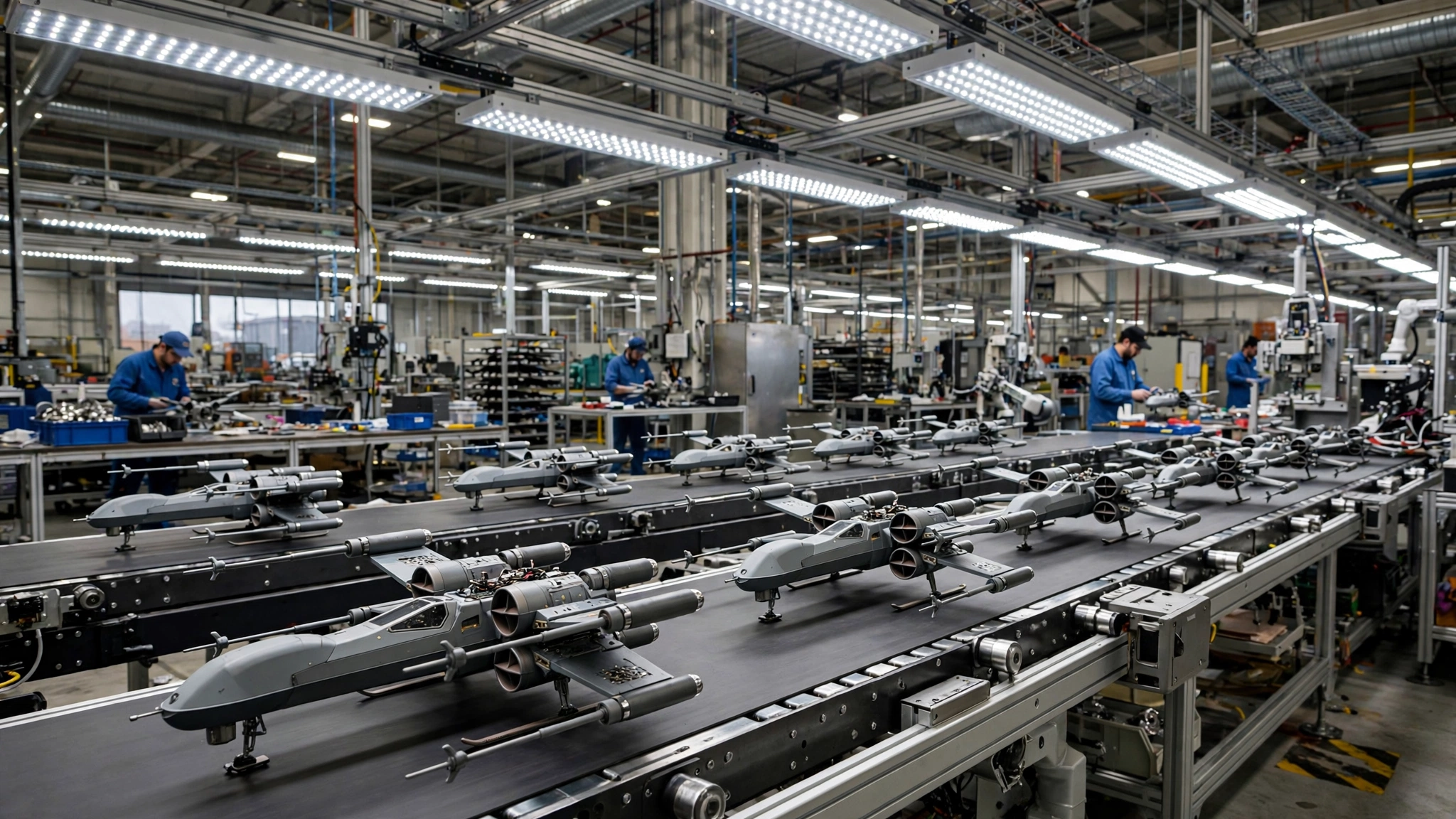
Helsing calls its production facilities Resilience Factories. RF-1, the first, opened in southern Germany in early 2025 and has an initial monthly capacity of over 1,000 HX-2 drones, though current output is 450 due to the need to train more workers. Helsing has announced plans to build additional Resilience Factories across Europe, with the explicit goal of scaling to 2,500 per month, or roughly 84 drones per day.
Its ambition is not fantasy. European demand is real. Germany's Bundestag authorized a strike drone program with framework options potentially reaching €9 billion, of which Helsing holds a €1.46 billion framework agreement. Europe's broader rearmament cycle, kicked off by Russia's invasion of Ukraine, represents the largest NATO spending increase since the Cold War: Germany alone created a €100 billion special defense fund and is pushing toward sustained 2%+ GDP defense spending. Global defense tech venture capital hit $49.1 billion in 2025, nearly doubling 2024 levels.
And the HX-2 has something few competitors offer: real combat data. Helsing has delivered or ordered roughly 10,000 drones for Ukraine across HX-2 and the earlier HF-1 model. In May 2026, Helsing demonstrated HX-2 maritime launch from a speedboat off Plymouth's coast, a capability subsequently confirmed in Ukrainian operational use. U.S. soldiers tested the HX-2 in a NATO exercise on Europe's eastern flank, achieving 15 simulated kills in a squadron-scale integration event.
But this is precisely the bet, not the proof. Production ramps of this scale are notoriously difficult in defense manufacturing, where supply chains are constrained, workforce training takes time, and quality requirements are unforgiving. Anduril, with approximately 4,000 employees and over $5 billion in cumulative capital, has struggled with production scaling for its own munitions programs. Helsing, with 900 people, is simultaneously manufacturing loitering munitions, developing a collaborative combat aircraft (the CA-1 Europa, a joint venture with HENSOLDT announced in May 2026), building maritime autonomy systems through its Blue Ocean MTS acquisition, launching space-based ISR through an OHB partnership, integrating three acquisitions made in eight months, and maintaining Eurofighter electronic warfare software with Saab.
That is seven simultaneous operational priorities for a company with fewer employees than a mid-size American high school.
The Spotify Chairman's War Portfolio
Helsing's largest shareholder is not a defense conglomerate. It is Daniel Ek, the co-founder and CEO of Spotify, operating through his investment vehicle Prima Materia. Ek invested €100 million in Helsing's 2021 seed round, led the €600 million Series D in June 2025 at a €12 billion valuation, and chairs the company's board. His total commitment exceeds €700 million of personal wealth, drawn from a fortune built on music streaming.
That juxtaposition has generated sustained backlash. Massive Attack, King Gizzard and the Lizard Wizard, Godspeed You Black Emperor, and Xiu Xiu have all pulled their music from Spotify in protest. Artists' unions have noticed. The United Musicians and Allied Workers called Ek "a warmonger who pays artists poverty wages." A growing coalition of artists argues that Spotify's $0.003 to $0.005 per-stream royalty rate is effectively subsidizing autonomous weapons development through Ek's personal balance sheet.
Ek has not equivocated. "I am 100 per cent convinced that this is the right thing for Europe," he told the Financial Times, and his board chairmanship signals operational involvement, not passive capital allocation. Spotify's artist exodus, while consisting of acts representing a small fraction of total catalog, is notable as a leading indicator of the cultural friction that defense tech will face as it recruits capital from consumer technology wealth. Silicon Valley's defense turn, led by Anduril and Shield AI in the U.S., has largely avoided consumer-brand entanglement because its founders came from defense or enterprise backgrounds. Ek has no such firewall. Every Spotify earnings call is now also, implicitly, a Helsing earnings call, though only one of those companies discloses its revenue.
The Strongest Counterargument
Here is the bull case against the valuation skepticism I just laid out, stated at full strength: defense tech valuations are not revenue multiples applied to current output. They are discounted forecasts of contract conversion in a market experiencing a generational demand shock. European NATO nations committed over $380 billion in new defense spending between 2022 and 2025, and the procurement pipeline is accelerating, not decelerating. Helsing's €1.46 billion framework agreement represents ceiling revenue that, if even 50% converts, generates €730 million in backlog against which production can be financed and factories can be built. Helsing's Altra software platform, if it becomes the standard European sensor-to-shooter stack across Eurofighter, Wingman, and CA-1 Europa programs, creates recurring multi-decade revenue with switching costs so high that no procurement officer will rip it out once it is certified and fielded. Eighteen billion dollars is not paying for 450 drones a month. It is paying for the probability that European defense spending makes 2,500 a month inevitable within 36 months, and that Helsing is the only credible European company positioned to deliver it. At that production rate, the valuation is a bargain compared to Anduril.
That is a real argument. The risk is that it requires multiple assumptions to hold simultaneously: that European procurement accelerates (historically slow), that Helsing's production ramp executes without the delays that plague defense manufacturing, that the CA-1 Europa CCA program progresses to funded development rather than joining the long list of European collaborative defense projects that died in committee, and that Helsing's combat performance in Ukraine, which was contested by media reports in January 2026 alleging targeting glitches and unfavorable price-performance compared to local $500 FPV alternatives, proves robust enough to win NATO procurement beyond Germany.
What This Analysis Does Not Prove
It does not prove Helsing is overvalued. My unit price estimate of €40,000 is bracketed but not confirmed; the actual figure could be higher (making the revenue math more favorable) or lower (making it worse). Software and services revenue from Altra, which operates across multiple programs, is genuinely opaque and could add hundreds of millions that this hardware-focused model does not capture. Furthermore, this analysis treats production rate as a hard constraint, when defense contracts frequently include advance payments and milestone billings that recognize revenue before delivery. If Helsing is billing against its €268 million Bundestag contract on a percentage-of-completion basis, recognized revenue could exceed what the drone-per-month math suggests.
What the production math does show, unambiguously, is the scale of the manufacturing bet embedded in the $18 billion price tag. This is not a software valuation where scaling means spinning up servers. Physical drones require factories, trained workers, supply chains for sensors and electric motors, and quality control processes that take years to mature. Helsing is asking investors to believe it can do in 36 months what took Anduril, with four times the headcount and twice the capital, nearly a decade.
The Bottom Line
If you are a defense investor or analyst, the single metric to watch is monthly HX-2 production rate, not contract announcements or partnership press releases. When Helsing reports crossing 1,000 per month at RF-1 and breaks ground on a second Resilience Factory, the $18 billion valuation has a credible path to justification. Until then, it is a $1.8 billion bet on a production curve. If you are a European defense planner, Helsing's pipeline is the most serious indigenous strike drone program on the continent, and the framework agreement structure means your procurement decisions directly determine whether the factory of tomorrow gets built. Helsing's competitors in the German drone award, Stark Defence and Rheinmetall, are not idle, and Quantum Systems is raising $710 million ahead of an early 2027 IPO. Europe's defense AI market is forming right now, and the cap table being assembled this year will determine who builds the continent's autonomous arsenal for the next thirty. If you are a Spotify subscriber who just read that the CEO's personal investment vehicle chairs the board of a kamikaze drone manufacturer, the economic linkage between your $11.99 monthly premium and Helsing is indirect but real: Ek's wealth is fungible, and he has placed more than €700 million of it into autonomous weapons. Whether that changes your streaming habits is a values question, not a financial one. But it is worth knowing the math on both sides.