⚡ Energy
Divide $7.2 Billion by 658 Megawatts: Fervo's IPO Filing Prices 24/7 Geothermal at 9.3 Cents a kWh
Fervo Energy's S-1 discloses 658 MW of binding power purchase agreements worth $7.2 billion in potential revenue. Run the division and you get the first observable market price for enhanced geothermal electricity: roughly 9 cents per kilowatt-hour, for firm, carbon-free power that never sleeps.
About $10.9 million per megawatt. That is the contracted revenue behind every megawatt of Fervo Energy's power purchase backlog, according to the company's IPO filing. Spread over fifteen-year contracts and 8,760 hours a year, the number collapses into something stranger: roughly 9.3 cents per kilowatt-hour. It is the first observable price for enhanced geothermal electricity, because until Fervo filed its S-1 in May, the industry had no commercial scale.
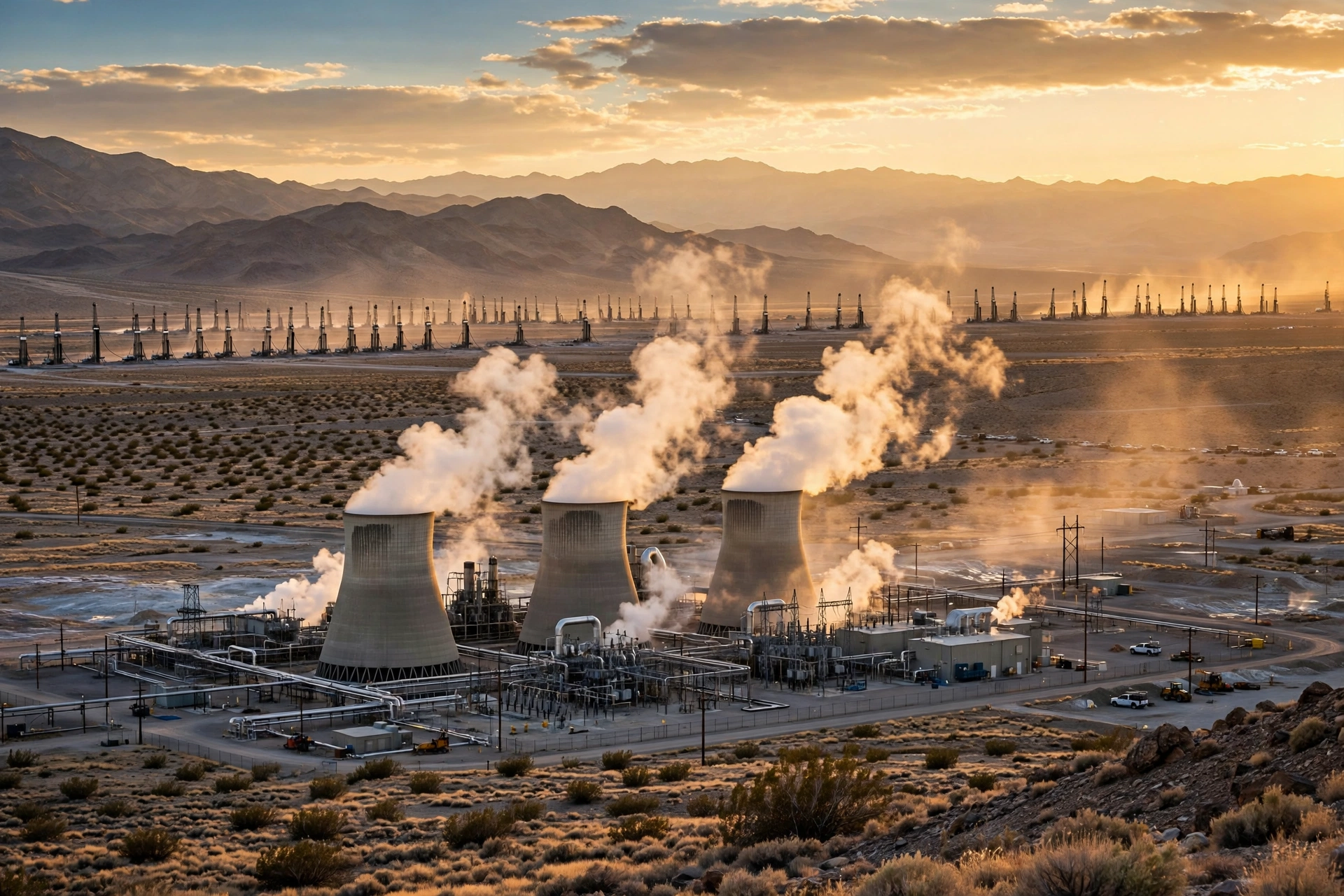
Fervo, which debuted on Nasdaq as FRVO on May 14 after raising about $2.2 billion at $27 a share, drills like an oil company to make steam where nature did not provide it: horizontal wells, hydraulic fracturing, fiber-optic monitoring, all aimed at hot dry rock. Its Nevada pilot, Project Red, proved the mechanics in 2023 with two wells reaching 7,500 feet down and 3,000-foot laterals in 350-degree rock, good for 3.5 megawatts of baseload. Cape Station outside Milford, Utah is the real project: 100 megawatts in Phase I, due for first power this quarter, 400 more megawatts in Phase II by 2028, and permits in hand for up to 2 gigawatts.
Phase I costs about $7,000 per kilowatt to build, which the company calls competitive with new nuclear and far above gas. Phase II, already under construction, comes in at $5,500 per kilowatt. Its target is $3,000. Between 2022 and 2025, Fervo cut drilling times by roughly 75 percent and per-foot drilling costs by roughly 70 percent, with a well-by-well chart in the S-1 tracing the decline. August's second-quarter results set a new record on top of it: Sawtooth 7, the ninth "Fervo 3.0" well design, reached nearly 19,500 feet of measured depth in 460-degree rock in 21 days from spud to total depth. In geothermal, drilling is the whole game. A record like that is not a trophy; it is the cost curve, visible.
The division nobody ran
Fervo disclosed 658 megawatts of binding power purchase agreements, signed with Southern California Edison, community choice aggregators, Google, and Shell, adding up to "approximately $7.2 billion in potential revenue backlog." IPO coverage in the Wall Street Journal notes the contracts run about fifteen years. Geothermal plants run as baseload at roughly 90 percent capacity factor, since the resource does not take nights off.
Multiply it out: 658 megawatts times 8,760 hours a year is about 5.19 million megawatt-hours annually at 90 percent capacity factor, or roughly 77.8 terawatt-hours over fifteen years. Divide $7.2 billion by 77.8 terawatt-hours and you land at $92.50 per megawatt-hour: 9.3 cents per kilowatt-hour, the implied average price of every electron Fervo has sold.
Since the inputs are estimates, here is the sensitivity. At 85 percent capacity factor the price rises to 9.8 cents; at 95 percent it falls to 8.8. A twelve-year average term pushes it to 11.6 cents; twenty years pulls it down to 6.9. Nothing in that range changes the story, because the band is 7 to 12 cents and the center is 9.3.
| Assumption | Implied price |
|---|---|
| Base: 90% capacity factor, 15-year terms | 9.3¢/kWh |
| 85% capacity factor | 9.8¢/kWh |
| 95% capacity factor | 8.8¢/kWh |
| 12-year average term | 11.6¢/kWh |
| 20-year average term | 6.9¢/kWh |
For scale, that is about 5.2 terawatt-hours a year, enough for roughly 480,000 American homes at average EIA residential consumption. That power is not headed to homes, though: a 3-gigawatt framework agreement with Google, signed alongside the IPO, plus a 115-megawatt deal with NV Energy to serve Google's Nevada data centers, say the customer is the hyperscaler. The product is carbon-free electricity at 3 a.m. in January, which hyperscalers cannot buy anywhere else.
What 9.3 cents buys
EIA's Annual Energy Outlook 2025 puts new combined-cycle gas at about $64.55 to $67.09 per megawatt-hour, combustion-turbine peakers near $133, and battery storage around $126, all including tax credits. Those are levelized costs rather than PPA prices, so read the comparison as directional: Fervo's implied 9.3 cents sits well above gas, well below peakers and storage, while selling something gas cannot: zero carbon, zero fuel-price exposure, and output independent of weather or charge cycles.
One EIA figure deserves a footnote in your head: the agency's geothermal number, $37.58 to $37.82 per megawatt-hour. That prices conventional hydrothermal geothermal, steam that already exists underground, not enhanced geothermal manufactured by fracking hot rock. $37.80 is the floor set by geology's charity cases. Fervo's price is for making the resource exist at all, anywhere with hot rock and a drilling rig. Nobody else sells that product.
Does the learning curve reach $3,000 a kilowatt?
A second calculation checks the company's central promise. Cutting drilling time 75 percent over three years implies about 37 percent annual improvement, since 0.25 to the one-third power is 0.63. Cutting per-foot drilling cost 70 percent implies about 33 percent a year. Blistering but disclosed, and the $7,000-to-$5,500 step is a 21 percent drop that already happened.
Back of the envelope: the wells are roughly half of project cost, with turbines, cooling, and grid connection as standard kit. If per-foot drilling costs keep falling 33 percent a year for three more years, the drilling portion of a 2028 project costs 30 percent of today's. Half of $5,500 falling 70 percent lands total capex near $3,575 per kilowatt, within reach of the $3,000 target, provided the geology cooperates and the easy gains are not already gone.
The strongest case against
Now the case for the defense, stated at full strength, because it is genuinely strong. Every bullish number rests on hot rock staying hot for fifteen years, and the oldest evidence Fervo has is three years old. A 3.5-megawatt pilot running cleanly since 2023 says almost nothing about a 500-megawatt reservoir over fifteen years, and geothermal history holds fields that cooled faster than modeled, forcing unbudgeted make-up wells.
Fervo's own telling concedes the point. Its S-1 calls pilot output "consistent, stable temperature," while the Journal quotes Project InnerSpace's Dani Merino-Garcia noting Fervo may need to refracture wells or drill new ones to hold output over the contract terms. Those contracts are fixed-price, so extra drilling comes out of Fervo's pocket, not the buyers'. Then there is the risk no cost curve captures: induced seismicity. EGS means fracturing rock under pressure, and the cautionary tale is Pohang, South Korea, where a stimulation project was linked to a magnitude 5.5 earthquake in 2017. Fervo fracks in smaller stages and rings its sites with seismic monitors, the right answer, but a mitigation is not an elimination. Permitting is the slower version of the same problem: the Cape Station expansion took about three years of federal review, a tax every future project pays in time.
Sharpest version of the bear case: a calendar. Geothermal's federal tax credits run through 2033, and they flatter every number here in ways the filings do not fully isolate. Financing, permitting, drilling, and connecting the 1.1-gigawatt-by-2030 target, raised by 100 megawatts in August, all has to happen inside a window where the credits still exist and the curve still bends. Investors already priced the curve continuing. The rock has not voted yet.
Limitations
The honest accounting. That 9.3-cent figure assumes uniform fifteen-year terms and 90 percent capacity factor across all 658 megawatts; actual PPAs vary by buyer, and the "$7.2 billion in potential revenue backlog" may include escalators, option value, or non-electricity services. Read the 6.9-to-11.6-cent band as the responsible version. This learning-curve check assumes drilling is about half of project capex, an industry rule of thumb for EGS rather than a Fervo-disclosed figure, so the $3,575-per-kilowatt sketch is illustrative, not predictive. EIA's geothermal LCOE is conventional hydrothermal and is not comparable to Fervo's enhanced geothermal; it appears here only as a reference floor. Finally, the tax credits flattering every number expire after 2033, and nothing in the filings isolates post-credit economics.
What to watch
GeoBlock 1's first power, targeted for this quarter with full Phase I production by year end, is the binary catalyst. Watch whether Sawtooth 7's 21-day well was a hero run or a repeatable design: Phase II needs eight GeoBlocks of them in 2028. In quarterly filings, two lines matter: the drilling-time trend and any reservoir temperature or flow degradation disclosure.
For utilities and corporate buyers, the actionable read: firm, carbon-free, 24/7 power just got its first observable price, about 9 cents. Use it as the number to beat in every PPA negotiation, and get EGS bids into the queue before the 2033 credit cliff reprices them. For investors, the signal is whether Google's 3-gigawatt framework converts into binding PPAs; frameworks are intentions, megawatts are revenue. For everyone else, the honest answer is that there is nothing to do yet except watch the fourth quarter play out. If Cape Station hits its commercial operation date, discount every skeptical model of geothermal. If it slips into 2027, discount every learning curve instead.
The Bottom Line
A geothermal company went public, disclosed $7.2 billion of contracted revenue against 658 megawatts, and buried the lede. Divide the two and you get roughly 9.3 cents per kilowatt-hour for electricity that is carbon-free, fuel-free, and on at 3 a.m. Behind it, 75 percent faster drilling in three years arithmetically supports the $3,000-per-kilowatt target. One question no filing can answer: whether fractured hot rock stays hot for fifteen years. First real evidence arrives this quarter, when Cape Station's first GeoBlock is supposed to come online. Nine cents is either the bargain of the energy transition or the teaser rate. The rock decides.
Sources
- Fervo Energy S-1/A filing, SEC, May 11, 2026 (658 MW binding PPAs, ~$7.2B potential revenue backlog, 3.65 GW pipeline, Project Red and Cape Station well designs, $57.8M 2025 net loss, $138K revenue)
- Fervo Energy Q2 2026 results, GlobeNewswire, Aug 12, 2026 (Sawtooth 7 drilling record: 19,500 ft in 21 days; GeoBlock 1 first power Q4 2026; 1.1 GW 2030 target; $2.2B IPO; 3 GW Google framework)
- Baker Hughes investor release, Sept 2025 (Cape Station Phase I 100 MW 2026, Phase II 400 MW 2028, permitted up to 2 GW)
- EIA, "Levelized Costs of New Generation Resources in the Annual Energy Outlook 2025" (geothermal $37.58–$37.82/MWh, gas CC $64.55–$67.09, peaker ~$133, storage ~$126; figures include tax credits; geothermal is conventional hydrothermal, not EGS)
- Canary Media, "Fervo Energy's IPO is a milestone," May 2026 ($7,000/kW Phase I, $5,500/kW Phase II, $3,000/kW target; 75% faster / 70% cheaper drilling 2022–2025; PPA counterparties)
- Wall Street Journal, "A Hot IPO Lifts Geothermal Power Companies," May 2026 (15-year contract terms, thermal-durability risk, Project InnerSpace on refracturing, Ormat comparison)