CRISPR Just Cured the Youngest Children Ever Treated — Then the Chemo Killed One
Exagamglogene autotemcel achieved 100% efficacy in children ages 5–11 with sickle cell disease and beta thalassemia, the youngest cohort ever treated with CRISPR gene editing. One child died from the chemotherapy conditioning required to deliver it. An original break-even analysis shows why the math still overwhelmingly favors earlier treatment.
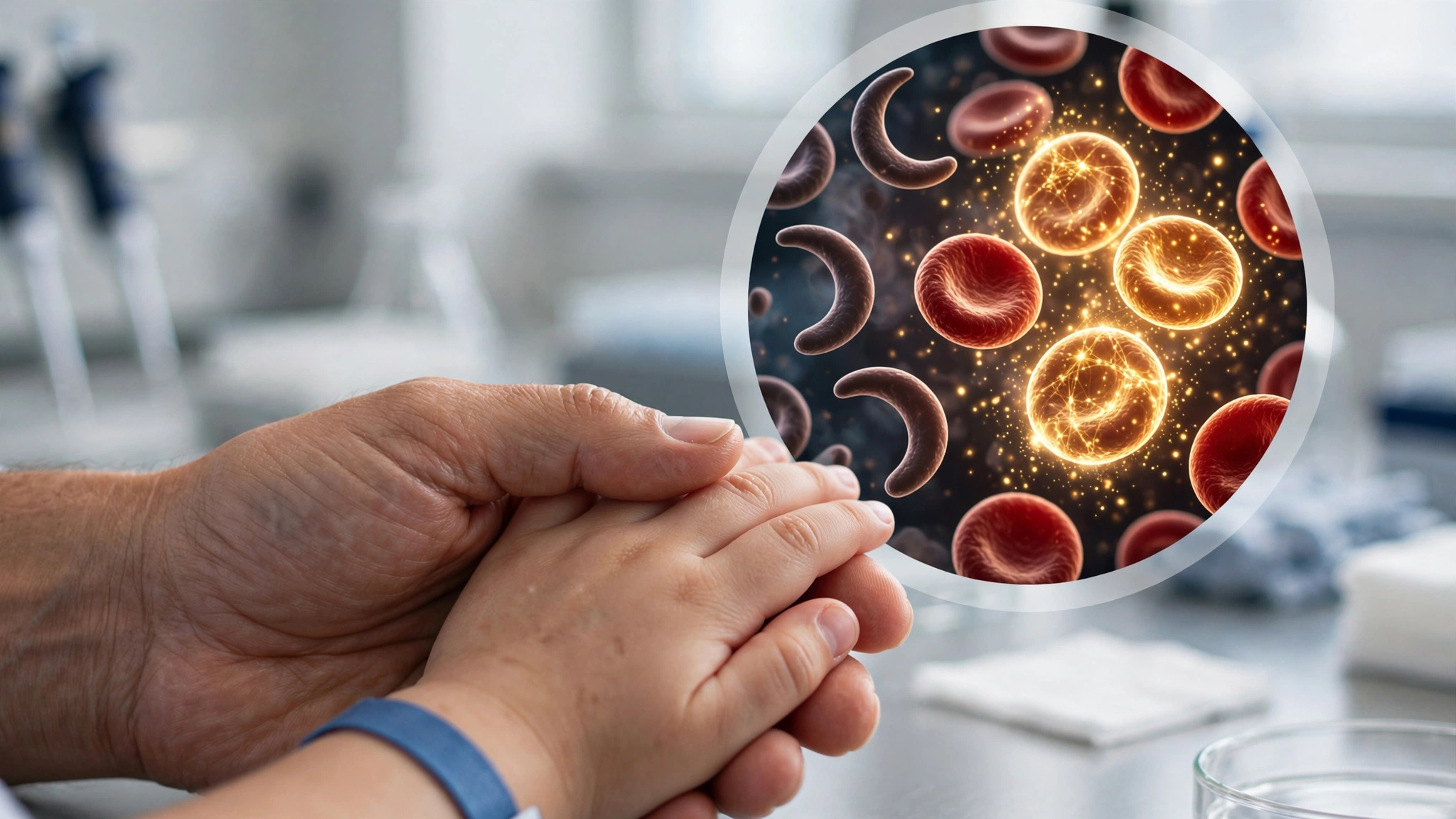
Eight for eight. Every child with transfusion-dependent beta thalassemia who received exagamglogene autotemcel and reached sufficient follow-up achieved complete transfusion independence for 12 consecutive months, according to a New England Journal of Medicine study published June 29. Every child with sickle cell disease remained free from severe vaso-occlusive crises for 12 months. Youngest humans ever treated with CRISPR gene editing.
It worked. Then a child died.
Not from CRISPR. From busulfan, the myeloablative chemotherapy required before infusion, dosed once daily instead of every six hours. Cumulative drug exposure hit an area-under-the-curve of 93.5 mg·hr/L, overshooting the target range of 74 to 90. Study day 132: multiorgan failure, pneumonia, death. Investigators amended the protocol to restrict busulfan to every-six-hour dosing exclusively, and no other children experienced graft failure, malignancy, or any event linked to the gene-editing component itself.
Exa-cel has been FDA-approved as Casgevy since December 2023 for sickle cell disease and January 2024 for beta thalassemia in patients 12 and older. Two phase 3 trials (CLIMB THAL-141 and CLIMB SCD-151) enrolled 26 children across eight sites in Canada, Germany, Italy, the UK, and the US to answer a harder question: should younger children wait, or does treating earlier justify the risk?
What 16 Children Showed
Fifteen children had beta thalassemia, 11 had sickle cell disease, and median follow-up ran 16.0 and 16.9 months respectively across a cohort that produced uniformly remarkable results in every evaluable patient: 8/8 beta thalassemia patients achieved transfusion freedom, 8/8 sickle cell patients remained crisis-free, fetal hemoglobin exceeded 45% in sickle cell children (well above the roughly 30% protective threshold), and allelic editing efficiency held above 60% in peripheral blood from month three onward, reaching 77 to 85% in bone marrow. Perfect, but small.
Pivotal trials in ages 12 to 35 showed 91% transfusion independence for beta thalassemia and 97% crisis freedom for sickle cell disease across larger cohorts, and with only eight evaluable patients per disease in the pediatric study, the 95% confidence interval for that 100% rate spans all the way from 63 to 100%, which means the true efficacy could plausibly sit at two-thirds and nobody would know from this sample alone. Not yet proof that younger children do better. Proof they can do as well.
An Original Break-Even Calculation
Nobody has published this math. Treating a sickle cell child at age 7 instead of 12 avoids five extra years of disease: approximately 16 severe crises (at 3.2 per year), 13.5 hospitalizations, and $336,410 in direct costs based on $67,282 annual spending that NIH-funded research in Blood Advances found for commercially insured patients with recurrent crises, whose lifetime insurer costs average $1.7 million. But that number dramatically understates true savings, because it ignores what the disease quietly does to organs during those five years and what repairing that damage costs decades later.
Silent cerebral infarcts hit 4.6% of sickle cell children annually, each crisis compounds glomerular hyperfiltration toward chronic kidney disease by the twenties, and beta thalassemia patients on transfusions accumulate 5 to 7 mg/kg/year of cardiac iron loading when chelation compliance falters, which in children it almost invariably does, meaning these invisible injuries surface as $200,000 to $500,000 ICU stays decades later. At $2.2 million per patient, exa-cel still looks cheap: sickle cell patients with recurrent crises who survive to age 50 accumulate $3.8 million in healthcare costs, beta thalassemia runs $5 to $5.7 million lifetime, and the cure pays for itself by age 30 with decades of avoided costs ahead.
Against this: a 6.7% procedure-related mortality rate (1/15 in beta thalassemia), confounded by a dosing error since corrected.
Why Parents Face an Impossible Choice
A 6.7% mortality rate exceeds the annualized death rate for well-managed beta thalassemia, but the comparison misleads in both directions: one death resulted from a fixable protocol error, and the relevant benchmark is not any single year’s risk but cumulative mortality over a lifetime in which patients on conventional therapy face roughly 4.8 deaths per 100 person-years with substantially shortened life expectancy even under modern chelation.
Compare with the alternative cure: allogeneic stem cell transplant carries 5 to 10% mortality with a matched sibling donor, 10 to 20% haploidentical, plus 15 to 30% graft-versus-host disease risk. Only 20% of sickle cell patients have a matched sibling. Exa-cel uses the patient’s own cells, eliminating rejection and graft-versus-host disease entirely.
Nine Centers for 100,000 Patients
Infrastructure is the real bottleneck. Only three HCA Healthcare facilities offer exa-cel or are preparing to, while about 100,000 Americans have sickle cell disease, another 5,000 to 10,000 have transfusion-dependent beta thalassemia, and expanding eligibility to ages 5 through 11 would add an estimated 3,000 to 5,000 patients domestically against a treatment capacity that Netherlands regulators, for their own population, estimate at roughly seven patients per year. Globally, the mismatch is grotesque: sickle cell affects 20 million people, concentrated in sub-Saharan Africa, India, and the Middle East, and Nigeria alone sees 150,000 sickle cell births annually. $2.2 million per treatment, a miracle priced for rich countries only.
Limitations
Single-arm, open-label, no comparator group, only 16 evaluable patients across two diseases, followed a median 16 months with cure durability beyond three years entirely unknown. Cost math uses US pricing and insurer claims, inapplicable to 95% of patients in low- and middle-income countries. Mortality calculation confounded by a correctable protocol error. No comparison with newer haploidentical HSCT approaches exists.
Strongest Counterargument
Myeloablative busulfan conditioning is an extreme intervention for a five-year-old, one that requires destroying a child’s bone marrow to cure a disease that, in well-managed cases, is survivable with transfusions and hydroxyurea for decades. One child died because the bridge to the cure is itself dangerous, and the corrected dosing protocol has not been validated at scale. For a family whose child is clinically stable, waiting for larger safety data on the amended regimen may be the more rational bet than volunteering to help generate it.
Bottom Line
CRISPR works in the youngest children ever treated, matching or exceeding adult results. Science is not the constraint anymore. A conditioning regimen killed a child when dosed incorrectly, treatment infrastructure serves dozens against a need in hundreds of thousands, and pricing walls off the populations most devastated by these diseases. For any individual who can access and survive the procedure, break-even math overwhelmingly favors treatment. Systemically, $2.2 million cures competing for healthcare dollars against $50 childhood vaccines remain an unresolved moral equation.
What You Can Do
Parents of children with SCD or beta thalassemia: ask your hematologist about exa-cel eligibility and whether trials CLIMB THAL-141 and CLIMB SCD-151 are enrolling at your center, and start now because authorization and manufacturing take months before infusion.
Health policy professionals: ICER analyses peg exa-cel at roughly $16,800 per quality-adjusted life year, far below standard $100,000 to $150,000 coverage thresholds, meaning the barrier is infrastructure capacity and upfront budget impact, not value.
Following the science: watch for amended busulfan protocol data, because correcting from once-daily to every-six-hour dosing is the single most important variable in moving these results from promising to practice-changing, and until a larger cohort validates the safety of corrected conditioning in this age group, read 100% efficacy alongside 6.7% mortality, even if the latter reflects a fixable error.