Ford and GM Wrote Down $27 Billion on EVs. Now They're Converting Those Factories to Chase Tesla's Most Profitable Business.
Ford's $19.5 billion EV impairment and GM's $7.6 billion write-down left Detroit with idle battery plants and broken balance sheets. Both companies are now repurposing those factories for grid-scale energy storage, a market where Tesla already earns 30% gross margins, twice what it makes selling cars. An original analysis of the cost per gigawatt-hour of capacity, the revenue gap, and the arithmetic of catching a competitor with a ten-year head start and a customer who spent $1 billion on batteries in 30 months.
$27.1 billion. That is the combined sum Ford Motor Company and General Motors erased from their balance sheets in late 2025 after their electric vehicle ambitions collided with a market that did not want what they were selling. Ford's write-down alone, at $19.5 billion, ranked among the largest corporate impairments in American industrial history: $8.5 billion for canceled EV projects, $6 billion for a dissolved battery joint venture with SK On, and $5 billion for the organizational wreckage of pivoting a $56 billion multinational away from a strategy it had pursued for four years. In 2024, Ford lost $44,000 on every F-150 Lightning that rolled off the line. GM's $7.6 billion hit was quieter but no less definitive, representing the cost of an electrification strategy that never achieved the scale its planners had promised.
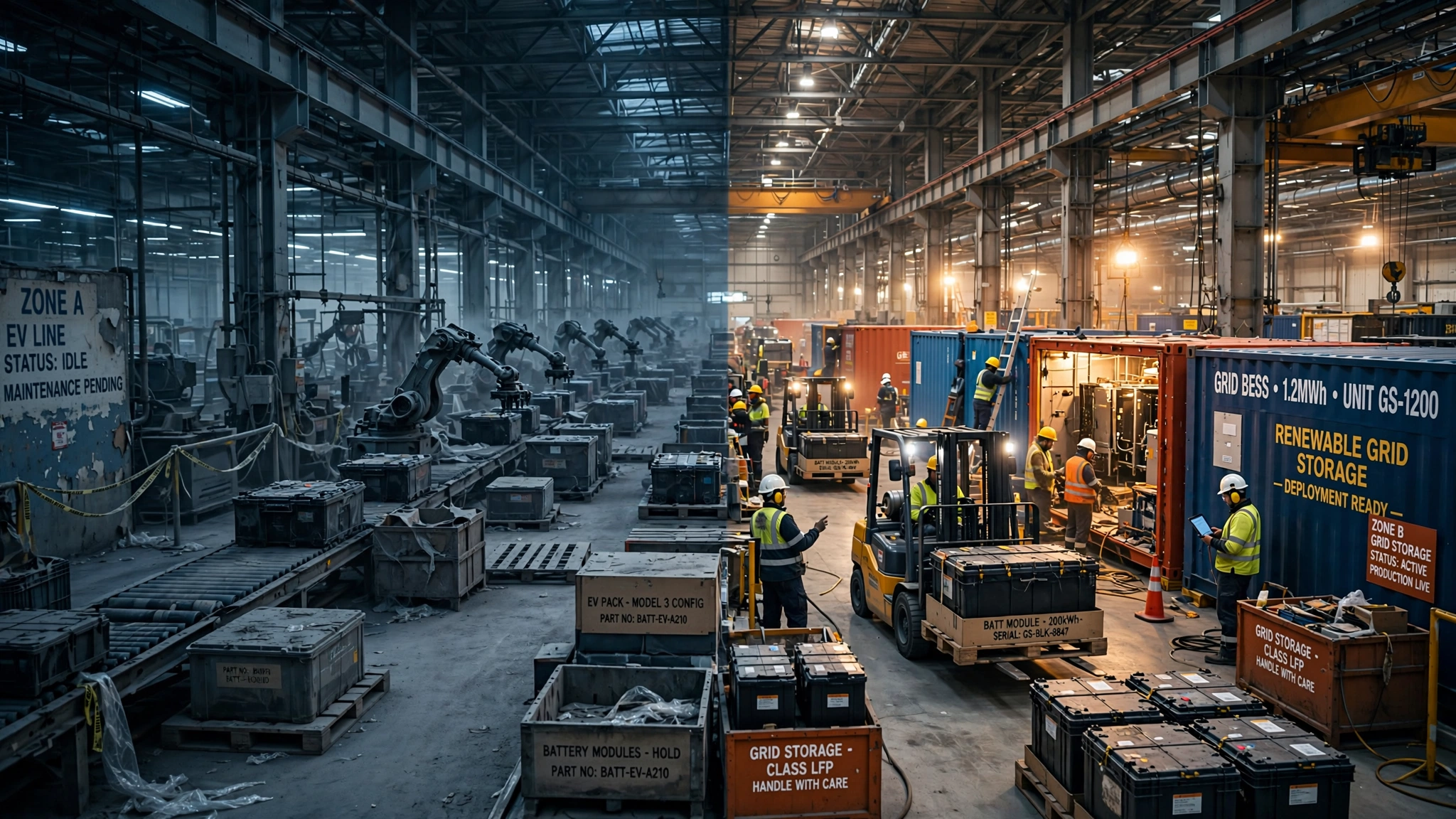
Both companies are now doing something counterintuitive with the factories those write-downs left behind. They are filling them with batteries again, not for cars people weren't buying, but for electrical grids that cannot get enough power storage fast enough. Ford launched Ford Energy, a wholly owned subsidiary repurposing its Glendale, Kentucky, plant to assemble battery energy storage systems (BESS) targeting utilities, data centers, and industrial customers. GM is retooling its Nashville Ultium Cells plant, a $2.3 billion joint venture with LG Energy Solution, for the same purpose. Detroit is betting that the infrastructure of its most expensive failure can become the foundation of its next business.
There is just one problem. The company they are chasing started a decade ago, already earns twice the margin on grid batteries that it does on automobiles, and recently collected $1 billion from a single customer for its flagship storage product.
Tesla's Accidental Empire
When Tesla launched its energy storage division around 2015, the initiative registered as a curiosity. An electric car company making grid batteries felt like a distraction. Ten years later, it is arguably Tesla's best business by margin, and it is growing faster than anything else the company sells.
In 2025, Tesla deployed a record 46.7 gigawatt-hours of energy storage products, a 48% increase over 2024, generating $12.8 billion in revenue. That revenue represents 13% of Tesla's total, but it punches far above its weight in profitability. Tesla's energy storage gross margin sits at roughly 30%, nearly double the 15% the company earns selling cars and trucks. In dollar terms, batteries and solar installations now drive nearly a quarter of Tesla's total gross profit.
Run the division math, and the numbers get uncomfortable for Detroit. Tesla earned $12.8 billion on 46.7 GWh of deployments, which works out to $274 million in revenue per gigawatt-hour deployed. At 30% margins, each gigawatt-hour generates roughly $82 million in gross profit. Those margins come from selling Megapacks, utility-scale battery systems that ship in standardized containers to power companies, data centers, and grid operators who need reliable, dispatchable power that doesn't burn gas.
The demand signal is not subtle. Elon Musk's own AI company, xAI, has purchased roughly $1 billion in Tesla Megapacks since 2024, according to SpaceX's amended S-1 IPO filing. In April 2026 alone, xAI spent $269 million on Megapacks, more than it spent in all of 2024. When a single buyer's monthly battery tab exceeds what most energy startups raise in a Series B, the market has a demand problem, not a demand question.
What $2 Billion Buys in Kentucky
Ford's pitch to investors is straightforward: the factory exists, the technology is licensed, and the customers are asking. Ford Energy is investing $2 billion to convert the Glendale, Kentucky, facility into a BESS assembly plant producing lithium iron phosphate (LFP) battery systems using technology licensed from CATL, the Chinese manufacturer that dominates global battery production. The flagship product, the Ford Energy DC Block, packs 5.45 megawatt-hours into a shipping-container-sized unit designed to compete directly with Tesla's Megapack.
Ford has already signed a framework agreement with EDF Power Solutions for up to 20 GWh of storage over five years. Initial LFP cell production at its Marshall, Michigan, plant began in June 2026, with commercial-scale production on track for year-end. Lisa Drake, a veteran of Ford's EV programs, is leading the subsidiary. Ford targets 20 GWh in annual deployments by late 2027.
Now consider the arithmetic. If Ford achieves its 20 GWh annual target and commands revenue per gigawatt-hour comparable to Tesla's, the business would generate approximately $5.5 billion per year in revenue. At Tesla-like 30% margins, that translates to $1.65 billion in annual gross profit. The $2 billion capital investment pays back in about 14 months. Morgan Stanley analyst Andrew Percoco wrote in May that Ford's CATL relationship "is an underappreciated strategic competitive advantage," and when Ford disclosed its BESS plans, the stock surged 13% in a single day, its largest gain in six years.
The $19.5 billion write-down is a different conversation entirely. That money is sunk. It bought factories, tooling, battery lines, and engineering for cars that customers turned away. The pivot does not recover the write-down; it repurposes what the write-down left behind. If you divide that $19.5 billion by the projected annual gross profit of the storage business, the write-down would take roughly 12 years of maximum-rate energy storage profits to offset. Ford is not recovering from a mistake so much as extracting value from its wreckage.
GM's Sodium Gamble
General Motors is taking a riskier path. While Ford licensed proven LFP technology from the global market leader, GM chose sodium. The company announced a partnership with Peak Energy, a sodium-ion battery startup, to develop grid-scale storage at its R&D center in Warren, Michigan. Separately, GM is spending $70 million to retool its Nashville Ultium Cells plant, converting it from EV battery production to LFP-based storage cells through its existing partnership with LG Energy Solution.
The sodium bet is the one that spooked investors. GM stock dropped more than 5% the day after the announcement. Sodium-ion batteries use sodium, an element roughly 1,000 times more abundant in Earth's crust than lithium, and they avoid cobalt and nickel entirely. CATL, which has been developing sodium-ion technology since 2016, signed a landmark 60 GWh deal with Beijing HyperStrong Technology in April 2026 and plans to deliver its first commercial sodium-ion energy storage systems in September. The technology promises 15,000-plus charge cycles at 80% capacity retention and an operating range from -40°C to 70°C. Precedence Research projects the global sodium-ion battery market will grow from $1.39 billion in 2025 to $7.81 billion by 2035.
Kurt Kelty, GM's battery chief and a former Tesla executive, framed the strategy in chemistry terms: "The future of batteries will be defined by matching the right chemistry to the right job." Peak Energy has signed a separate $500 million agreement with Jupiter Power to supply up to 4.75 GWh of sodium-ion storage by 2030. But GM has disclosed no standalone revenue targets, no deployment capacity goals, and no timeline for customer deliveries. Its GM Energy division does not publish separate financial results. Investors were left to weigh a promising chemistry against an absence of concrete commercial commitments, and they sold.
The Competitive Gap Nobody Talks About
Ford plans to ship its first BESS units in late 2027. GM's timeline is even vaguer, with estimates pointing to 2027 or 2028. Tesla launched its energy storage business around 2015. That is a 12-to-13-year head start, and the gap is not purely chronological.
| Metric | Tesla Energy | Ford Energy | GM Energy |
|---|---|---|---|
| First storage product | ~2015 | Late 2027 | 2027–28 |
| 2025 revenue | $12.8B | $0 | Not disclosed |
| Gross margin | ~30% | TBD | TBD |
| 2025 deployments (GWh) | 46.7 | 0 | ~0 |
| Pivot investment | Organic over decade | $2B | $70M (retool) |
| Annual capacity target | ~50 GWh (Houston) | 20 GWh | Not disclosed |
| Cell chemistry | NMC / LFP | LFP (CATL license) | LFP + Sodium-ion |
Will Rhind, CEO of GraniteShares, put the gap in blunt terms: by the time Ford and GM begin shipping, Tesla will be "two product generations ahead." The Megapack 3 and a new product called Megablock are already ramping at Tesla's Houston Megafactory, which has capacity for up to 50 GWh of annual production. "The real moat is not the battery box," Rhind told Investor's Business Daily. "It is the software layer, the grid integration, and a decade of deployment experience that legacy automakers are starting from zero on."
And Tesla is not the only formidable competitor Detroit faces. BYD, the Chinese automaker that overtook Tesla as the world's top EV seller in 2025, deployed 60 GWh of energy storage in 2026, surpassing Tesla to become the world's largest BESS business. BYD has operated an energy storage division since 2008. It has 18 years of institutional knowledge in a market Ford has operated in for zero.
The Market Is Growing Faster Than Anyone Can Fill It
The saving grace for Detroit is that the market itself is exploding. Global BESS installations reached 315 GWh in 2025, a 51% increase over 2024, according to Benchmark Mineral Intelligence. Grid-scale projects drove the bulk of it, with 46 giga-scale installations entering operation compared with 17 the year before. Benchmark forecasts more than 450 GWh in new capacity for 2026, with 150-plus giga-scale projects in the pipeline. The total BESS market hit $76.7 billion in revenue in 2025, and Mordor Intelligence projects it will reach $198.9 billion by 2031.
That growth is being driven by two overlapping forces. The first is the global buildout of renewable energy, which creates an inherent need for dispatchable storage to cover periods when solar panels sit in darkness and wind turbines stand still. China, the world's largest BESS market, installed more battery capacity in December 2025 alone than the entire United States deployed over the full year. The second force is artificial intelligence. AI data centers consume power at densities that make traditional grid infrastructure physically inadequate, and battery storage systems provide the bridge between what the grid can deliver and what a 100-megawatt training cluster demands. MarketsandMarkets projects the data center battery market specifically will grow from $4.8 billion in 2026 to $10.2 billion by 2032.
At the current growth rate, even if Ford and GM achieve their stated capacity targets on time, they will collectively add about 20 to 25 GWh to a market deploying 450-plus GWh annually. Detroit would capture roughly 5% of global installations. That is meaningful revenue but hardly market-defining dominance.
Limitations
This analysis uses Tesla's revenue-per-GWh as a benchmark for Ford and GM's potential revenue, but that comparison has structural flaws worth stating plainly. Tesla's $274 million per GWh figure blends utility-scale Megapack sales (which carry premium pricing) with residential Powerwall units, which have different economics entirely. Ford is targeting only the utility-scale segment with its DC Block product, so its revenue per GWh could diverge significantly in either direction. Additionally, BYD's margins on energy storage are not publicly reported and could be substantially lower if BYD is pursuing market share over profitability, which would compress margins industry-wide as competition intensifies. GM's sodium-ion path depends on a chemistry that is commercially unproven at grid scale, meaning the cost, performance, and customer acceptance data that would validate the strategy simply does not exist yet. CATL's licensing terms with Ford remain confidential, so the actual cost structure of Ford's LFP cells is unknown. Finally, 35% U.S. tariffs on Chinese-made cathode and anode materials affect all domestic battery producers and could alter the economics of every player in this comparison.
The Strongest Case for Detroit
The comparison to Tesla's head start, while accurate, misses the structural argument in Ford's favor. The write-down is irrelevant to forward economics because that $19.5 billion is gone whether Ford builds storage systems or converts the Kentucky plant into a museum. What matters is the $2 billion forward investment and its expected return. By that measure, Ford's pivot looks genuinely shrewd. For $2 billion, Ford enters a market growing at 50% annually, armed with proven CATL cell technology, existing factory infrastructure that cost billions to build but now carries near-zero book value, a confirmed anchor customer in EDF Power Solutions, and the manufacturing expertise that comes from building millions of complex machines per year for over a century. CATL's LFP technology may be better suited for stationary grid storage, where energy density matters less than cycle life and thermal stability, than anything Tesla currently manufactures in-house. Tesla's software and integration advantages are real, but they may matter less in a market where the product is a commodity container of cells, an inverter, and a grid interconnection agreement.
What You Can Do
If you manage energy procurement for a utility, data center, or large commercial facility, the entry of Ford and GM means credible second and third suppliers are arriving by late 2027, which gives you leverage on pricing in Tesla and BYD negotiations starting now. If you hold positions in any of these companies, the relevant metric is not whether Detroit "catches" Tesla but whether the BESS market is large enough for multiple profitable players at 50% annual growth. Current projections say yes. If you work in a plant that is being converted, the skills involved in assembling LFP prismatic cells for grid storage overlap substantially with EV battery assembly. Retooling is real, but the career transition is less dramatic than "factory closes," which is the headline Ford avoided by pivoting rather than liquidating. And if you are evaluating sodium-ion, wait for CATL's September 2026 commercial shipments before committing capital to an unproven chemistry at grid scale, regardless of how abundant sodium is in Earth's crust. Abundance is a supply argument. Commercial viability is a manufacturing argument. They are not the same thing.
The Bottom Line
Detroit's pivot from failed EV factories to grid-scale energy storage is not a redemption story. It is a salvage operation. Ford and GM burned a combined $27.1 billion learning that consumers did not want their electric vehicles at the prices and volumes both companies had planned for, and they are now spending a comparatively modest $2 billion-plus to redirect the surviving infrastructure toward a market that is genuinely starved for capacity. The economics of that forward investment are strong. But the competitive reality is brutal: Tesla has been building this business for a decade and already earns 30% margins, BYD deployed more storage in 2026 than Ford plans to build by 2028, and the software, integration, and customer relationships that define grid storage competitiveness take years to develop regardless of how many factories you own. Detroit has factories. It needs everything else.