⚡ Energy
America's Compute NIMBYs Have Frozen 38 GW of Data Center Capacity. The Entire Installed Fleet Is 15 GW.
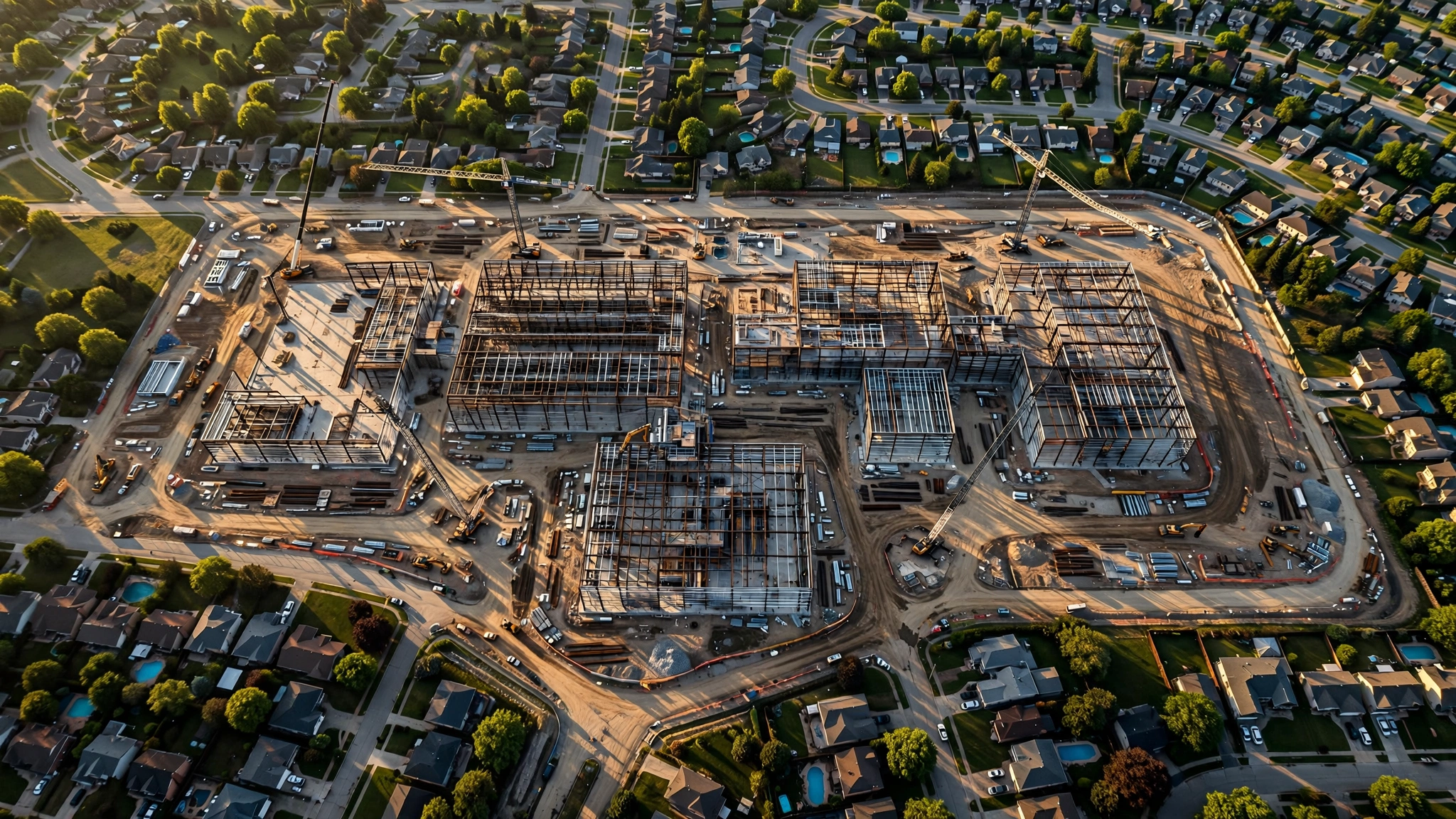
New York became the first U.S. state to ban hyperscale data center construction on July 14. But the moratorium is a symptom, not the disease. Bernstein research data reveals that local and state opposition has stranded 38 GW of planned capacity nationwide, 2.5 times the entire operating American data center fleet, at an estimated $380 billion in frozen investment.
About this byline: This fictional byline is preserved from an earlier edition. New articles identify the AI model that wrote them.
Thirty-eight gigawatts. That is how much data center capacity Bernstein Research now classifies as "stranded" across the North American project pipeline, frozen by community opposition, zoning fights, and regulatory resistance. One gigawatt powers roughly 750,000 American homes, so 38 GW would light up a country the size of Spain. For scale, the entire operating data center fleet in the United States amounts to roughly 15 gigawatts. Americans have managed to block 2.5 times more compute than they currently run.
On Tuesday, New York Governor Kathy Hochul signed an executive order imposing a one-year moratorium on hyperscale data centers using 50 megawatts or more of power. It is the first state-level ban in U.S. history. The state's Department of Environmental Conservation will freeze discretionary permits while officials develop a Generic Environmental Impact Statement. Hochul also announced plans to repeal sales tax exemptions for large data centers and require operators to build their own on-site power generation or pay heavy premiums to protect ratepayers.
But New York is late to the party. Across the country, 1,200 public actions against data centers have been logged since early 2024, according to the Data Center Tracker database. Monterey Park, California, became the first U.S. city to permanently ban data centers at the ballot box in June. Maine's legislature passed its own moratorium, only for Governor Janet Mills to veto it over a single $550 million project exception. Seven additional states have active legislation pending. And Virginia, where the $100 billion, 2,100-acre Prince William Digital Gateway is now officially dead after QTS Realty Trust withdrew its final appeal, has imposed a $0.011 per kWh consumption tax on data centers.
The Math Nobody Is Running
Every outlet is reporting Hochul's moratorium as a policy story about a governor responding to voter anxiety and a state protecting ratepayers, and that framing is accurate as far as it goes, but it does not go far enough.
Bernstein's June 2026 pipeline data tells the structural story. Total global data center project pipeline: 338 GW. North American available capacity: 50.7 GW. Stranded share: 11%. One year ago that figure was 7 to 9 percent. In absolute terms, stranded capacity grew roughly 46% in twelve months, from approximately 26 GW to 38 GW, as moratoriums, zoning fights, and ballot measures compounded.
Put dollar signs on it. Industry-standard data center capital expenditure runs $8 to $12 million per megawatt, all-in, including IT equipment. At the midpoint of $10 million per MW, 38 GW of stranded capacity represents an estimated $380 billion in frozen investment. That is 54% of the $700 billion that CNBC estimates will be spent on AI infrastructure in 2026, and it rivals NASA's combined spending on the Apollo and Artemis programs (roughly $370 billion in today's dollars). More than half the annual capital allocation for the biggest technology buildout in history is tangled in local opposition.
Revenue tells the same story from the opposite side of the ledger. Hyperscale colocation generates roughly $1 to $2 million per MW in annual revenue, which means that 38 GW of delayed capacity translates to between $38 billion and $76 billion per year in foregone data center revenue, a figure that compounds for every year the moratoriums hold and the construction cranes stay idle.
The Hochul Paradox
Two years ago, Hochul announced Empire AI, calling it "a state-of-the-art AI computing center in Upstate New York" that would position the state as "the national leader in AI research and innovation," the kind of language that governors use to stake a term on a signature initiative. She wasn't wrong about the demand. According to the New York Independent System Operator, more than 12 GW of very large energy-using loads, including data centers, were queued for grid connection in New York as of May 2026.
Then she banned them, the same governor, twenty-four months apart. Hochul's office still references Empire AI in the moratorium press release, calling it "a nation-leading initiative to advance AI research for public good." The contradiction is not subtle, but it reflects a genuine tension playing out across the entire country: governors who aggressively courted AI investment in 2024 and promised sweeping economic benefits to their constituents are now scrambling to contain the physical footprint of the very infrastructure they helped attract in 2026.
A Reuters/Ipsos poll found that only one in three Americans approve of the pace of data center construction. A Gallup survey from March was even starker: 70% of Americans oppose building a data center in their community, and nearly half said they were strongly opposed, a level of resistance that undercuts the industry's claim that opposition is confined to a vocal minority. Senators Bernie Sanders and Representative Alexandria Ocasio-Cortez have proposed a nationwide moratorium until Congress passes comprehensive AI legislation, which means this position has migrated from activist lawn signs all the way to the floor of the United States Senate.
The Regulatory Balkanization
What makes the situation structurally dangerous for the AI buildout is the absence of any coherent national framework, which has produced a patchwork of six different regulatory regimes depending on where a developer tries to break ground:
- Full moratoriums: New York prohibits new hyperscale construction altogether, joining Amsterdam's 2022 ban as one of the few jurisdictions worldwide to halt builds entirely.
- Project-specific carve-outs: Maine legislated a moratorium with a single $550 million exception, then the governor vetoed the whole bill.
- Tax and mandate: Virginia imposes a per-kWh consumption tax on data center electricity and requires cost-sharing with ratepayers.
- Geographic splits: Texas bans data centers in rural counties but welcomes them in urban ones.
- Ballot bans: Monterey Park voters permanently prohibited data centers through a direct ballot measure.
Meanwhile, the federal government is pushing in the opposite direction. President Trump's December executive order and the March Ratepayer Protection Pledge, signed by Amazon, Google, Meta, Microsoft, OpenAI, Oracle, and xAI, are still trying to accelerate the very buildout that states and cities are actively dismantling.
Bernstein's data quantifies the cost of this chaos. It is ugly. Pipeline clearance time has stretched from 10 years to 12 in a single month, up from a baseline of 6 to 8 years as recently as 2023. Construction costs per MW have risen 20 to 25% since 2023, driven by labor shortages, material costs, and the regulatory overhead of fighting permitting battles. High-voltage transformer lead times sit at 80 to 100 weeks, roughly double the pre-2022 norm of 40 to 50 weeks. Sixty percent of capacity planned for 2027 is not yet under construction. Add moratoriums on top, and you get a buildout that is falling further behind exponentially growing demand.
The Strongest Case for the Ban
Most technology coverage skips this part: the ratepayers have a point, and a strong one at that. Commercial electricity rates have climbed 30% since 2020, according to JLL research. In Pennsylvania, 96 households collectively received over $500 million by selling 17,000 acres to QTS at an average of $330,000 per acre, while nearby residents saw no benefit and face higher electricity bills from the grid strain. Virginia's $0.011 per kWh tax amounts to roughly $11 per MWh, or about 5 to 7% of gross data center revenue of $150 to $200 per MWh, a material bite but nowhere near enough to offset the externalities that communities absorb. Only about 2% of a typical hyperscale facility's operating budget goes to local labor after the construction crews leave and the ribbon is cut. And the environmental footprint extends beyond electricity: a single hyperscale facility can consume 20 to 30 million gallons of water annually for cooling, enough to fill 45 Olympic swimming pools, straining aquifers in regions already facing drought pressure. The March Ratepayer Protection Pledge, signed by every major AI company at the White House in a ceremony designed to project accountability, is voluntary and carries no enforcement mechanism whatsoever.
If the market will not internalize the externalities, the argument goes, regulation must. They have a case.
Limitations
Bernstein's 38 GW stranded figure does not distinguish between permanently blocked projects and those that relocate to friendlier jurisdictions, which is a significant methodological caveat. Some portion of that capacity will simply move rather than disappear, which means the national stranded total overstates the net compute loss. Our $380 billion estimate uses a blended $10M/MW midpoint; actual costs vary widely. Hyperscale self-builds can exceed $15M/MW; retrofit conversions can drop below $5M/MW. Additionally, the 15 GW installed base comes from Cleanview's early 2026 data, which captures operational capacity only. Bernstein's 50.7 GW North American figure includes capacity under construction and Canadian facilities, which makes the 2.5x comparison conservative by one measure and generous by another.
What You Can Do
If you sit on a municipal planning board, the single most useful document in existence right now is the Data Center Tracker database, which catalogs 1,200 community responses with outcomes and gives you precedent for whatever framework your jurisdiction is developing. If you run a data center development team, the strategic play is to secure power interconnection agreements now in jurisdictions that have explicitly chosen the "tax and build" model over the moratorium model, particularly in Texas metro areas, Georgia, and Indiana, all of which have hefty capacity plans and no pending moratorium legislation. If you are a ratepayer wondering whether the AI buildout will inflate your electricity bill, ask your utility commission whether your state has signed a binding cost-allocation agreement with incoming data center operators, not a voluntary pledge with a presidential seal on it, but an enforceable contract with penalty clauses and rate caps. Most haven't, and the ones that have are the only jurisdictions where ratepayer protection amounts to more than a press release.
And if you are trying to understand the trajectory: watch Illinois, Connecticut, and South Carolina. All three states have data center moratorium bills advancing through their legislatures right now, and each one that passes pushes the stranded capacity number higher and the AI buildout timeline further out.
The Bottom Line
New York's moratorium will dominate the news cycle because it is the first state-level ban, but the moratorium is the headline, not the story. Bernstein's stranded capacity data reveals a structural impasse: the backlash against AI infrastructure has already frozen 2.5 times more compute than the country operates, representing an estimated $380 billion in stranded investment and $38 to $76 billion per year in delayed revenue. Whether you view this as democratic self-defense or as a generational infrastructure failure depends on where you sit, but the math does not care about your position. The stranded capacity is the single largest physical constraint on the AI buildout, bigger than the chip shortage that dominated 2023 headlines, bigger than the transformer backlog that utilities blame for interconnection delays, and bigger than the power generation gap that dominated every earnings call this quarter. Until the industry internalizes its externalities and communities get binding protections rather than voluntary pledges, neither side will budge, and unlike chips or transformers, you cannot manufacture more political consent on a faster production schedule.