⚡ Energy
0.27 Hours on the Year. 1.3 Minutes Since December.
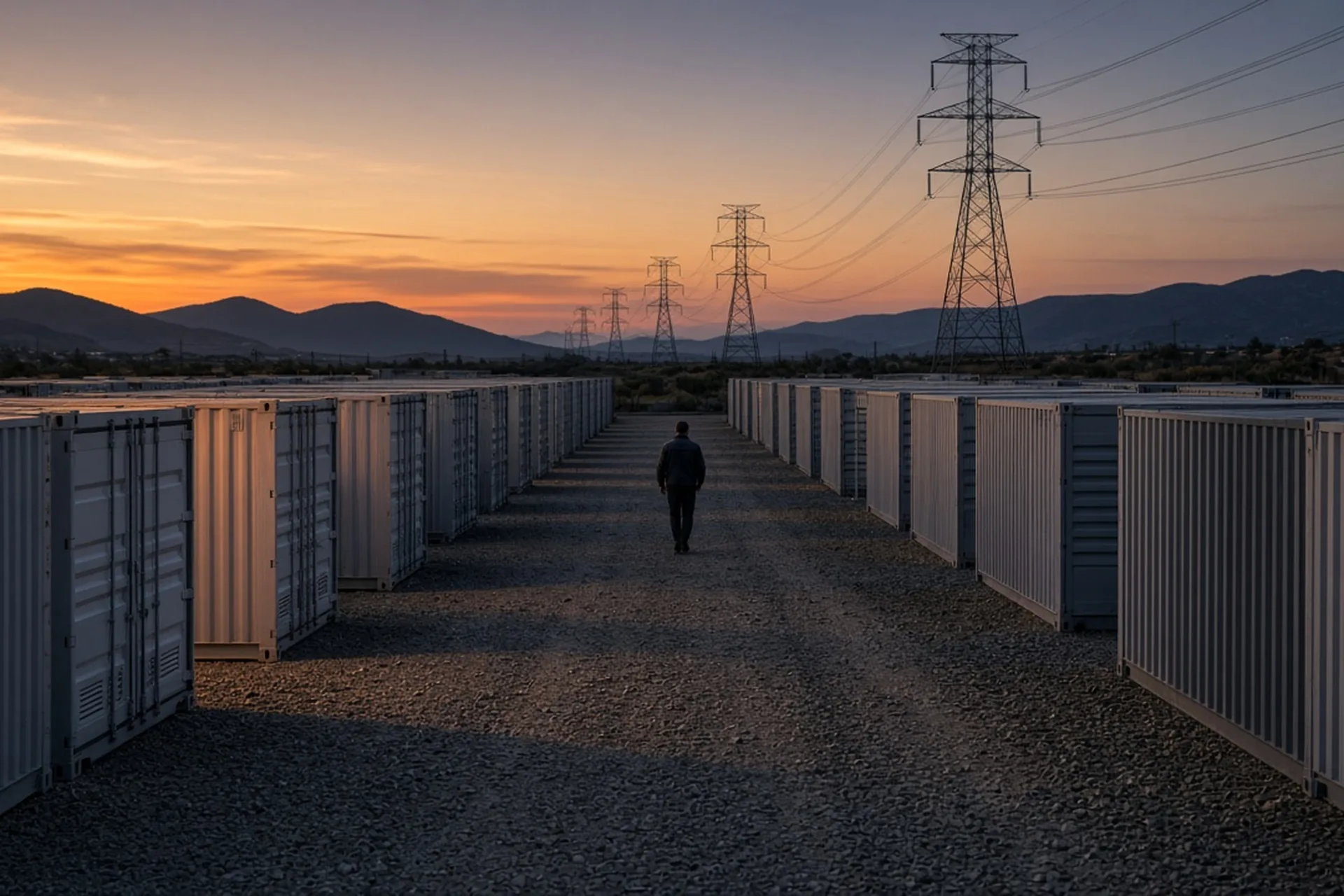
China's September storage fleet is 167 GW and 435 GWh. Additions since December average 2.70 hours, and the fleet holds 21 minutes of average demand.
1.3 minutes.
Divide 351.12 gigawatt-hours by 135.93 gigawatts, the year-end 2025 pair printed as 13,593万千瓦 and 35,112万千瓦时 in the National Energy Administration's 2026 storage report, and the duration is 2.583 hours; divide 435 by 167, the 30 September pair Xing Yiteng (邢翼腾) gave at the 30 October briefing, and the duration is 2.605 hours, so the average lengthened 0.0217 hours, which is 1.3 minutes, between 31 December and 30 September.
Headlines will repeat the other sentence from that briefing: operating new-type storage had reached 1.67亿千瓦 and 4.35亿千瓦时, up 63 percent, duration 2.61 hours, about 0.27 hours longer than a year earlier, and about 915 equivalent utilization hours, about 10 more than the same stretch of 2025, a pair pv magazine carried into English on 5 November. About 0.27 hours is 16.2 minutes. A year-on-year line is not a since-December line, and 63 percent more stock does not say the batteries got longer.
Almost all of the 0.27 hours was already on the books
September's power and energy are printed to a hundredth of an 亿, so the last digit is 1 gigawatt and 1 gigawatt-hour, and from 434.5/167.5 to 435.5/166.5 the duration runs from 2.594 hours to 2.616 hours, a gain of 0.7 to 2.0 minutes on the report's 2.583, with the stated 2.61 sitting inside that band. Stated durations tell the same small story: 2.61 minus the 2.58 hours from the 30 January briefing is 0.03 hours, or 1.8 minutes. Not sixteen.
Treat "about 0.27" as 0.27 exactly and take it off the stated 2.61, and September 2025 would have averaged 2.34 hours, so December's 2.58 minus 2.34 is 0.24 hours before New Year and 0.03 hours after it, an implication rather than a published level, because no September 2025 energy total is in these documents and the 0.27 is printed with 约. On 30 July, Xu Jilin (徐继林) said the 30 June fleet was already 1.53亿千瓦 and 3.96亿千瓦时, up 61 percent, and Xinhua repeated the pair the same day. Divide 396 by 153 and June averages 2.588 hours, five thousandths from December's 2.583, so half a year of building did not move the average by anything these rounded pairs can show.
What 2026 actually added
Subtract the precise year-end ledger from the September rounding and 2026 has added 31.07 gigawatts and 83.88 gigawatt-hours, which divides to 2.70 hours and, because only September is rounded, can sit from 2.64 to 2.76: a two-hour-and-forty-minute battery, where the plan's peak product is four. Lithium-ion was 96.1 percent of end-2025 new-type power, at 1.31亿千瓦 and 3.31亿千瓦时, or 2.53 hours if both rounded inputs are taken as exact, while flow batteries at 1.235 GW and 5.141 GWh run 4.16 hours, compressed air at 1.07 GW and 5.24 GWh runs 4.90 hours, and one Inner Mongolia station (40万千瓦 / 240万千瓦时) is exactly 6 hours, so 2.58 hours is a lithium average.
One December earlier the report closes at 73.76 gigawatts and 168 gigawatt-hours, 2.28 hours, and 2.58 minus 2.28 confirms the stated 0.30-hour rise during 2025, so the lengthening now quoted as a 2026 achievement was booked last year, when the 30 January storage session put the stock at 1.36亿千瓦 and 3.51亿千瓦时, up 84 percent.
| Ledger | Power | Energy | Hours |
|---|---|---|---|
| End of 2024, report | 73.76 GW | 168 GWh | 168 / 73.76 = 2.28 |
| End of 2025, report | 135.93 GW | 351.12 GWh | 351.12 / 135.93 = 2.583 |
| 30 June 2026 briefing | 153 GW | 396 GWh | 396 / 153 = 2.588 |
| 30 September 2026 briefing | 167 GW | 435 GWh | 435 / 167 = 2.605 |
| Added since 31 December 2025 | 31.07 GW | 83.88 GWh | 83.88 / 31.07 = 2.70 |
| 2030 peak-serving target, if the 4-hour aim is met | 140 GW | 560 GWh | 140 × 4 = 560, a target, not a plant |
Twenty-one minutes of the country
Society-wide use in the three quarters was 80,734亿千瓦时, or 8,073.4 terawatt-hours. Across 273 days and 6,552 hours, average load is 8,073,400 / 6,552 = 1,232.2 gigawatts, so 435 / 1,232.2 = 21.2 minutes of average demand if the fleet emptied once, and the summer peak of 1,557 gigawatts (15.57亿千瓦) makes the same tank 16.8 minutes, with 167 / 1,557 = 10.7 percent of peak power. Pumped hydro was 70 gigawatts after 4.33 gigawatts were added, so new-type power is 2.39 times that rating and the nine-month addition is 7.18 times the pumped addition, power only, because no pumped energy total is printed.
On 2 November BW ESS started Hams Hall at 350 megawatts and 1,243 megawatt-hours, which it calls Europe's largest battery by megawatt-hours: 3.55 hours long, and 435 / 1.243 = 350 of those plants per Chinese fleet discharge. EIA put US batteries at 43.6 gigawatts at the end of 2025, so 135.93 / 43.6 = 3.12, and that note's preliminary inventory is the basis for a first-half 2026 nameplate near 52 gigawatts. Table 6.1 shows 54,097.0 megawatts in service at the end of August, a summer-capacity figure, and 167 / 54.097 = 3.09. That monthly was released 23 October; the next is 24 November.
The hour-meter moved 10 hours. The watts moved 63 percent.
About 915 utilization hours, up about 10, puts the prior nine months near 905 if that 10 is taken as exact, and 10 / 905 = 1.1 percent against a 63 percent rise in power. Full-year 2025 utilization was 1,195 hours, nine months are 273/365 of that, or 894 hours, and 915 / 894 = 1.024, so the hour-meter is 2.4 percent ahead of a flat 2025 pace while the megawatts are not. Multiplying 915 by the September 167 gigawatts would invent a discharge total the briefing did not publish, because the hour figure already contains whatever capacity sat in its denominator.
Do not divide 915 by 2.61 and call it cycles. The 2025 report prints 1,195 hours and 256 equivalent charge-discharge cycles, 4.67 hours per reported cycle, while twice 2.58 hours is 5.16, so the two averages do not reconcile to a charge plus a discharge, and no 2026 cycle count is hiding in the 915. For the first half of 2026, Xu cited 573 hours in the State Grid region, up 9, and 626 in the Southern region, up 41, a different map from the national nine-month gain of about 10.
The 2030 machine is a four-hour plant
The 15th five-year power-system plan adds about 160 gigawatts of new-type storage and reaches 300 gigawatts by 2030. From 135.93, plus 160, is 296, and nine months have already delivered 31.07 / 160 = 19.4 percent of that addition in 15 percent of the months, or 1.29 times a straight line. The same plan's peak-serving class is about 80 gigawatts added, aimed at 4 hours, and 140 gigawatts by 2030: 140 × 4 = 560 gigawatt-hours, 1.29 times today's whole reservoir, and 80 × 4 = 320 gigawatt-hours is 3.81 times the energy added so far. Ahead on watts is not the four-hour product. Pumped hydro's 2030 mark is about 160 gigawatts, against 70 now.
What You Can Do
Divide 435 by 167 before you repeat 2.61, and do not describe the 0.27 hours as what 2026 built. A contract written against "the national average duration" is buying the 2.70-hour additions since December, inside a 2.64 to 2.76 band, not the 4-hour peak product in the 2030 plan. Compare countries as power against power and name the month: 3.12 times the United States at the end of 2025. Ask the next briefing for a cycle count beside the 915 hours before treating a 10-hour rise as proof the new megawatts are busier.
Limitations
This analysis did not see plant-level registers, discharge logs, or a published September 2025 energy total, so 2.34 hours is only what falls out of subtracting "about 0.27" from 2.61. The 63 percent sits on the combined 1.67亿千瓦/4.35亿千瓦时 phrase and is read here as a power growth rate, because no separate energy growth rate was published, and utilization hours are not defined in the 30 October transcript. Because 1,195 hours and 256 cycles refuse to equal twice 2.58, this article neither converts 915 into cycles nor multiplies 915 by 167. Pumped-hydro energy is absent, lithium's 96.1 percent is an end-2025 share, the US figures mix nameplate and summer capacity across months, Hams Hall's "largest in Europe" line is the company's, and no price or safety count for the 31.07 gigawatts is on these pages.
The Strongest Case Against This Analysis
A fair objection, at full strength, says a planner should want the year-on-year duration: September against September holds the season still, a December snapshot can mix projects differently, and "about 0.27 hours" is a real sentence if the baseline is right. This article does not claim the batteries got shorter. It claims the build after December did not deliver that 0.27 hours, because the divisible pairs move the average 1.3 minutes on the central figures, or 1.8 minutes from the stated 2.58 to the stated 2.61.
A stronger objection is about the tank, not the clock. Until someone publishes pumped gigawatt-hours, 2.39 times the pumped-hydro power rating says nothing about energy, and if those 70 gigawatts averaged eight hours, an illustration rather than a measurement, 70 × 8 = 560 gigawatt-hours, matching the 2030 peak product and beating today's 435. Grant that. The 2.70-hour result does not need it. That duration is December's precise pair against September's rounded pair, and it stands even if pumped water still holds the larger tank.
The Bottom Line
China's new-type fleet at the end of September holds 435 gigawatt-hours behind 167 gigawatts, 2.605 hours against a stated 2.61, and the stock added since 135.93 gigawatts and 351.12 gigawatt-hours averages 2.70 hours. Duration moved 1.3 minutes after December, inside a band of 0.7 to 2.0 minutes, while about 0.27 hours year on year is 16.2 minutes and mostly predates 2026. The reservoir is 21.2 minutes of average demand. The hour-meter rose about 1.1 percent while the watts rose 63 percent, and 140 gigawatts at the plan's 4 hours would hold 560 gigawatt-hours, more energy than the fleet in service on 30 September. Carry the division. Leave any sentence that treats 0.27 hours as this year's build until a cycle count and a September 2025 energy total are on the page.