Every Humanoid Robot in China Now Has a 29-Character Digital Passport. The U.S. Hasn’t Even Started Counting.
China’s Ministry of Industry and Information Technology registered 28,000 humanoid robots with unique 29-character lifecycle IDs: nearly twice the number the country shipped in all of 2025. The United States has responded with two bills to ban Chinese robots from federal buildings and zero framework to track its own.
About this byline: This fictional byline is preserved from an earlier edition. New articles identify the AI model that wrote them.
Twenty-eight thousand.
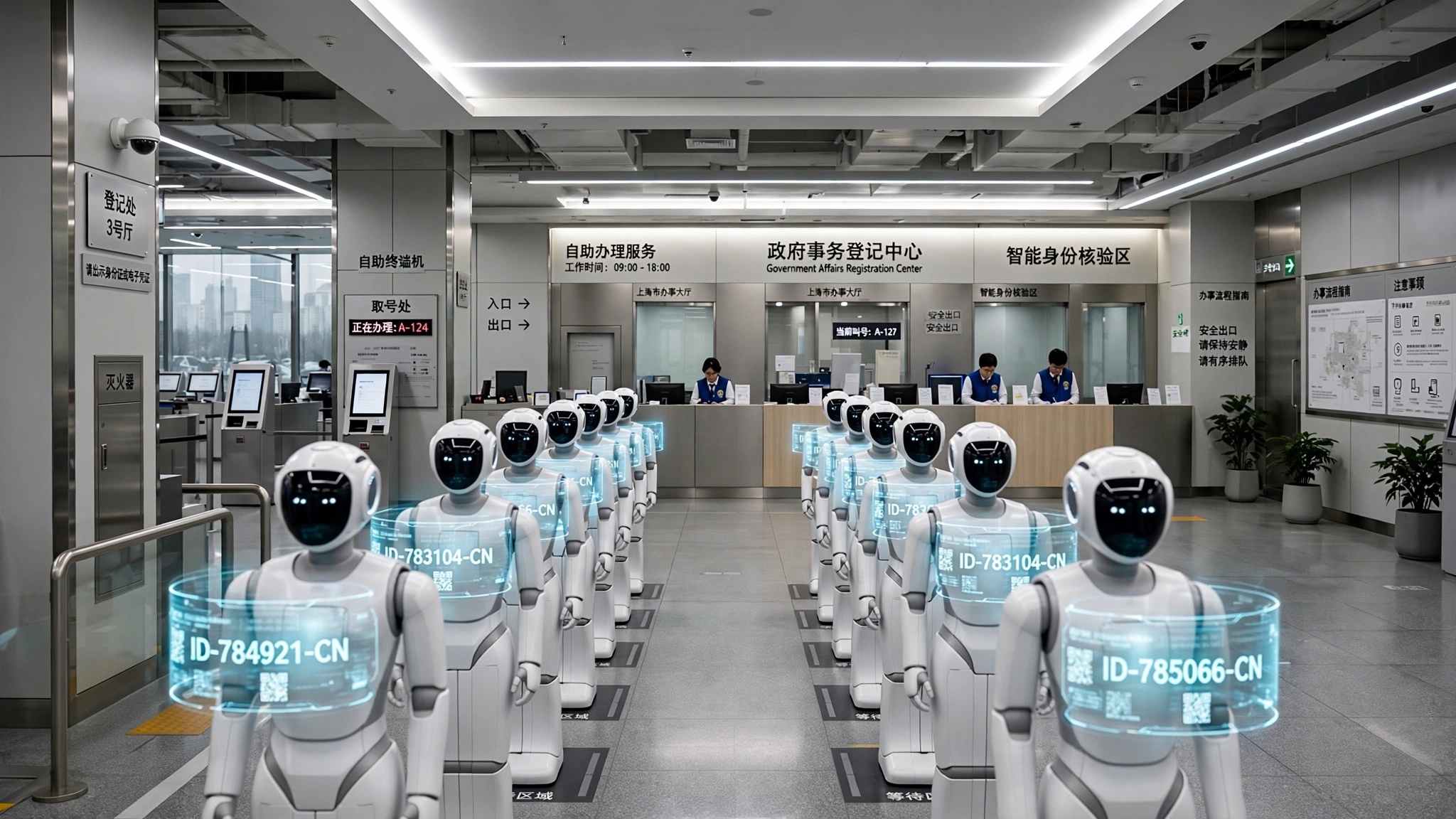
That is how many humanoid robots China has registered with unique 29-character digital identity codes on a national platform that tracks each machine from factory floor to scrapyard. The system, called the Humanoid Full Lifecycle Management Service Platform, went live in late May under the Ministry of Industry and Information Technology’s Humanoid Robot and Embodied AI Standardization committee. Every registered robot gets a code structured like a mechanical birth certificate: two digits for country of origin, four for manufacturer, six for model, and seventeen for serial data covering joint wear, battery degradation, software training history, and movement precision.
The number matters because it is larger than it should be. The entire world shipped roughly 17,000 humanoid robots in 2025, according to IDC data compiled by CCID Publishing, of which China produced 84.7%, approximately 14,400 units from more than 140 domestic manufacturers. Twice. China has now registered nearly twice as many robots as it built last year, which means either 2026 production has already blown past 2025 totals or the registry is retroactively capturing prototypes and pre-production units that were never counted in commercial shipment data. Either reading points the same direction: governance infrastructure is scaling ahead of deployment, not behind it.
A VIN for Robots
Americans have seen this playbook before. Different machine. Same lesson.
In 1969, NHTSA issued the first Vehicle Identification Number requirements, and it took twelve years for the standard to congeal because each manufacturer used its own format until NHTSA mandated a uniform 17-character VIN in 1981 under 49 CFR Part 565, a string that today is the backbone of recall enforcement, insurance underwriting, and stolen-vehicle recovery.
China is compressing that twelve-year standardization arc into a single mandate. One country, one format, 28,000 units on day one.
The extra eleven characters beyond China’s citizen ID encode the technical metadata a regulator needs: which joints were spec’d for what loads, which software version was running during an incident, whether the battery had degraded past rated cycle life. Liu Chuanhou, COO of the Hubei Humanoid Robot Innovation Center, told China Daily the system tracks maintenance and safety inspections over the robot’s entire service life.
No blockchain, no distributed ledger — the architecture is centralized, government-controlled, and modeled on the same identity infrastructure China uses to track its 1.4 billion citizens. The state knows where every registered robot is, what it can do, and how well it is doing it.
The Governance Vacuum
Now consider what the United States has built.
Nothing.
NHTSA tracks vehicles, the FAA assigns tail numbers to aircraft, the NRC licenses reactors, and the FCC allocates spectrum. But for humanoid robots, machines that walk through factories and will eventually enter homes and handle children and operate power tools and make decisions that generate liability, there is no federal registration, no lifecycle tracking, no assigned agency, and no standard ID format. A humanoid robot in an American warehouse today has less federal oversight than a ham radio.
The U.S. legislative response has focused on keeping Chinese robots out rather than tracking American ones in. Senator Bill Cassidy’s Humanoid ROBOT Act would ban federal agencies from using robots built by adversary nations. The House’s GUARD Act would add flagged models to the FCC’s Covered List, the same mechanism used to restrict Huawei gear. Agility Robotics CEO Peggy Johnson endorsed both: protection, not governance.
Neither bill creates a registration system or assigns a federal agency to do for humanoid robots what NHTSA spent twelve years building for cars: a universal identification standard that would let a regulator trace any machine from any manufacturer back to its production batch, its software version, and its operational history.
| Dimension | China | United States |
|---|---|---|
| Registration system | Yes (28,000+ registered) | None |
| Lifecycle tracking | Birth to recycling | None |
| Assigned agency | HEIS / MIIT | None |
| ID format | 29-character code | None |
The Scale Problem
The difference is stark. China nearly strangled its own electric vehicle industry on incompatible charging standards and battery form factors a decade ago, when dozens of manufacturers each invented proprietary connectors and communication protocols, until the government forced consolidation through GB/T national standards after years of interoperability headaches that cost billions and delayed the rollout of charging infrastructure across rural provinces.
Humanoid robots are heading for the same cliff at five times the speed. IDC reported 508% year-over-year growth in Chinese humanoid shipments in 2025. Five hundred percent. MIIT counted more than 140 domestic manufacturers producing over 330 product models. If production continues anywhere near that curve, China alone could ship 70,000 to 80,000 units in 2026, each built to different specs, running different software, with different safety envelopes, answerable to no common standard that would let a regulator issue a recall for a specific joint defect or firmware vulnerability across every affected unit in every province where these machines are deployed. Chaos. At that scale, a safety recall without universal identification becomes a detective story.
Jensen Huang, speaking at Computex on June 8, called humanoid robots “very, very close” to industrial reality as Nvidia deepened partnerships with Hyundai and LG. Nvidia’s new H2+ humanoid reference platform gives any manufacturer a turnkey brain for a walking robot. More brains, more bodies, more urgency for someone to start writing down which body is which.
The Strongest Case Against China’s Approach
The counterargument deserves its full weight. China’s robot ID system may be less about governance and more about extending the same surveillance apparatus it applies to people, a centralized architecture with no blockchain, no distributed verification, and no third-party audit layer where the government sees everything any registered robot does, everywhere it operates, for every company that deploys it. Every joint-wear metric and software update log tells Beijing not just what the robot is doing but what the company deploying it is doing and how its factory runs. Western democracies might deliberately avoid centralized registries because the governance-versus-surveillance boundary is impossible to police once the database exists. The absence of a U.S. framework may not be negligence; it may be a preference for fragmentation over the risks of centralized knowledge.
Limitations
The 28,000 registration figure comes from multiple outlets citing Chinese government sources; we have not independently verified it against primary MIIT data, and alternative global shipment estimates range from 15,000 to 22,000 units for 2025, which would narrow the registration-to-shipment gap but not eliminate it. The 29-character ID structure is described in secondary reporting; the full technical specification has not been published in English. The VIN comparison is an analogy. Not an equivalence.
The Bottom Line
History is unambiguous about what happens when a fast-scaling industry goes without identification standards: fragmentation, expensive retrofits, and the country that builds the standard first exports it to everyone else. ISO adopted the VIN format that NHTSA wrote. The GSM standard that Europe mandated became the global cellular protocol. China is writing the first humanoid robot identification standard at the exact moment production is exploding.
The United States has two bills to ban Chinese robots from government buildings. It has zero bills to register American ones.
If you work in robotics procurement, start tracking your fleet now: manufacturer, model, serial, software version, maintenance logs. When a federal standard eventually arrives, the companies with clean records will have a head start and the ones without will be doing archaeology. If you are a policymaker, the question is not whether humanoid robots need identification. Every complex machine humanity has ever mass-produced has eventually required it. The question is whether the United States writes that standard or adopts China’s. The window for writing is open. The 508% growth rate is closing it.