⚡ Energy
No Price Tag on 1.43 GWh of Texas Batteries. Our Math Puts the Deal at $170-310 Million.
Canadian Solar's e-STORAGE unit will supply 590 MW of batteries to X-ELIO across Texas and New South Wales, each project backed by a 22-year service deal, and since the release names no price, we priced it from the unit economics at roughly $170 to $310 million.
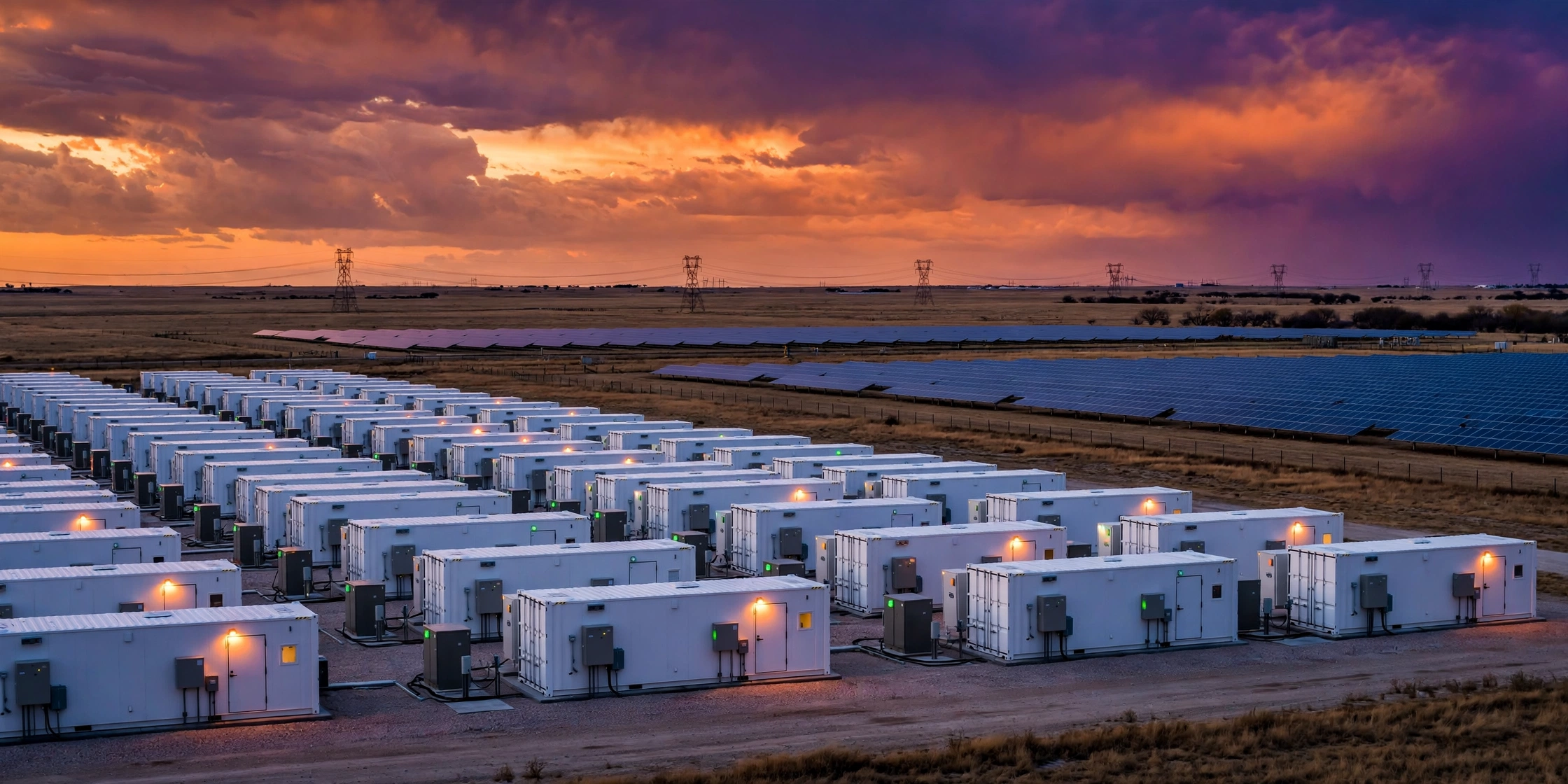
$313 million: the top of our estimate for a battery deal whose press release names no price at all. On November 18, Canadian Solar announced that e-STORAGE will supply five battery projects totaling 590 megawatts and 1.43 gigawatt-hours to X-ELIO, a Brookfield-owned renewable developer: four in Texas, one in New South Wales, each agreement carrying a 22-year service contract. Shipments are moving, and commercial operation lands in 2027 and 2028.
All five projects use e-STORAGE's SolBank 3.0: cells made at Canadian Solar's own facilities, plus power conversion systems and plant controls. Their stated job is narrow: take solar power made at midday, when Texas has more than it can use, and release it in the evening, when the sun is down and demand stays high. In New South Wales the same hardware backs coal retirement goals. Nobody in the announcement talks about breakthrough chemistry or record efficiency. This is not a science story but a procurement story, and procurement stories are where the energy transition actually happens.
The Calculation
No dollar value was disclosed, so we built one from the unit economics. BloombergNEF's December 2025 survey puts turnkey utility-scale battery systems at about $219 per kilowatt-hour in the United States and $117 globally. Multiply either figure by 1,430 megawatt-hours and the hardware lands between roughly $170 million and $310 million, because four projects sit in Texas, where U.S. pricing applies, and one sits in Australia, where it does not, so the true figure sits inside that band. Wood Mackenzie adds a wrinkle: U.S. system prices rose about 23 percent from 2024 to 2025 on tariffs and tight supply, even as cell prices kept falling, so the American end of the range is the likelier one.
| Metric | Value | How we got it |
|---|---|---|
| Duration at full power | 2.4 hours | 1.43 GWh / 590 MW |
| Texas homes, one day of use | ~39,700 | 1,430 MWh / 36.0 kWh per home per day (EIA 2024) |
| Share of ERCOT storage power | 2.7% | 590 MW / 21,537 MW installed (ERCOT, Oct 2026) |
| Share of ERCOT stored energy | ~5.0% | 1.43 GWh / 28.8 GWh installed (June 2026) |
| Share of ERCOT record peak | 0.65% | 590 MW / 91,308 MW (July 22, 2026) |
| Implied hardware value | $170-310 million | 1,430 MWh x $117-219/kWh (BloombergNEF, Dec 2025) |
| Share of Texas 2026 additions | 11.6% | 1.43 GWh / 12.3 GWh added Jan-Sep 2026 (SEIA/Benchmark) |
Two numbers in that table deserve a second look: divide 1.43 gigawatt-hours by 590 megawatts and the fleet lasts 2.4 hours at full power, which is not a limitation but a design choice: Texas's evening peak runs about two to three hours, and a battery built for that window is built for exactly one job. Divide the stored energy by the average Texas home's daily use, 36 kilowatt-hours per the Energy Information Administration's 2024 data, and the deal holds about 39,700 homes' worth of a day's electricity. That is an energy equivalence, not a promise: at full power, it is gone in 2.4 hours.
Why Texas, Why Now
Texas is the right yardstick, and ERCOT entered 2026 with 13.9 gigawatts of installed battery storage, reached 14.96 gigawatts by the end of March after adding 6 gigawatts in 2025 alone, and stood at 21.5 gigawatts by October. Against that fleet, this deal is 2.7 percent of installed storage power and 5 percent of the energy capacity ERCOT had by mid-2026. Against ERCOT's record demand of 91,308 megawatts, set on July 22, 2026, it is 0.65 percent. Small on its own. That fleet nearly doubled in fifteen months.
Texas added 12.3 gigawatt-hours of utility-scale storage in the first nine months of 2026, more than any other state. This one deal equals 11.6 percent of that nine-month total, which means what looks like one press release is about a month of the busiest battery market in the country changing hands in one signature.
The 22-Year Tail
Then there is the part of the deal that outlives the hardware. Five agreements times 22 years is 110 contract-years of service running to roughly 2050, and e-STORAGE has shipped more than 23 gigawatt-hours and holds a $3.5 billion contracted backlog as of June 30, 2026, so this deal adds about 6.2 percent to its shipped volume. But the service tail is the durable part: whoever maintains the battery owns the customer for two decades, through cell degradation and the updates that decide whether a battery bought in 2027 still earns its keep in 2047. Hardware is a one-time sale. Service is a twenty-two-year annuity.
A Correction Worth Noting
Canadian Solar corrected this release hours later, and its original 7:00 AM version said the largest project, a 200-megawatt, 482-megawatt-hour site in Texas, would run on EQ-S, e-STORAGE's proprietary energy management system. Its corrected 2:11 PM version drops that sentence, so every number here comes from the corrected release.
What You Can Do
If you pay a Texas electric bill, watch evening prices as this fleet grows: batteries charging on cheap midday solar and discharging at 7 PM are why the evening peak is getting cheaper to serve, and your time-of-use window is where that shows up first. If you invest in energy storage, watch the gap between BloombergNEF's U.S. turnkey price of $219 per kilowatt-hour and its $117 global average: that $102 spread is tariffs, interconnection queues, and permitting, and whoever closes it wins the American market. If you follow the grid, watch ERCOT's queue: 148 gigawatts proposed against a fleet adding about 6 gigawatts a year, which means most of the queue will never be built, and the winners will be projects with signed supply deals like this one.
Limitations
This analysis has holes, and they matter: no dollar value was disclosed, so the $170-310 million figure is an estimate built from BloombergNEF unit prices, not a reported contract value; margin, payment schedule, and revenue timing are all unknown. The split between Texas and New South Wales is undisclosed, so no project-level claims are made here. ERCOT's fleet figures mix vintages: the 5 percent energy-share figure uses a June 2026 denominator. That 1.43 gigawatt-hours is a DC rating; after conversion and round-trip losses of roughly 7 to 12 percent, the energy delivered to the grid is smaller.
The Strongest Case Against This Analysis
Here is the best case against taking this deal seriously. Five hundred ninety megawatts is 0.65 percent of ERCOT's record peak, a rounding error on a grid that added more battery capacity in one quarter than this deal contains, and batteries store energy rather than making it, so a 2.4-hour battery is useless on the third consecutive cloudy day, when Texas still needs gas plants and transmission lines. It arrived at a trade show, its price undisclosed, and the largest-project detail corrected out within hours. Read that way, this is a vendor press release dressed as news, and the energy transition does not turn on it.
Most of that is correct, but it misses the point. Nobody claims 590 megawatts transforms the Texas grid. What transforms the grid is the fleet, and the fleet is compounding: under 8 gigawatts at the start of 2025, 15 by the end of March 2026, 21.5 by October. This deal matters because it shows the mechanism: a developer with a 22-year service contract, a supplier with cells and software in-house, and a price per kilowatt-hour falling everywhere tariffs do not hold it up. Judge the press release and it is small. Judge the mechanism and it is the whole story.
The Bottom Line
Canadian Solar sold 1.43 gigawatt-hours of batteries into the fastest-growing storage market in America without naming a price, so we priced it: $170 to $310 million, 2.4 hours of evening peak, 39,700 Texas homes' worth of a day's electricity, and 110 contract-years of service running to 2050. Batteries are the headline. That twenty-two-year service tail is the business. And the fleet they join nearly tripled in under two years, which is why one supply deal at a trade show is worth reading twice.
Related
- America Just Installed a Record 20.2 GWh of Batteries. Its Data Centers Burn That Much Every 52 Minutes.
- 1,000 Six-Minute Charges, Zero Loss: The Lithium-Free Battery That Outlasted Its Rival 12-to-1
- $10 Billion, 7 Companies, 0 All-Solid Cells in Customer Cars: The 2026 Battery Scorecard
Sources: Canadian Solar Inc., PR Newswire, November 18, 2026 (corrected release); EIA Table 5A, 2024, via PowerPlans; Modo Energy, ERCOT battery storage in 2026; ERCOT battery fleet figures, June-October 2026; BloombergNEF December 2025 battery price survey, as reported by NegUp Energy; SEIA / Benchmark Mineral Intelligence, Texas 2026 storage additions, via List.Solar; calculations are the author's own.