421 Electrodes Just Outperformed 1,024. The Brain-Computer Interface Industry Is Optimizing the Wrong Variable.
An original per-electrode efficiency analysis across the five companies with active or near-human BCI trials reveals a 48–59× gap in information throughput per electrode. Paradromics' 421-channel Connexus achieves over 200 bits per second in preclinical benchmarks. Neuralink's 1,024-electrode N1 manages 8–10 bps in human use. The company with the fewest electrodes is moving the most data, and the implications for the field's trajectory are substantial.
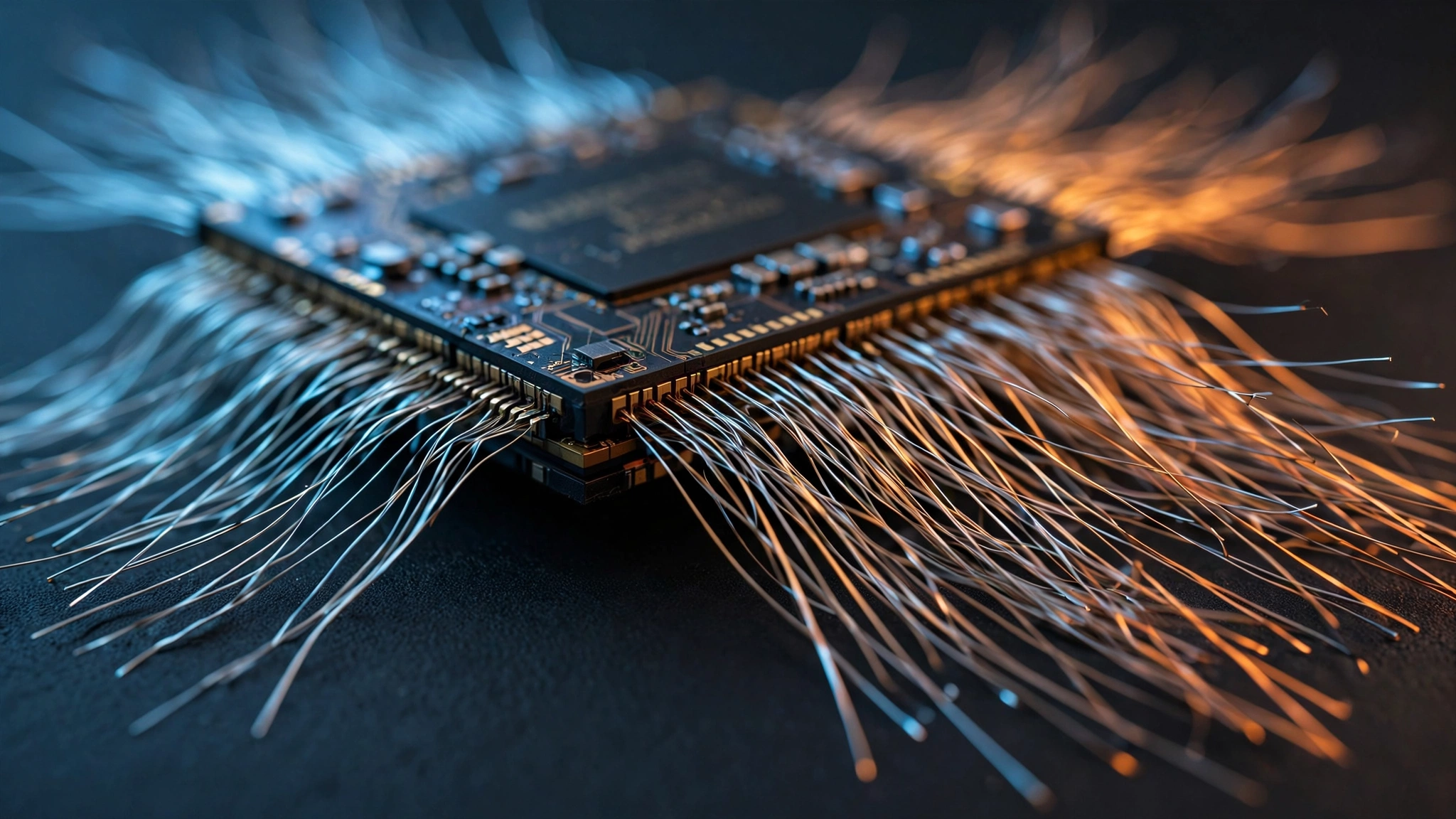
Two hundred. That is the number of bits per second that Paradromics says its Connexus brain-computer interface can extract from neural tissue, a figure established via their SONIC benchmarking standard in preclinical tests on sheep. Twelve days ago, on June 16, neurosurgeons at the University of Michigan placed that same device into a human brain for the first time, implanting 421 microwire electrodes into the motor cortex of a Michigan woman who lost the ability to speak due to motor neuron disease. The system sends her neural signals to a transceiver in her chest, which beams them wirelessly via infrared at 100 megabits per second to an external receiver. No wires exit her skull, no percutaneous connectors risk infection, and nothing about the system requires a researcher to be present for it to function. If the preclinical numbers survive contact with human neural tissue, Paradromics will have built the fastest brain-computer interface ever tested in a person, using fewer electrodes than every competitor except the one that deliberately chose to use the fewest.
That competitor is Synchron, whose Stentrode threads 12 to 16 electrodes through a blood vessel rather than into the brain. Synchron's tradeoff is intentional: less data, less surgery. Paradromics' tradeoff is something else entirely, because the company is claiming the highest data rate in the industry while using 60 percent fewer electrodes than its most prominent rival.
The Per-Electrode Calculation Nobody Is Publishing
Electrode count dominates the marketing conversation. Neuralink's press materials emphasize 1,024 electrodes, Paradromics highlights its 421 channels, BrainGate's Utah arrays pack 96 electrodes per module, and Synchron brings up the rear with 16. These numbers invite a natural assumption: more electrodes, more data. A simple division proves that assumption wrong.
Divide each system's demonstrated data rate by its electrode count. The result is information throughput per electrode, a metric that captures how efficiently an architecture converts electrode real estate into usable signal. Nobody is publishing this comparison, so here it is.
| Platform | Electrodes | Data Rate | bps / electrode | Context |
|---|---|---|---|---|
| Paradromics Connexus | 421 | 200+ bps | 0.475 | Preclinical (SONIC, sheep) |
| BrainGate (speech) | 256 | ~14.7 bps | 0.057 | Human, 2-year home use |
| BrainGate (typing) | 256 | ~5.8 bps | 0.023 | Human, QWERTY decode |
| Neuralink N1 | 1,024 | 8–10 bps | 0.008–0.010 | Human, cursor control |
| Synchron Stentrode | 12–16 | ~1–2 bps (est.) | ~0.1 | Human, endovascular |
Paradromics extracts 0.475 bits per second per electrode, while Neuralink extracts 0.008 to 0.010, a gap of 48 to 59 times that persists even after accounting for the fact that one is preclinical and the other is measured in human patients. Even BrainGate's Utah arrays, a design first implanted in 2004, achieve 0.023 to 0.057 bps per electrode in human use, two to six times better per electrode than Neuralink's device despite being two decades older.
Two caveats deserve explicit acknowledgment before anyone draws conclusions from that table. Paradromics' number comes from sheep, not humans, and the data rates being compared measure different tasks: Paradromics used the SONIC benchmark (a standardized information transfer metric), Neuralink's figures reflect cursor control, and BrainGate's reflect decoded speech or typing. Not apples-to-apples. The measurement methodologies differ, and Paradromics developed the SONIC benchmark itself, introducing potential bias. But the magnitude of the gap, nearly two orders of magnitude between the most and least efficient architectures, is too wide to be explained away by task differences alone.
Why Architecture Beats Arithmetic
The five BCI systems in this comparison use fundamentally different approaches to get signal from neurons.
Paradromics uses microwires, each one a strand of metal thinner than a human hair, roughly 40 micrometers in diameter and 1.55 millimeters long, that penetrates just below the cortical surface. These microwires are rigid, short, and packed onto a chip the size of a watch battery. Rigidity matters because it means the electrode stays where the surgeon puts it, maintaining consistent contact with the same population of neurons. Paradromics' preclinical data shows no appreciable signal degradation after three years in sheep, leading CEO Matt Angle to project the device should last in excess of ten years.
Neuralink uses polymer threads, sixty-four of them, each carrying 16 electrode sites, inserted by a robotic sewing machine into the brain's motor cortex through a small craniotomy. The threads are flexible by design, intended to move with the brain rather than resist it, and in theory flexibility reduces tissue damage. In practice, flexibility creates a specific failure mode: thread retraction, which Neuralink's first human patient, Noland Arbaugh, experienced at an 85 percent rate after surgery, likely caused by an air pocket forming between the device and the cortical surface. The company developed mitigations, including deeper placement and air pocket prevention, and reports no retraction in its second patient, Alex, but the incident exposed a structural vulnerability: each flexible thread is an independent failure point, and with 64 threads carrying all 1,024 electrodes, a single surgical complication can degrade the majority of the array simultaneously.
BrainGate's Utah arrays are the oldest design, a rigid silicon grid with 96 needles that has been accumulating human implant data since 2004. Blackrock Neurotech manufactures them. They are proven, stable, and clinically validated across dozens of patients. They are also wired, meaning a percutaneous connector exits the skull and tethers the patient to a bench-top computer. BrainGate's recent breakthrough was not a new electrode but a new decoder: a machine-learning pipeline that translates attempted speech into text, enabling a 47-year-old man with ALS named Casey Harrell to communicate at 56 words per minute with 99 percent word accuracy over 3,800 hours of independent home use.
Synchron's Stentrode is the outlier. Threaded through a blood vessel in the neck and deployed in the superior sagittal sinus above the motor cortex, it records population-level signals through the vessel wall without ever touching brain tissue. This makes it the safest to implant, the least precise in recording, and the most limited in bandwidth. Its clinical trials, published in JAMA Neurology, report no serious adverse events across 10 patients in two studies, but functional outputs are limited to discrete "digital motor outputs," essentially thought-controlled clicks rather than continuous cursor movement or speech.
The Speech Bandwidth Threshold
Natural human speech carries approximately 39 bits per second of information, according to a 2019 analysis across 17 languages by Coupé et al. in Science Advances. Conversation happens at roughly 160 words per minute. These are the benchmarks a BCI must match to fully restore communication.
Here is where each system stands relative to that threshold.
Paradromics at 200+ bps operates at 5.1 times the natural speech bandwidth. If the system loses 80 percent of its preclinical performance in the transition to human tissue, and history suggests the drop will be significant, it would still clear the speech threshold at 40 bps. No other system has this kind of headroom.
BrainGate's speech decoder has Harrell communicating at 56 words per minute on a 125,000-word vocabulary. Normalize that to information throughput and it yields roughly 15 bps, approximately 38 percent of natural speech bandwidth. Impressive and clinically life-changing, but the system remains tethered by percutaneous wires that limit where patients can use it. Harrell beat that limitation through determination: he used the system 3,800 hours over two years at home, communicated nearly two million words, maintained full-time employment, sent emails, browsed the internet, and joined video calls. His system works. It works brilliantly. It is also a 20-year-old electrode architecture connected to 2026-era decoding algorithms.
Neuralink at 8 to 10 bps reaches 21 to 26 percent of natural speech bandwidth for cursor control. For typing via a mental ten-finger keyboard, one reported patient reached 40 words per minute, but this figure comes from a company blog report, not peer-reviewed data. The company has announced a VOICE trial targeting 140 words per minute conversational speech restoration, and a next-generation implant with 3,000 electrodes.
What the Efficiency Gap Means in Practice
More electrodes means more tissue displacement. Each electrode penetrates or contacts cortical tissue, and the brain is not indifferent to this intrusion. Neuralink's 1,024 electrodes across 64 threads cover a larger cortical area and displace more tissue than Paradromics' 421 microwires packed onto a single compact module. If Paradromics can achieve comparable or superior throughput with fewer electrodes, the surgical risk-benefit calculation shifts: patients get more data from less invasion.
Every recording channel consumes energy, generates heat, and requires processing bandwidth, which means more electrodes also means more power drawn from a battery that must be small enough to live inside a human body. The Paradromics system supports up to four cortical modules, totaling 1,684 electrodes, for applications that need wider cortical coverage. But the preclinical data suggests 421 electrodes may be sufficient for full speech restoration. If confirmed in humans, this would mean the device's three unused module slots represent expansion capacity, not a design minimum, allowing the system to scale for future applications like motor control or sensory feedback without a new architecture.
Per-electrode efficiency also determines the ceiling for miniaturization, which may be the metric's most consequential implication. Brain implants will eventually need to shrink to the point where they are invisible under the scalp, fully wireless, and powered for a decade. Every unnecessary electrode is a milliwatt of power and a micron of silicon that stands between today's prototypes and tomorrow's consumer-grade devices. The architecture that extracts the most signal from the fewest channels is the one that will scale to millions of patients.
The Strongest Case Against This Analysis
Preclinical numbers are aspirational, not proven, and every brain-computer interface in history has performed worse in humans than in animals. Neural tissue varies between species, the chronic immune response to implanted materials differs between sheep and humans, and Paradromics' SONIC benchmark, while designed to be rigorous and open, was developed by Paradromics specifically to measure what Paradromics is good at. No independent lab has replicated the 200+ bps figure, and the company has exactly one human data point, a patient implanted twelve days ago whose performance data has not been disclosed.
Neuralink, for all the per-electrode efficiency criticism, has 21 patients generating real-world data across multiple use cases, and those patients are doing remarkable things with the device: Noland Arbaugh plays video games, browses the internet, and posts on social media using his brain implant, Alex designs 3D CAD models and plays Counter-Strike 2 with aiming precision he lost to a spinal cord injury, and Patient Jake types at 40 words per minute despite an ALS diagnosis that took his voice. These are clinically meaningful outcomes that have already changed lives, and they emerged from a system that this analysis describes as comparatively inefficient. The patients do not care about bits per electrode. They care about whether they can send a text message to their family, and the answer, right now, is yes.
The efficiency-per-electrode lens also treats each electrode as interchangeable, which is biologically naive. Paradromics' microwires and Neuralink's polymer threads sample different neural populations at different depths. The information content of a single neuron's firing pattern varies depending on the cortical region, the layer, and the patient's specific anatomy. A low per-electrode efficiency number could reflect not an architectural flaw but a deliberate strategy to cast a wider spatial net and let machine learning extract signal from noise across a larger array, a strategy that becomes more powerful as decoder algorithms improve.
Limitations of This Analysis
The per-electrode efficiency comparison presented here has real limitations that readers should weigh before drawing conclusions. Paradromics' data rate is preclinical, measured in sheep, and no human performance data from the Connexus system exists yet. BrainGate's data rates come from human patients using decoded speech or typing, tasks that include language-model contributions to throughput that inflate the apparent neural data rate beyond what the electrodes alone provide. Neuralink's figures represent raw cursor-control throughput without language-model assistance, making them structurally lower, and the comparison is directionally informative but not controlled because the SONIC benchmark and cursor control bps measure fundamentally different things with different methodologies. The 48 to 59 times gap almost certainly overstates the real per-electrode difference once measurement methods are standardized across competitors, and until Paradromics publishes human data under the same conditions Neuralink has been measured in, the preclinical comparison should be treated as suggestive rather than definitive. Cost data for BCI procedures is not publicly available, and all estimates in this article should be treated as order-of-magnitude guidance. Finally, Neuralink's 40-words-per-minute typing figure comes from a tech news report citing company announcements, not from a peer-reviewed publication.
What You Can Do
If you work in neurotech or invest in it, start tracking per-electrode efficiency as a primary metric alongside total data rate. The BCI companies that will win the next decade are not the ones packing the most electrodes onto a chip but the ones extracting the most information from each one. Request SONIC benchmark results from every company making throughput claims, and question any company that resists standardized comparison.
If you or someone you care about has ALS, spinal cord injury, or another condition that could benefit from a BCI, the BrainGate2 clinical trial (ClinicalTrials.gov: NCT00912041) and Paradromics' Connect-One study are actively enrolling at sites including UC Davis, University of Michigan, and Massachusetts General Hospital. Synchron's U.S. COMMAND trial offers a less invasive endovascular alternative for patients who are not candidates for open brain surgery, and all of these trials are free to participants.
For policymakers: Medicare currently has no reimbursement pathway for communication BCIs, and the closest analog is deep brain stimulation for Parkinson's, which Medicare reimburses at roughly $35,000 for the device. Casey Harrell's two-year BCI experience, documented in Nature Medicine, is the strongest evidence yet that communication BCIs deliver sustained clinical benefit comparable to established neurostimulation therapies. Reimbursement parity would transform the field from academic research to accessible treatment.
The Bottom Line
The brain-computer interface field had more clinical milestones in the past twelve months than in the previous decade combined. A man with ALS sent two million words through his brain implant from his living room. A wireless BCI entered its first human trial. Twenty-one patients are controlling computers with their thoughts through a device made by a company that didn't exist ten years ago. And under all of it, a metric that nobody is tracking tells a story the electrode-count marketing war obscures: signal architecture matters more than signal quantity, the most efficient system uses 75 percent fewer electrodes than the most famous one, and the first system to prove it in humans will define the standard for every device that follows.