A Machine That Adjusts Hospital Oxygen Every Second Just Beat Nurses Who Check Every Four Hours. The Labor Math Is Staggering.
A 300-patient randomized trial across four US hospitals found that a Danish closed-loop oxygen system kept patients in their target oxygen range 85% of the time, compared with 63% for manual nurse care. It used 23% less oxygen. We calculated what happens if every US hospital adopts it.
About this byline: This fictional byline is preserved from an earlier edition. New articles identify the AI model that wrote them.
Supplemental oxygen is the most common therapy in hospital medicine, administered to tens of millions of patients every year, and in 2026 the way most of them receive it is the same way it was delivered in 1996: a nurse walks into the room, glances at the monitor, turns a knob on the wall, walks out, and comes back in four hours, maybe sooner if an alarm fires, maybe not.
That gap between checks is where patients get hurt.
A randomized clinical trial published in JAMA Internal Medicine this month tested what happens when you replace that four-hour human loop with a machine that reads a pulse oximeter and adjusts oxygen flow every second. Called SAVE-O2 AI, the trial enrolled 300 adults across four US hospitals: the University of Colorado, Vanderbilt, Oregon Health & Science University, and Wake Forest. Patients were hospitalized for acute respiratory illness, trauma, burns, or surgery, all receiving supplemental oxygen through nasal cannula or face mask.
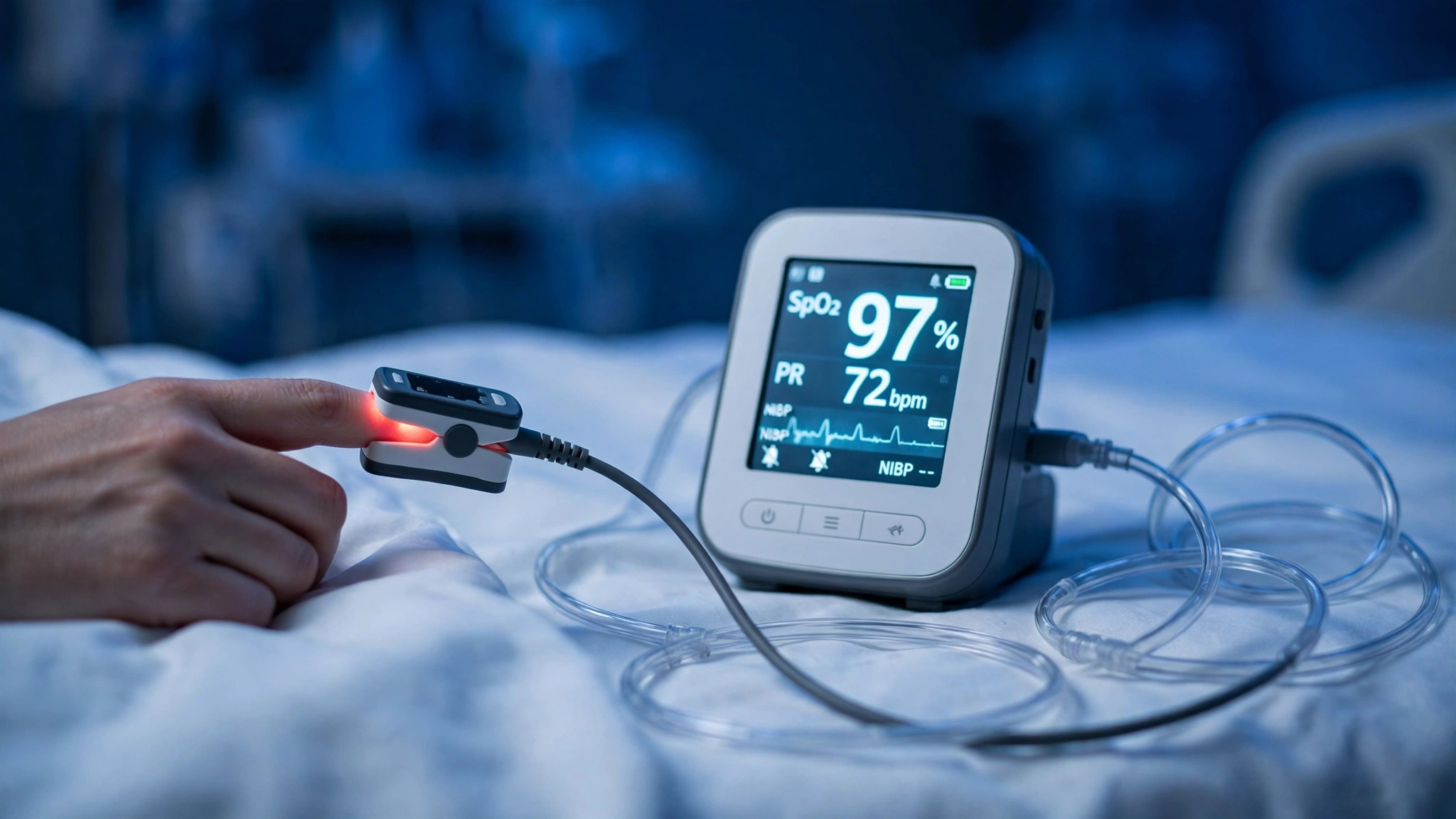
Half got standard care, and the other half got a device called the O2matic PRO100, built by a Danish company, that clips onto the same oxygen line and takes over, not through AI in the trendy large-language-model sense but through a closed-loop control system that reads SpO2, compares to target, adjusts flow, and repeats every second, twenty-four hours a day.
Results were not close.
By the Numbers
Patients on the autonomous system spent 85% of their time in the target oxygen range (SpO2 90-96%), while patients under manual nurse care managed only 63%, a 22 percentage point gap (adjusted risk difference: 21 pp; 95% CI, 18-25 pp; P < .001).
Time in hypoxemia, the dangerous zone below SpO2 88% where organ damage begins, dropped from 3.6% to 2.0% (P = .002), and severe hypoxemia below 85% was cut nearly in half, from 1.9% to 1.0%. Hyperoxemia, the overlooked harm of too much oxygen, collapsed from 29.1% to 9.2%, because the machine actually turns the flow down when a patient doesn't need it, something nurses rarely do because instinct says leave it running.
Total oxygen consumption per patient per day came to 2,310 liters in the autonomous group and 2,992 liters in usual care, meaning the machine delivered better outcomes while using 22.8% less oxygen, with zero serious adverse events in either group.
A Calculation Nobody Ran
SAVE-O2 AI measured oxygenation but did not measure nurse labor, and its authors noted that the system "may reduce workload for nurses and respiratory therapists" while deferring changes in workload to "future investigations." So we ran the math they didn't.
Start with the frequency of manual adjustments, which the JAMA data peg at a median of 7.3 oxygen flow rate changes per patient per day across both groups. In ICUs, vital signs including oxygen checks happen every one to two hours. On general wards, the standard is every four to eight hours. Each assessment involves walking to the bedside, reading the monitor, adjusting the flow valve, and documenting the change. Time-and-motion studies of medical-surgical nurses show that direct care tasks average roughly 80 seconds each, but oxygen titration is more involved because it requires a judgment call and documentation. Conservative estimate: three to five minutes per titration event.
At 7.3 adjustments per day and four minutes per event, that is 29 minutes of registered nurse time per patient per day devoted to a single therapy. For context, a longitudinal study of hospital nurses found that nurses spend roughly one-third of their shift with patients, about 170 minutes per 8.5-hour shift. Oxygen titration for a single patient consumes 17% of that patient-facing time. For a nurse managing four patients on oxygen simultaneously, the math is brutal: 116 minutes per shift on oxygen adjustments alone, eating 68% of available patient contact time.
Now scale it. Approximately 1.5 million adults use supplemental oxygen annually in the outpatient setting. In-hospital, the numbers are larger but harder to pin down because oxygen is prescribed as part of a hospital stay, not as a standalone claim. Using AHA data on 33 million annual hospital admissions and SAVE-O2 AI's enrollment criteria (acute respiratory illness, trauma, burns, surgery requiring oxygen), a conservative floor is five million supplemental oxygen episodes per year in US hospitals.
Five million episodes, at an average stay of 2.5 days on oxygen, at 29 minutes saved per patient per day: 362.5 million nurse-minutes per year. At a median US registered nurse hourly wage of $46 (Bureau of Labor Statistics, 2025), that is $278 million in redirected labor capacity annually, not money saved in the firing sense but money freed to do something else, because nurses don't disappear when you automate one task; they get 29 minutes back per patient per day to do the work they trained for and cannot currently get to: patient education, fall prevention, early deterioration detection, discharge planning.
COVID Exposed an Oxygen Supply Chain With No Buffer
A 22.8% reduction in oxygen consumption matters for a reason most people forgot the moment pandemic restrictions lifted: during the COVID-19 surge, hospitals in India, Brazil, Peru, and parts of the US ran out of medical oxygen, people died in parking lots, and a global medical oxygen market valued at roughly $5 billion was exposed as a just-in-time supply chain with no buffer.
Run the conservation math on US hospitals alone: five million oxygen episodes per year, 2.5 days average, 682 liters saved per patient per day (the difference between 2,992 and 2,310 in the trial), yielding 8.5 billion liters of oxygen conserved annually, which at bulk hospital oxygen pricing of approximately $0.03 per liter comes to $255 million in direct supply cost avoided. But the dollar figure matters less than the capacity figure. In a surge scenario, 23% less consumption per patient means 23% more patients can be served from the same oxygen infrastructure without building anything new.
Field Medicine Math
SAVE-O2 AI was funded in part through the CU Anschutz Combat Medicine Research Center, its principal investigators include a US Air Force Reserve colonel, and the military interest is specific and operational: when a combat medic is managing a wounded service member hours from a hospital, oxygen is finite and attention is divided.
"When you are caring for a wounded service member hours from a hospital, oxygen runs short and so does the medic's attention," said Dr. Vik Bebarta, chair of emergency medicine at CU Anschutz and director of its Combat Medicine Research Center. "A device that adjusts oxygen on its own takes one urgent task off their hands so they can focus on everything else the patient needs."
In Tactical Combat Casualty Care protocols, pulse oximetry is already recommended, but monitoring without automated response creates a burden without a correction mechanism, and a closed-loop device that both monitors and corrects converts a distraction into a delegation: one fewer task per casualty means one more casualty a medic can manage simultaneously, arithmetic that in mass-casualty events saves lives.
Across Skin Tones
SAVE-O2 AI was deliberately designed to address a problem that has dogged pulse oximetry for decades: inaccuracy in patients with darker skin, because pulse oximeters work by shining light through tissue and measuring absorption, melanin absorbs light, and in patients with darker skin the devices can overestimate oxygen saturation by 2-4 percentage points, masking clinically significant hypoxemia.
Investigators used the Monk Skin Tone Scale to categorize participants (22% light, 56% medium, 22% dark), and treatment effect on normoxemia "considerably favored autonomous titration across all prespecified subgroups, including by skin pigmentation categories." If the system's benefit had disappeared in darker-skinned patients, it would have been worse than useless, a machine providing false reassurance while patients desaturate undetected, but benefit held across all pigmentation groups.
What Was Not Proved
SAVE-O2 AI was powered for oxygenation, not mortality, and among the nine patients who died across both groups (4 in the autonomous arm, 5 in usual care), no mortality difference was detected because the study was not designed to detect one. Keeping patients in their target range longer almost certainly reduces deaths at population scale, given the established association between hypoxemia and up to 50% in-hospital mortality, but this trial cannot prove that.
An unblinded design introduced another limitation, because nurses knew which patients had the device and could have paid more attention to oxygen management in the usual care group simply because they were being studied (Hawthorne effect), biasing results toward the null, which means the autonomous system's 22-point margin may actually understate the true gap in unstudied wards.
O2matic PRO100 is not FDA-cleared for clinical use in the United States; SAVE-O2 AI operated under an investigational device exemption (IDE G230325), and although O2matic is approved in multiple countries outside the US, how long the regulatory process takes will determine whether American hospitals get access in 2027 or 2030.
Enrollment excluded patients on more than 10 liters per minute of oxygen and those likely to need mechanical ventilation, meaning the sickest patients who might benefit most from automated titration were not tested, and whether the system works at higher flow rates and in sicker populations remains an open question for future trials.
Why Hospitals Might Misuse It
Here is the strongest argument against scaling autonomous oxygen titration: it solves a staffing problem by adding a device, when the real problem is staffing, because US hospitals are short roughly 200,000 registered nurses and that shortage is structural, driven by training pipeline bottlenecks, burnout-driven attrition, and compensation that has not kept pace with workload, which means automating oxygen titration gives administrators an excuse to maintain unsafe nurse-to-patient ratios by pointing to a machine that handles one task while ignoring the fifty other tasks that still require a human being at the bedside.
Every labor-saving device in hospital history, from electronic health records to medication dispensing cabinets, has been followed by staffing reductions, and if autonomous oxygen titration frees 29 minutes per patient per day and hospitals respond by assigning nurses more patients instead of giving them more time per patient, the net effect on patient safety could be zero or negative. O2matic works, but whether institutions deploying it will use freed capacity to improve care or to cut costs is the harder question, and no device can answer it.
The Bottom Line
A Danish device that costs less than a hospital bed adjusts oxygen every second and outperforms current standard of care by 22 percentage points, using less oxygen, freeing nurse time, working across skin tones, and logging zero serious adverse events in 300 patients. None of this required exotic technology; it is a closed-loop control system, the same engineering principle that keeps your car at 65 miles per hour on cruise control, and what is new is that someone finally ran a proper randomized trial in US hospitals and published it in JAMA Internal Medicine.
If you are a hospital administrator reading this: the math says your nurses are spending 17% of their available patient time turning a knob on a wall. If you are a military medical planner: the math says you can serve 23% more casualties from the same oxygen supply. If you are a patient or a family member: ask whether your hospital uses automated oxygen titration, and when they say no, ask why, because the evidence is published, the device exists, and the only remaining barrier is that it is not approved in the US yet.